

Quick Summary: Europe hosts some of the world’s most accomplished 3D architectural visualization companies, combining technical excellence with artistic vision. This curated list presents 11 top European agencies—from London’s creative powerhouses to Eastern Europe’s cost-effective studios—recognized for their portfolio quality, innovation, and client satisfaction. Each firm brings distinct strengths in photorealistic rendering, virtual reality integration, and project turnaround capabilities.
The architectural visualization industry in Europe has evolved into a sophisticated ecosystem where technology meets artistry. These specialized studios transform architectural designs into compelling visual narratives that help architects, developers, and real estate professionals communicate their vision before a single brick is laid.
Choosing the right visualization partner can make the difference between a presentation that wins projects and one that falls flat. The European market offers remarkable diversity—from studios pioneering AI-assisted workflows to traditional ateliers that treat each render as fine art.
This guide examines ten leading firms across the continent, evaluating their technical capabilities, creative approaches, and the specific strengths that set them apart.
Why European Architectural Visualization Companies Lead the Industry
European visualization studios have carved out a distinctive position in the global market. The continent’s architectural heritage, combined with cutting-edge digital innovation, creates a unique environment where visualization firms understand both classical design principles and bleeding-edge rendering technology.
Several factors contribute to Europe’s visualization excellence. The region’s concentration of prestigious architectural practices means visualization studios work on internationally significant projects. They’re not just rendering buildings—they’re crafting visual stories for landmarks that will define city skylines.
The 3D rendering industry has experienced substantial growth. Industry analyses indicate growth rates exceeding 20% annually, with the sector surpassing the $2 billion threshold in recent years. European firms capture a significant share of this expanding market.
According to RIBA research, 41% of UK architects were already using AI on at least occasional projects. Of those adopting AI tools, 43% reported efficiency improvements in their design process. These adoption rates are expected to increase as tools mature, positioning European visualization firms at the forefront of innovation.
European studios also benefit from diverse talent pools. Artists, architects, and technical specialists from across the continent collaborate in these firms, bringing varied aesthetic sensibilities and problem-solving approaches.
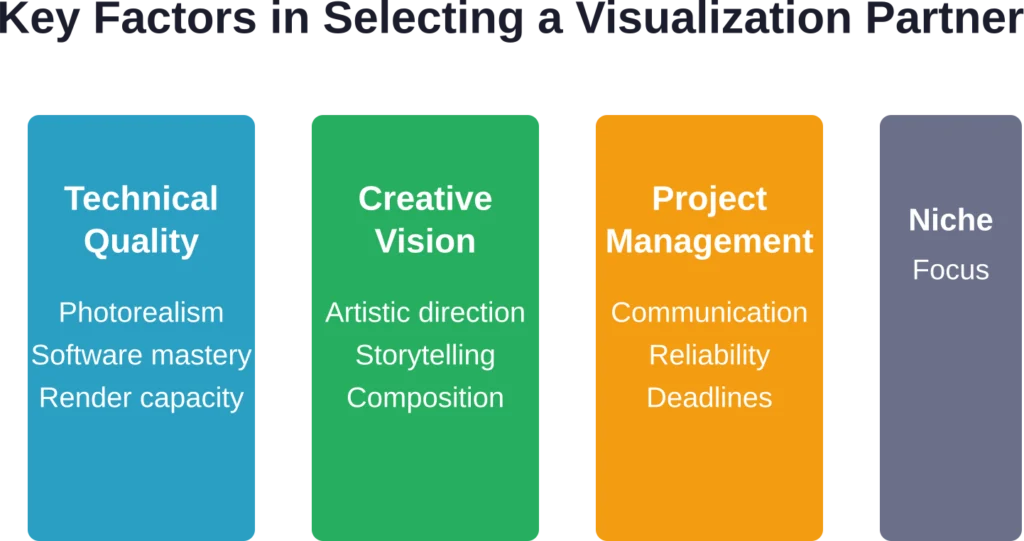
What Sets Top Architectural Visualization Firms Apart
Not all rendering services deliver the same value. The distinction between competent execution and exceptional visualization work becomes apparent across several dimensions.
Technical Excellence and Photorealism
The best studios master the complex interplay of lighting, materials, and camera work that makes renders indistinguishable from photography. They understand how light behaves in different atmospheric conditions, how various materials reflect and absorb illumination, and how to compose images that feel natural rather than artificially perfect.
These firms invest heavily in rendering infrastructure. High-end workstations, render farm capacity, and the latest software versions ensure they can deliver quality work within competitive timeframes.
Artistic Direction and Storytelling
Technical capability alone doesn’t guarantee compelling visualization. Top firms employ creative directors who understand narrative construction—how to guide viewer attention, evoke emotional responses, and highlight design features that matter most to the intended audience.
Real talk: anyone can learn rendering software. The artistic judgment that determines which angle best showcases a building’s innovation, or which lighting scenario communicates the architect’s intent—that’s the differentiator.
Communication and Project Management
Exceptional visualization firms function as true collaborators rather than mere service providers. They ask probing questions about project goals, target audiences, and key selling points. They provide regular updates, accept feedback constructively, and deliver on schedule.
Poor communication turns visualization projects into frustrating experiences. The studios featured here have earned reputations for reliability and professionalism.
Specialization and Niche Expertise
Some firms excel at residential visualization, others at large-scale urban planning projects. Certain studios specialize in competition entries, while others focus on real estate marketing materials. Understanding these specializations helps match projects to the right partner.
Top 11 Architectural Visualization Companies in Europe
The following firms represent the best of European architectural visualization. Each brings distinctive capabilities and has earned recognition through consistent delivery of exceptional work.

1. Powerkh
Powerkh is a UK-based company with offices in the USA and Ukraine, providing 3D architectural visualization services for architects, developers, and construction teams across Europe. The company creates detailed visualizations and BIM-based 3D models for residential, commercial, hospitality, and mixed-use developments.
Their services include architectural rendering, exterior visualization, BIM modelling from LOD 100 to LOD 500, and Scan to BIM workflows based on point cloud data. Powerkh also supports project coordination between architectural, structural, and MEP systems using Autodesk Revit and Navisworks.
The company combines architectural visualization with BIM workflows to keep renderings aligned with technical project data and construction documentation. Their work helps teams review designs, present projects more clearly, and coordinate updates during different project stages.
Contact Information:
- Website: www.powerkh.com
- Email: [email protected]
- Facebook: www.facebook.com/100064039650167
- LinkedIn: www.linkedin.com/company/powerkh
- Instagram: www.instagram.com/powerkh_com
- Address: 3, Lavinia Walk, Taw Hill, Swindon SN25 1AP
- Phone: +44 7490 426678

2. MIR (Norway)
Based in Bergen, Norway, MIR has built an international reputation as one of the most artistically accomplished visualization studios in the world. The firm’s work appears regularly in architectural publications, and their portfolio includes projects for Snøhetta, Zaha Hadid Architects, and other prominent practices.
What distinguishes MIR is their painterly approach to visualization. Their images possess an almost cinematic quality, with carefully considered lighting, weather conditions, and atmospheric effects that give each render emotional depth. They don’t just show buildings—they create moods and narratives.
The studio specializes in high-profile competition entries and landmark projects where exceptional visual quality justifies premium positioning. Their work has helped clients win major international competitions, demonstrating the tangible business value of outstanding visualization.
MIR’s team includes artists with backgrounds in fine art and film, bringing cross-disciplinary perspectives to architectural rendering. This diverse expertise allows them to approach each project with fresh eyes and innovative techniques.

3. Brick Visual (Hungary)
Budapest-based Brick Visual combines Eastern European technical talent with a thoroughly international portfolio and client base. Founded in 2003, they’ve grown into one of Europe’s most technically sophisticated visualization studios.
The firm excels at large-scale urban development projects, master plans, and complex mixed-use developments. They’ve developed proprietary workflows for handling massive datasets and creating consistent visual languages across multi-phase projects.
Brick Visual’s technical infrastructure is impressive. They maintain substantial render farm capacity, enabling them to deliver high-resolution imagery and animation with quick turnarounds. This combination of quality and speed appeals to clients working on tight presentation schedules.
The studio has embraced emerging technologies enthusiastically. They offer virtual reality experiences, augmented reality applications, and interactive real-time presentations that go beyond traditional static imagery. For clients seeking innovative presentation formats, Brick Visual provides cutting-edge capabilities.

4. Luxigon (United Kingdom)
London-based Luxigon has established itself as a go-to visualization partner for luxury residential developments and high-end commercial projects. Their work appears in marketing campaigns for some of the world’s most prestigious real estate developments.
The studio’s strength lies in their understanding of lifestyle visualization. They don’t just render architecture—they craft aspirational images that communicate the experience of living or working in these spaces. Interior styling, landscaping details, and human activity feel natural and uncontrived.
Luxigon maintains close relationships with leading architectural practices and developers. This repeat business speaks to their reliability and the commercial effectiveness of their work. When marketing budgets are substantial and every detail matters, Luxigon delivers the polish required.
Their portfolio demonstrates versatility across project scales, from intimate residential interiors to sweeping urban vistas. This range makes them adaptable to varying project requirements while maintaining consistent quality standards.

5. Beauty and the Bit (Spain)
This Barcelona-based studio brings a distinctly artistic sensibility to architectural visualization. Beauty and the Bit’s work often features bold compositions, dramatic lighting scenarios, and a willingness to push beyond conventional photorealism into more expressive visual territory.
The firm collaborates closely with architects during design development, functioning as creative partners rather than service providers executing predefined views. This early involvement allows them to help shape presentation strategies and identify the most compelling ways to communicate design concepts.
Beauty and the Bit excels at competition imagery where standing out matters as much as technical accuracy. Their images grab attention and linger in memory—crucial advantages when juries review dozens or hundreds of submissions.
The studio’s team includes architects and designers who understand building design from the inside out. This architectural literacy ensures their visualizations respect design intent while adding that extra layer of visual storytelling that elevates presentations.

6. dbox (United Kingdom)
With London offices complementing their New York headquarters, dbox operates at the intersection of architectural visualization, branding, and experiential design. They’re not just a rendering studio—they’re a comprehensive creative agency specializing in architecture and real estate.
dbox’s integrated approach encompasses visualization, website design, interactive experiences, print materials, and marketing strategy. For developers launching major projects, this one-stop-shop capability streamlines the creative process and ensures visual consistency across all touchpoints.
The firm’s portfolio includes some of the world’s most significant residential, commercial, and cultural projects. They’ve visualized work for starchitects including Herzog & de Meuron, Rem Koolhaas, and Norman Foster, among many others.
What sets dbox apart is their strategic thinking. They don’t just execute beautiful images—they help clients understand which images will be most effective, what story needs telling, and how visualization fits into broader marketing objectives.
7. Playtime (France)
Paris-based Playtime has earned recognition for their sophisticated approach to architectural imagery. The studio’s work balances technical precision with artistic refinement, creating visualizations that feel both accurate and emotionally resonant.
Playtime specializes in cultural buildings, educational facilities, and public architecture—projects where communicating social impact matters as much as showing physical form. Their images often feature believable human activity that helps viewers imagine how spaces will actually function.
The firm maintains strong relationships with French architectural practices while also serving international clients. This dual focus gives them exposure to diverse design philosophies and project types, enriching their creative toolkit.
Playtime’s attention to contextual detail sets them apart. Landscaping, street furniture, vehicles, and background buildings all receive careful consideration, creating visualizations that feel embedded in real places rather than floating in abstract space.

8. Uniform (United Kingdom)
London studio Uniform has built a reputation for clean, contemporary visualization work that emphasizes clarity and design communication. Their aesthetic tends toward the minimalist, allowing architecture to speak without excessive stylistic flourishes.
The firm works extensively with emerging and mid-career architectural practices, providing high-quality visualization at accessible scales. They understand the economics of smaller studios and independent architects, structuring their services to deliver professional results without enterprise-level budgets.
Uniform’s workflow efficiency allows competitive turnaround times without sacrificing quality. They’ve refined their processes to eliminate redundancy, enabling them to deliver more value within typical project timeframes and budgets.
The studio offers both exterior and interior visualization, master planning imagery, and animation. This service breadth makes them a versatile partner for practices that need consistent visual support across varied project types.

9. Negativ (Romania)
Bucharest-based Negativ represents the strong technical capabilities emerging from Eastern Europe’s visualization sector. The studio combines cost-effectiveness with quality that competes with Western European firms, making them attractive to budget-conscious clients.
Negativ specializes in residential and commercial architecture, with particular strength in interior visualization. Their attention to material finishes, lighting design, and furniture styling creates convincing interior spaces that help clients visualize the final experience.
The firm has invested in real-time rendering capabilities, offering interactive walkthroughs and VR experiences. These technologies allow clients and stakeholders to explore spaces dynamically rather than viewing predetermined static images, facilitating better design feedback and decision-making.
Negativ’s portfolio demonstrates consistent quality across hundreds of projects, suggesting well-developed quality control systems and trained team depth. For clients needing reliable delivery at volume, this production capacity is valuable.
10. Arqui9 (Portugal)
Lisbon-based Arqui9 brings Portuguese design sensibility to architectural visualization. The studio’s work often features the warm light and material palette characteristic of Mediterranean architecture, executed with technical sophistication.
Arqui9 serves both Portuguese clients and international practices working on projects in Southern Europe. This geographic specialization gives them deep familiarity with regional architectural styles, building materials, and environmental conditions that affect lighting and atmosphere.
The firm excels at creating visualization that feels site-specific and culturally appropriate. Rather than applying generic international styling, they craft images that respect local architectural character while showcasing contemporary design.
Arqui9 offers competitive value positioning, making professional visualization accessible to smaller developers and independent architects. Their service model demonstrates that quality visualization doesn’t require astronomical budgets when studios operate efficiently.

11. ATchain (Germany)
Berlin-based ATchain combines traditional visualization services with blockchain-based project management and intellectual property protection. This innovative approach addresses pain points around version control, asset ownership, and collaborative workflows.
The studio serves architectural practices, developers, and design firms across Germany and internationally. Their technical capabilities span photorealistic rendering, animation, VR experiences, and interactive presentations.
ATchain’s adoption of emerging technologies positions them at the forward edge of the industry. While blockchain integration may not matter for simple rendering projects, it offers genuine value for complex collaborations involving multiple stakeholders and extensive asset libraries.
The firm’s portfolio demonstrates versatility across project types and scales, from residential renovations to major infrastructure developments. This breadth suggests a flexible team capable of adapting to diverse project requirements.
Evaluating Visualization Companies for Your Project
Selecting the right visualization partner requires careful consideration of several factors beyond portfolio aesthetics. Here’s a practical framework for evaluation.
Portfolio Review and Quality Assessment
Start by examining recent work. Look beyond superficial beauty to assess technical competence. Are materials rendered convincingly? Does lighting feel natural? Do compositions effectively direct attention to key design features?
Pay attention to project diversity. Studios that show range across building types, scales, and visual styles demonstrate adaptability. Conversely, if you need a specialist—say, someone exceptional at luxury interiors—focused portfolios may be preferable.
Look for work comparable to your project. If you’re commissioning visualization for a residential renovation, firms whose portfolios showcase massive commercial developments might not be the best fit, regardless of quality.
Technical Capabilities and Software
Understanding a studio’s technical infrastructure helps predict what they can deliver. Ask about their primary software tools, rendering engines, and hardware capacity.
Common software includes 3ds Max with V-Ray or Corona, Cinema 4D, Unreal Engine for real-time work, and various specialty tools. No single answer is “correct,” but mismatches between your project requirements and their capabilities can cause problems.
Render farm access matters for projects with tight deadlines or extensive animation requirements. Studios with substantial computing resources can deliver faster without compromising quality.
Communication and Project Management
How a studio handles initial inquiries often predicts how they’ll manage actual projects. Responsive communication, thoughtful questions about project objectives, and clear explanations of their process all signal professionalism.
Ask about revision policies, feedback mechanisms, and typical project timelines. Understanding these logistics upfront prevents misaligned expectations later.
Request client references, particularly for projects similar to yours. Speaking with past clients reveals how studios perform under pressure, handle unexpected challenges, and support clients through the visualization process.
Value Proposition and Budget Alignment
Visualization budgets vary enormously. A single image might cost anywhere from a few hundred to several thousand euros, depending on complexity, deadline, and studio positioning.
This guide excludes specific rates because they fluctuate based on project scope, deadline, revision allowances, usage rights, and studio capacity. When soliciting quotes, provide detailed briefs to enable accurate estimates.
Value isn’t synonymous with low cost. The cheapest option rarely delivers the best results, while the most expensive isn’t automatically superior. The right choice aligns quality, service level, and technical capability with your budget and project needs.
Emerging Trends in European Architectural Visualization
The visualization industry continues evolving rapidly. Several trends are reshaping how European studios work and what services they offer.
AI-Assisted Workflows
Artificial intelligence tools are transforming visualization production. AI can accelerate certain tasks—generating entourage, suggesting material variations, or creating initial massing studies—while artists focus on creative decisions requiring human judgment.
According to RIBA research, 41% of UK architects already incorporate AI into at least some projects. Among those users, 43% report efficiency gains. These adoption rates are expected to increase as tools mature and integration becomes more seamless.
Leading European studios are experimenting with AI thoughtfully, using it to enhance rather than replace human creativity. The results can be impressive: faster iteration, more design options explored, and reduced production time for routine tasks.
Real-Time Rendering and Virtual Reality
Game engine technology has matured to where real-time rendering quality approaches traditional ray-traced imagery. This shift enables interactive experiences where clients explore spaces freely rather than viewing predetermined images.
Virtual reality takes this further, providing immersive spatial experiences that help stakeholders understand scale, proportion, and spatial relationships in ways static images cannot match. Several firms in this list offer VR as standard services.
The practical benefit is better design feedback. When clients can “walk through” a space, they identify issues and opportunities that wouldn’t emerge from viewing renderings. This leads to fewer costly changes during construction.
Sustainable Visualization Practices
The environmental impact of computation is receiving increased attention. Rendering farms consume substantial energy, and the carbon footprint of visualization work is non-trivial.
Progressive European studios are adopting more sustainable practices: optimizing rendering efficiency, using renewable energy for computing resources, and helping clients visualize sustainable design features effectively.
This trend aligns with broader European sustainability leadership. As regulations and client expectations around environmental responsibility strengthen, visualization practices will continue adapting.
Integrated Design Services
Visualization increasingly connects with other services. Some studios now offer branding, web design, interactive experiences, and strategic consulting alongside traditional rendering.
This integration makes sense. The same 3D models can generate still images, animations, VR experiences, and real-time configurators. Clients benefit from working with partners who understand how visualization assets flow through multiple channels.
For complex projects, particularly major real estate developments, this comprehensive approach streamlines creative development and ensures consistency across all visual touchpoints.
| Technology Trend | Current Adoption | Primary Benefit | Best Use Cases |
|---|---|---|---|
| AI-Assisted Rendering | Growing rapidly | Faster iteration and production | Design development, concept exploration |
| Real-Time Engines | Widely available | Interactive exploration | Client presentations, design reviews |
| Virtual Reality | Specialized offering | Immersive spatial understanding | High-value projects, complex spaces |
| Cloud Rendering | Mainstream | Scalable computing power | Animation, high-resolution output |
| Parametric Visualization | Emerging | Automated variation generation | Option studies, mass customization |
Working Effectively with Visualization Studios
Getting the best results from visualization partnerships requires clear communication and proper preparation. These practices help ensure successful outcomes.
Preparing Comprehensive Briefs
Quality input generates quality output. Provide visualization studios with thorough information: CAD files, material specifications, design intent statements, reference images showing desired mood or style, and clear identification of what needs emphasis.
Specify practical requirements: final image resolution, file formats, usage rights needed, and deadlines. Ambiguity here causes problems later.
Describe your audience. Visualization for planning approval differs from marketing imagery for luxury buyers. Understanding the end user helps studios make appropriate creative choices.
Establishing Clear Communication Channels
Designate a single point of contact on your team to interface with the visualization studio. Multiple stakeholders providing contradictory feedback creates confusion and delays.
Agree on communication methods and response time expectations. Will feedback happen via email, video calls, or collaborative platforms? How quickly will each party respond to questions?
Schedule regular check-ins for longer projects. Early feedback prevents expensive late-stage revisions.
Understanding Revision Policies
Most studios include a specified number of revision rounds in their quotes. Additional changes may incur extra fees. Understanding these terms upfront prevents budget surprises.
Consolidate feedback rather than sending piecemeal comments. When multiple stakeholders review work, collect all input before sending it to the studio. This prevents contradictory direction and reduces revision cycles.
Distinguish between corrections and changes. If the visualization doesn’t match specifications you provided, corrections are typically free. If you decide to change the design or explore different options, expect revision charges.
Planning Realistic Timelines
Quality visualization takes time. Rush jobs cost more and often show compromised quality. Build adequate visualization time into project schedules.
Typical timelines for a single high-quality exterior view might range from one to three weeks, depending on complexity and studio workload. Animation and VR experiences require longer development periods.
Buffer time for unexpected iterations. Even with thorough briefs, some back-and-forth is normal as ideas translate from concept to final imagery.
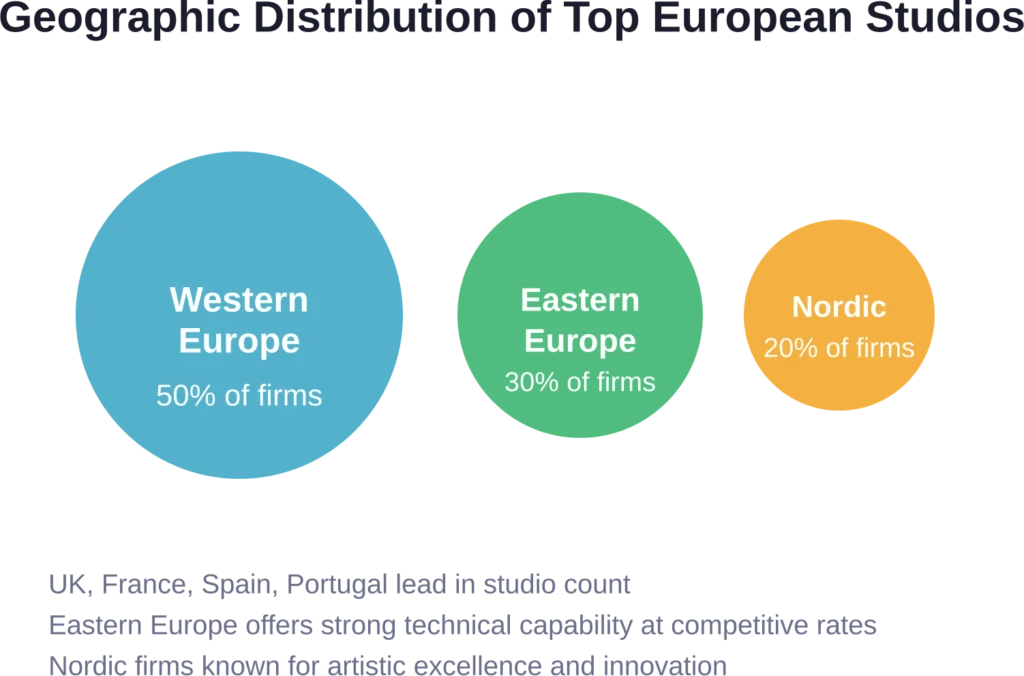
Regional Considerations: Eastern vs. Western European Studios
Geographic location within Europe affects studio characteristics in ways worth understanding when selecting partners.
Western European Studios
Firms in the UK, France, Spain, and similar markets typically command premium positioning. They often work with high-profile architects and major developers, building portfolios with internationally recognized projects.
These studios frequently offer integrated services beyond pure visualization—branding, strategy, interactive experiences. For complex projects requiring comprehensive creative services, this breadth provides value.
Western European studios usually have higher operating costs, which reflects in their fees. The trade-off is often more hands-on creative direction, strategic input, and established relationships with the architectural community.
Eastern European Studios
Countries like Hungary, Romania, and Poland have developed strong visualization sectors combining technical excellence with more accessible fee structures. These studios often provide remarkable quality-to-cost ratios.
Eastern European firms invest heavily in technical capabilities. They typically have substantial teams and render farm infrastructure, enabling them to handle high volumes without compromising quality or timelines.
Language and time zone considerations matter less than they once did. Most Eastern European studios working internationally operate fluently in English and structure workflows to accommodate client time zones.
The choice isn’t about quality—both regions host exceptional studios. It’s about service model, budget, and specific project needs. Some clients prefer the strategic partnership approach common in Western Europe; others prioritize technical execution excellence that Eastern European firms deliver efficiently.
Frequently Asked Questions
Focus on recent work that demonstrates technical competence across the areas your project requires. Assess photorealism in material rendering, natural lighting quality, convincing composition, and appropriate levels of detail. Look for projects comparable to yours in type, scale, and complexity. Diversity in the portfolio suggests adaptability, while specialized portfolios indicate deep expertise in particular building types. Pay attention to how effectively the work communicates design intent—beautiful images that fail to highlight key architectural features miss the point.
Timelines vary substantially based on complexity, studio workload, and deliverable type. A single high-quality exterior rendering might require one to three weeks from briefing through final delivery, including revision rounds. Interior views often take similar timeframes. Complex animations or VR experiences can require several weeks to months for development. Rush services are sometimes available at premium rates, though quality may suffer. Plan to build adequate visualization time into project schedules—typically at least three to four weeks for standard deliverables to allow for creative development and iterations.
Absolutely. Most established European visualization studios regularly serve international clients and have workflows optimized for remote collaboration. Digital file transfer, video conferencing, and project management platforms make geographic distance largely irrelevant. Time zone differences require some schedule coordination but rarely create significant obstacles. Many studios deliberately cultivate international client bases to diversify their project pipeline and gain exposure to varied architectural approaches. Language is rarely a barrier, as studios serving international markets operate fluently in English alongside local languages.
Most studios work with standard architectural CAD formats. Common options include AutoCAD DWG files, Revit models, SketchUp files, Rhino models, and IFC format from various BIM platforms. Many studios can also work with PDF plans and elevations if 3D models aren’t available, though this requires additional modeling time. Provide the most detailed and accurate files available—the better your input, the more accurate the visualization. Include material specifications, finish schedules, and any reference images that communicate design intent. Discuss file requirements during initial conversations to ensure compatibility.
Many studios work across all design phases, though service models vary. Some firms specialize in early-stage concept visualization, helping explore design options through quick study images. Others focus on competition entries or marketing materials requiring high polish. The best studios adapt their approach to project phase—rougher, faster iterations during design development, then refined photorealism for final presentations. Discuss your needs upfront. Studios invested in true collaboration will ask questions about project phase and objectives to recommend appropriate visualization approaches.
The terms are often used interchangeably, though subtle distinctions exist. Rendering typically refers to the technical process of generating images from 3D models—the computational work of calculating light, materials, and camera perspective. Visualization encompasses the broader creative process: deciding what to show, how to compose images, which lighting scenarios communicate design intent, and crafting narratives through imagery. In practice, most firms use both terms to describe their services. What matters is understanding that quality visualization requires both technical rendering capability and creative artistic direction.
Start by identifying your priorities. Marketing imagery for luxury real estate demands different treatment than planning submission documents or competition entries. Review studio portfolios specifically looking for work that matches your project type and presentation context. Consider whether you need photorealism, stylized artistic interpretation, or something in between. Schedule conversations with shortlisted studios to discuss your project and gauge their understanding of your objectives. Ask how they would approach your specific brief. The right match comes from aligned expectations about style, service level, and project priorities rather than simply choosing the most impressive portfolio.
Conclusion
Europe’s architectural visualization industry offers remarkable depth and quality. The ten studios highlighted here represent diverse approaches, specializations, and value propositions, yet all share commitment to excellence that has earned them recognition in this competitive field.
Selecting the right visualization partner involves balancing multiple considerations. Technical capability, artistic vision, communication style, specialization alignment, and budget all factor into the decision. The “best” studio is the one that matches your specific project needs rather than any single firm that tops every category.
The European visualization landscape continues evolving. AI integration, real-time rendering, and virtual reality are transforming workflows and expanding what’s possible. Studios that embrace these technologies while maintaining focus on fundamental visualization principles—effective storytelling, design communication, and aesthetic quality—will lead the industry forward.
For architects, developers, and design professionals, investing in quality visualization delivers tangible returns. Compelling imagery wins competitions, secures planning approvals, attracts buyers, and communicates design intent more effectively than any other medium. The studios featured in this guide provide the expertise to make that investment pay off.
Whether you’re presenting a residential renovation or a landmark civic building, visualization has become essential to architectural practice. Partnering with studios that combine technical mastery, creative vision, and professional reliability ensures your projects receive the visual representation they deserve.
Ready to elevate your architectural presentation? Research these studios, review their portfolios, and reach out to discuss your project. The right visualization partner is waiting to help bring your designs to life.