
Quick Summary: Dubai hosts a thriving ecosystem of 3D modeling design agencies specializing in architectural visualization, product rendering, BIM services, and animation. This guide profiles ten leading companies that deliver professional 3D modeling solutions for real estate developers, architects, interior designers, and construction firms across the UAE, helping businesses transform concepts into photorealistic visuals and technical models.
Dubai’s construction boom and digital transformation have created unprecedented demand for high-quality 3D modeling services. From towering skyscrapers along Sheikh Zayed Road to luxury residential developments on the Palm Jumeirah, every major project now relies on sophisticated 3D visualization before breaking ground.
The city’s competitive landscape has fostered a community of specialized design studios that blend international expertise with local market knowledge. These agencies understand the unique requirements of UAE clients, regional architectural preferences, and the regulatory environment that shapes construction projects across the Emirates.
But choosing the right 3D modeling partner isn’t straightforward. The quality gap between agencies is substantial, and selecting poorly can mean missed deadlines, miscommunication, and renders that fail to impress stakeholders or secure investment.
Why 3D Modeling Services Matter for Dubai Businesses
The UAE construction sector operates at a scale and pace that demands visualization tools capable of communicating complex designs to diverse stakeholders. Investors, government authorities, and end clients all need to understand proposed developments before committing resources.
Traditional 2D drawings and blueprints can’t convey spatial relationships, material finishes, or lighting conditions the way photorealistic 3D renders do. According to authoritative sources, eiwaa consultancy is among the leading BIM modeling companies in UAE, offering scan to BIM services, building information management, making 3D models, and 3D drawings for architectural engineering consultants and building construction companies.
Here’s what makes 3D modeling essential in the current market:
Real estate developers use architectural visualization to pre-sell units before construction begins. High-quality exterior and interior renders help potential buyers envision finished spaces, dramatically shortening sales cycles and improving conversion rates.
Construction firms rely on Building Information Modeling for clash detection, quantity takeoffs, and construction sequencing. These technical 3D models integrate structural, mechanical, electrical, and plumbing systems, identifying conflicts before they become expensive on-site problems.
Product manufacturers need photorealistic renders for marketing materials, e-commerce platforms, and investor presentations. Creating physical prototypes is costly and time-consuming, but 3D modeling allows rapid iteration and visualization of design variations.
Interior designers present spatial layouts, furniture arrangements, and material palettes to clients through immersive 3D visualizations. These tools eliminate ambiguity and ensure client expectations align with the final delivered space.
Types of 3D Modeling Services Available in Dubai
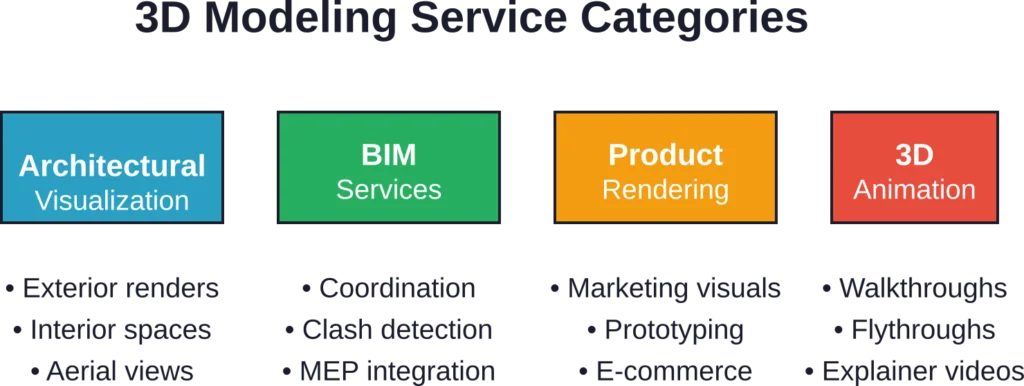
The 3D modeling industry encompasses several distinct specializations, each requiring different technical skills, software proficiency, and industry knowledge.
Architectural Visualization and Rendering
Architectural rendering studios create photorealistic images and animations of buildings, developments, and urban planning projects. These services typically include exterior renders showing buildings in context with surrounding environments, interior renders depicting furnished spaces with accurate lighting, and aerial views providing bird’s-eye perspectives of large developments.
The most sophisticated agencies deliver renders indistinguishable from professional photography, incorporating real-world lighting physics, accurate material properties, and environmental details like landscaping and human figures.
Building Information Modeling (BIM)
BIM services go beyond visual appeal to create information-rich 3D models containing data about every building component. As noted in authoritative sources, eiwaa consultancy offers MEP design, architectural design, sustainable design for green buildings, and BIM architecture services when compared to other engineering consulting companies in Dubai.
These intelligent models support lifecycle management from design through construction to facility maintenance. BIM specialists work with formats like Revit, ArchiCAD, and Tekla, delivering coordinated models that multiple disciplines can use simultaneously.
Product Design and Rendering
Product modeling studios create detailed 3D representations of manufactured goods, from consumer electronics to furniture to industrial equipment. These models support marketing campaigns, patent applications, manufacturing planning, and e-commerce platforms.
Product renders often require extreme attention to material accuracy, with specialized rendering of metals, plastics, fabrics, and glass to match real-world appearance.
3D Animation and Walkthroughs
Animation studios produce video content showing buildings, products, or spaces from dynamic perspectives. Architectural walkthroughs guide viewers through developments, while product animations demonstrate functionality and assembly.
High-end animation work incorporates camera movement, lighting changes, and environmental effects to create engaging narratives around design projects.
Top 11 3D Modeling Design Companies in Dubai
The following agencies represent the most established and capable 3D modeling service providers operating in Dubai and the broader UAE market. Each brings specialized expertise, proven track records, and the technical infrastructure to handle projects ranging from individual residential units to master-planned communities.

1. Powerkh
Powerkh is a UK-based BIM and VDC consultancy with offices in the United States and Ukraine, supporting architects, developers, and construction teams with 3D modelling and visualization services for projects in Dubai and other international markets. The company provides architectural 3D modelling, BIM coordination, rendering, and Scan to BIM services for residential, commercial, and mixed-use developments.
Their services include BIM modelling from LOD 100 to LOD 500, architectural visualization, point cloud modelling, clash detection, and coordination between architectural, structural, and MEP systems. Powerkh also supports renovation and reconstruction projects through existing conditions modelling and scan-based workflows.
The company uses Autodesk Revit, Navisworks, and BIM-based workflows to help project teams improve coordination, manage design information, and create accurate 3D models for design review, construction planning, and project documentation.
Contact Information:
- Website: www.powerkh.com
- Email: [email protected]
- Facebook: www.facebook.com/100064039650167
- LinkedIn: www.linkedin.com/company/powerkh
- Instagram: www.instagram.com/powerkh_com
- Address: 3, Lavinia Walk, Taw Hill, Swindon SN25 1AP
- Phone: +44 7490 426678
2. MEVIA Creative Agency
MEVIA positions itself as a 360-degree creative agency delivering end-to-end creative solutions across multiple disciplines. The studio handles 3D architectural visualization alongside branding, digital marketing, and multimedia production.
Their architectural rendering portfolio demonstrates proficiency with both residential and commercial projects throughout Dubai and the wider Gulf region. The agency’s integrated approach means clients can coordinate 3D visualization with broader marketing campaigns, ensuring visual consistency across all client touchpoints.
MEVIA’s team combines international design standards with understanding of regional aesthetic preferences, making them particularly effective for developers targeting both local and international buyers.

3. Orbis Production
Orbis operates as a global network with offices across Europe, Asia, and the Middle East, including a dedicated UAE presence. Their international footprint gives them access to specialized talent pools and allows them to handle large-scale projects requiring substantial rendering capacity.
The company emphasizes technical precision in architectural visualization, with particular strength in high-rise developments and mixed-use projects. Their work appears in marketing materials for some of Dubai’s most recognizable developments.
Orbis maintains case studies and portfolio samples accessible through their global network, providing transparency about their project experience and technical capabilities.
4. eiwaa Consultancy
eiwaa Consultancy specializes in technically oriented 3D modeling, focusing on BIM services, scan-to-BIM conversion, and construction documentation. Rather than purely aesthetic rendering, they create information-rich models that support engineering analysis and construction coordination.
Their scan-to-BIM services are particularly valuable for renovation projects and existing building documentation, using laser scanning technology to capture precise as-built conditions and convert them into workable 3D models.
The consultancy serves architectural engineering consultants, MEP contractors, and construction companies requiring coordinated building models for complex projects. Their expertise extends to sustainable design for green buildings and architectural design services.
5. Digital Visions Studio
Digital Visions operates primarily in the luxury residential and hospitality sectors, creating high-end interior and exterior visualizations for premium developments. Their rendering style emphasizes photorealism and attention to atmospheric details like lighting, materiality, and contextual integration.
The studio’s portfolio includes numerous villa developments, penthouse units, and boutique hotels throughout Dubai and Abu Dhabi. They excel at creating marketing-ready visuals that communicate luxury positioning and lifestyle aspirations.
Digital Visions maintains long-term relationships with several prominent UAE developers, handling visualization for multiple phases of ongoing projects.

6. Blueprint Interactive
Interactive 3D experiences beyond static rendering, including virtual reality walkthroughs and augmented reality applications, are increasingly offered by agencies in Dubai’s market. Their services include virtual reality walkthroughs, augmented reality applications, and interactive configurators that allow clients to customize finishes and layouts in real-time.
These interactive tools are increasingly important for pre-sales environments, where potential buyers want to explore spaces and personalize options before committing to purchases. Blueprint’s technical infrastructure supports both web-based and dedicated VR headset experiences.
The company serves primarily real estate developers and interior design firms looking to differentiate their sales processes through technology.

7. Render Vision Middle East
Agencies in Dubai’s market specialize in large-scale master plan visualizations and urban development projects. Their work often involves creating entire neighborhoods or districts, showing how individual buildings relate to infrastructure, public spaces, and surrounding context.
This macro-level visualization requires different skills than single-building rendering, including urban planning knowledge, transportation modeling, and landscape architecture understanding.
Render Vision’s client base includes government authorities, master developers, and urban planning consultancies working on Dubai’s expansion zones and free zone developments.
8. Vertex Visualization Studio
Vertex operates across multiple 3D modeling disciplines, handling architectural visualization, product rendering, and animation work. This diversification allows them to serve varied client types, from construction firms to consumer goods manufacturers.
Their product rendering division has worked with UAE-based furniture designers, lighting manufacturers, and consumer electronics brands, creating images for catalogs, websites, and retail displays.
Vertex maintains competitive delivery timelines, often appealing to clients with compressed schedules who need quality renders produced quickly.

9. 3D Perspectives Dubai
3D Perspectives concentrates exclusively on architectural visualization for the construction industry. Their specialization means deep expertise in architectural rendering workflows, construction documentation, and coordination with design consultants.
The studio works extensively with architectural firms as an extension of their in-house teams, handling overflow work during peak periods and providing specialized rendering expertise that smaller practices lack internally.
3D Perspectives maintains strong relationships with several international architecture firms with UAE operations, serving as their preferred local visualization partner.
10. TechMod Engineering
Agencies bridge engineering and visualization, offering BIM coordination, MEP modeling, and structural analysis alongside 3D visualization services. Their technical orientation makes them particularly valuable for complex infrastructure projects, industrial facilities, and technically demanding building types.
The company’s engineering background ensures their models aren’t just visually appealing but also technically accurate and constructible. They frequently collaborate with engineering consultancies requiring both analysis capabilities and client-facing visualization.
TechMod’s project portfolio includes airports, hospitals, educational facilities, and industrial plants throughout the Gulf region.
11. Creative Dimension Studios
Creative Dimension operates at the intersection of architecture and entertainment, producing both marketing-focused architectural visualization and more artistic, conceptual renders for design competitions and concept development.
Their team includes architects, graphic designers, and 3D artists, allowing them to handle projects from early concept sketching through final marketing imagery. This comprehensive service appeals to design firms wanting a single partner throughout project evolution.
Creative Dimension has built reputation for distinctive visual styles that stand out in crowded marketing environments, helping developments create memorable brand identities.
How to Choose the Right 3D Modeling Partner
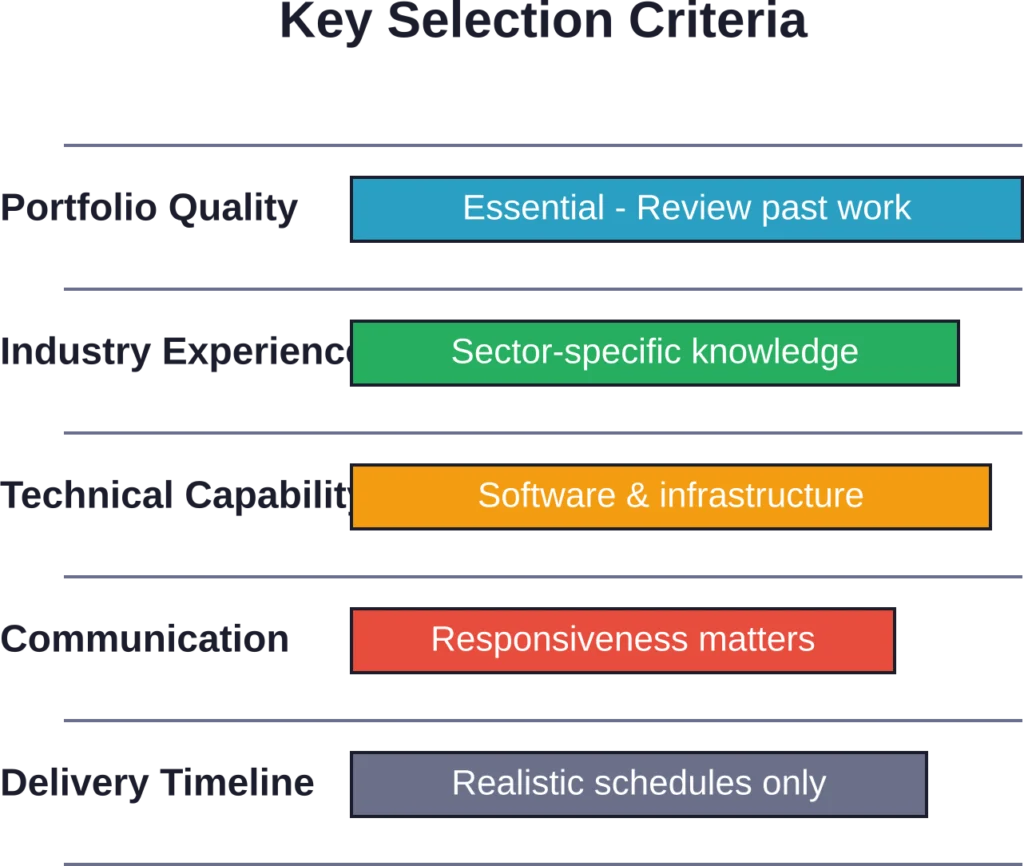
Selecting a 3D modeling agency requires evaluating technical capabilities, creative sensibilities, and operational reliability. The wrong choice leads to missed deadlines, budget overruns, and visuals that fail to achieve their marketing or communication objectives.
Evaluate Portfolio Relevance
Don’t just look for attractive images. Examine whether agencies have handled projects similar in scale, building type, and complexity to what’s being planned. A studio with beautiful villa renders might struggle with high-rise coordination or infrastructure projects.
Portfolio quality indicates both technical skill and creative direction. Look for consistency across projects, suggesting reliable processes rather than occasional lucky results.
Assess Technical Infrastructure
Understanding agencies’ technical capabilities prevents discovering limitations mid-project. Ask about software platforms, rendering capacity, file management systems, and revision workflows.
Agencies working with industry-standard tools like 3ds Max, V-Ray, Revit, or Unreal Engine can typically integrate smoothly with design consultants and contractors. Proprietary or outdated software creates compatibility problems.
Rendering capacity matters for large projects requiring numerous views or animations. Studios with render farms can deliver faster turnarounds than those relying on desktop workstations.
Check Industry Specialization
Specialized knowledge significantly impacts results. Architectural visualization studios understand building systems, construction methods, and design terminology. Product rendering specialists know manufacturing constraints, material properties, and retail marketing requirements.
Generalist agencies might produce adequate work, but specialists typically deliver better results faster because they don’t face learning curves understanding industry-specific requirements.
Consider Communication and Process
Clear communication prevents misunderstandings that derail projects. During initial discussions, evaluate how agencies ask questions, clarify requirements, and propose workflows.
Well-organized studios provide detailed briefs, milestone schedules, and structured review processes. Chaotic communication patterns during sales discussions typically worsen during production.
Geographic proximity matters less than it once did, but time zone alignment facilitates real-time communication. UAE-based agencies or those maintaining Gulf-hours availability simplify coordination.
Review Client References
Speaking with past clients reveals information agencies won’t volunteer. References can address responsiveness during revisions, accuracy of timeline estimates, and how agencies handle problems or scope changes.
Ask specific questions about collaboration experience rather than general satisfaction. How many revision rounds were typical? How did the agency handle technical challenges? Would the client use them again?
3D Modeling Technology and Software Landscape
The tools driving 3D modeling have evolved dramatically, with software becoming more accessible while simultaneously more capable. Understanding the technology landscape helps evaluate agency capabilities and set realistic expectations.
Architectural Visualization Tools
Most architectural rendering studios build workflows around Autodesk 3ds Max combined with rendering engines like V-Ray, Corona Renderer, or Lumion. These tools offer photorealistic output with sophisticated material systems, global illumination, and physical camera models.
Real-time rendering engines like Unreal Engine and Twinmotion are gaining traction, allowing interactive experiences and faster iteration. These tools sacrifice some rendering quality for speed and interactivity, making them ideal for presentations and VR applications.
Post-production in Adobe Photoshop remains standard, with artists adjusting color, adding atmospheric effects, and compositing rendered elements with photographic backgrounds.
BIM Platforms
Building Information Modeling relies primarily on Autodesk Revit, ArchiCAD, and Bentley Systems software. These platforms create parametric models where components understand their relationships and properties.
BIM models contain far more data than visual representations, including material specifications, cost information, maintenance schedules, and performance characteristics. This information supports analysis, quantity takeoffs, and facility management long after construction.
Coordination workflows use Navisworks or Solibri for clash detection, identifying where different building systems conflict before construction begins.
Product Modeling Software
Product designers often work in SolidWorks, Rhino, or Fusion 360, creating precise CAD models with manufacturing-ready specifications. These models then import into rendering software for visualization.
KeyShot and Modo are popular rendering tools for product work, offering material libraries specifically designed for manufactured goods and simplified workflows for creating marketing imagery.
Emerging Technologies
Artificial intelligence is beginning to impact 3D modeling workflows. AI-powered tools can generate textures, upscale images, remove backgrounds, and even create initial design variations from text descriptions.
Scan technologies including photogrammetry and LiDAR allow rapid capture of existing conditions or sites, creating accurate 3D base models for renovation projects or contextual visualization.
Cloud collaboration platforms enable distributed teams to work on shared models simultaneously, particularly important for international projects involving consultants across multiple time zones.
Common 3D Modeling Project Types in Dubai
Understanding typical project categories helps clients scope work appropriately and agencies specialize effectively. Dubai’s market presents several recurring project types, each with distinct requirements.
High-Rise Residential Developments
Tower visualization remains constant demand given Dubai’s vertical growth. These projects require exterior renders showing architectural design and urban context, typical floor plan renders for sales materials, amenity space visualization for gyms and pools, and often penthouse-level interior renders showing luxury finishes.
Developers typically need multiple view angles, different times of day, and seasonal variations to support international marketing campaigns targeting diverse buyer segments.
Villa Communities and Townhouses
Low-rise residential developments require different visualization approaches than towers. Projects often include master plan overview showing entire community layout, individual villa exterior renders in context, interior renders for multiple unit types, and landscape visualization showing gardens and community facilities.
These projects emphasize lifestyle and community rather than urban verticality, with rendering styles often softer and more approachable than high-rise work.
Retail and Hospitality
Commercial projects demand visualization that communicates brand identity and customer experience. Hotels need lobby and public space renders, typical room visualization, restaurant and bar renders, and exterior views showing arrival experiences.
Retail projects require store layout visualization, material and lighting studies, and often animated walkthroughs showing customer flow through spaces.
Mixed-Use Developments
Large integrated projects combining residential, retail, office, and entertainment uses need comprehensive visualization showing how different components integrate. Master plan renders establish overall vision, while detailed views of each component serve specific marketing and financing requirements.
These complex projects often require both broad contextual views and intimate street-level perspectives showing pedestrian experiences.
Infrastructure and Institutional
Government and institutional projects including airports, hospitals, schools, and cultural facilities have different stakeholders than commercial real estate. Visualization must communicate functionality, operational flow, and public benefit alongside architectural quality.
These projects often involve public consultation processes where visualization helps non-technical audiences understand proposed developments.
| Project Type | Primary Deliverables | Key Considerations |
|---|---|---|
| High-Rise Residential | Exterior renders, typical floor plans, amenity spaces, penthouse interiors | Multiple view angles, day/night versions, seasonal variations |
| Villa Communities | Master plan, villa exteriors, interior layouts, landscape views | Lifestyle emphasis, community context, approachable style |
| Retail & Hospitality | Public spaces, typical units, brand environments, arrival sequences | Brand alignment, customer experience, lighting design |
| Mixed-Use Developments | Master plan overview, component details, street-level views | Integration of functions, pedestrian experience, phasing |
| Infrastructure | Operational visualization, public interfaces, technical integration | Stakeholder communication, functional clarity, public benefit |
3D Modeling Best Practices for Client Projects
Successful 3D modeling projects follow certain patterns that maximize quality while minimizing revisions and delays. Both clients and agencies benefit from understanding these best practices.
Provide Comprehensive Briefing Materials
Visualization quality depends heavily on input quality. Agencies need architectural drawings, material specifications, reference images for finishes, site context information, and brand guidelines or style preferences.
Incomplete briefs lead to assumptions, which lead to misaligned results requiring extensive revisions. Time invested in thorough briefing saves far more time later in production.
Establish Clear Milestone Reviews
Structured review processes catch problems early when they’re easy to fix. Typical milestones include camera angle and composition approval, modeling review checking geometry and proportions, material and lighting review, and final rendering with minor adjustment rounds.
Attempting to provide comprehensive feedback only at final delivery creates impossible revision requests or forces acceptance of suboptimal results.
Limit Revision Scope Appropriately
Understanding what constitutes minor versus major changes prevents scope creep and budget conflicts. Minor revisions include color adjustments, small composition changes, and material refinements. Major changes involve camera angle redesign, significant modeling changes, or adding elements not in the original brief.
Contracts should clearly define revision allowances and what triggers additional fees, preventing disputes when project scope expands.
Maintain Realistic Timeline Expectations
Quality 3D modeling takes time. A single high-quality architectural render typically requires several days including modeling, material setup, lighting, rendering, and post-production. Complex animations require weeks or months.
Rush timelines force quality compromises or require premium pricing for expedited delivery. Planning visualization schedules early in project timelines prevents becoming critical path bottlenecks.
Respect Intellectual Property
Clear agreements about image ownership, usage rights, and portfolio permissions prevent later conflicts. Clients typically receive usage rights for marketing and project purposes, while agencies often retain portfolio rights unless confidentiality agreements specify otherwise.
Architectural designs remain property of design consultants, with visualization agencies creating derivative works rather than claiming design authorship.
Cost Factors in 3D Modeling Projects
While specific pricing varies widely between agencies and project types, understanding cost drivers helps set realistic budgets and evaluate proposals.
Project Complexity
Simple residential interiors require less work than complex infrastructure or high-rise buildings. Complexity factors include building size and detail level, number of unique materials and finishes, environmental context requirements, special effects like water or vegetation, and animation versus static images.
More complex projects require more modeling time, longer rendering calculations, and additional revision rounds to achieve quality standards.
Deliverable Quantity and Format
More images cost more, but per-image costs typically decrease with volume as base modeling work serves multiple views. Animation pricing considers duration, camera complexity, and whether footage includes special effects or character animation.
Output resolution and format affect pricing, with print-quality large format images requiring more rendering time than web-resolution visuals.
Timeline Requirements
Standard delivery timelines allow agencies to optimize rendering resources and staff allocation. Rush projects require premium pricing to compensate for workflow disruption and potentially overtime costs.
Planning ahead provides best value, while last-minute requests incur substantial premiums.
Revision Allowances
Most agencies include limited revision rounds in base pricing, with additional changes billed separately. Clients requiring extensive iteration should discuss expanded revision allowances during contracting.
Well-defined briefs and milestone reviews minimize revision needs, keeping projects within standard allowances.
Agency Positioning and Overhead
Premium agencies with established reputations command higher fees than smaller studios or freelancers. This premium reflects not just creative quality but also reliability, process maturity, and risk mitigation.
Location affects overhead costs, though remote work has somewhat equalized pricing between markets. Dubai-based agencies incur higher operating costs than outsourcing to lower-cost regions but offer advantages in communication, market knowledge, and client service.
The Dubai 3D Modeling Market in 2026
Dubai’s 3D modeling industry has matured significantly over the past decade, evolving from primarily outsourced services to a robust local ecosystem of specialized studios.
Market Drivers
Several factors sustain strong demand for 3D modeling services. Dubai’s construction pipeline remains substantial despite global economic uncertainties, with major projects throughout Dubai 2040 Urban Master Plan implementation continuing to move forward.
International investment in UAE real estate requires sophisticated marketing materials, with 3D visualization essential for pre-sales to buyers who can’t physically visit developments. The shift toward digital marketing has increased demand for render content across websites, social media, and virtual showrooms.
Government initiatives promoting design excellence and sustainable development create opportunities for visualization supporting planning approvals and public engagement.
Competitive Landscape
The market includes international agencies with Dubai offices, regionally headquartered studios serving Gulf markets, specialized boutique firms focusing on specific niches, and individual freelancers and small teams serving budget-conscious clients.
Competition has driven quality improvements and service diversification, with agencies expanding beyond basic rendering into interactive experiences, virtual reality, and comprehensive digital marketing support.
Technology Trends
Real-time rendering and game engine technology are increasingly important, enabling interactive experiences that static renders can’t match. Virtual reality walkthroughs have moved from novelty to standard offering for premium developments.
Artificial intelligence tools are beginning to augment workflows, though human creativity and technical judgment remain essential. AI assists with repetitive tasks, asset generation, and post-production rather than replacing skilled artists.
Cloud collaboration platforms enable distributed teams and remote client reviews, reducing the geographic friction that once required physical proximity between clients and agencies.
Working with International Versus Local Agencies
Clients face choices between Dubai-based studios, regional agencies, and international firms with varying trade-offs in cost, communication, and cultural understanding.
Local Dubai Agencies
UAE-based studios offer several advantages for Dubai projects. They understand local architectural styles, regulatory requirements, and market preferences. Same time zone facilitates real-time communication and quick turnarounds. Face-to-face meetings remain possible for complex briefings or critical reviews.
Local agencies typically maintain higher operating costs than outsourced alternatives, reflected in their pricing. But communication efficiency, reduced revision cycles, and market-appropriate output often justify premium fees.
Regional Studios
Agencies based elsewhere in the Gulf region offer middle ground between local and fully international options. They understand regional market dynamics while potentially offering cost advantages versus Dubai-based alternatives.
Time zone alignment remains good, though physical meetings require travel. Cultural and market understanding is generally strong for Gulf projects.
International Outsourcing
Studios in lower-cost markets like Eastern Europe, South Asia, or Southeast Asia can offer substantial cost savings, particularly for large-volume rendering work or technically straightforward projects.
Trade-offs include time zone challenges affecting communication responsiveness, potential gaps in understanding UAE market preferences, and sometimes quality inconsistency requiring more extensive revision rounds.
Many Dubai developers use hybrid approaches, partnering with local studios for client-facing work requiring close collaboration while outsourcing high-volume production work to lower-cost providers.
Quality Standards and Deliverable Specifications
Setting clear quality expectations prevents disputes about whether delivered work meets requirements. Technical specifications should be agreed upfront rather than debated at project completion.
Resolution and Format Requirements
Image resolution should match intended usage. Web and presentation graphics typically need 1920×1080 to 3840×2160 pixels (HD to 4K). Print applications require higher resolutions, with large format printing sometimes demanding 6000+ pixel dimensions.
File formats should suit downstream workflows. JPEG works for most applications but lacks transparency support. PNG preserves transparency for compositing. TIFF provides maximum quality for print production.
Rendering Quality Settings
Photorealistic visualization requires sophisticated rendering settings including global illumination calculations, accurate material reflections and refractions, depth of field and motion blur effects, and high sample counts minimizing noise.
Draft or preview renders use simplified settings for faster turnaround during review phases, with final production rendering employing full quality settings.
Style and Aesthetic Expectations
Visual style should align with project positioning and target audience. Luxury developments warrant sophisticated, refined rendering with careful attention to lighting and composition. Affordable housing projects often use more straightforward, accessible visual languages.
Reference images during briefing help align aesthetic expectations before production begins.
Accuracy Versus Artistic License
Different projects balance technical accuracy against creative enhancement differently. Construction documentation requires precise representation of actual conditions. Marketing visualization often incorporates artistic license with idealized weather, enhanced landscaping, and carefully composed views.
Clear communication about this balance prevents misunderstandings, particularly when visualization serves both technical coordination and marketing purposes.
Future Trends in 3D Modeling for Dubai Projects
The 3D modeling industry continues evolving rapidly, with several trends particularly relevant for Dubai’s market.
Metaverse and Virtual Worlds
Virtual world platforms are creating demand for 3D environments beyond traditional rendering. Real estate projects increasingly include virtual showrooms, allowing remote property exploration and even virtual events in digital twins of physical developments.
These applications require different modeling approaches than static rendering, with optimization for real-time performance and interactive experiences.
Augmented Reality Integration
AR applications overlay digital content onto physical environments, enabling on-site visualization of proposed developments in their actual context. Construction teams use AR to visualize building systems before installation.
Mobile AR has become accessible through smartphones and tablets, requiring 3D content optimized for these platforms.
AI-Assisted Design
Artificial intelligence tools are beginning to generate design variations, optimize layouts for specific criteria, and accelerate repetitive modeling tasks. These tools augment rather than replace human designers, handling routine work while professionals focus on creative decisions.
Text-to-image AI models can generate concept visualization from descriptions, potentially changing early-stage design communication.
Sustainable Design Visualization
Growing emphasis on sustainable construction creates demand for visualization communicating environmental performance. Agencies increasingly create graphics showing solar analysis, natural ventilation, green building features, and sustainability certifications.
These technical visualizations bridge engineering analysis and client-facing communication.
Integration with Digital Twins
Digital twin platforms create persistent virtual models of physical buildings, updated throughout construction and operation. 3D modeling increasingly serves as foundation for these ongoing digital representations rather than producing disposable marketing content.
This shift toward models as living data assets rather than static images changes how agencies structure work and deliverable formats.
Common Challenges and How to Avoid Them
Most 3D modeling projects encounter predictable challenges. Understanding these patterns helps prevent problems before they occur.
Scope Creep and Revision Cycles
Projects without clear boundaries expand unpredictably as stakeholders request additional views, changed elements, or refined details beyond original agreements. This creates budget conflicts and delays.
Prevention requires detailed scopes of work defining deliverables, revision allowances, and change order processes. Both parties should track requested changes against agreed scope.
Misaligned Expectations
Visual quality is subjective, and clients sometimes expect results inconsistent with project budgets or timelines. Unrealistic expectations lead to disappointment regardless of delivered quality.
Portfolio review, reference images, and test renders help align expectations before full production begins. Discussing trade-offs between quality, speed, and cost prevents surprises.
Technical File Issues
Incompatible file formats, missing information in provided drawings, or outdated reference materials create delays as agencies wait for clarification or corrected inputs.
Pre-project technical review identifies file issues before production begins. Agencies should specify required formats and information completeness upfront.
Communication Breakdowns
Distributed teams, multiple stakeholders, and compressed timelines create opportunities for miscommunication. Feedback from different reviewers sometimes conflicts, leaving agencies uncertain which direction to pursue.
Designated single point of contact, consolidated feedback, and documented decision-making prevent communication chaos.
Last-Minute Design Changes
Design development continuing after visualization begins creates moving targets. Changes to architectural plans, material selections, or project scope after modeling work is complete require substantial rework.
Milestone-based workflows with approval gates minimize wasted work from late changes. When changes are unavoidable, clear change order processes manage scope and budget impacts.
Frequently Asked Questions
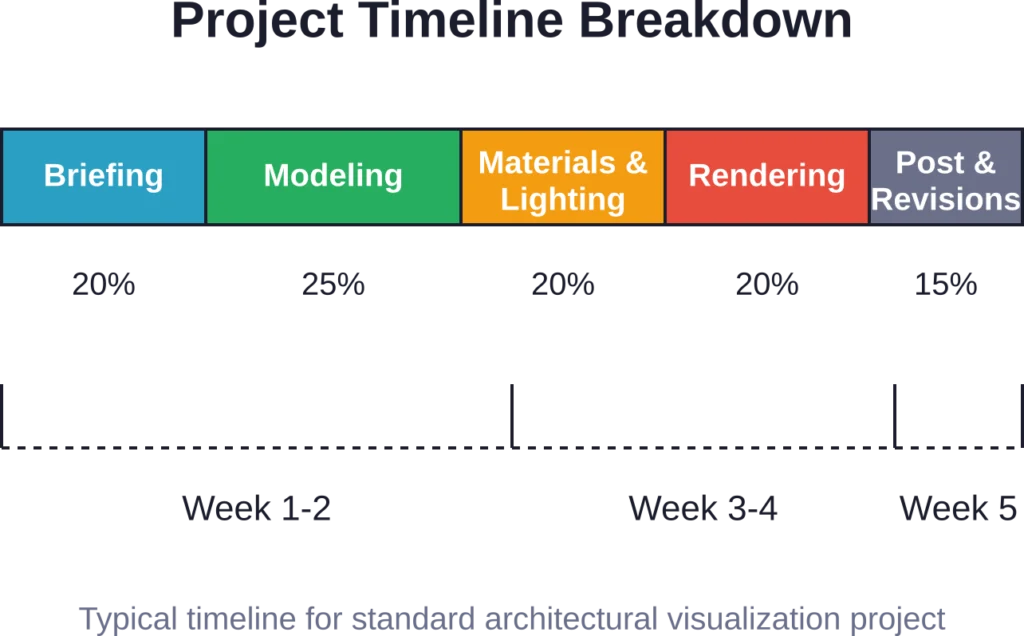
Standard architectural visualization projects typically require 3-5 weeks from briefing to final delivery. Simple projects with few deliverables might complete in 1-2 weeks, while complex developments with many views or animations can require 2-3 months. Timeline depends on project complexity, number of deliverables, revision rounds, and whether rush delivery is needed. Agencies can sometimes accommodate expedited schedules for premium fees, but quality 3D modeling fundamentally requires time for proper execution.
Revision allowances vary by agency, with standard agreements typically including limited revision rounds. The first occurs after modeling and composition approval, the second after initial rendering, and a final round for minor adjustments. Extensive changes or additional revision cycles typically incur extra fees. Well-defined briefs and milestone reviews minimize revision needs. Clients should consolidate feedback from all stakeholders before submitting revision requests to avoid conflicting direction across multiple rounds.
Agencies typically prefer AutoCAD DWG files for architectural plans, PDF drawings with dimensions and specifications, SketchUp or Revit models if available, material specification documents, and reference images for finishes and context. High-resolution site photos help with environmental integration. Brand guidelines ensure appropriate styling. The more comprehensive the input materials, the more accurate initial results will be, minimizing revision cycles.
Yes, base 3D models can typically be adapted for variations more efficiently than creating entirely new models. Changes to finishes, furniture layouts, or minor architectural elements require less work than original modeling. Agencies should retain source files allowing future updates. Discuss variation requirements during initial scoping to ensure modeling approach supports anticipated changes. Some projects benefit from parametric modeling approaches that systematically generate variations from base geometry.
3D modeling is the process of creating geometric representations of objects or spaces in three-dimensional software. 3D rendering is the process of converting those models into 2D images by calculating lighting, materials, and camera perspectives. Modeling creates the structure; rendering creates the picture. Both are necessary for architectural visualization. The term “3D modeling services” often encompasses both activities, though they represent distinct technical processes requiring different skill sets.
Ownership terms vary by contract and should be explicitly defined upfront. Typically, clients receive rendered images and usage rights for marketing and project purposes. The underlying 3D model files may or may not transfer to clients depending on agreement terms. Many agencies retain model ownership while granting comprehensive usage rights for outputs. Some projects include model file delivery for additional fees. Architectural design intellectual property remains with design consultants regardless of visualization contracts.
Accuracy requires working from complete, coordinated construction documents rather than preliminary designs. Agencies should request material specifications, finish schedules, and details showing actual building components. Site visits help understand context and existing conditions. For critical projects, involvement of architects and engineers in review processes catches technical errors. But visualization always involves some artistic interpretation. Disclaimers typically note that renderings represent artistic impressions rather than exact construction documentation.
Conclusion
Dubai’s 3D modeling ecosystem offers sophisticated capabilities across architectural visualization, Building Information Modeling, product rendering, and animation services. The ten agencies profiled represent diverse approaches from technically focused BIM specialists to marketing-oriented visualization studios.
Selecting the right partner requires evaluating portfolio relevance, technical infrastructure, industry specialization, and communication processes. The best agencies combine creative excellence with reliable project management, delivering results that meet quality standards while respecting timelines and budgets.
As Dubai continues its ambitious development trajectory, demand for professional 3D modeling services remains strong. Projects increasingly require not just static images but interactive experiences, virtual reality environments, and digital twins supporting building lifecycle management.
The agencies listed here have demonstrated capability handling Dubai’s demanding project requirements, from luxury residential towers to large-scale infrastructure developments. But the final selection should always consider specific project needs, working styles, and the collaborative fit between client and agency teams.
Ready to transform your project concepts into compelling visual reality? Reach out to agencies whose portfolios align with your project type and quality expectations. Invest time in thorough briefing and milestone reviews. The result will be visualization that effectively communicates your vision to investors, buyers, and stakeholders.