

Quick Summary: The UK is home to world-renowned architectural engineering firms that combine design excellence with technical innovation. From global giants like Foster + Partners and Zaha Hadid Architects to specialist practices like Arup and BDP, these firms shape the built environment across residential, commercial, cultural, and infrastructure sectors. This comprehensive list highlights ten leading agencies that represent the best of British architectural engineering talent in 2026.
The UK architectural landscape continues evolving in 2026, blending heritage with cutting-edge innovation. British architectural engineering firms consistently rank among the world’s most influential practices, delivering projects that redefine skylines and communities alike.
According to the Royal Institute of British Architects (RIBA), more than 4,000 world-class practices operate across the UK, representing the highest standards in professionalism and ethics. These firms range from global powerhouses to boutique specialists, each bringing distinct expertise to the table.
But which firms truly stand out?
This guide examines ten leading architectural engineering companies that have demonstrated exceptional capability in 2026. From sustainability pioneers to cultural landmark creators, these agencies represent the cream of British architectural talent.
What Defines a Top Architectural Engineering Company?
The best architectural engineering firms share several characteristics that set them apart from the competition.
Technical excellence forms the foundation. These practices integrate structural engineering, environmental design, and digital innovation into cohesive solutions. They don’t just draw buildings—they solve complex engineering challenges while creating spaces that inspire.
RIBA Chartered Practice membership signals commitment to quality standards. The designation demonstrates dedication to top-tier professionalism, with practices gaining access to exclusive business resources, quality management guidance, and environmental frameworks that elevate their work.
Portfolio diversity matters too. Leading firms tackle multiple project types—residential, commercial, cultural, infrastructure—proving their adaptability and breadth of expertise.
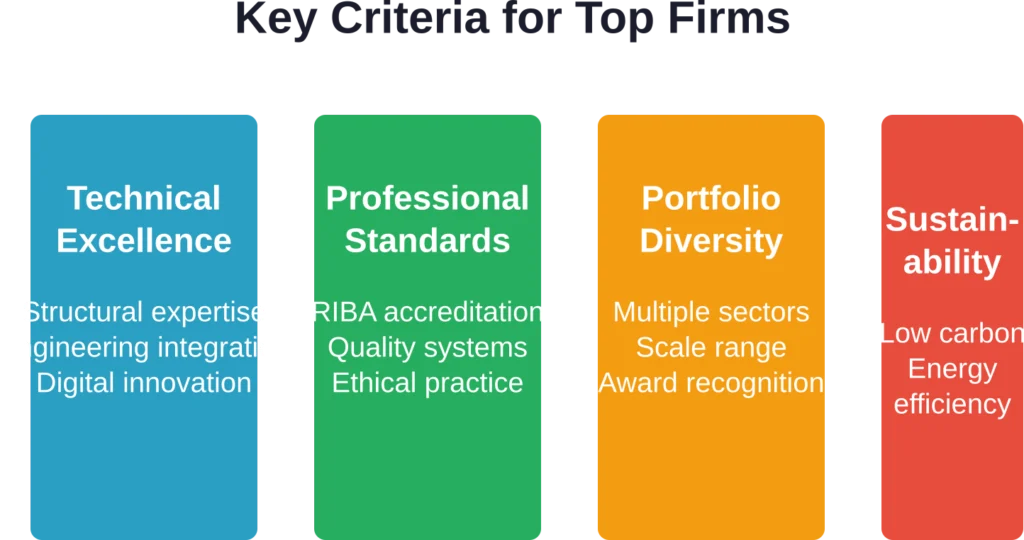
Sustainability credentials increasingly separate leaders from followers. With growing emphasis on embodied carbon and operational energy, top practices demonstrate measurable environmental performance. Leading projects demonstrate low-carbon design principles through careful material selection and construction sequencing, with verified award-winning projects achieving operational energy use as low as 46.08 kWh/m2/y.
Top 11 Architectural Engineering Companies in the UK

1. Powerkh
Powerkh is a UK-based BIM and VDC consultancy with offices in the United States and Ukraine, supporting architectural and engineering teams across Europe. The company provides BIM modelling, design coordination, Scan to BIM, and technical support for residential, commercial, and industrial projects.
Their services include BIM modelling from LOD 100 to LOD 500, clash detection, constructability review, structural detailing, and coordination between architectural, structural, and MEP systems. Powerkh also works with point cloud data and existing building modelling for renovation and reconstruction projects.
The company uses Autodesk Revit, Navisworks, and BIM-based workflows to help teams improve coordination, manage project information, and support design and construction processes with more accurate models and documentation.

2. Foster + Partners
Founded by Norman Foster in 1967, Foster + Partners remains one of the world’s most recognizable architectural practices. The London-based firm operates globally but maintains deep UK roots.
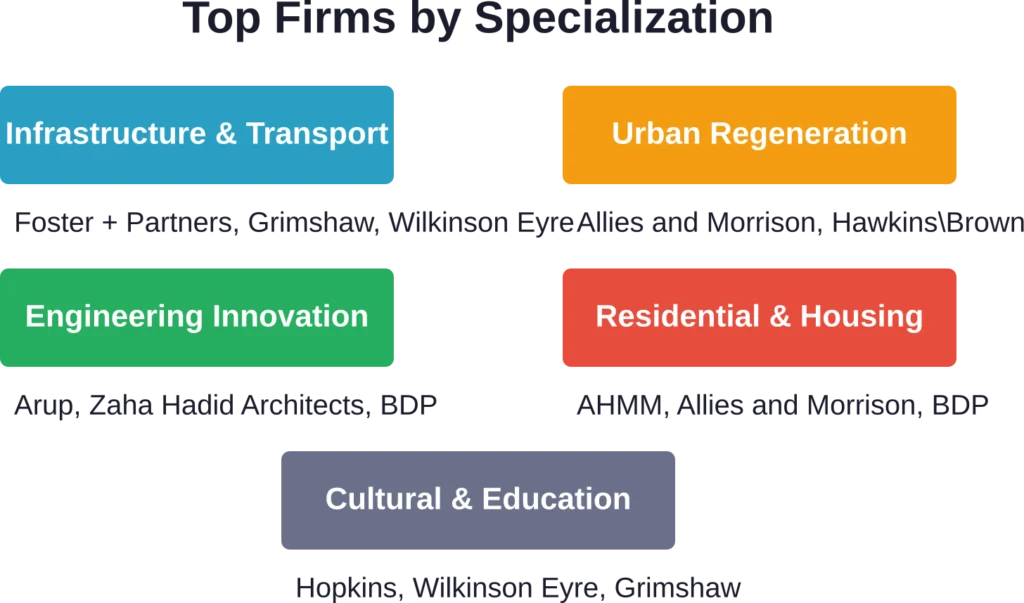
The practice excels at large-scale infrastructure and commercial projects. Their portfolio spans airports, civic buildings, office towers, and cultural institutions. The Apple Park headquarters in California and London’s Gherkin tower demonstrate their signature blend of engineering precision and elegant form.
Foster + Partners integrates advanced engineering from project inception. Their in-house specialists collaborate across disciplines—structural, environmental, lighting, and acoustics—ensuring technical solutions enhance rather than constrain design ambition.
Sustainability drives current work. The firm targets net-zero carbon across projects while exploring innovative materials and construction methods that reduce environmental impact without compromising performance.

3. Zaha Hadid Architects
Following founder Zaha Hadid’s passing in 2016, principal Patrik Schumacher continues evolving this iconic practice. The firm’s parametric design approach and fluid geometries remain instantly recognizable.
Complex structural engineering defines their work. Projects like the London Aquatics Centre and Guangzhou Opera House required sophisticated computational analysis and advanced fabrication techniques to realize their distinctive forms.
The practice operates at the intersection of architecture and engineering. Custom software tools generate forms optimized for structural performance while achieving visual drama. This computational approach has influenced broader architectural practice, particularly in educational and cultural buildings.
Current projects emphasize sustainability alongside formal innovation. The firm explores biomimetic design principles and adaptive building systems that respond dynamically to environmental conditions.

4. Arup
Arup occupies unique territory—an engineering consultancy that shapes architectural outcomes as significantly as design-led practices. Founded in 1946 by Ove Arup, the firm maintains its founding philosophy of “total design.”
Multidisciplinary integration defines the Arup approach. Teams combine structural, mechanical, electrical, and environmental engineers with planners, economists, and digital specialists. This breadth enables holistic solutions that address technical, economic, and social dimensions simultaneously.
Landmark projects demonstrate their engineering prowess. The Sydney Opera House, Pompidou Centre, and Beijing National Stadium showcase Arup’s ability to enable architectural vision through engineering innovation.
In 2026, Arup leads in digital transformation and sustainability consulting. Their carbon reduction strategies and smart building technologies help clients navigate increasingly stringent environmental regulations while future-proofing assets.

5. BDP (Building Design Partnership)
BDP operates as one of the UK’s largest independent interdisciplinary practices. With studios across Britain and Europe, they tackle diverse project types from masterplanning to interior design.
The integrated model sets BDP apart. Architects, engineers, urbanists, and environmental specialists work collaboratively from day one, avoiding the siloed approach common in traditional practice structures.
Education, healthcare, and workplace sectors form core expertise areas. Recent projects include university campuses, hospital expansions, and corporate headquarters that balance functional requirements with architectural quality.
Sustainability credentials run deep. BDP pioneered low-energy design in the UK and continues pushing boundaries in circular economy principles, regenerative design, and climate adaptation strategies relevant to Britain’s built environment challenges.

6. Grimshaw Architects
Founded by Nicholas Grimshaw in 1980, Grimshaw Architects specializes in technically complex projects where engineering and architecture merge seamlessly.
Transport infrastructure represents a signature strength. The firm designed Waterloo International Terminal, Southern Cross Station in Melbourne, and Fulton Center in New York—projects requiring sophisticated coordination of structural, operational, and experiential considerations.
Materials innovation distinguishes their approach. Grimshaw explores advanced fabrication techniques and novel material applications that enhance performance while reducing environmental footprint.
Biophilic design principles increasingly inform current work. Projects integrate natural systems and ecological thinking, creating buildings that connect occupants with nature while improving environmental outcomes.

7. Hopkins Architects
Michael and Patty Hopkins established their practice in 1976, building a reputation for elegant tectonics and refined detailing.
The practice balances innovation with contextual sensitivity. Projects respond thoughtfully to site, climate, and cultural context while incorporating advanced building systems and sustainable technologies.
Educational and cultural buildings showcase their expertise. The Evelina London Children’s Hospital and Westminster Abbey visitor facilities demonstrate Hopkins’ ability to create uplifting spaces that serve complex programmatic needs.
Craftsmanship matters here. The firm’s attention to material quality, joinery details, and construction precision produces buildings that age gracefully and perform reliably over decades.

8. Allies and Morrison
This London practice, established in 1984, focuses primarily on UK projects with particular strength in urban regeneration and heritage contexts.
Contextual design defines their philosophy. Rather than imposing signature styles, Allies and Morrison develop solutions specific to each site’s history, character, and community needs.
Mixed-use and residential projects form portfolio cornerstones. The practice excels at complex urban sites requiring careful integration of multiple functions, stakeholders, and regulatory frameworks.
Heritage sensitivity distinguishes their work. Projects like the BBC Television Centre redevelopment and King’s Cross regeneration demonstrate skillful blending of historic fabric with contemporary intervention.

9. Wilkinson Eyre
Founded in 1983 by Chris Wilkinson and Jim Eyre, this practice earned recognition for innovative structural solutions and sculptural forms.
Bridge design represents a specialty. The Gateshead Millennium Bridge—a tilting structure that rotates to allow ships passage—exemplifies their engineering creativity and architectural ambition.
Cultural and education projects feature prominently. The Cooled Conservatories at Gardens by the Bay in Singapore and various university buildings demonstrate versatility across scales and typologies.
Engineering expression shapes their aesthetic. Structure isn’t hidden but celebrated, with exposed frameworks and dynamic forms that communicate how buildings stand and function.
10. AHMM (Allford Hall Monaghan Morris)
AHMM operates at the practical end of British architecture—delivering high-quality buildings with efficiency and economy that don’t sacrifice design ambition.
Housing expertise runs deep. The practice has completed thousands of residential units across London and beyond, pioneering approaches to affordable housing that raise standards while controlling costs.
Innovation through typology characterizes their method. Rather than reinventing each project, AHMM refines building types through iterative improvement, extracting maximum value from standardization while maintaining architectural quality.
Community engagement informs processes. Projects emerge through dialogue with end users and stakeholders, ensuring buildings serve real needs rather than abstract design concepts.

11. Hawkins\Brown
This London-based practice, founded in 1988, balances commercial pragmatism with architectural invention.
Mixed-use urban projects dominate the portfolio. From Here East at Queen Elizabeth Olympic Park to The Forge in Southwark, Hawkins\Brown excels at complex urban sites requiring flexible, adaptable solutions.
Adaptive reuse represents growing expertise. The firm transforms existing structures into contemporary uses, demonstrating that sustainability often means retaining and upgrading rather than demolishing and rebuilding.
Social infrastructure projects showcase community focus. Recent education, healthcare, and cultural buildings demonstrate commitment to architecture’s civic role in supporting thriving communities.
Trends Shaping UK Architectural Engineering in 2026
Several forces reshape how architectural engineering firms operate and what clients demand.
Sustainability and Carbon Reduction
Environmental performance isn’t optional anymore. Firms face pressure to demonstrate measurable carbon reduction across embodied and operational dimensions.
Leading practices demonstrate commitment to embodied carbon reduction through material innovation and sustainable construction methods. Operational energy targets similarly tighten, with best-in-class buildings demonstrating consumption below 30 kWh/m2/yr through passive design strategies and on-site renewable generation.
Material selection drives much of this shift. Timber construction, low-carbon concrete alternatives, and circular economy approaches that prioritize reuse over new production gain traction across leading practices.
Digital Transformation and AI Integration
Technology continues transforming architectural practice. From computational design tools to AI-assisted documentation, firms invest heavily in digital capabilities.
Recent industry surveys show growing AI adoption among architectural practices for tasks ranging from code compliance checking to generative design optimization. These tools don’t replace architects—they augment capability, handling repetitive tasks and enabling teams to focus on higher-value design thinking.
Building Information Modeling (BIM) matured from novelty to standard. Leading firms now push beyond 3D coordination toward 4D scheduling, 5D cost management, and 6D facilities management integration that delivers value throughout building lifecycles.
Adaptive Reuse and Retrofit
Economic and environmental factors drive growing emphasis on existing building transformation rather than new construction.
Retrofitting existing structures can significantly reduce embodied carbon compared to demolition and rebuild. This reality pushes practices to develop expertise in structural assessment, building performance upgrade, and creative adaptation of heritage assets.
The approach requires different skills than ground-up design—surveying capabilities, structural evaluation, phased construction coordination, and regulatory navigation for buildings that predate current codes.
Health and Wellbeing Focus
Post-pandemic awareness of indoor environment quality persists. Clients increasingly prioritize air quality, daylight access, acoustic comfort, and biophilic design elements that support occupant health.
This trend extends beyond workplace to residential, education, and healthcare sectors. Practices that demonstrate measurable wellbeing outcomes through evidence-based design gain competitive advantage.
| Trend | Impact on Practice | Key Capabilities Required |
|---|---|---|
| Carbon Reduction | Embodied and operational carbon become core metrics | Life cycle assessment, material specification, energy modeling |
| Digital Transformation | AI and computational tools augment design processes | Parametric design, data analysis, BIM coordination |
| Adaptive Reuse | Retrofit projects increase relative to new build | Structural assessment, heritage knowledge, phasing expertise |
| Health & Wellbeing | Indoor environment quality drives design decisions | Evidence-based design, environmental monitoring, biophilic strategies |
How to Choose the Right Firm for Your Project
Selecting an architectural engineering company requires careful consideration of several factors.
Start with relevant experience. Review portfolios for projects similar in type, scale, and complexity to what you’re planning. A firm brilliant at bespoke houses might not suit a commercial office tower, and vice versa.
Check professional credentials. RIBA Chartered Practice status demonstrates commitment to quality management, professional development, and ethical standards. According to RIBA, Chartered Practices undergo regular assessment ensuring they maintain robust business systems and professional competence.
Assess team chemistry. Architecture involves intense collaboration over months or years. Meeting potential architects helps gauge communication styles, creative approaches, and whether personalities mesh with project stakeholders.
Understand project approach. Some firms offer full-service delivery from concept through construction; others focus on early design stages. Clarify scope, team structure, and how the practice manages design development and site oversight.
Request references. Speaking with past clients reveals how firms handle challenges, manage budgets and schedules, and perform after the honeymoon period of initial meetings.
Consider geographic proximity for smaller projects. While technology enables remote collaboration, local firms often bring valuable knowledge of planning authorities, contractor networks, and regional building traditions.
The Value of RIBA Membership and Accreditation
Professional accreditation matters more than many clients realize.
RIBA Chartered Practice status isn’t automatic. Practices must demonstrate robust quality systems, adequate insurance, continuing professional development for staff, and compliance with RIBA’s Code of Professional Conduct.
The designation provides client protection. Chartered Practices commit to transparent fee structures, clear contractual arrangements, and professional indemnity insurance that safeguards clients if things go wrong.
Members access extensive resources that improve practice quality. From business support helplines to technical guidance on environmental management and health and safety, RIBA provides frameworks that elevate professional standards across the membership.
For practices themselves, Chartered status enhances credibility. Many public sector clients and institutional developers prefer or require RIBA Chartered Practices, recognizing the quality assurance the designation represents.
Frequently Asked Questions
Architects focus primarily on design, spatial planning, and aesthetic considerations while ensuring buildings meet functional requirements. Architectural engineers specialize in technical building systems—structural, mechanical, electrical—integrating engineering solutions with architectural intent. Top firms employ both, creating multidisciplinary teams that address design and technical challenges simultaneously.
Fee structures vary widely. Many firms charge percentage-based fees (typically 8-15% of construction cost), others use fixed lump sums for defined scopes, and some bill hourly rates. RIBA provides fee guidance through resources like their Fee Calculator, helping practices create proposals aligned with project complexity and risk. Always request detailed fee breakdowns showing what services are included and what constitutes additional work.
UK law doesn’t require architects for most projects, but professional expertise dramatically improves planning success rates. Architects understand planning policy, local authority expectations, and how to present proposals persuasively. For complex sites, conservation areas, or listed buildings, professional representation becomes practically essential even when not legally required.
Timelines depend entirely on project complexity. A house extension might require 3-4 months design development plus 2-3 months planning approval. Large commercial projects can involve 12-18 months design work before construction begins. Early discussions with architects help establish realistic schedules based on specific project parameters and local authority processing times.
The RIBA Plan of Work provides a framework organizing design and construction into defined stages from initial concept through post-occupancy. The 2020 version includes stages 0-7, covering Strategic Definition, Preparation and Briefing, Concept Design, Spatial Coordination, Technical Design, Manufacturing and Construction, Handover, and In Use. This standardized structure helps clients and project teams maintain clear communication about project progress and deliverables.
Absolutely. Most leading firms possess in-house expertise or partnerships with specialists who guide projects through sustainability certification processes. BREEAM, LEED, Passivhaus, and similar frameworks require detailed documentation and performance verification that experienced practices integrate into design and delivery workflows. Discuss certification goals early—achieving high ratings requires strategic decisions from project inception.
Prepare site information (surveys, title deeds, photos), budget parameters, functional requirements, aesthetic preferences (images of buildings you admire), and timeline expectations. The more information provided, the more productively initial conversations can explore possibilities and identify potential challenges. Don’t worry about having all answers—good architects help clarify and refine briefs through collaborative dialogue.
Conclusion
The UK’s architectural engineering sector combines world-class design talent with sophisticated technical capability. From globally recognized names like Foster + Partners and Zaha Hadid Architects to specialist practices like Arup and AHMM, British firms continue shaping the built environment through innovation, sustainability leadership, and design excellence.
Choosing the right firm requires understanding project needs, evaluating relevant experience, and assessing professional credentials like RIBA Chartered Practice status. Whether tackling infrastructure, cultural landmarks, urban regeneration, or residential projects, the UK offers architectural expertise to match virtually any ambition.
As sustainability pressures intensify and digital tools transform practice, leading firms demonstrate that technical performance and design quality aren’t competing priorities—they’re complementary aspects of architecture done right.
Ready to start your project? Explore the RIBA’s Find an Architect service to connect with Chartered Practices suited to your specific needs, or reach out directly to firms whose portfolios align with your vision. Great architecture begins with finding the right partner.