

Quick Summary: While some individuals claim to remember being in the womb, scientific evidence shows that fetuses can form memory traces in utero—but these are not the same as conscious autobiographical memories. Research confirms that fetuses can learn and respond to familiar stimuli, but true recall of womb experiences is likely impossible due to infantile amnesia and the underdevelopment of brain structures necessary for explicit memory formation.
The idea of remembering life in the womb sounds impossible. Yet some people insist they have vivid memories from before birth—warm darkness, muffled sounds, even specific sensations. Actor Nicolas Cage famously claimed he remembers being in his mother’s womb and seeing faces. Rebecca Sharrock, who has highly superior autobiographical memory (HSAM), says she can recall being a newborn and even earlier experiences.
But does science support these claims? Can the human brain actually form and retain memories from the prenatal period?
The answer is more complex than a simple yes or no. Research shows that fetuses do form memory traces in utero, but the kind of memories we typically think of—conscious, retrievable autobiographical memories—are almost certainly impossible to retain from the womb.
What Science Says About Fetal Memory
Fetuses don’t just float passively in amniotic fluid. They’re actively learning about their environment.
According to research published in Brain Sciences, newborns show clear autonomic and neuronal responses to stimuli they were exposed to prenatally. In one study, fetuses were exposed to a maternal spoken nursery rhyme during pregnancy. When tested two and five weeks after birth, these infants showed recognition responses to the familiar rhyme—demonstrating that memory traces had formed in utero and persisted after birth.
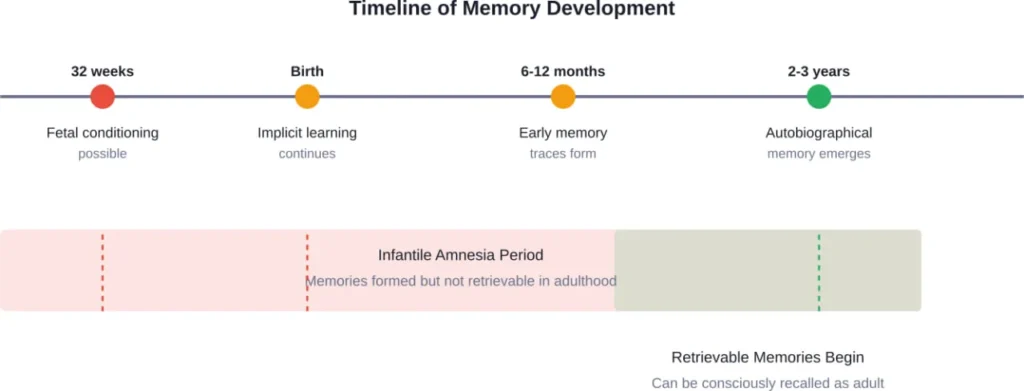
This isn’t just about hearing. Fetuses can be conditioned to respond to paired stimuli as early as 32 weeks of gestation. Research has demonstrated conditioning with vibration-sound pairings in fetuses. The fetus learns to anticipate the noise when the vibration occurs.
So fetuses can learn. They can form memories of a sort. But here’s the thing—these aren’t conscious, retrievable autobiographical memories.
The Difference Between Implicit and Explicit Memory
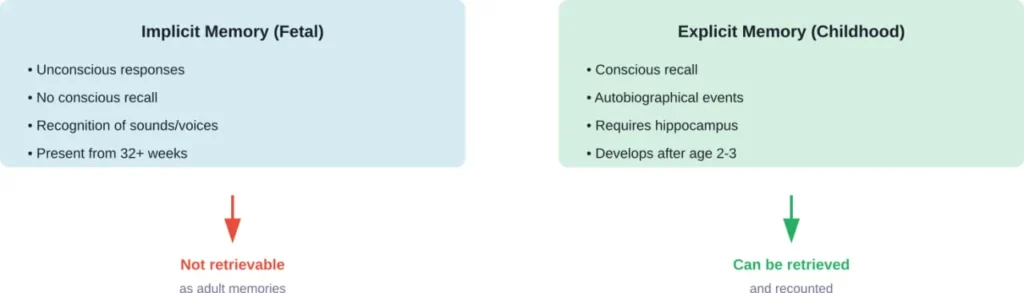
Memory isn’t one single system. Neuroscientists distinguish between implicit memory (unconscious, automatic responses) and explicit memory (conscious recall of facts and events).
Fetal memory falls squarely in the implicit category. When a newborn recognizes their mother’s voice or shows a preference for a lullaby heard in the womb, they’re demonstrating implicit memory—a learned response without conscious awareness or ability to recall the learning experience.
Explicit autobiographical memory—the kind where we can say “I remember when”—requires sophisticated brain structures, particularly the hippocampus. And that’s where the problem lies for prenatal memories.
Why We Can’t Remember Being Born
Most people can’t remember anything before age 2 or 3. This phenomenon is called infantile amnesia or childhood amnesia, and it’s universal across cultures.
Recent research from Yale provides new insights. While researchers long believed infants couldn’t encode specific memories because the hippocampus was still developing, new evidence suggests infants can encode memories—but the problem lies in retrieval.
Think about it this way: the filing system for memories is being built while memories are being filed. When the system changes dramatically during early development, those early files become inaccessible.
The hippocampus doesn’t reach maturity until well into childhood. During infancy and the fetal period, the neural architecture for laying down retrievable autobiographical memories simply doesn’t exist in its mature form.
Brain Development and Memory Formation
Research published by the National Institutes of Health shows that fetal brain development is extraordinarily sensitive to maternal influences—nutrition, stress, infection. These factors shape neural progenitor populations during embryogenesis and affect memory systems long-term.
Studies in mice exposed to low-protein diets during gestation showed that these animals displayed deficiencies in short-term memory in adulthood. The point? Fetal memory systems are forming, but they’re primitive and vulnerable.
Maternal choline intake during pregnancy, for instance, plays a crucial role in optimal brain development. Adequate choline supports the development of memory structures that will function later in life—but this doesn’t mean the fetus is forming retrievable memories during gestation.
When People Claim Womb Memories
Community discussions reveal that some people genuinely believe they remember being in the womb. These accounts typically describe darkness, warmth, muffled sounds, or floating sensations.
Rebecca Sharrock’s case is particularly interesting. With HSAM, she can remember virtually every day of her life in extraordinary detail. She claims to remember being a newborn and even earlier. But does her condition actually allow access to true prenatal memories, or is something else happening?
Here’s what’s more likely occurring:
- Constructed memories based on later knowledge about what the womb is like
- Dream content that feels like memory
- Confabulation—the brain filling gaps with plausible but false information
- Misattribution of early postnatal experiences to the prenatal period
One interesting theory from research on sudden infant death syndrome suggests that during REM sleep, newborns may dream about their fetal experience since that dominates their memory. But dreaming about the womb isn’t the same as consciously remembering it.
What Fetuses Actually Learn in the Womb
While conscious memory of the womb is implausible, fetuses are far from blank slates. They’re absorbing information constantly.
Newborns show clear preferences for their mother’s voice over other female voices. They recognize lullabies or stories read repeatedly during pregnancy. Some studies suggest they even recognize their mother’s native language patterns.
| Fetal Learning Ability | Earliest Demonstrated Age | Evidence Type |
|---|---|---|
| Sound discrimination | 25-27 weeks | Heartbeat changes to familiar vs. novel sounds |
| Classical conditioning | 32 weeks | Pairing vibration with loud noise |
| Voice recognition | Third trimester | Newborn preference for maternal voice |
| Language pattern recognition | Third trimester | Response to native language prosody |
These capabilities demonstrate that the fetal brain is active, responsive, and capable of forming associations. But again—these are implicit learning processes, not explicit memories that can later be recalled and described.
The Role of Maternal Nutrition in Fetal Memory
If we can’t remember the womb, does fetal memory even matter? Absolutely.
Research indicates that dietary choline during fetal development supports brain development and memory systems. Adequate maternal choline intake supports hippocampal development—the very structure needed for explicit memory later.
Similarly, prenatal folate levels influence brain and cognitive development in ways that persist into childhood. These nutrients don’t create retrievable fetal memories, but they build the foundation for the memory systems that will develop.
Research suggests prenatal hypoxia can affect brain development and cognitive functions. Maternal stress, infection, and malnutrition all leave marks on the developing memory systems.
So while the fetus won’t remember these experiences consciously, they profoundly shape how memory will function across the lifespan.
Small Children and Womb Memories
Some parents report that their toddlers spontaneously describe being in the womb or being born. These accounts are fascinating but require careful interpretation.
Young children between ages 2-5 are developing language and narrative abilities. They’re learning to construct stories about experiences. But they’re also highly suggestible and may incorporate things they’ve heard or been told into their own “memories.”
A child who says they remember being “in mommy’s tummy” might be:
- Repeating information told to them about pregnancy and birth
- Creating a narrative from photos or stories they’ve heard
- Misattributing feelings or dreams to actual memories
- Responding to subtle cues about what parents want to hear
This doesn’t mean parents are lying or that children are being deceptive. Memory is constructive, not reproductive—we build memories from fragments, expectations, and narratives, especially in early childhood.
Extraordinary Cases: HSAM and Other Conditions
Rebecca Sharrock’s highly superior autobiographical memory allows her to recall virtually every day since early infancy with remarkable precision. Rebecca Sharrock claims to have memories from very early infancy.—and claims even earlier memories.
But even HSAM has limits. The hippocampus and related structures still need to reach a minimum developmental threshold for explicit memory encoding. What Sharrock may be experiencing are the earliest possible explicit memories combined with implicit memories that feel like conscious recall.
HSAM is extraordinarily rare. For the vast majority of people, the earliest retrievable memories date to around age 2-4, with most clustering around age 3-4.
Could We Ever Prove Womb Memories?
Here’s the challenge: how would we verify a claimed womb memory?
The person claiming the memory can’t provide details that couldn’t be known from later learning. We can’t ask a fetus to press a button when they recognize something, then test them decades later.
Neuroimaging shows that newborns’ brains respond to familiar prenatal stimuli, proving memory traces exist. But proving that an adult’s conscious recollection genuinely dates to the prenatal period—rather than being a constructed memory—is essentially impossible with current methods.
The burden of proof is high, and the neurological evidence suggests it’s implausible.
Frequently Asked Questions
Fetuses form implicit memory traces in utero—they recognize familiar sounds, voices, and patterns after birth. However, these aren’t conscious, retrievable autobiographical memories. Newborns show learned responses to prenatal stimuli, but they don’t have conscious recall of the womb experience.
Infantile amnesia prevents conscious recall of experiences before age 2-3. The hippocampus and related brain structures necessary for forming retrievable autobiographical memories aren’t sufficiently developed during infancy and the prenatal period. While memories may form, they can’t be retrieved in the same way as later memories.
Research indicates most people’s earliest retrievable memories date to around age 2-4. Memories claimed before 18-24 months are extremely rare and difficult to verify as genuine autobiographical recall rather than constructed memories based on photos, stories, or later learning.
Yes, fetuses demonstrate memory capabilities from around 32 weeks of gestation. They can be conditioned to respond to paired stimuli and show recognition of familiar sounds and voices. This is implicit memory—unconscious learning and recognition—rather than explicit autobiographical memory that can be consciously recalled.
Not necessarily. They may genuinely believe their memories are real. However, these are more likely constructed memories, confabulations, or misattributed experiences rather than true prenatal recall. The brain is remarkably good at creating coherent narratives that feel like genuine memories, especially when incorporating knowledge learned later in life.
Absolutely. Maternal nutrition, stress, infection, and other prenatal factors profoundly influence brain development and long-term cognitive function. These effects persist throughout life even though the person has no conscious memory of the prenatal period. Fetal experiences shape neural architecture in lasting ways.
No verified scientific case exists of someone proving genuine conscious autobiographical memory from the prenatal period. While individuals like Rebecca Sharrock claim very early memories, distinguishing true prenatal recall from constructed memories or earliest postnatal experiences remains scientifically unverifiable with current methods.
What This Means for Expectant Parents
Even if conscious womb memories aren’t possible, prenatal experiences absolutely matter.
Talking to the developing baby, playing music, reading stories—these activities create familiar stimuli that the newborn will recognize. This recognition provides comfort and may support early bonding.
More importantly, maternal health during pregnancy shapes the developing brain in profound ways. Adequate nutrition, particularly choline and folate, supports optimal brain development. Managing stress, avoiding toxins, and maintaining good health create the best conditions for fetal neural development.
The fetus won’t remember these efforts consciously. But they’ll benefit from them for a lifetime.
The Bottom Line on Womb Memories
The romantic idea of remembering our time in the womb doesn’t align with neuroscience. The brain structures necessary for forming retrievable autobiographical memories simply aren’t developed enough during the prenatal period.
But that doesn’t diminish the importance of fetal experience. Fetuses are learning constantly. They’re forming associations, recognizing patterns, and building the neural foundations for all future memory and cognition.
When someone claims to remember the womb, they’re likely experiencing constructed memories that feel genuine—or describing the very earliest postnatal memories misattributed to the prenatal period. With rare conditions like HSAM, individuals may access memories from the boundary period around birth, but true prenatal recall remains scientifically implausible.
The wonder of fetal development doesn’t require conscious memory. The implicit learning happening in utero, the sensitivity to maternal voice and environmental sounds, the foundations being built for lifelong cognitive function—these are remarkable enough on their own.
Understanding the difference between implicit fetal memory and explicit autobiographical recall helps us appreciate both what’s scientifically supported and what remains in the realm of wishful thinking. The womb is a crucial learning environment, even if we’ll never consciously remember our time there.