
Quick Summary: The 22nd Amendment prohibits any person from being elected president more than twice, making it constitutionally impossible for Trump to run for a third term through normal means. While Trump has repeatedly hinted at seeking a third term and displayed ‘Trump 2028’ hats, legal experts note the Constitution is clear on this two-term limit, though some have speculated about theoretical loopholes that would face enormous legal and political hurdles.
President Donald Trump has made headlines throughout his second term by openly flirting with the idea of running for president again in 2028. He’s displayed red “Trump 2028” hats on his Oval Office desk and told reporters aboard Air Force One that he’d “love to do it.”
But here’s the thing: the U.S. Constitution explicitly prohibits it.
The question isn’t just theoretical anymore. Trump has shifted from calling a third term “probably not” possible to saying “maybe we do one more term,” according to USA Today reporting. So what’s actually possible under American law?
What the 22nd Amendment Actually Says
The constitutional barrier is crystal clear. According to Cornell Law School, the 22nd Amendment states: “No person shall be elected to the office of the President more than twice.”
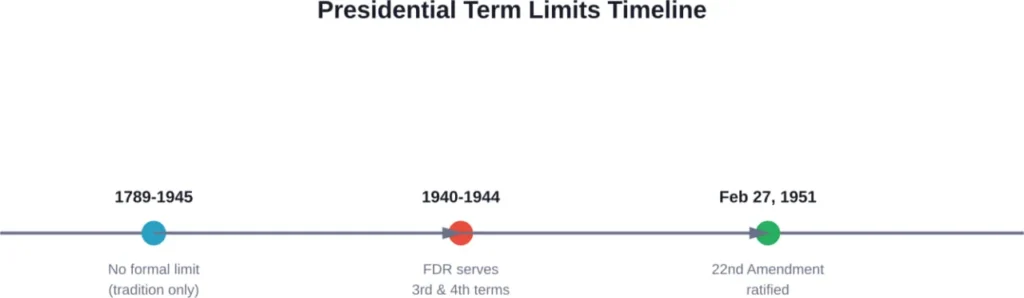
This amendment was ratified on February 27, 1951, specifically to prevent any future president from serving more than two terms. The historical context matters here.
Only one president in American history has served more than two terms: Franklin Delano Roosevelt, who won four consecutive elections between 1932 and 1944. According to Wayne State University research, Roosevelt’s unprecedented four terms prompted Congress to formalize what had been an unwritten tradition established by George Washington.
The amendment applies regardless of whether the terms are consecutive. Trump served as the 45th president from 2017 to 2021, then won election again in 2024 as the 47th president. His second term began in 2025. These two terms exhaust his constitutional allowance.
Trump’s Public Statements About a Third Term
Despite the constitutional barrier, Trump hasn’t exactly ruled out the idea. In fact, he’s done the opposite.
According to BBC reporting from October 2025, Trump told reporters he would “love to” run for president in 2028 but acknowledged he’s “not allowed to run.” Yet in the same breath, he suggested there might be “methods” to pursue a third term.
The president has displayed “Trump 2028” hats prominently in the White House, creating what Wikipedia describes as an ongoing “third term proposal” discussion. This visual messaging sends a clear signal to his supporters, even when his words are more equivocal.
But when pressed by reporters aboard Air Force One, Trump admitted the Constitution is “pretty clear” about the two-term limit. So which is it?
Theoretical Loopholes Legal Experts Have Identified
Here’s where things get interesting. While the 22nd Amendment seems straightforward, some legal experts have identified potential workarounds—though all face massive constitutional hurdles.
According to competitor reporting, there are four possible theoretical options Trump could attempt:
| Proposed Method | Legal Basis | Likelihood |
|---|---|---|
| Amend the Constitution | Repeal or modify 22nd Amendment | Extremely unlikely (requires 2/3 Congress + 3/4 states) |
| Vice President route | Run as VP, then president resigns | Trump has ruled this out publicly |
| Constitutional reinterpretation | Argue amendment only bars consecutive terms | No legal support for this reading |
| Non-consecutive term argument | Claim gap between terms creates loophole | Contradicts plain text of amendment |
The BBC reports that Trump explicitly rejected the vice president option, telling reporters he won’t attempt that particular workaround. That eliminates one frequently discussed scenario.
Why Constitutional Amendment Is Virtually Impossible
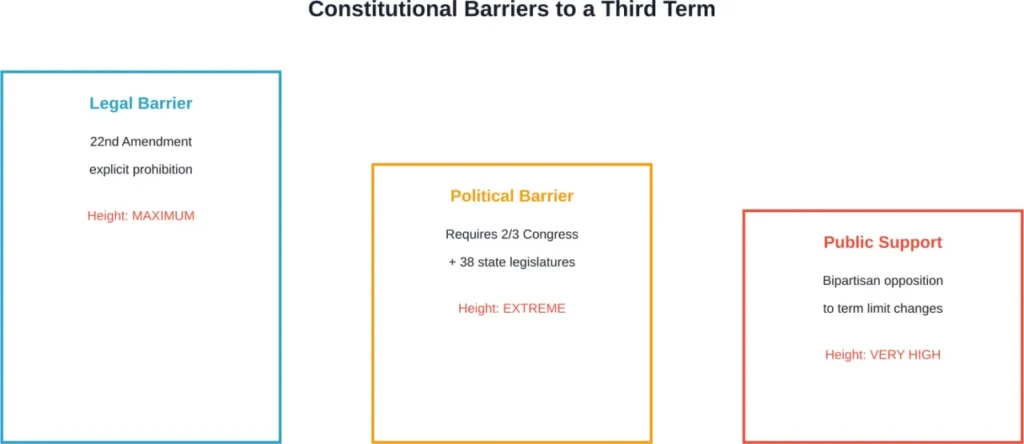
The most legitimate path to a third term would be repealing or modifying the 22nd Amendment. But this faces astronomical political barriers.
Constitutional amendments require approval from two-thirds of both houses of Congress, then ratification by three-fourths of state legislatures (38 out of 50 states). This is an extraordinarily high bar.
Real talk: even with strong Republican support, this would require unprecedented bipartisan cooperation and state-level backing. The political will simply doesn’t exist for such a fundamental change to presidential power, regardless of which party controls government.
What the Courts Would Likely Say
According to Brookings Institution analysis, courts have the final say on executive actions that push constitutional boundaries. Legal challenges to any third-term attempt would be swift and certain.
The 22nd Amendment’s language is unambiguous. Cornell Law School’s constitutional analysis emphasizes that it explicitly prohibits being “elected” to the office more than twice. There’s no wiggle room in that phrasing.
Any creative interpretation would face immediate legal challenges and would almost certainly be struck down by federal courts, likely reaching the Supreme Court within weeks.
Frequently Asked Questions
No. The 22nd Amendment prohibits anyone from being elected president more than twice. Trump has already been elected twice (2016 and 2024), which exhausts his constitutional limit regardless of whether the terms were consecutive.
Yes, but only one. Franklin Delano Roosevelt served four terms from 1933 until his death in 1945. His unprecedented tenure led directly to the ratification of the 22nd Amendment in 1951 to prevent future presidents from exceeding two terms.
While some supporters have floated this idea, Trump has publicly ruled it out. Additionally, constitutional scholars debate whether the 22nd Amendment would prohibit this workaround, as it might violate the spirit of the term limit provision.
Amending the Constitution requires two-thirds approval in both the House and Senate, followed by ratification from three-fourths of state legislatures (38 states). This extraordinarily high threshold has only been met 27 times in American history.
Trump’s statements appear to serve multiple purposes: energizing his base, dominating news cycles, and potentially testing public reaction. However, he has acknowledged to reporters that the Constitution is “pretty clear” about the two-term limit.
Extremely unlikely. The amendment’s language is clear and unambiguous: “No person shall be elected to the office of the President more than twice.” Courts generally cannot reinterpret plain constitutional text that has no ambiguity.
Trump has sent mixed signals, displaying “Trump 2028” hats and saying he’d “love to” run again, while also acknowledging he’s “not allowed.” He hasn’t formally announced a third-term campaign, and doing so would face immediate constitutional challenges.
The Bottom Line
The Constitution is unambiguous: Trump cannot be elected to a third presidential term. While he’s repeatedly floated the idea and tested the waters publicly, the 22nd Amendment creates an insurmountable legal barrier that has stood for over 75 years.
Any theoretical workarounds face massive constitutional, political, and legal obstacles. The courts would almost certainly block any attempt to circumvent term limits, and the political support for changing the Constitution simply doesn’t exist.
So when Trump displays those “Trump 2028” hats or tells reporters about potential “methods” for a third term, it’s more political theater than realistic possibility. The constitutional framework that has governed American democracy since 1951 remains firmly in place.