

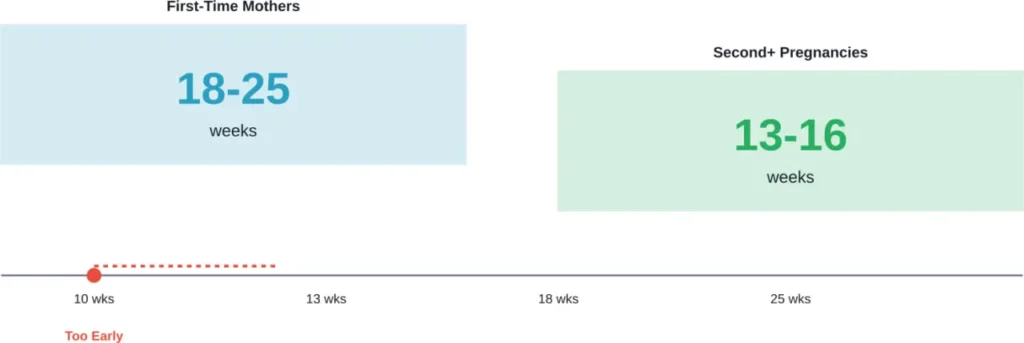
Quick Summary: At 10 weeks pregnant, it’s not possible to feel your baby move. While the fetus begins moving around 7-8 weeks, these movements are too small to detect. Most first-time mothers feel fetal movement (quickening) between 18-25 weeks, while second-time mothers may notice it as early as 13-16 weeks due to familiarity with the sensation.
That gurgling sensation in your belly at 10 weeks? The flutter you swear just happened? Unfortunately, it’s not your baby.
This disappoints many expectant mothers, especially second-time parents who remember those unmistakable kicks from previous pregnancies. But there’s solid science behind why feeling movement this early simply isn’t possible.
What’s Actually Happening at 10 Weeks
According to the American College of Obstetricians and Gynecologists (ACOG), week 10 marks an important developmental milestone. The embryonic stage has ended, and the fetal stage begins around week 8.
At this point, your baby measures roughly half an inch from crown to rump—about the size of a small bean. The brain and spine continue developing rapidly, and cardiac tissue that started forming weeks ago now beats in a recognizable rhythm.
Here’s the thing though—your baby is moving. Fetal movement actually begins around 7-8 weeks of pregnancy. The developing fetus makes small, jerky movements as the nervous system starts firing signals to developing muscles.
But you can’t feel any of it.
Why You Can’t Feel Movement at 10 Weeks
The movements happening at 10 weeks are microscopic. Your fetus weighs less than half an ounce and floats in amniotic fluid within a uterus that’s still tucked behind your pelvic bone.
Think about it this way: a goldfish swimming in a large aquarium barely creates ripples you can feel from the outside. Now imagine that goldfish is the size of a kidney bean. That’s the scale we’re talking about.
The uterine wall, abdominal muscles, fat tissue, and skin all create layers between you and those tiny movements. No matter how thin you are or how intensely you focus, the physics just don’t work at this stage.
Research published in medical literature confirms that maternal perception of fetal movement typically begins around 18-20 weeks gestation, with variability based on several factors.
When Will You Actually Feel Baby Move?
The first perception of fetal movement is called quickening. The timing varies significantly between individuals.
First-Time Mothers
If this is your first pregnancy, expect to feel movement between 18 and 25 weeks. Most first-time mothers report quickening around weeks 20-22.
The delay isn’t about the baby moving less. It’s about recognition. You’ve never felt this sensation before, so your brain needs the movements to be stronger and more obvious before you identify them as fetal activity rather than gas, digestion, or muscle twitches.
Experienced Mothers
Second, third, or fourth-time mothers often feel movement earlier—sometimes as early as 13 weeks, but more commonly around 16 weeks.
This happens for two reasons. First, you know exactly what you’re looking for. That subtle flutter isn’t confusing anymore. Second, abdominal muscles stretched during previous pregnancies may be slightly looser, allowing you to perceive gentler movements.
Online communities including Reddit frequently include discussions of mothers who report feeling movement at 10 weeks during subsequent pregnancies. While understandable, this perception doesn’t align with physiological reality. The sensation is almost certainly intestinal activity or abdominal muscle movement.
Other Factors That Affect Timing
Research on maternal perception of fetal movements shows several factors can delay when you feel that first kick:
- Body mass index: Higher BMI creates more tissue between the uterus and skin surface
- Placental position: An anterior placenta (attached to the front uterine wall) acts as a cushion that dampens movement
- Maternal age: Older mothers may experience slightly delayed perception
- Activity level: Busy mothers who are constantly moving may not notice subtle sensations
What Those First Movements Actually Feel Like
When quickening finally happens, it rarely feels like the strong kicks you’ll experience in the third trimester.
| Gestational Age | Common Descriptions | Frequency |
|---|---|---|
| 13-16 weeks | Light flutters, bubbles, butterfly wings, popcorn popping | Sporadic and easy to miss |
| 17-22 weeks | Gentle taps, fish swimming, rolling sensations | Still irregular but more noticeable |
| 23-28 weeks | Distinct kicks, jabs, rolls | Daily, becoming predictable |
| 29+ weeks | Strong kicks, stretches, hiccups, visible movement | Consistent daily patterns |
Many mothers describe early movements as feeling like gas bubbles that don’t quite behave like gas. Others compare it to muscle twitches or the sensation of a goldfish swimming in a bag.
The movements come and go. You might feel something unmistakable one day, then nothing for several days. This is completely normal in the second trimester.
Monitoring Fetal Movement Later in Pregnancy
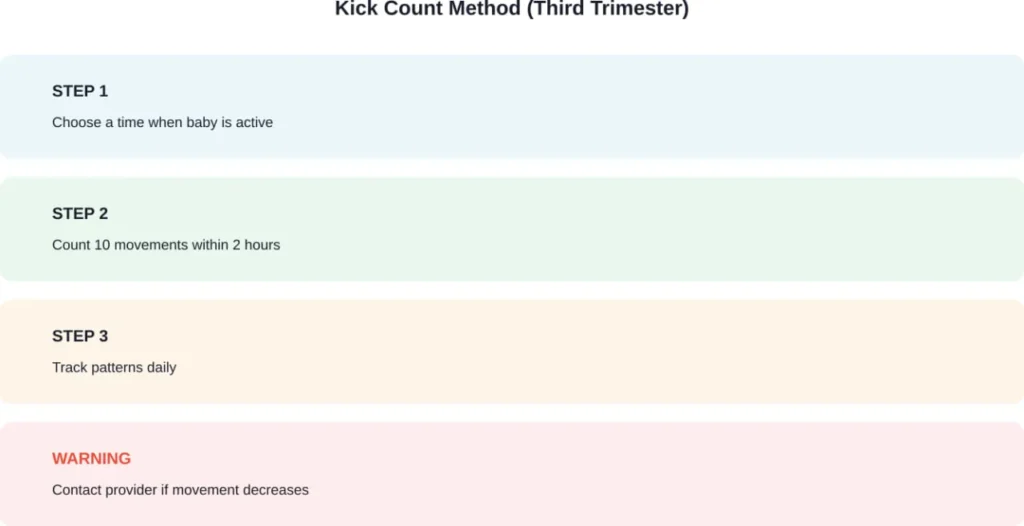
While feeling movement at 10 weeks isn’t possible, monitoring movement becomes crucial in the third trimester.
According to research published in the National Library of Medicine’s StatPearls database, fetal movement serves as an important clinical indicator of fetal viability and neurologic integrity. Healthcare professionals routinely advise patients to monitor fetal activity, either through general awareness or structured methods like kick counts.
A reduction or alteration in movement patterns can indicate fetal compromise and warrants immediate evaluation. Research indicates that changes in fetal movement patterns may be clinically significant, particularly in late pregnancy.
The non-stress test (NST) is a common clinical assessment that evaluates fetal heart rate patterns in relation to fetal movements. A reactive NST is characterized by the presence of at least 2 fetal heart rate (FHR) accelerations within 20 minutes, indicating proper oxygenation and autonomic function.
But all of this matters much later. At 10 weeks, there’s nothing to count or monitor from a movement perspective.
What You Should Focus On at 10 Weeks
Instead of waiting for impossible kicks, concentrate on things that actually matter at this stage.
According to the American College of Obstetricians and Gynecologists (ACOG), moderate exercise is safe and beneficial during pregnancy. The organization recommends 30 minutes of moderate exercise most days of the week, totaling 150 minutes weekly. Walking, swimming, and yoga are among the safest options.
Nutrition becomes increasingly important as the fetus develops rapidly. Morning sickness commonly occurs during early pregnancy, making it challenging to maintain a balanced diet. Small, frequent meals usually work better than three large ones.
Prenatal appointments typically occur monthly during early pregnancy. Your healthcare provider will monitor fetal development through ultrasound and Doppler monitoring—this provides objective confirmation of fetal development.
When to Contact Your Healthcare Provider
At 10 weeks, contact your provider if you experience:
- Severe abdominal pain or cramping
- Heavy bleeding or passing tissue
- Severe, persistent vomiting preventing hydration
- Fever or other signs of infection
- Painful urination or signs of infection
Don’t worry about not feeling movement. It’s not a warning sign at this stage—it’s simply too early.
Later in pregnancy, particularly after 28 weeks, a noticeable decrease in fetal movement requires immediate evaluation. Pregnant women observe complex patterns of movement, and qualitative changes may be clinically important. Maternal perception should take precedence over any numeric definition when something feels different.
The Reality Check
Look, pregnancy involves a lot of waiting. Waiting to feel sick. Waiting to feel better. Waiting to show. Waiting for test results. And yes, waiting to feel those first magical kicks.
At 10 weeks, you’re still firmly in the waiting phase for movement. The fetus is developing exactly as it should, moving around in ways that will eventually become obvious. But right now, those movements happen on a microscopic scale that no amount of focus or stillness will help you detect.
Second-time mothers who remember the sensation from previous pregnancies may feel especially frustrated. That muscle memory makes every abdominal sensation feel potentially significant. But the timeline doesn’t change based on experience—only the recognition of the sensation once it becomes physically possible to feel.
What you’re feeling at 10 weeks—whether it’s flutters, bubbles, or movement—is your digestive system doing its job. Gas moves through intestines. Muscles contract and release. Blood flows through vessels. All of these create sensations that can feel surprisingly similar to the fetal movement you’ll experience in about 8-15 weeks.
Frequently Asked Questions
No. While lower body mass index does allow earlier and clearer perception of fetal movement later in pregnancy, it doesn’t make 10-week movement detectable. The fetus is simply too small and the movements too weak, regardless of maternal body composition. Even extremely thin mothers typically don’t feel movement before 16 weeks at the earliest.
This usually reflects either misidentified gestational age or misattributed sensations. Mothers who felt movement at “10 weeks” may have actually been 14-16 weeks with dating confusion. More commonly, strong intestinal activity feels similar enough to fetal movement that the brain makes an incorrect association, especially when you’re hoping and watching for it.
Absolutely. Prenatal appointments include fetal heart rate monitoring via Doppler, typically starting around 10-12 weeks. Ultrasounds show fetal development and movement even when you can’t feel it. These objective measures provide far more reliable information about fetal wellbeing than maternal perception of movement at this early stage.
Kick counts become relevant in the third trimester, typically starting around 28 weeks. Before this point, movement patterns are too irregular to establish a meaningful baseline. Once you reach the third trimester, monitoring for 10 movements within a two-hour window provides useful information about fetal wellbeing.
Contact your healthcare provider. While the normal range extends to 25 weeks for first-time mothers, lack of perceived movement by this point warrants evaluation. An ultrasound can confirm fetal movement and check for factors like anterior placenta position that might explain why sensations aren’t getting through.
Yes. Fetal activity levels vary between individuals, just like activity levels vary between children and adults. Some fetuses are naturally more active, while others move less frequently. What matters isn’t matching a specific number but rather maintaining a consistent pattern once movement becomes regular in the third trimester.
Maternal stress and activity level can affect your awareness of subtle movements but don’t change when those movements become physically detectable. A busy, active mother might not notice the earliest flutters simply because she’s distracted. However, no amount of stress or activity prevents movement perception at 10 weeks because the movements aren’t strong enough to feel regardless of circumstances.
The Bottom Line
You cannot feel your baby move at 10 weeks pregnant. Not if you’re thin, not if this is your fifth pregnancy, not if you’re incredibly in tune with your body.
The fetus is moving—that’s true. Development is progressing beautifully. But those movements exist on a scale too small for maternal perception. You’ll need to wait another 6-15 weeks before quickening occurs and you feel that unmistakable sensation of life moving inside you.
When it happens, you’ll know. Until then, trust that your body is doing exactly what it should, even if you can’t feel the proof yet.
Think you might be feeling movement earlier than expected? Schedule a prenatal appointment to confirm your gestational age and check fetal development through ultrasound and Doppler monitoring.