
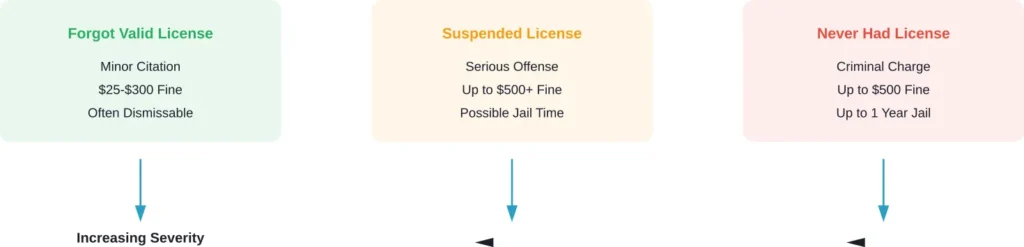
Quick Summary: Getting pulled over without your physical license can result in a citation, typically called a “correctable offense” or “fix-it ticket.” Penalties vary by state but generally range from $25-$300 in fines. If you can prove you had a valid license at the time of the stop by showing it to the court or police station within a specified timeframe, the ticket is often dismissed. This differs significantly from driving without ever having a valid license, which is a serious offense that can result in jail time.
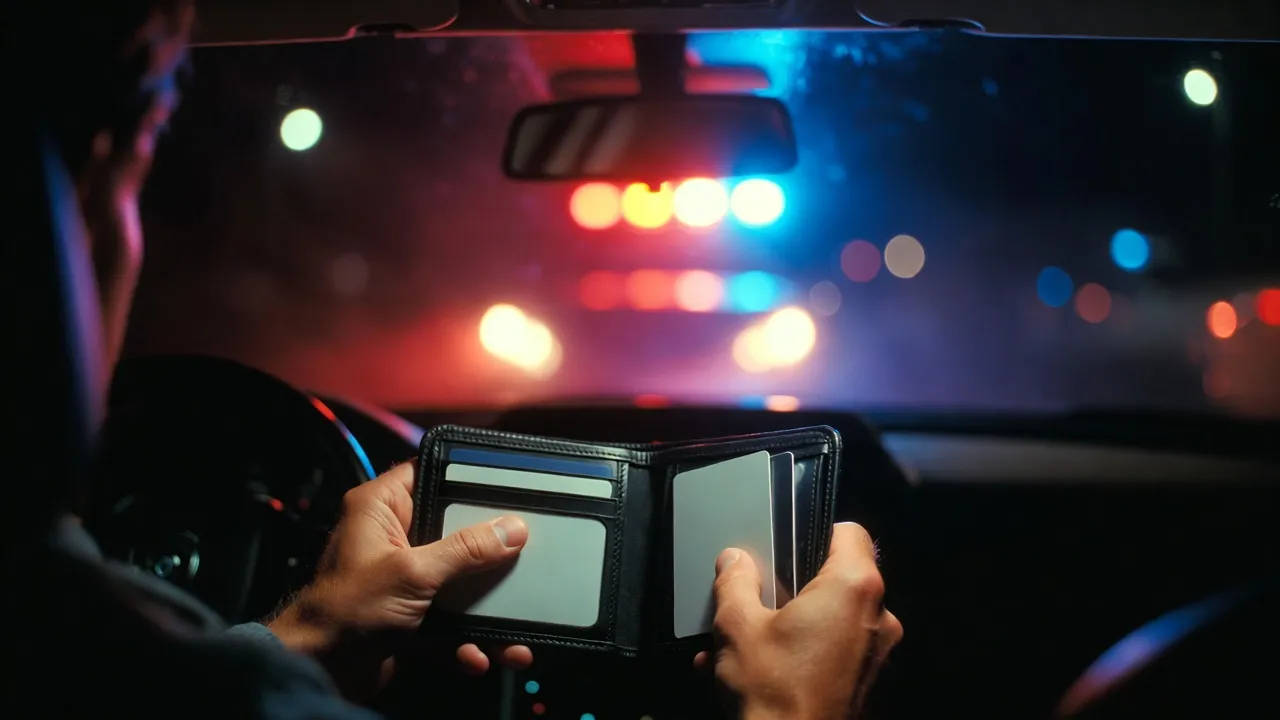
The moment those blue and red lights flash in the rearview mirror, most drivers instinctively reach for their wallet. But what happens when that wallet is sitting on the kitchen counter?
Carrying a valid driver’s license while operating a vehicle is a legal requirement in virtually every state. Yet countless drivers find themselves in situations where they’ve simply forgotten to grab their license before heading out. The consequences can range from a minor inconvenience to significant legal penalties, depending on the specific circumstances and state laws.
Understanding the difference between forgetting a valid license and actually driving without ever having one is critical. These are two entirely different scenarios with vastly different legal outcomes.
The Legal Requirement to Carry Your License
Every state mandates that drivers carry their physical license whenever operating a motor vehicle. This isn’t just a suggestion—it’s codified law designed to help law enforcement officers verify that the person behind the wheel is legally authorized to drive.
When an officer pulls someone over for any reason—speeding, broken taillight, routine traffic stop—one of the first requests is always “license and registration.” This allows the officer to confirm the driver’s identity, check for any outstanding warrants or violations, and verify driving privileges.
The requirement exists for several practical reasons. Officers need immediate confirmation that a driver has passed the necessary tests, isn’t currently suspended or revoked, and matches the person registered to the vehicle. Without physical proof, this verification process becomes complicated and time-consuming.
What Happens During the Traffic Stop
So the officer has asked for the license, and it’s not there. What happens next?
First, the officer will ask for other forms of identification. A passport, state ID, or even a work badge with photo can help establish identity. The officer will then run the information through their system to verify whether a valid license exists.
This verification process takes longer than a standard license check. The officer needs to manually enter information and wait for database responses. During this time, the driver remains pulled over, which can be particularly stressful.
Officer Discretion Matters
Here’s where things get interesting. Officers have considerable discretion in these situations.
Some officers, especially for drivers with clean records and valid licenses that simply weren’t physically present, may issue a warning. Others might write a citation that can be dismissed later. The officer’s decision often depends on the driver’s attitude, driving record, reason for the initial stop, and local department policies.
Community discussions reveal that cooperation and honesty matter significantly. Drivers who are polite, apologetic, and forthcoming about forgetting their license typically receive more lenient treatment than those who are combative or evasive.
The Citation: Correctable Offense vs. Serious Violation
If the officer issues a ticket for not having a physical license, it’s typically classified as a “correctable offense” or “fix-it ticket.” This designation is crucial.
According to available data, fines for this violation typically range from $25 to $300 depending on jurisdiction. Some states allow drivers to present their license at court or a local precinct soon after the stop, which can reduce or dismiss the penalty entirely.
The key factor is proving that a valid license existed at the time of the stop. This isn’t about getting a license after being pulled over—it’s about demonstrating that the license was valid but simply not physically present.
How to Get the Ticket Dismissed
Most jurisdictions allow drivers to clear these citations by following a simple process. Drivers typically need to appear at a courthouse or police station within a specified timeframe—usually 10 to 30 days—with their valid license.
The clerk or officer will verify that the license was valid at the time of the citation and mark the ticket as corrected. Some jurisdictions charge a small administrative fee, while others dismiss it entirely without additional costs beyond court processing fees.
This process acknowledges that the violation was purely procedural—failing to carry the license—rather than substantive—actually lacking legal authorization to drive.
Driving Without Ever Having a Valid License
Now this is where consequences escalate dramatically. Driving without ever obtaining a license, or driving with a suspended or revoked license, is a completely different situation.
Based on state penalty data, first-time offenses for driving without ever having obtained a license can be classified as misdemeanors. In Missouri, for example, this is typically a Class D misdemeanor resulting in fines up to $500 and potentially up to one year in jail.
Subsequent offenses elevate the charges and penalties significantly. These aren’t correctable offenses—they represent fundamental violations of traffic law that indicate the driver hasn’t passed required tests or has lost driving privileges due to previous violations.
Suspended vs. Revoked Licenses
There’s also an important distinction between suspended and revoked licenses. According to available state DMV sources, both represent the loss of driving privileges, but they differ in severity and restoration requirements.
A suspended license is temporary. Once the suspension period ends and any required fees are paid, driving privileges can be restored. Common reasons for suspension include failure to pay traffic fines, accumulating too many points, or failing to pay child support.
A revoked license is more serious. It means driving privileges have been terminated, and the individual must reapply for a new license, often retaking written and road tests. Revocations typically result from serious violations like DUI convictions or repeated traffic offenses.
Driving with a suspended or revoked license carries penalties that vary by state but are consistently more severe than simply forgetting a valid license. According to the Florida Department of Highway Safety and Motor Vehicles, these violations can result in extended suspension periods, substantial fines, and potential vehicle impoundment.
State-Specific Penalties and Variations
Penalties for not carrying a valid license vary considerably across states. While the general principle remains consistent—it’s illegal to drive without having a license physically present—the specific fines and procedures differ.
| Situation | Typical Fine Range | Additional Penalties | Dismissal Possible? |
|---|---|---|---|
| Forgot valid license | $25-$300 | Court costs, administrative fees | Yes, with proof |
| Expired license (recent) | $40-$300 | Must renew immediately | Sometimes |
| Never obtained license | $200-$500+ | Possible jail time (up to 1 year), points | No |
| Suspended license | $300-$1,000+ | Extended suspension, possible jail | No |
| Revoked license | $500-$5,000+ | Jail time, vehicle impoundment | No |
These ranges represent typical penalties compiled from various state DMV sources. Actual penalties depend on jurisdiction, prior driving record, and specific circumstances of the stop.
Some states have also begun accepting digital licenses through official DMV apps. However, acceptance isn’t universal, and not all officers are equipped or authorized to accept digital verification. Drivers should verify their state’s current policies before relying solely on digital licenses.
The Point System and Insurance Implications
Beyond immediate fines, license violations can affect driving records through point systems. The New York DMV, for instance, assigns points for various traffic violations as a way to identify high-risk drivers.
While simply forgetting to carry a valid license typically doesn’t add points to a driving record, more serious violations absolutely do. Driving with a suspended or revoked license can add significant points, leading to additional penalties including mandatory driver assessment fees.
According to state DMV point systems, accumulating points can result in license suspension. Civil penalties for various violations can be substantial. For example, NY DMV data shows a first violation of Zero Tolerance Law requires a $125 civil penalty plus a $100 suspension termination fee before privileges can be restored.
Insurance Rate Increases
Insurance companies monitor driving records closely. While a single correctable offense for forgetting a license likely won’t impact rates, more serious violations certainly will.
Driving without a valid license—meaning never having obtained one or driving while suspended—signals high-risk behavior to insurers. This can result in substantially increased premiums or policy cancellation.
Some insurers won’t cover drivers with recent convictions for driving without a valid license. This creates additional hardship, as most states require proof of insurance to register vehicles or reinstate suspended licenses.
What to Do If You’re Pulled Over Without Your License
Real talk: the best approach is honesty and cooperation. Officers can verify license status through their systems—lying or being evasive only makes the situation worse.

Here’s the practical breakdown. When the officer asks for a license, immediately acknowledge that it was forgotten at home. Offer alternative identification and provide accurate personal information so the officer can verify license status.
Be polite and apologetic. Officers deal with confrontational drivers constantly—being respectful and taking responsibility goes a long way. Explain where the license is (home, office, other vehicle) if asked.
If the officer issues a citation, ask about the process for showing proof later. Many officers will provide information about how to get the ticket dismissed or reduced by presenting the license at court or a police station.
After Receiving a Citation
Don’t ignore the ticket. Failing to respond to a citation can result in additional penalties, license suspension, or even a warrant for arrest in some jurisdictions.
Check the citation for instructions on how to resolve it. Most will indicate a courthouse address and deadline for either paying the fine or appearing to show proof of a valid license.
Gather necessary documentation—the physical license, proof of insurance, vehicle registration—and go to the designated location before the deadline. Many courthouses have specific windows or hours for handling correctable offenses.
Accidents and Claims Without a License
What happens if someone gets into an accident without having their license physically present? The situation gets more complicated.
From an insurance perspective, coverage typically depends on whether the driver had a valid license, not whether it was physically present. Most policies cover licensed drivers who simply forgot their physical license.
However, insurance companies will verify license status after an accident. If the investigation reveals the license was actually suspended, revoked, or never existed, the claim may be denied and the policy potentially cancelled.
For personal injury claims, driving without a valid license can significantly impact the case. While it doesn’t automatically negate a claim, it can be used to argue comparative negligence or to question the driver’s credibility.
Insurance Coverage Complications
Many insurance policies contain exclusions for drivers without valid licenses. This means if someone is driving with a suspended or revoked license and causes an accident, their insurance may refuse to cover damages.
This leaves the driver personally liable for all damages—medical bills, property damage, lost wages, and other costs. These can easily reach tens or hundreds of thousands of dollars for serious accidents.
Even passengers in vehicles driven by unlicensed drivers can face complications when seeking compensation. Insurance companies often scrutinize whether passengers knew or should have known the driver lacked a valid license.
New Residents and License Transfer Requirements
People moving to new states face specific requirements for transferring licenses. Most states require new residents to obtain a local license within 30 to 90 days of establishing residency.
During this transition period, drivers can typically use their out-of-state license. However, once the deadline passes, that out-of-state license is no longer valid for driving in the new state.
Getting pulled over after this grace period with only an out-of-state license can result in citations for driving without a valid license. The “I just moved here” excuse only works within the legally specified timeframe.
Some states have reciprocity agreements that streamline the transfer process. Others require new written tests, vision tests, or even road tests depending on the driver’s age and where they’re transferring from.
Digital Licenses and Modern Verification
Several states have begun implementing digital driver’s licenses accessible through official DMV mobile apps. These digital versions carry the same legal weight as physical licenses—when accepted.
The catch? Not all states recognize digital licenses yet, and even in states that do, not all law enforcement agencies have updated their procedures and technology to accept them.
Drivers using digital licenses should verify that their state legally recognizes them and that they’re acceptable during traffic stops. Having both the digital and physical license available provides the safest approach during this transition period.
For interstate travel, physical licenses remain the safer choice. A digital license issued by one state may not be recognized by law enforcement in another state, even if both states have digital license programs.
Frequently Asked Questions
This depends on the officer’s decision and state law. Some officers may allow drivers to continue after verification, especially if someone can bring the license to the traffic stop location. Others may prohibit further driving until the license is retrieved or require the vehicle to be towed. If the officer issues a citation but allows driving, the driver can typically continue operating the vehicle.
Typically no. Simply forgetting to carry a valid license is usually a non-moving violation that doesn’t add points to a driving record. However, laws vary by state. More serious violations like driving with a suspended or revoked license do add points and can lead to license suspension.
Timeframes vary by jurisdiction but typically range from 10 to 30 days. The citation should specify the deadline and location where proof must be presented. Missing this deadline can result in the full fine being imposed or additional penalties being added. Some courts allow extensions if requested before the original deadline.
Generally no. A photo of a license stored on a phone isn’t legally sufficient in most states. Officers need to verify the authenticity of the license, which requires either the physical card or, in states that allow it, an official digital license accessed through the state DMV’s authorized app. Regular photos can be easily altered or outdated.
An expired license is legally considered invalid, which is more serious than simply forgetting a valid license. However, recent expirations—especially within a few weeks or months—are often treated more leniently than long-expired licenses. Penalties typically involve fines of $40-$300, and drivers are usually required to renew immediately. The ticket may be reduced if renewal is completed quickly.
No. Police need reasonable suspicion or probable cause to initiate a traffic stop. They cannot randomly pull drivers over solely to check for licenses. However, according to the Supreme Court decision in Kansas v. Glover, officers can pull over a vehicle if the registered owner has a suspended license and the officer reasonably suspects that owner is driving, even without directly observing the driver’s identity first.
If the license was valid but simply not physically present, insurance typically covers accidents normally. However, if the license was actually suspended, revoked, or never existed, most insurance policies will deny claims. Insurance companies verify license status after accidents regardless of what was physically present at the scene.
Conclusion: Prevention Is the Best Policy
The simplest solution to all of these complications is developing a habit of always carrying a valid driver’s license. Keep it in a consistent location—wallet, purse, or dedicated compartment in the vehicle.
But mistakes happen. When they do, the consequences for simply forgetting a valid license are relatively minor compared to more serious violations. Honesty, cooperation, and prompt follow-through on any citations typically result in minimal penalties.
The real penalties—substantial fines, jail time, insurance complications, and extended suspensions—are reserved for those who drive without ever obtaining a license or who drive while suspended or revoked. These violations represent serious breaches of traffic law that create genuine safety risks.
Understanding these distinctions helps drivers navigate these situations appropriately. A forgotten license is an inconvenience and potentially a small fine. Driving without valid authorization is a crime with lasting consequences.
If facing any license-related violation, consulting with a traffic attorney can help minimize penalties and protect driving privileges. Many violations that seem straightforward have nuances that experienced attorneys can leverage to achieve better outcomes.
Keep that license handy. And if the unthinkable happens and it’s forgotten, stay calm, be honest, and follow through on resolving the citation promptly.