
Quick Summary: When struck by lightning, the human body experiences an extremely high-voltage electrical current (around 30 million volts) that can cause immediate cardiac arrest, neurological damage, burns, and multi-organ injuries. According to the CDC, approximately 10% of lightning strike victims die, while nearly 90% survive with varying degrees of injury. Immediate CPR and emergency medical treatment significantly improve survival outcomes.
Lightning strikes the ground about 40 million times each year in the United States alone. The odds of being struck in any given year are less than one in a million, according to CDC data from 2024. But when it does happen, the consequences are severe and often life-changing.
From 2006 through 2021, lightning caused an average of 28 deaths per year in the United States. That’s down from the 82 annual deaths recorded between 1980 and 1995. Better awareness and improved emergency response have made a difference.
But here’s the thing—understanding what actually happens during a lightning strike can help save lives.
The Immediate Physical Impact
Lightning carries an electrical current with approximately 30 million volts. Unlike standard alternating current (AC) or direct current (DC), lightning delivers this massive energy in an extremely short duration—typically just a fraction of a second.
When lightning strikes a person, the electrical energy doesn’t behave like it does when someone gets electrocuted by household current. The duration is so brief that deep tissue burns are often less severe than expected.
However, the instantaneous power surge creates multiple pathways through the body. The current can travel across the skin surface (called flashover), through the cardiovascular system, the nervous system, and along moisture pathways like sweat.
How Lightning Strikes Occur
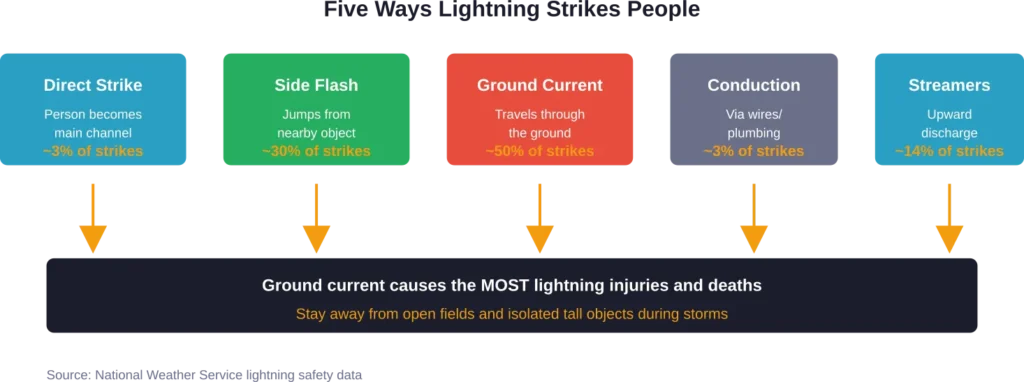
According to the National Weather Service, lightning can strike people in five distinct ways:
- Direct strike—the person becomes part of the main lightning discharge channel
- Side flash—lightning jumps from a nearby object (like a tree) to a person
- Ground current—lightning strikes the ground and travels through it to the victim
- Conduction—lightning travels through metal wires or plumbing
- Streamers—upward discharge from the person toward the downward lightning bolt
Ground current causes the most lightning deaths and injuries, particularly when multiple people are standing near each other.
What Happens to the Body During a Strike
The human body responds to lightning in several catastrophic ways simultaneously. Medical research published by the NIH describes lightning injuries as fundamentally different from standard electrical injuries.
Cardiac Effects
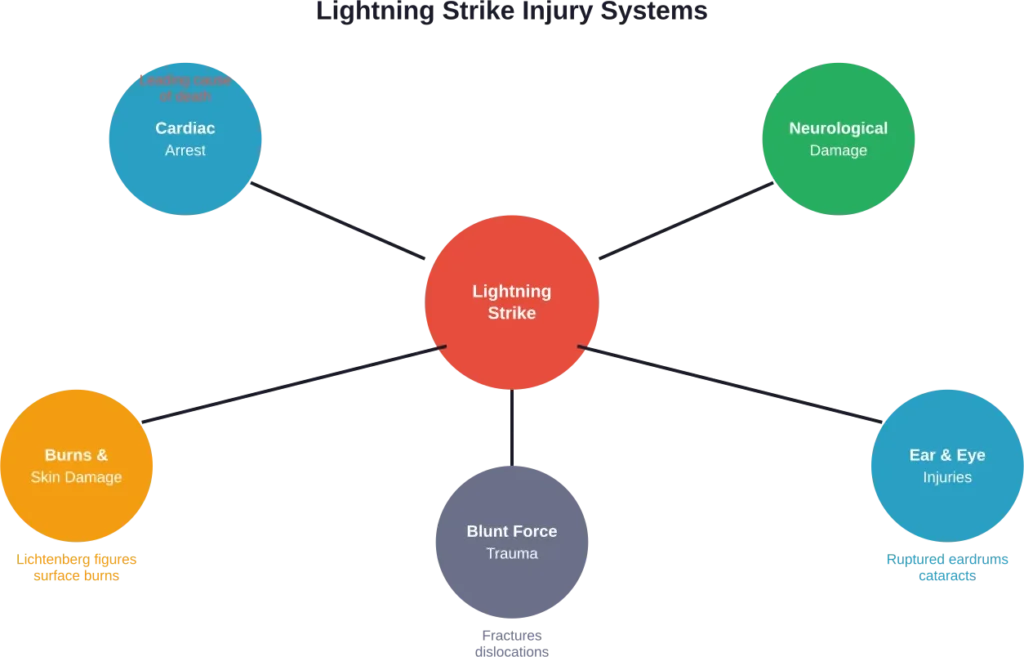
Cardiac arrest is the leading cause of death from lightning strikes. The electrical current disrupts the heart’s normal rhythm, causing it to stop beating effectively. Unlike a heart attack, where blood vessels are blocked, lightning-induced cardiac arrest is purely electrical.
Victims who survive the initial strike may experience irregular heartbeats (arrhythmias) for hours or days afterward. Some develop myocardial damage similar to what occurs during a heart attack.
Neurological Damage
The nervous system is particularly vulnerable because it operates on electrical signals. Lightning can cause immediate unconsciousness, seizures, and confusion. Some victims experience keraunoparalysis—a temporary paralysis with mottled blue skin that typically resolves within a few hours, according to medical literature.
Long-term neurological effects are common among survivors. These include memory problems, difficulty concentrating, personality changes, chronic pain, and sleep disturbances. Research from Swiss trauma centers found that neurological complications can persist for years.
Burns and External Injuries
Despite the extreme voltage, deep tissue burns are often less severe than expected. The brief duration means the current typically travels across the skin surface rather than through deep tissue.
However, victims commonly develop characteristic Lichtenberg figures—fernlike patterns on the skin caused by ruptured capillaries. These usually fade within days. Superficial and deep burns occur at entry and exit points or where the current concentrated.
Clothing and metal objects can ignite or become superheated, causing secondary thermal burns. Jewelry often leaves burn marks where it contacted skin.
Ear and Eye Damage
The explosive force of lightning can rupture eardrums. The thunder created by the strike—occurring at point-blank range—causes immediate acoustic trauma. Many survivors experience permanent hearing loss or chronic tinnitus.
Eye injuries include cataracts (which may develop months later), retinal damage, and corneal lesions. The UV radiation from the lightning flash can cause photokeratitis, similar to snow blindness.
Blunt Trauma
Lightning causes violent muscle contractions that can throw victims several feet. This results in fractures, dislocations, and head trauma. The pressure wave from the strike can also cause internal injuries.
Survival Statistics and Outcomes
Here’s some encouraging news—the survival rate for lightning strikes is approximately 90%, according to CDC data published in 2024. That means about 10% of people struck by lightning die, typically from immediate cardiac or respiratory arrest.
From 2006 through 2021, there were 444 lightning strike deaths in the United States. Of the 1318 persons who died between 1980-1995, 1125 (85%) were male. From the 1980-1995 period, males accounted for 85% of lightning fatalities, and people aged 15-44 represented 68% of deaths.
The dramatic improvement in survival rates over the past decades reflects better public awareness, faster emergency response, and improved medical treatment. In the 1980-1995 period, an average of 82 people died annually from lightning.
Factors Affecting Survival
Immediate CPR makes the difference between life and death. Unlike most cardiac arrest situations where CPR success rates are low, lightning victims respond remarkably well to resuscitation. Their hearts are essentially healthy organs that experienced an electrical disruption.
The type of strike matters. Direct strikes are typically more severe than ground current injuries. Side flash injuries vary depending on how much current traveled through the victim’s body.
Time to medical care is critical. Lightning victims need rapid assessment for cardiac, neurological, and traumatic injuries. Even those who seem stable initially can deteriorate as secondary effects develop.
Long-Term Effects for Survivors
Surviving a lightning strike doesn’t mean returning to normal life immediately. Many survivors face chronic health problems that last months or years.
Neurological issues are the most common long-term complications. Survivors report persistent headaches, difficulty with memory and concentration, personality changes, irritability, and depression. These cognitive effects can impact work performance and relationships.
Chronic pain syndromes develop in many survivors. Pain may be neuropathic (nerve-related) or musculoskeletal from the traumatic injuries sustained during the strike.
Sleep disturbances, fatigue, and temperature regulation problems plague some survivors. The autonomic nervous system—which controls automatic body functions—can be damaged by the electrical current.
Sensory problems including vision changes, hearing loss, and altered sense of touch or taste may persist indefinitely.
Immediate First Aid Response
If someone is struck by lightning, immediate action saves lives. Here’s what to do:
First, it’s safe to touch a lightning strike victim. They don’t carry an electrical charge. This is a dangerous myth that prevents people from providing life-saving care.
Call 911 immediately. Even if the victim appears conscious and alert, they need emergency medical evaluation.
Check for breathing and pulse. If absent, begin CPR immediately. Lightning victims have high CPR success rates because their hearts are structurally normal.
Move the victim to safety only if they’re in immediate danger from ongoing lightning activity. Otherwise, keep them still to avoid worsening potential spinal injuries.
Treat visible burns with cool water and cover with clean, dry dressings. Don’t apply ice directly to burns.
Monitor for shock. Keep the victim warm and lying down with legs elevated slightly if there’s no suspected spinal injury.
Prevention: Reducing Lightning Risk
The best treatment for lightning injuries is prevention. According to OSHA and National Weather Service guidelines, follow these safety rules:
When thunder roars, go indoors. If you can hear thunder, lightning is close enough to strike you. Don’t wait for rain or for the storm to be directly overhead.
Seek substantial shelter—enclosed buildings with electrical wiring and plumbing, or hard-topped metal vehicles with windows closed. Small structures like sheds, picnic shelters, and tents provide no protection.
Avoid elevated areas and open fields. Lightning typically strikes the tallest object in an area. Stay off ridges, hilltops, and open fields.
Stay away from isolated tall objects including single trees, flagpoles, and light posts. Don’t shelter under trees during storms.
Get off and away from bodies of water. Lightning can travel through water and wet ground for considerable distances.
Wait 30 minutes after the last thunder before resuming outdoor activities. Many lightning deaths occur as storms move away because people return outside too soon.
Indoor safety matters too. During thunderstorms, avoid plumbing fixtures, corded phones, and contact with electrical appliances. Lightning can travel through building wiring and plumbing.
| Risk Level | Activities/Locations | Recommended Action |
|---|---|---|
| Extreme Risk | Open fields, golf courses, beaches, boats, swimming | Evacuate immediately to substantial shelter |
| High Risk | Near tall isolated objects, under trees, on ridges | Move to lower ground and seek enclosed shelter |
| Moderate Risk | Small shelters, tents, convertible vehicles | Relocate to hard-topped vehicle or building |
| Safe | Inside enclosed buildings, hard-topped vehicles | Stay inside until 30 minutes after last thunder |
FAQs About Lightning Strikes
Yes, approximately 90% of lightning strike victims survive, according to CDC data. Survival depends on factors like the type of strike, immediate CPR if needed, and rapid access to emergency medical care. Most deaths occur from immediate cardiac arrest.
The odds of being struck by lightning in a given year are less than one in a million. However, certain activities and locations increase risk significantly, particularly outdoor recreation during thunderstorms and occupations requiring outdoor work.
Many survivors report feeling an intense blow or explosion, followed by immediate muscle contractions and loss of consciousness. Some describe a tingling sensation before the strike. Others remember nothing about the event itself due to the neurological disruption.
Recovery time varies dramatically. Some victims recover within weeks, while others experience permanent disabilities. Neurological symptoms like memory problems and chronic pain can persist for years. Physical injuries typically heal within months, but cognitive effects may be lifelong.
Lightning rarely comes through closed windows. However, it can strike near windows and send dangerous electrical currents through nearby metal frames or shatter glass with the pressure wave. Stay away from windows during thunderstorms as a precaution.
The extremely brief duration of lightning current flow means it often travels across the skin surface (flashover) rather than through vital organs. When combined with immediate CPR and emergency care, this gives victims a fighting chance despite the massive voltage involved.
Keraunoparalysis is a temporary paralysis with cold, mottled, blue skin that occurs in some lightning strike victims. It typically affects the lower extremities and resolves within a few hours. The condition results from vascular spasm caused by the electrical current.
Conclusion: Respect Lightning’s Power
Lightning strikes deliver approximately 30 million volts to the human body in a fraction of a second. This causes cardiac arrest, neurological damage, burns, and multi-system trauma. While 90% of victims survive, many face long-term health consequences including cognitive impairment and chronic pain.
The key to survival is prevention through proper lightning safety practices. When thunder roars, go indoors to substantial shelter. Wait 30 minutes after the last thunder before returning outside. If someone is struck, immediate CPR can save their life—victims respond remarkably well to resuscitation.
Understanding what happens during a lightning strike empowers individuals to take appropriate precautions and provide effective emergency care when needed. With about 40 million lightning strikes hitting the ground annually in the United States, awareness and preparation aren’t optional—they’re essential for staying safe during thunderstorms.