

Quick Summary: Getting caught driving after a seizure can result in serious legal consequences including license suspension, criminal charges ranging from misdemeanors to felonies, substantial fines, and potential jail time. The severity depends on state laws, whether you disclosed your condition to the DMV, and if an accident occurred. Most states require seizure-free periods ranging from 3-12 months before driving privileges can be restored.
Driving after experiencing a seizure isn’t just dangerous—it’s illegal in every U.S. state. The consequences extend far beyond public safety concerns and enter the realm of serious legal penalties that can impact your life for years.
But here’s the thing: the specific penalties vary dramatically depending on where you live, how your seizure disorder was documented, and whether you were forthcoming with medical authorities. Some states treat it as a traffic violation. Others? They’ll charge you criminally.
Understanding what happens when you’re caught driving after a seizure requires navigating a complex web of state laws, medical reporting requirements, and legal precedents that differ significantly across jurisdictions.
Understanding the Legal Framework for Seizure-Related Driving Restrictions
Every state in the U.S. has laws restricting driving privileges for individuals who experience seizures, but the enforcement mechanisms and penalties differ substantially.
According to medical research published by the National Institutes of Health, driving restrictions for people with seizure disorders are intended to ensure public safety, but these restrictions can also significantly harm the welfare of affected individuals given how essential driving is in most parts of the country.
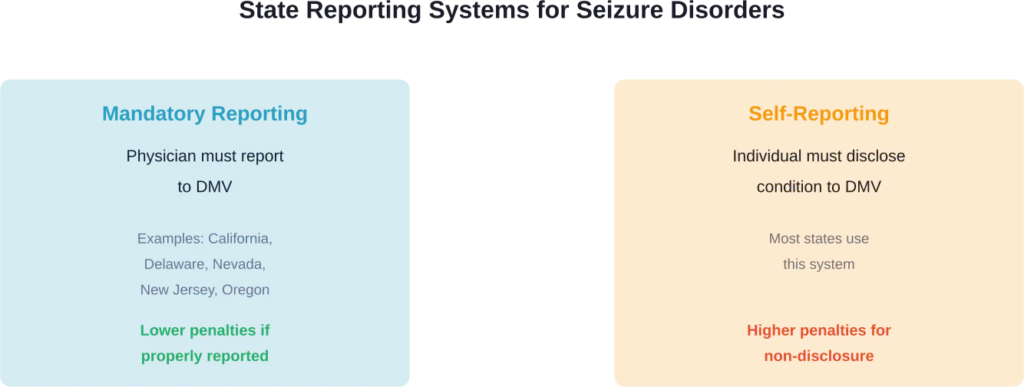
State laws generally fall into two categories: mandatory physician reporting states and self-reporting states. In mandatory reporting jurisdictions, physicians must notify the Department of Motor Vehicles when a patient experiences seizures. In self-reporting states, the burden falls on the individual to disclose their condition.
Physician Reporting vs. Self-Reporting States
The reporting mechanism in your state determines how authorities discover you’ve been driving after a seizure. In states like California, physicians have legal obligations to report certain medical conditions that may affect driving ability. The California DMV explicitly monitors drivers with lapses of consciousness, including seizures.
In self-reporting states, you’re expected to voluntarily inform the DMV about seizure activity. Failure to do so—and subsequently getting caught driving—typically results in more severe penalties than in mandatory reporting states.
This distinction matters significantly when determining criminal liability and the severity of charges you might face.
Immediate Consequences: License Suspension and Revocation
The first and most common consequence of getting caught driving after a seizure is immediate license suspension. This happens swiftly, often within days of authorities learning about the violation.
Louisiana law, for example, authorizes the Department of Motor Vehicles to suspend licenses for 12 months upon receiving evidence of certain convictions or medical conditions. Similar provisions exist in virtually every state, though the suspension duration varies.
Standard Seizure-Free Period Requirements
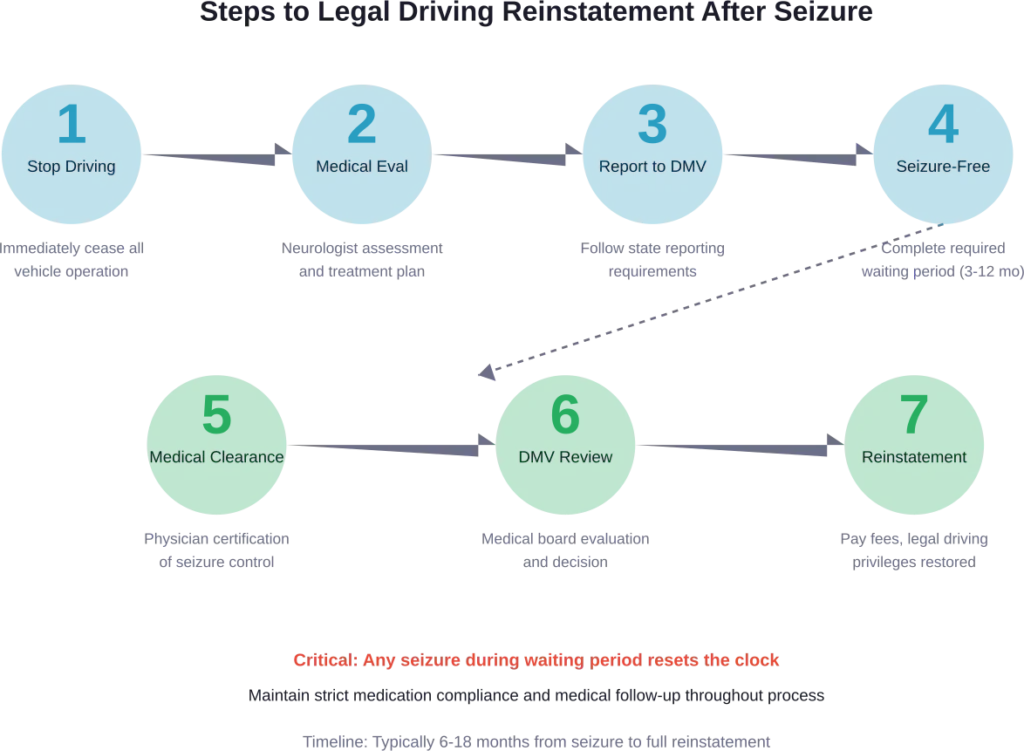
Most states require a seizure-free period before driving privileges can be restored. According to medical research, a common standard referenced is a 3-month seizure-free interval, though many states extend this to 6 or 12 months.
The Georgia Department of Driver Services, like many state agencies, maintains specific protocols for drivers with epilepsy and updates driving records when violations occur. Courts report convictions to the DMV, which then applies penalties including suspensions.
| Seizure-Free Period | Common in States | Typical Conditions |
|---|---|---|
| 3 months | Less common, more lenient states | Well-controlled epilepsy, consistent medication compliance |
| 6 months | Most common standard | Standard requirement for most seizure types |
| 12 months | Stricter states, commercial drivers | Multiple seizures, structural brain disease, noncompliance |
Factors That Extend Suspension Periods
Medical research identifies several unfavorable modifiers that can lengthen the required seizure-free interval beyond the standard 3-month baseline. These include:
- Noncompliance with medication or medical visits
- Lack of credibility in reporting seizure activity
- Recent history of active alcohol or drug abuse
- Structural brain disease
- Uncorrectable brain functional or metabolic disorders
If you’re caught driving during a suspension period and any of these factors apply, authorities will likely extend your suspension significantly or move to permanent revocation.
Criminal Charges: Misdemeanors, Gross Misdemeanors, and Felonies
License suspension is just the beginning. Depending on circumstances, driving after a seizure can result in criminal prosecution.
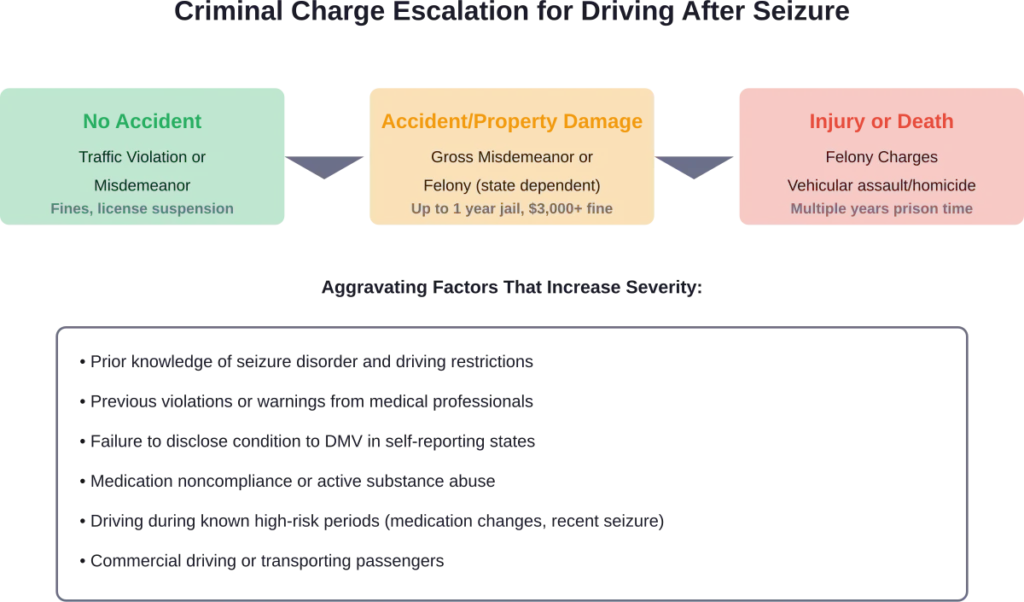
The severity of criminal charges typically depends on three factors: whether you knowingly violated driving restrictions, whether an accident occurred, and whether anyone was injured or killed.
Misdemeanor Charges
In many states, driving after a seizure when you knew about your condition and driving restrictions constitutes a misdemeanor. According to Minnesota statutes, a misdemeanor can result in imprisonment for not more than 90 days, or payment of a fine of not more than $1,000, or both.
A standard misdemeanor for driving with a suspended license—including suspensions due to medical conditions—typically carries penalties in most jurisdictions.
Gross Misdemeanor and Felony Charges
When driving after a seizure results in property damage, injury, or death, charges escalate dramatically. Minnesota law defines a gross misdemeanor as a crime for which a person may be sentenced to imprisonment for not more than 364 days, or to payment of a fine of not more than $3,000, or both.
Some states will charge drivers who cause accidents while knowingly driving with a seizure disorder with reckless endangerment, vehicular assault, or even vehicular homicide if someone dies. These are felony charges carrying years of potential prison time.
Real talk: if you have a seizure while driving and cause a fatal accident, prosecutors may argue you knowingly created an unreasonable risk. That’s manslaughter territory in many jurisdictions.
Financial Penalties: Fines and Reissue Fees
Beyond criminal fines, getting caught driving after a seizure triggers administrative fees that can be substantial.
California’s DMV charges reissue fees when reinstating a suspended license, including a $55 Reissue Fee and a $125 Admin Per Se Reissue Fee in applicable cases. Additional fees may apply depending on the specific circumstances of the suspension.
Louisiana law similarly authorizes reinstatement fees once the suspension period ends and medical clearance is obtained. In cases where the district court must intervene to issue a restricted driver’s license, legal fees compound the financial burden.
The total cost of getting caught can easily reach thousands of dollars when combining:
- Criminal fines (up to $3,000 for gross misdemeanors in some states)
- License reissue fees ($55-$125)
- Court costs and legal representation
- Required medical examinations and documentation
- Increased insurance premiums (if coverage continues at all)
- Alternative transportation costs during suspension
Medical Examination Requirements and Reinstatement Process
Regaining driving privileges after getting caught driving following a seizure isn’t automatic. States require comprehensive medical evaluation to determine whether it’s safe for you to resume driving.
According to the California DMV, drivers with lapses of consciousness must undergo medical examinations to determine whether they can safely operate a vehicle. This process involves neurological evaluation, documentation of seizure control, and often specialist reports.
What the Medical Review Process Involves
The medical review typically requires:
- Detailed seizure history from your neurologist
- Documentation of current medications and compliance
- EEG results and other diagnostic testing
- Physician certification of the required seizure-free period
- Assessment of seizure type and likelihood of recurrence
Medical research indicates that certain seizure types may qualify for modified restrictions. Simple seizures that don’t interfere with consciousness or motor function, seizures with consistent and prolonged auras, or seizures occurring only during sleep may receive special consideration in some states.
But here’s the catch: getting caught driving illegally during your restriction period destroys credibility with medical review boards. Noncompliance is one of the key unfavorable modifiers that extends required seizure-free periods.
Restricted License Possibilities
Some states offer restricted licenses during the reinstatement process. Louisiana law, for example, allows district courts to issue orders directing the DMV to grant restricted licenses in certain circumstances, either through ex parte order or after a contradictory hearing.
Restricted licenses typically limit driving to essential activities like work, medical appointments, or school. Violating these restrictions while under a medical suspension can result in even harsher penalties.
Commercial Driving: Heightened Restrictions and Permanent Disqualification
Commercial drivers face significantly stricter standards. Federal regulations and state laws impose heightened medical requirements for commercial driver’s license holders.
Generally speaking, a single seizure can permanently disqualify someone from holding a commercial license. The safety implications of an 80,000-pound semi-truck losing control far exceed those of a passenger vehicle, so regulations reflect this increased risk.
Medical research notes that commercial driving regulations typically require longer seizure-free periods—often 12 months minimum—and may exclude certain seizure disorders entirely from commercial driving eligibility.
If you’re caught driving a commercial vehicle after a seizure, expect:
- Immediate CDL revocation
- Federal disqualification periods that override state law
- Permanent career impact in transportation industries
- Enhanced criminal penalties due to the commercial vehicle operation
Civil Liability: Lawsuits and Insurance Consequences
Criminal and administrative penalties are only part of the picture. Civil liability can be devastating.
If you cause an accident while driving after a seizure—particularly if you knew about your condition and drove anyway—you’ve likely created a clear case of negligence. Injured parties can sue for damages, and your insurance company may deny coverage based on your illegal operation of a vehicle.
Insurance Denial and Policy Cancellation
Insurance policies typically include clauses excluding coverage for accidents occurring while the driver was engaged in illegal activity. Driving with a suspended license due to a medical condition often triggers these exclusions.
Without insurance coverage, you’re personally liable for all damages including:
- Medical expenses for injured parties
- Property damage to vehicles and other property
- Lost wages and future earning capacity of victims
- Pain and suffering damages
- Punitive damages if the court finds your conduct especially egregious
These civil judgments can reach hundreds of thousands or millions of dollars in serious injury cases. And bankruptcy won’t necessarily discharge them if the court finds willful or malicious conduct.
State-by-State Variations in Seizure Driving Laws
The consequences described above vary significantly by jurisdiction. Some states take a more lenient approach focused on medical management, while others impose harsh criminal penalties.
| State Approach | Characteristics | Example States |
|---|---|---|
| Physician Reporting | Mandatory doctor notification to DMV; earlier intervention; slightly more lenient penalties if compliant | California, Delaware, Nevada, New Jersey, Oregon |
| Self-Reporting | Individual responsibility; harsher penalties for nondisclosure; emphasis on personal accountability | Most states including Louisiana, Minnesota, Georgia |
| Advisory Board Review | Medical advisory boards assess individual cases; more flexibility in restrictions | States with well-developed epilepsy programs |
States also differ dramatically in required seizure-free periods, ranging from 3 months to 12 months or more. Some states count only certain seizure types toward the restriction period, while others apply blanket rules.
Indiana as a Case Example
Indiana, like many states, has specific protocols outlined by epilepsy advocacy organizations operating within the state. These protocols typically involve medical certification, specific seizure-free periods, and ongoing monitoring requirements.
Each state’s Department of Motor Vehicles maintains detailed guidelines—often available online—explaining the specific requirements and penalties for drivers with seizure disorders.
Defenses and Mitigating Circumstances
Not all situations are clear-cut. Some circumstances may provide partial defenses or mitigating factors that reduce penalties.
First-Time Seizure
If you experienced your first-ever seizure while driving and had no prior diagnosis, this differs substantially from knowingly driving with a documented seizure disorder. While you’ll still face license suspension pending medical evaluation, criminal charges are less likely absent an accident.
Medication Changes Under Doctor Supervision
Medical research identifies seizures during medically directed changes in medication as a potential modifier to standard restrictions. If your seizure occurred during a supervised medication adjustment, this may be viewed more favorably than noncompliance-related seizures.
Seizures That Don’t Impair Driving Ability
Simple partial seizures that don’t affect consciousness or motor control may not legally prohibit driving in some states. Similarly, seizures with consistent and prolonged auras that provide adequate warning might qualify for modified restrictions.
If you were caught driving with one of these seizure patterns and can document it medically, penalties may be reduced.
Emergency Circumstances
Courts occasionally recognize necessity defenses in extreme emergency situations—for example, driving someone to the hospital when no other transportation was available and calling an ambulance would result in death. These defenses are narrow and rarely successful, but they exist.
Long-Term Consequences Beyond Immediate Penalties
The impacts of getting caught extend far beyond the initial suspension and fines.
Employment Impact
Jobs requiring driving become impossible. Even positions where driving isn’t central but is occasionally necessary may become problematic. Criminal convictions—particularly gross misdemeanors or felonies—appear on background checks and can limit employment opportunities across many fields.
Permanent Criminal Record
Misdemeanor and felony convictions for driving after a seizure create permanent criminal records in most states. These records can affect:
- Professional licensing in medicine, law, education, and other fields
- Housing applications and rental approvals
- Firearm ownership rights
- Immigration status for non-citizens
- Educational opportunities and financial aid
Insurance Ramifications
Even after reinstatement, insurance companies may refuse coverage or charge prohibitively expensive premiums. High-risk driver classifications can persist for years, costing thousands in additional premiums annually.
What to Do If You’re Caught Driving After a Seizure
If you find yourself in this situation, immediate steps can help minimize consequences.
First, don’t make statements to police without legal representation. Anything you say about your knowledge of your condition, previous seizures, or medical advice can be used against you in criminal proceedings.
Second, contact an attorney who specializes in traffic law and medical license suspensions. The legal landscape is complex, and specialized representation significantly impacts outcomes.
Third, immediately schedule a comprehensive neurological evaluation. Demonstrating proactive medical management shows good faith and may influence both criminal sentencing and license reinstatement decisions.
Fourth, document everything. Keep records of all medical appointments, medication compliance, seizure logs, and communications with healthcare providers. This documentation becomes critical during reinstatement proceedings.
Fifth, explore alternative transportation arrangements immediately. Continued illegal driving while charges are pending dramatically worsens your situation.
Prevention: Understanding and Following Restrictions
The best approach is avoiding this situation entirely. If you have a seizure disorder, understanding and complying with restrictions protects both public safety and your own legal interests.
Know Your State’s Specific Requirements
Driving laws by state vary substantially. Research your jurisdiction’s specific seizure-free period requirements, reporting obligations, and reinstatement procedures. Epilepsy advocacy organizations often maintain state-by-state guides.
Work Closely With Healthcare Providers
Maintain regular contact with your neurologist. Discuss driving restrictions openly and honestly. Medical professionals can provide guidance on when it’s legally and medically safe to resume driving.
Plan for Seizure-Free Period Interruptions
If you experience a breakthrough seizure during your seizure-free period, the clock resets. Have contingency plans for alternative transportation. Rideshare services, public transit, family support, and employer accommodations can bridge gaps.
Consider Medication Compliance Systems
Noncompliance with medication is both a common cause of breakthrough seizures and an unfavorable modifier that extends restriction periods. Pill organizers, smartphone reminders, and pharmacy auto-refill programs help maintain compliance.
Frequently Asked Questions
Yes, jail time is possible depending on state law and circumstances. Simple violations without accidents typically result in fines and license suspension, but if you cause an accident—particularly with injuries—many states will pursue criminal charges. Gross misdemeanors can carry up to 364 days in jail, and felony charges for vehicular assault or homicide can result in years of imprisonment. The key factors are whether you knowingly violated restrictions and whether harm resulted from your actions.
License suspension duration varies by state, typically ranging from the length of the required seizure-free period (3-12 months) plus processing time. Most states require 6 months seizure-free as a standard, though stricter states mandate 12 months. Factors like medication noncompliance, structural brain disease, or previous violations can extend this period. The suspension continues until you complete the seizure-free period and obtain medical clearance, which then must be reviewed and approved by the DMV.
This depends on whether your state has mandatory physician reporting or self-reporting. In mandatory reporting states like California, Nevada, and Oregon, physicians must notify the DMV when patients have seizures. In self-reporting states, individuals are legally required to disclose their condition. Failure to report in a self-reporting state and subsequently getting caught driving typically results in harsher penalties than if the condition had been properly disclosed. Check your specific state’s requirements.
A first-time seizure while driving will result in immediate license suspension pending medical evaluation, even if you had no prior diagnosis. However, criminal charges are less likely for a truly unexpected first seizure compared to knowingly driving with a documented disorder. You’ll need comprehensive neurological evaluation to determine the cause and whether you have epilepsy or another seizure disorder. The DMV will require medical clearance before reinstatement, and you’ll likely need to complete a seizure-free observation period.
Some states offer restricted licenses for essential activities like employment, medical appointments, or education during medical suspensions. Louisiana law, for example, allows district courts to order the DMV to issue restricted licenses in certain circumstances. However, eligibility varies significantly by state, and many jurisdictions don’t offer this option for medical suspensions. Violating the terms of a restricted license results in complete revocation and additional penalties. Consult with an attorney familiar with your state’s laws.
Insurance coverage becomes complicated and often denied if you knowingly drove while restricted due to a seizure disorder. Most policies exclude coverage for accidents occurring during illegal activities, and driving with a medically suspended license qualifies. If you had an unexpected first seizure with no prior diagnosis, coverage is more likely. However, if you knew about your condition, failed to report it, or drove during a suspension period, insurers will likely deny the claim, leaving you personally liable for all damages.
For driving restriction purposes, states focus on seizure activity rather than formal epilepsy diagnosis. A single unprovoked seizure typically triggers the same reporting requirements and restrictions as diagnosed epilepsy. Some states may treat provoked seizures (caused by specific temporary factors like head injury, fever, or substance withdrawal) differently than unprovoked seizures or epilepsy. However, any seizure that impairs consciousness or motor control generally results in driving restrictions until medical evaluation determines the cause and recurrence risk.
Conclusion: The Stakes Are Too High to Risk It
Getting caught driving after a seizure carries consequences that extend far beyond inconvenience. License suspension, criminal charges, substantial fines, civil liability, and long-term impacts on employment and insurance create a cascade of problems that can take years to resolve.
The legal system views driving after a seizure as creating unreasonable risk to public safety. Courts and prosecutors take these cases seriously, particularly when accidents occur. The combination of administrative penalties through the DMV and potential criminal prosecution creates a two-front legal battle that’s difficult to navigate without specialized help.
But wait—there’s another critical factor. Community discussions and legal precedent increasingly recognize that knowingly driving with uncontrolled seizures isn’t just a traffic violation. It’s a choice that can destroy lives, including your own.
If you have a seizure disorder, work closely with healthcare providers, understand your state’s specific requirements, and comply strictly with all restrictions. The temporary inconvenience of alternative transportation is nothing compared to the permanent consequences of getting caught—or worse, causing a tragedy.
Already facing charges for driving after a seizure? Contact a qualified attorney immediately. The complexity of medical license suspensions, state-specific regulations, and potential criminal liability requires specialized legal representation. Early intervention can significantly impact both immediate penalties and long-term consequences.
Your mobility matters. So does public safety. Find the legal path forward instead of risking everything by driving illegally.