

Quick Summary: Sleeping too much—typically defined as more than 9 hours nightly—has been linked to increased risks of cardiovascular disease, stroke, obesity, diabetes, and cognitive decline. Excessive sleep duration may signal underlying health conditions like depression, sleep disorders, or neurological issues. Most adults need 7-8 hours of quality sleep, and consistently exceeding this may indicate a need for medical evaluation.
Everyone knows that skimping on sleep wrecks your health. But what about the flip side? Can you actually sleep too much?
Turns out, the answer is yes. And the consequences might surprise you.
According to the CDC, a total of 65.2% of respondents reported a healthy sleep duration of 7 or more hours. That leaves a significant portion either sleep-deprived or, less commonly, oversleeping. While the health dangers of too little sleep get plenty of attention, excessive sleep duration flies under the radar—despite mounting research linking it to serious health problems.
How Much Sleep Is Actually Too Much?
According to CDC guidance and sleep research consensus, the average basal sleep needs of adults is approximately 7 to 8 hours per night. Adolescents require about 9 hours. When sleep consistently exceeds these amounts—particularly beyond 9 hours for adults—health risks start climbing.
But here’s the thing: It’s not just about the number. Sleep quality matters enormously. Someone sleeping 10 hours might be compensating for fragmented, poor-quality rest rather than genuinely needing that duration.
Research distinguishes between occasional long sleep (catching up after a rough week) and chronic oversleeping. The latter raises red flags.
The U-Shaped Risk Curve
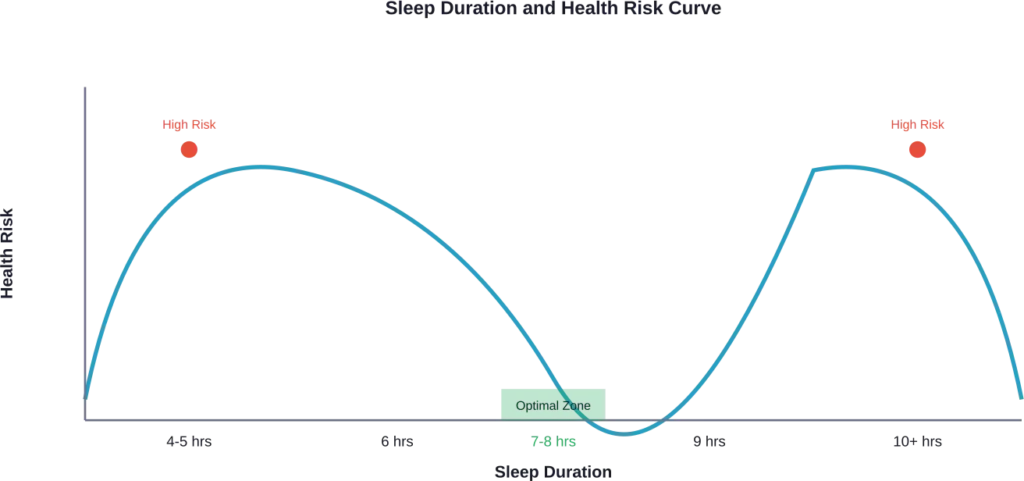
Scientists have identified what they call a U-shaped relationship between sleep duration and health outcomes. Both extremes—too little and too much—increase disease risk, while moderate sleep (7-8 hours) sits at the bottom of that curve.
A national survey of 24,671 adults (INPES Health Barometer) examined the U-shaped association between sleep duration and morbidity risks. This pattern holds across different populations and age groups.
Cardiovascular Disease and Stroke Risk
Here’s where the data gets alarming.
Research examining sleep patterns and stroke risk found that people sleeping 9 or more hours nightly had a 23% higher risk of stroke compared to those sleeping less than 8 hours. That’s not a trivial increase.
Studies on cardiovascular disease show similar patterns. Both short (less than 7 hours) and long sleep durations (over 9 hours) increase overall cardiovascular mortality risk. This association appears particularly strong in Asian populations and elderly individuals.
The NIH funded research explaining that reduced blood oxygen levels during sleep—common in conditions like obstructive sleep apnea—significantly contribute to cardiovascular risk. In the MESA study, for every measure of observed reduction in blood oxygen levels, a person had a 45% increased associated risk for having a primary cardiovascular event.
But wait. Does oversleeping cause heart problems, or do heart problems cause oversleeping? That’s the million-dollar question researchers are still untangling. The relationship likely works both ways.
Weight Gain and Metabolic Problems
Sleeping too much doesn’t just affect your heart—it messes with your metabolism too.
One study showed that people who slept for nine or 10 hours every night were 21% more likely to become obese over a six-year period than were people who slept between seven and eight hours. This association remained even after controlling for physical activity and diet.
The mechanisms aren’t entirely clear. Some theories suggest that excessive sleep disrupts metabolic hormones like leptin and ghrelin, which regulate hunger and satiety. Others point to reduced physical activity—someone sleeping 10-11 hours simply has fewer waking hours for movement.
Diabetes risk also climbs with extended sleep duration. Research indicates a U-shaped relationship between sleep and chronic conditions like diabetes, kidney disease, and obesity.
Mental Health and Cognitive Effects
Oversleeping and mental health create a complicated feedback loop.
Depression frequently causes hypersomnia—the medical term for excessive sleepiness. But sleeping too much can also worsen depressive symptoms, creating a vicious cycle. Waking up after 10-11 hours might sound restorative, but many people report feeling mentally foggy, unmotivated, and emotionally flat.
According to research on excessive quantity of sleep, people with long sleep durations show higher rates of psychiatric comorbidities and impaired daily functioning compared to normal sleepers.
Cognitive performance takes a hit too. Memory consolidation, attention span, and decision-making all suffer when sleep duration strays too far from the 7-8 hour sweet spot—in either direction.
Understanding Hypersomnia
Sometimes excessive sleep signals an underlying sleep disorder called hypersomnia.
According to NIH research, the cardinal EDS symptom is defined as “an uncontrollable need to sleep or daytime sleepiness that persists for at least 3 months even with adequate or prolonged nighttime sleep.” The cardinal symptom is an uncontrollable need to sleep during the day, even after sleeping 9+ hours at night.
There are different types:
- Idiopathic hypersomnia: No identifiable cause, but patients sleep excessively and struggle to feel rested
- Kleine-Levin syndrome: Rare disorder causing recurring episodes of extreme sleepiness (sometimes 20+ hours)
- Secondary hypersomnia: Caused by another condition like sleep apnea, medication, or neurological disease
Excessive daytime sleepiness (EDS) is estimated to cause almost one-fifth of the motor vehicle accidents in this country. That’s a massive public health problem. Patients with hypersomnia have decreased workplace productivity, lower quality of life, and increased risk of work-related injury.
When to See a Doctor
Real talk: How do you know if your sleep is genuinely excessive versus just catching up?
Consider seeking medical evaluation if you:
- Consistently sleep more than 9 hours and still feel exhausted
- Experience uncontrollable daytime sleepiness despite adequate nighttime sleep
- Take long naps (over 1 hour) regularly
- Have difficulty waking up or extreme sleep inertia
- Notice your oversleeping started after a medication change, illness, or life event
Breaking the Oversleeping Cycle
So what can someone do about chronic oversleeping?
First step: Figure out what’s driving it. That usually means seeing a healthcare provider, possibly a sleep specialist.
Sleep Hygiene Improvements
According to the CDC, good sleep practices include:
- Maintaining a consistent sleep-wake schedule, even on weekends
- Keeping your bedroom quiet, dark, and cool
- Turning off electronic devices at least 30 minutes before bed
- Avoiding large meals and alcohol before bedtime
- Getting regular physical activity during the day
These sound basic, but they’re surprisingly effective when applied consistently.
Setting a Wake-Up Time
Here’s a counterintuitive approach: Set a firm wake-up time and stick to it, regardless of when you fell asleep. Your body will eventually adjust its bedtime to match.
Use an alarm across the room so you physically have to get up to turn it off. No snooze button—that fragments your sleep architecture anyway.
Light Exposure
Bright light exposure in the morning helps reset your circadian rhythm. Open curtains immediately upon waking, or use a light therapy box if natural sunlight isn’t available.
Conversely, dim lights in the evening signal to your brain that sleep time approaches.
The Quality vs. Quantity Debate
Not all sleep hours are created equal.
Someone might log 10 hours in bed but experience fragmented, low-quality sleep due to underlying conditions like sleep apnea. Their brain never reaches the deep, restorative stages necessary for proper rest.
Research on extended sleep opportunity found that TST (total sleep time) decreased significantly during extended sleep opportunity periods in healthy individuals. This suggests that chronic long sleep often reflects poor sleep quality rather than genuine need for extended duration.
| Sleep Quality Indicator | Good Quality | Poor Quality |
|---|---|---|
| Time to fall asleep | 10-20 minutes | <5 min or >30 min |
| Night awakenings | 0-1 brief waking | Multiple or prolonged |
| Morning feeling | Refreshed, alert | Groggy, unrefreshed |
| Daytime energy | Sustained throughout day | Crashes, naps needed |
| Sleep efficiency | >85% time asleep in bed | <85% time asleep |
Age Considerations
Sleep needs change across the lifespan, according to CDC guidelines:
- Newborns (0-3 months): 14-17 hours
- Infants (4-12 months): 12-16 hours including naps
- Toddlers (1-2 years): 11-14 hours including naps
- Preschoolers (3-5 years): 10-13 hours
- School age (6-12 years): 9-12 hours
- Teens (13-18 years): 8-10 hours
- Adults (18+ years): 7-8 hours
What’s concerning is when adults consistently exceed the adult recommendation by 2+ hours without clear reason.
Frequently Asked Questions
Consistently sleeping 10+ hours is associated with increased health risks including cardiovascular disease, stroke, diabetes, and cognitive decline. While occasional long sleep isn’t harmful—especially when recovering from illness or sleep deprivation—chronic oversleeping warrants medical evaluation to identify underlying causes.
Oversleeping disrupts your circadian rhythm and sleep architecture, leading to grogginess and mental fog called sleep inertia. Extended sleep can also trigger headaches, back pain, and worsen mood disorders like depression. Your body operates on natural sleep-wake cycles, and excessive sleep throws those cycles off balance.
Research shows people sleeping 9-10 hours nightly are 21% more likely to become obese over time compared to those sleeping 7-8 hours. Oversleeping may disrupt metabolic hormones, reduce physical activity time, and correlate with sedentary lifestyle patterns that contribute to weight gain.
Set a consistent wake-up time and stick to it daily, even weekends. Get bright light exposure immediately upon waking. Improve sleep quality by maintaining good sleep hygiene. Address underlying issues like depression or sleep disorders with medical help. Gradually adjust your schedule rather than making drastic changes overnight.
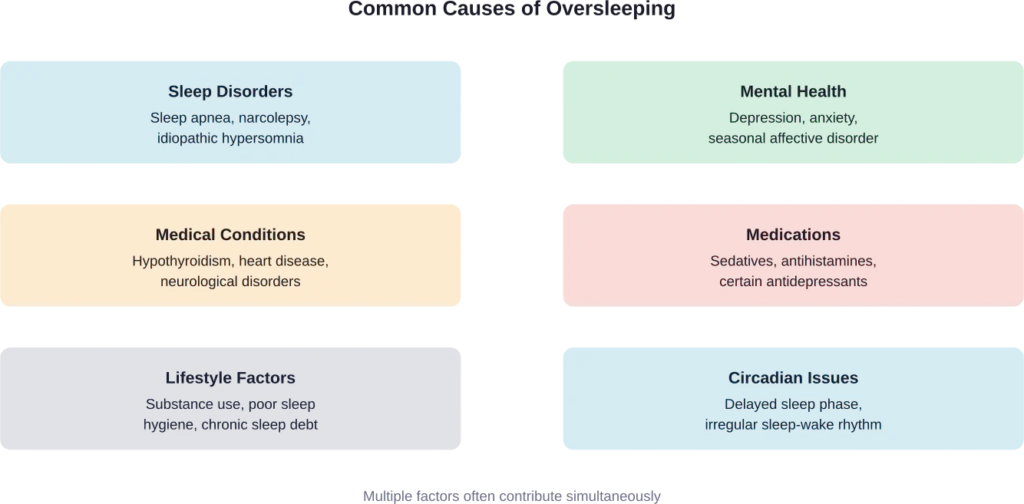
Common causes include sleep disorders (sleep apnea, narcolepsy, idiopathic hypersomnia), mental health conditions (depression, seasonal affective disorder), medical issues (hypothyroidism, heart disease, neurological disorders), medications (sedatives, certain antidepressants), and circadian rhythm disorders. Proper diagnosis requires medical evaluation.
Neither extreme is ideal. Research consistently shows 7-8 hours provides optimal health outcomes for most adults. Both 6 hours (insufficient) and 9+ hours (excessive) are associated with increased risks for cardiovascular disease, metabolic problems, and mortality. Individual needs vary slightly, but rarely fall outside the 7-8 hour range.
If oversleeping is addressed early and stems from reversible causes (poor sleep hygiene, depression, medication side effects), the associated health risks often improve with treatment. However, chronic oversleeping linked to cardiovascular disease or metabolic syndrome may have caused damage requiring separate medical management. Early intervention matters.
The Bottom Line
Sleep is essential—nobody disputes that. But like most biological needs, there’s an optimal range.
Consistently sleeping more than 9 hours raises red flags that shouldn’t be ignored. The association with cardiovascular disease, stroke, obesity, diabetes, and cognitive decline is too strong to dismiss as coincidence.
Sometimes oversleeping signals an underlying health condition that needs treatment. Other times, poor sleep quality masquerades as excessive sleep need. Either way, chronic long sleep deserves attention.
If you regularly sleep 9+ hours and still feel exhausted, talk to your healthcare provider. Track your sleep patterns, note your daytime symptoms, and be honest about your quality of life. Solutions exist—from treating sleep disorders to adjusting medications to addressing mental health conditions.
Sleep quality beats quantity every time. Aim for that sweet spot of 7-8 hours of genuinely restorative sleep, and your body will thank you.