

Quick Summary: Swallowing a small amount of toothpaste is generally harmless and may cause mild stomach upset. However, ingesting large quantities can lead to fluoride toxicity, causing nausea, vomiting, diarrhea, and in severe cases, more serious symptoms requiring medical attention.
That toothpaste warning label isn’t just there for decoration. But what actually happens when toothpaste slides down your throat instead of into the sink?
The answer depends entirely on how much gets swallowed. A pea-sized smear won’t hurt anyone. An entire tube? That’s a different story.
Here’s everything parents, caregivers, and curious adults need to know about toothpaste ingestion and when it becomes a real problem.
Why Toothpaste Shouldn’t Be Swallowed
Most toothpastes contain fluoride, typically 900-1,100 parts per million (about 0.10%), according to the CDC. Fluoride strengthens tooth enamel and prevents cavities when applied topically to teeth.
The problem starts when fluoride enters the digestive system in larger amounts. According to Poison Control, while small unintentional ingestions of over-the-counter fluoride toothpaste are unlikely to be toxic, swallowing toothpaste can cause an upset stomach.
Beyond fluoride, toothpaste contains other ingredients that weren’t designed for consumption:
- Detergents and surfactants that create foam
- Abrasives that scrub teeth
- Flavoring agents and sweeteners
- Preservatives and binding agents
- Whitening or desensitizing compounds
None of these ingredients pose immediate danger in tiny amounts, but they can irritate the digestive tract when swallowed regularly or in large quantities.
What Happens After Swallowing Small Amounts
Accidentally swallowing the foam while brushing? No need to panic.
Small amounts of toothpaste typically cause minimal to no symptoms. Some people might experience:
- Mild nausea
- Slight stomach discomfort
- Temporary bad taste
These symptoms usually resolve on their own within a few hours without any treatment. The body processes and eliminates the small amount of fluoride and other ingredients naturally.
Real talk: most adults have swallowed toothpaste accidentally at some point. The occasional rinse-water swallow won’t cause harm.
When Toothpaste Becomes Dangerous
Large ingestions tell a different story. According to Poison Control, larger amounts of fluoride can be toxic.
Acute fluoride toxicity symptoms include:
- Nausea and vomiting
- Diarrhea
- Abdominal pain
- Excessive salivation
- Increased thirst
In severe cases involving very large amounts, symptoms can escalate to:
- Muscle weakness or spasms
- Tremors
- Seizures
- Heart rhythm abnormalities
- Difficulty breathing
The severity depends on body weight and the amount ingested. Children face higher risk because they weigh less, meaning the same amount of toothpaste represents a larger dose relative to their body size.
Special Concerns for Children
According to the CDC, approximately 38% of children aged 3-6 years use too much toothpaste. That’s a problem because young children haven’t mastered the spit reflex yet.
The CDC notes that nearly 80% of children aged 3-15 years began toothbrushing at age ≥1 year, and approximately one third brushed only once daily—both factors that can affect fluoride exposure patterns.
Children can develop dental fluorosis if they consume too much fluoride while their teeth are developing under the gums. Dental fluorosis causes white spots or streaks on tooth enamel. While mostly cosmetic, it indicates excessive fluoride exposure during critical development periods.
Only young children can develop dental fluorosis. Once teeth have erupted through the gums, fluorosis can no longer occur.
What to Do If Someone Swallows Toothpaste
Response depends on the amount swallowed.
For Small Amounts
If a child or adult swallows a pea-sized amount or less:
- Give them a small amount of water to drink
- Watch for stomach upset
- No further action needed unless symptoms develop
For Larger Amounts
According to Poison Control, if someone swallows a larger amount of toothpaste:
- Call Poison Control immediately at 1-800-222-1222
- Use the webPOISONCONTROL online tool at Poisonhelp.org
- Do not induce vomiting unless instructed
- Have the toothpaste container available to provide ingredient information
Both phone and online poison help are free, confidential, and available 24 hours a day. Expert guidance is provided by certified specialists.
Emergency Situations
Call 911 immediately if the person:
- Collapses
- Has a seizure
- Has trouble breathing
- Cannot be awakened
These symptoms indicate severe toxicity requiring emergency medical treatment.
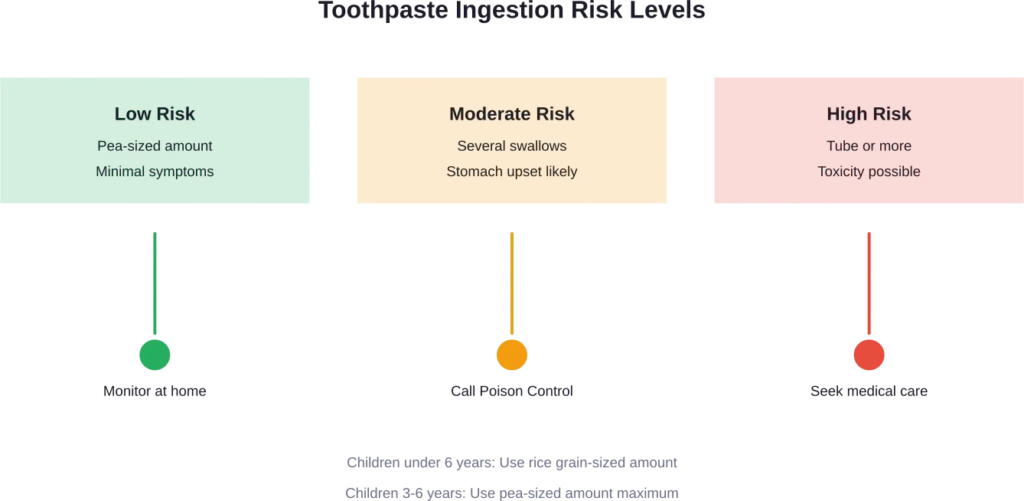
| Amount Swallowed | Risk Level | Action Required |
|---|---|---|
| Pea-sized or less | Minimal | Monitor, give water |
| Several swallows | Low to moderate | Call Poison Control for guidance |
| Partial tube or more | Moderate to high | Call Poison Control immediately |
| Multiple tubes | High | Seek emergency medical care |
Preventing Toothpaste Ingestion
Prevention beats treatment every time. Poison Control recommends these strategies:
Proper storage: Store toothpaste out of reach and sight of children. Treat it like medicine, not candy.
Correct amounts: Use age-appropriate portions. For children under three, use a rice grain-sized smear. For children three to six, use a pea-sized amount.
Supervision: Watch children while they brush until they can reliably spit out toothpaste, typically around age six or seven.
Education: Teach children that toothpaste is medicine, not food, even though it tastes good.
Choose wisely: For very young children who can’t spit yet, consider training toothpaste without fluoride until they master the technique.

Understanding Fluoride in Toothpaste
Fluoride deserves special attention because it’s both beneficial and potentially harmful depending on the dose.
According to the American Dental Association, fluoride strengthens teeth and helps prevent cavities when used correctly. Community water fluoridation and fluoride toothpaste have dramatically reduced tooth decay rates across all age groups.
But here’s the thing: fluoride works best when applied to teeth topically, not swallowed. The body doesn’t need ingested fluoride the way it needs calcium or vitamin D.
The FDA took action in October 2025 to restrict unapproved ingestible fluoride prescription products for children, particularly those labeled for use in children under age three or older children at low to moderate risk for tooth decay. This move underscores the importance of appropriate fluoride use.
Fluoride-Free Alternatives
Some parents choose fluoride-free toothpaste for young children who consistently swallow toothpaste. That’s a reasonable short-term solution while teaching proper brushing technique.
However, fluoride remains essential for dental health. It prevents cavities and strengthens enamel in ways that fluoride-free alternatives cannot match.
The goal isn’t to avoid fluoride entirely—it’s to use it correctly. Once children can reliably spit, switching to fluoride toothpaste provides the cavity protection their developing teeth need.
Frequently Asked Questions
Death from toothpaste ingestion is extremely rare but theoretically possible with massive ingestion. The generally accepted lethal dose range for adults is 5-10 grams of sodium fluoride (32-64 mg fluoride per kilogram of body weight). This would require consuming multiple large tubes of toothpaste. Small to moderate ingestions, while potentially causing symptoms, are not fatal.
According to Poison Control, small unintentional ingestions are unlikely to be toxic. Generally, swallowing more than a pea-sized amount warrants monitoring, and swallowing a quarter tube or more justifies calling Poison Control for guidance. The threshold varies with body weight—children face higher risk from smaller amounts.
First, estimate how much was consumed. For small amounts (pea-sized or less), give the child water and monitor for stomach upset. For larger amounts, call Poison Control at 1-800-222-1222 or use the online tool at Poisonhelp.org. Have the toothpaste container ready to provide ingredient information. Do not induce vomiting unless instructed by poison control or medical professionals.
Regularly swallowing toothpaste can lead to excessive fluoride intake, especially in children. This can cause dental fluorosis (cosmetic changes to developing teeth) and potentially contribute to other health issues with long-term exposure. The practice should be discouraged, and children should be taught to spit out toothpaste thoroughly after brushing.
Early symptoms include nausea, vomiting, diarrhea, abdominal pain, excessive salivation, and increased thirst. More severe cases can involve muscle weakness, tremors, seizures, heart rhythm problems, and breathing difficulties. Symptoms typically appear within 30 minutes to several hours after ingestion. Any concerning symptoms after swallowing large amounts of toothpaste warrant immediate medical attention.
Yes, though adults typically need to ingest larger amounts than children to experience toxicity due to higher body weight. Adults who accidentally swallow small amounts during normal brushing rarely experience symptoms. Intentional or accidental ingestion of large quantities can cause the same symptoms as in children, including gastrointestinal distress and, in severe cases, systemic toxicity.
Symptoms of acute fluoride toxicity typically begin within 30 minutes to two hours after ingestion. Gastrointestinal symptoms like nausea and vomiting usually appear first. More severe systemic symptoms, if they occur, may develop over the following hours. The timing and severity depend on the amount ingested and individual factors like body weight and stomach contents.
The Bottom Line on Swallowing Toothpaste
Toothpaste belongs on teeth, not in stomachs. But accidents happen, especially with curious toddlers and children learning to brush.
The good news? Small, unintentional swallowing rarely causes serious problems. An upset stomach might be the worst of it.
Larger ingestions require professional guidance. When in doubt, contact Poison Control. Their free, confidential service exists precisely for these situations.
Prevention remains the best strategy. Proper storage, age-appropriate amounts, supervision during brushing, and patient education all reduce risk significantly.
Teaching children proper brushing technique—including that critical spit-and-rinse step—protects both their dental health and their overall safety. The effort invested in supervision now pays dividends in healthy habits that last a lifetime.
Keep toothpaste where it belongs: on the brush, on the teeth, and down the drain. Not down the throat.