

Quick Summary: When someone dies without a will—called dying intestate—state intestacy laws determine who inherits their assets through a court-supervised probate process. The state follows a strict priority order, typically favoring spouses and children first, then parents, siblings, and other relatives. This process can be lengthy, costly, and may not reflect what the deceased actually wanted.
Many Americans lack wills. That might sound fine until someone dies and the family realizes the state—not the deceased—decides who gets what.
When there’s no will, the legal process becomes complicated fast. The probate court steps in, appoints someone to handle everything, and distributes assets according to rigid state formulas. These formulas don’t care about family dynamics, special relationships, or what the deceased might’ve wanted.
Here’s what actually happens when someone dies without a will, how intestate succession works, and why this matters for families trying to navigate an already difficult time.
Understanding Intestate Succession
According to the Legal Information Institute at Cornell Law School, intestate succession is a legal process that comes into play when someone passes away without leaving behind a valid will or other legally binding document dictating how their assets and property should be distributed. Instead, the distribution of assets is determined by the laws of intestacy in the state where the person passed away.
The term “intestate” simply means dying without a will. When this happens, state law writes the estate plan for the deceased person.
But here’s the thing—each state has its own intestacy laws. What happens in New York looks different from Virginia or California. The laws of intestacy establish a specific order of priority for the distribution of assets, typically prioritizing surviving spouses and children first.
How State Laws Differ
Most states follow a similar pattern, but the details vary dramatically. In New York, a surviving spouse receives the first $50,000 plus half of the remaining estate when children are involved. The children share the remaining 50%.
Virginia takes a different approach. If there are children from other relationships, the spouse receives only one-third of the estate.
These state variations can dramatically affect inheritance outcomes. The Uniform Probate Code attempted to standardize intestacy laws, but not all states adopted it. Research from the University of Michigan Law Reform journal notes that intestate succession laws function as “an estate plan written for the decedent by his state legislature.”
The Probate Process Without a Will
Probate is the court-supervised process of settling an estate. When there’s a will, probate validates the document and oversees the executor. Without a will, probate becomes more complex and typically more expensive.
The court must appoint someone to manage the estate—called an administrator or personal representative. This person handles everything from notifying creditors to distributing assets.
How the Court Appoints an Administrator
The probate court follows state law to determine who can serve as administrator. Usually, the surviving spouse has first priority, then adult children, then other close relatives.
If no family member wants the job—or if there’s conflict about who should do it—the court may appoint a professional administrator. That person gets paid from estate assets, reducing what heirs ultimately receive.
The administrator must post a bond in many states. This bond protects the estate from mismanagement, but it’s another cost that reduces the estate’s value.
Timeline and Costs
Probate without a will typically takes longer than probate with one. The process can stretch from several months to over a year, depending on estate complexity and state procedures.
Attorney fees, court costs, and administrator compensation add up. These expenses come directly from estate assets before any distribution to heirs.
Real talk: intestate probate costs families both time and money that proper estate planning would’ve avoided.
Who Actually Inherits Without a Will
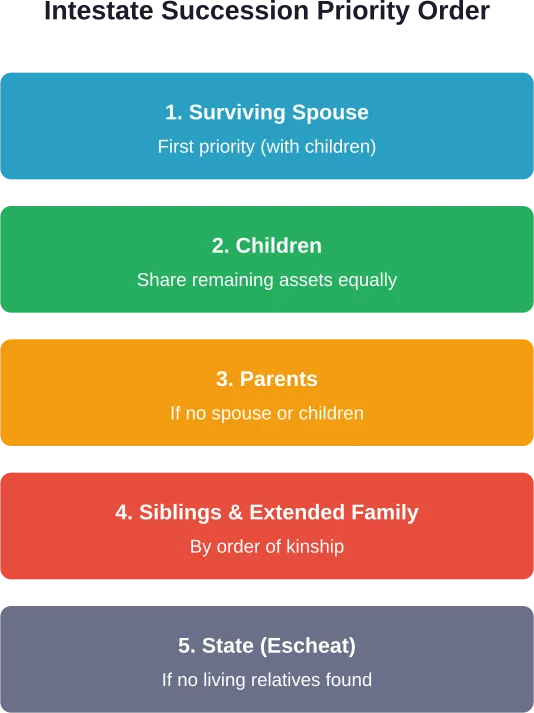
State intestacy laws create a hierarchy of heirs. The structure varies by state, but most follow a similar pattern prioritizing close family members.
Spouses and Children
At a very high level, most states prioritize spouses and children, then parents and siblings, then other relatives in order of kinship.
When both a spouse and children survive the deceased, things get complicated. The spouse doesn’t automatically get everything. In many states, the estate splits between the spouse and children according to specific formulas.
If there’s only a surviving spouse with no children, parents, or siblings, the spouse typically inherits the entire estate. But that’s not guaranteed in every state.
| Family Situation | Typical Distribution Pattern |
|---|---|
| Spouse and children | Spouse receives portion (often $50,000-$100,000 plus 33-50%), children split remainder |
| Spouse, no children | Spouse inherits everything (or shares with parents if living) |
| Children, no spouse | Children inherit everything equally |
| Parents, no spouse/children | Parents inherit everything |
| Siblings only | Siblings split estate equally |
| No close relatives | Extended family by kinship degree, or state takes estate |
Survivorship Requirements
To inherit under intestate succession laws, an heir might have to live a certain amount of time longer than the deceased person. In many states, the required period is 120 hours (five days).
This prevents situations where a spouse dies shortly after the intestate person, causing assets to pass to the spouse’s family rather than the deceased’s other relatives.
Who Gets Nothing
Intestate succession laws leave out many people who might’ve been important to the deceased:
- Unmarried partners and domestic partners (in most states)
- Stepchildren who weren’t legally adopted
- Friends, no matter how close
- Charities and organizations
- Caregivers who provided years of support
Only legal relationships count. The emotional bonds and personal wishes that would’ve been honored in a will simply don’t matter under intestacy laws.
Special Situations and Complications
Intestate succession creates specific challenges for blended families, unmarried couples, and anyone with non-traditional family structures.
Blended Families
Second marriages with children from previous relationships face particular complications. Stepchildren who weren’t legally adopted typically receive nothing under intestacy laws, even if the deceased treated them as their own children for decades.
The biological children of the deceased inherit according to state formulas, potentially creating conflict with a surviving spouse who expected to provide for stepchildren.
Unmarried Partners
Unmarried partners—even those in decades-long relationships—generally inherit nothing under intestate succession. The estate passes to blood relatives or a legal spouse, leaving the surviving partner without legal claim to shared assets.
Some states recognize common-law marriage or registered domestic partnerships, but requirements vary. Without meeting the specific legal criteria, unmarried partners are treated as legal strangers to the estate.
Minor Children and Guardianship
Here’s where dying without a will gets particularly problematic. Without a will, there’s no designated guardian for minor children.
The court decides who raises the children based on state law and the children’s best interests. While courts typically prefer close relatives, the deceased has no say in which relative gets priority. Family disputes over custody can turn ugly fast.
And the court must appoint a property guardian to manage any assets the children inherit until they reach legal age. This creates additional costs and court supervision that proper estate planning would’ve avoided.

Assets That Bypass Intestate Succession
Not every asset goes through intestate succession. Some property transfers automatically to designated beneficiaries regardless of whether there’s a will.
These assets include:
- Life insurance policies with named beneficiaries
- Retirement accounts (401k, IRA) with beneficiary designations
- Bank accounts with payable-on-death (POD) designations
- Investment accounts with transfer-on-death (TOD) designations
- Property held in joint tenancy with right of survivorship
- Assets in living trusts
But here’s the catch: if beneficiary designations are outdated or missing, those assets fall into the probate estate and become subject to intestate succession.
An ex-spouse listed on a life insurance policy from 20 years ago might receive the proceeds instead of current family members. A retirement account without a beneficiary designation gets distributed according to intestacy laws rather than going directly to intended heirs.
How to Prevent Intestate Succession Complications
The solution is straightforward: create a valid will. Even a simple will beats intestate succession by giving control over asset distribution and guardian designation for minor children.
Basic Estate Planning Steps
Creating a will doesn’t require months of work or thousands of dollars. Basic estate planning involves:
- Listing assets and deciding who should inherit what
- Naming an executor to manage the estate
- Designating guardians for minor children
- Signing the will with proper witnesses according to state requirements
Many states allow holographic (handwritten) wills or simple typed documents with witness signatures. While working with an estate planning attorney ensures everything’s done correctly, having any valid will is better than having none.
Updating Beneficiary Designations
Review beneficiary designations on all financial accounts regularly. Life changes—marriages, divorces, births, deaths—can make old designations obsolete fast.
Check these accounts at least every few years:
- Life insurance policies
- Retirement accounts
- Bank and investment accounts
- Any accounts with POD or TOD designations
Outdated beneficiaries create the same problems as dying intestate, even when there’s a valid will for other assets.
Considering Additional Estate Planning Tools
For larger or more complex estates, additional planning tools prevent complications:
- Living trusts that avoid probate entirely
- Powers of attorney for financial and healthcare decisions during incapacity
- Healthcare directives and living wills
- Special needs trusts for disabled beneficiaries
These tools work alongside a will to create comprehensive estate plans that protect families from legal complications and unnecessary costs.
The Real Cost of Dying Intestate
The financial impact of dying without a will extends beyond court costs and attorney fees. Intestate succession creates several layers of expense that reduce what heirs ultimately receive.
| Cost Category | With Will | Without Will |
|---|---|---|
| Probate duration | 6-9 months typically | 12-18+ months typically |
| Attorney fees | 2-4% of estate value | 4-7% of estate value |
| Administrator/executor bond | Often waived by will | Required in most states |
| Family conflict risk | Lower (clear instructions) | Higher (statutory formulas) |
| Guardian appointment | Named in will | Court decides |
| Tax planning opportunities | Available | Missed |
But the emotional costs matter too. Families already dealing with grief face additional stress from legal complications, uncertainty about asset distribution, and potential conflicts between relatives.
Intestate estates generally involve higher rates of family disputes and longer resolution times compared to estates with wills.
State-Specific Intestacy Examples
Understanding how intestacy works in specific states shows why one-size-fits-all assumptions don’t work.
New York
In New York, if the decedent is survived by a spouse and children, the surviving spouse receives $50,000 and one-half of the balance of the estate. The children share the remaining 50%.
If there’s a surviving spouse but no children or parents, the spouse receives everything. But if there’s a spouse and living parents but no children, the spouse receives $50,000 plus half the balance, with parents receiving the remainder.
Connecticut
Connecticut follows similar patterns but with different amounts. The spouse’s share varies depending on whether there are children and whether those children are from the current relationship or a previous one.
The complexity of these formulas shows why simply assuming “my spouse gets everything” can be dangerously wrong.
Differences That Matter
Some states treat separate property differently from community property. Some give parents a share even when there’s a surviving spouse. Some provide more protection for children from previous relationships.
These variations mean that moving from one state to another can completely change what happens to an estate without a will.
When Professional Help Matters Most
Some situations require professional legal guidance rather than DIY estate planning:
- Blended families with children from multiple relationships
- Significant assets or complex financial situations
- Business ownership that needs succession planning
- Family members with special needs
- Concerns about estate or inheritance taxes
- Property in multiple states
- Complicated family dynamics or potential disputes
Estate planning attorneys structure plans that account for specific family situations and state laws. The cost of proper legal guidance is typically far less than the complications and expenses of intestate succession.
Frequently Asked Questions
The house becomes part of the probate estate and gets distributed according to state intestacy laws. If the house was owned jointly with someone else (like a spouse) as joint tenants with right of survivorship, it passes directly to the surviving owner outside of probate. Otherwise, the court determines who inherits based on the priority order in state law—typically spouse and children first, then other relatives.
Not necessarily. In most states, if there are surviving children, the estate splits between the spouse and children according to specific formulas. For example, in New York, the spouse receives $50,000 plus half the remaining estate, with children splitting the other half. Only when there are no children, parents, or siblings does the spouse typically inherit everything, and even that varies by state.
Intestate probate typically takes 12 to 18 months or longer, compared to 6 to 9 months for estates with a will. The process takes longer because the court must appoint an administrator, notify potential heirs, and follow additional procedures. Complex estates with disputes between heirs can take several years to resolve.
Generally no. Intestate succession laws in most states only recognize legal relationships—spouses, children, parents, siblings, and other blood relatives. Unmarried partners, even in decades-long relationships, typically inherit nothing under intestacy laws unless the state recognizes common-law marriage or registered domestic partnerships and the couple meets the specific legal requirements.
The probate court decides based on state law and the children’s best interests. While courts typically prefer close relatives like grandparents, aunts, or uncles, the deceased parent has no say in which relative gets priority. Family members may need to petition the court and potentially contest each other’s petitions, which can create conflict during an already difficult time.
When there are no living relatives, the estate “escheats” to the state—meaning the state government takes ownership of all assets. States make extensive efforts to locate even distant relatives before taking this step, searching genealogical records for cousins, nieces, nephews, or other extended family. But if absolutely no relatives can be found, everything goes to the state.
No. A will doesn’t avoid probate—it guides the probate process by specifying how assets should be distributed and who should manage the estate. To avoid probate entirely, assets need to be held in living trusts, have beneficiary designations, or be owned jointly with rights of survivorship. But a will makes probate faster, cheaper, and more aligned with what the deceased actually wanted.
Taking Control of What Happens Next
Dying without a will hands control to the state. Intestate succession laws might distribute assets in ways that make no sense for specific family situations. Unmarried partners get excluded. Stepchildren receive nothing. Minor children end up with court-appointed guardians who wouldn’t have been the deceased’s choice.
The good news? Avoiding these problems doesn’t require complicated legal maneuvers or significant expense. Creating a basic will—naming an executor, designating guardians, and specifying who gets what—prevents most intestate succession complications.
Estate planning isn’t about having massive wealth. It’s about maintaining control over what happens to assets and who cares for children. It’s about making things easier for grieving family members rather than adding legal complications to their emotional burden.
So here’s what matters: Don’t let the state write an estate plan by default. Take an afternoon to create a will, review beneficiary designations, and have honest conversations with family about wishes and expectations. The alternative—dying intestate—costs families far more in time, money, and stress than preventing the problem ever would.
Start with listing assets and deciding distribution priorities. Then either work with an estate planning attorney or use the legal document resources available in most states to create a valid will. Update it when life circumstances change. And make sure family members know where to find it.
The difference between dying with a plan and dying without one shapes how families remember that difficult time for years to come.