

Quick Summary: If you miss a dose of Wellbutrin XL, skip it and take your next dose at the regular scheduled time. Never double up on doses, as bupropion lowers the seizure threshold and taking two doses too close together significantly increases seizure risk. Most people won’t experience immediate symptoms from one missed dose, though stability typically returns within a day or two of resuming regular dosing.
Missing medication happens. Life gets busy, routines get disrupted, and sometimes that morning pill just doesn’t make it into your system.
But when that medication is Wellbutrin XL (bupropion hydrochloride extended-release), the rules for what to do next are different—and more important—than with many other antidepressants.
Here’s the thing though: bupropion isn’t like SSRIs. It works differently in your brain, carries specific seizure risks, and has unique dosing requirements that make “just take two tomorrow” potentially dangerous advice.
Why Wellbutrin XL Is Different From Other Antidepressants
Wellbutrin XL belongs to the aminoketone class of antidepressants. Bupropion is an antidepressant used to treat major depressive disorder, seasonal affective disorder, and for smoking cessation.
Unlike selective serotonin reuptake inhibitors (SSRIs) such as Prozac or Zoloft, bupropion primarily affects dopamine and norepinephrine rather than serotonin. This different mechanism explains why it doesn’t cause the sexual side effects common with SSRIs and why some people experience it as more energizing.
But this mechanism also creates a critical safety consideration: bupropion lowers the seizure threshold.
The NIH notes that bupropion use in patients with preexisting seizure risk factors creates an unacceptably high risk of seizures, even at standard doses. This makes the drug particularly sensitive to dose-dependent effects.
Real talk: the seizure risk is why the rules around missed doses matter more with Wellbutrin than with most other antidepressants.
The Golden Rule: Never Double Up on Wellbutrin XL
If you miss a dose of Wellbutrin XL, skip it entirely and take your next dose at the regular scheduled time.
Sound simple? It is. But it’s also non-negotiable.
Taking two doses of Wellbutrin XL within 24 hours—whether that means taking yesterday’s missed dose plus today’s dose, or taking an extra-large dose to “make up” for the missed one—dramatically increases seizure risk.
The extended-release formulation is designed to deliver medication steadily over 24 hours. When you take two doses too close together, you override that controlled release and create a spike in bupropion blood levels that your brain isn’t prepared to handle.
| Formulation | Typical Dosing | Maximum Single Dose | Minimum Time Between Doses | If You Miss a Dose |
|---|---|---|---|---|
| IR (immediate-release) | 2-3 times daily | 150 mg | At least 6 hours | Take if 6+ hours remain before next dose |
| SR (sustained-release) | Twice daily | 200 mg | 8 hours apart | Take if 8+ hours remain before next dose |
| XL (extended-release) | Once daily | 450 mg | 24 hours apart | Skip the missed dose entirely |
The maximum single dose of Wellbutrin XL is 450 mg, and the medication must be spaced 24 hours apart. This isn’t a guideline—it’s a safety threshold.
What Actually Happens When You Miss One Dose
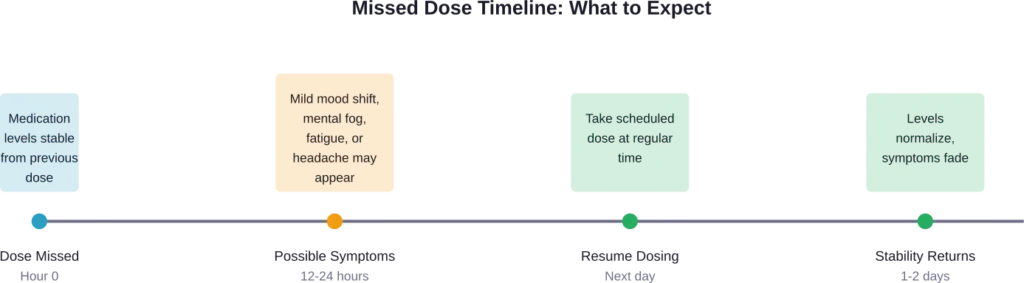
Most people won’t notice immediate effects from missing a single dose of Wellbutrin XL.
Bupropion has a relatively long half-life compared to some antidepressants, meaning it doesn’t leave your system immediately. The medication you took yesterday is still partially working today, even if you forgot this morning’s dose.
If symptoms appear, they usually develop within 12 to 24 hours after the missed dose. Common experiences include:
- Subtle mood shifts or increased irritability
- Difficulty concentrating or mental fog
- Slight increase in fatigue or drowsiness
- Mild headache
- Temporary return of depression symptoms
These effects are generally mild and transient. Once regular dosing resumes, stability often returns within a day or two.
That said, everyone metabolizes medication differently. Some people are highly sensitive to missed doses, while others barely notice. Neither response is abnormal.
Withdrawal Symptoms: When Missing Doses Becomes a Pattern
Missing one dose is different from missing several doses or stopping the medication abruptly.
According to the American Academy of Family Physicians, antidepressant discontinuation syndrome occurs in some patients after abrupt discontinuation of an antidepressant medication taken for at least six weeks. These symptoms usually are mild, last one to two weeks, and are rapidly extinguished with reinstitution of medication.
Bupropion withdrawal symptoms can include:
- Flu-like symptoms (achiness, fatigue, chills)
- Insomnia or vivid dreams
- Nausea or digestive upset
- Sensory disturbances (sometimes described as “brain zaps”)
- Increased anxiety or agitation
- Mood instability or tearfulness
The AAFP notes that antidepressant discontinuation syndrome is more likely with a longer duration of treatment and medications with shorter half-lives. While bupropion’s half-life is moderate, stopping it suddenly after months or years of use can still trigger withdrawal effects.
But here’s the distinction: missing one dose isn’t stopping the medication. It’s a brief interruption, not discontinuation.
The Seizure Risk: Why Bupropion Requires Extra Caution
The biggest safety concern with Wellbutrin isn’t what happens when you miss a dose—it’s what can happen if you try to compensate by taking extra medication.
According to the NIH, bupropion lowers the seizure threshold. This means the medication makes neurons in the brain more excitable and more likely to fire in the abnormal, synchronized pattern that causes seizures.
At therapeutic doses taken correctly, this risk is low. But it increases significantly with higher doses or when doses are taken too close together.
According to the official prescribing information for Wellbutrin XL, time to peak plasma concentrations for bupropion is approximately 5 hours after dosing. The extended-release formulation is specifically designed to prevent rapid spikes in blood levels.
When someone takes two XL tablets within 24 hours—either intentionally to “catch up” or accidentally because they forgot they already took one—they override this safety mechanism.
Patients at higher baseline risk include those with:
- History of seizure disorder or epilepsy
- Current or past eating disorders (anorexia or bulimia)
- Alcohol or benzodiazepine withdrawal
- Traumatic brain injury or head trauma history
- Brain tumors or structural abnormalities
- Taking medications that also lower seizure threshold
But seizures have occurred in people without any of these risk factors when bupropion doses were too high or too close together. The risk exists for everyone—it’s just higher for some.
How Bupropion Compares to SSRIs When You Miss a Dose
Different antidepressants have different forgiveness factors when it comes to missed doses.
SSRIs like fluoxetine (Prozac) have very long half-lives. Fluoxetine stays in the system for days, so missing one dose rarely causes noticeable effects. Other SSRIs like paroxetine (Paxil) have shorter half-lives and can cause more immediate discontinuation symptoms.
Bupropion falls somewhere in the middle. It doesn’t cause the “brain zaps” and dizziness commonly reported with SSRI discontinuation, but it also doesn’t have the multi-day buffer that fluoxetine provides.
The critical difference is seizure risk. With SSRIs, taking two doses close together might cause nausea or jitteriness, but it’s rarely dangerous. With bupropion, the stakes are higher.
| Medication Class | Example Drugs | Typical Half-Life | Missed Dose Impact | Risk of Doubling Dose |
|---|---|---|---|---|
| SSRI (long) | Fluoxetine | 4-6 days | Minimal | Low |
| SSRI (short) | Paroxetine | 21 hours | Moderate | Low to moderate |
| SNRI | Venlafaxine | 5 hours | Moderate to high | Moderate |
| NDRI | Bupropion XL | 21 hours | Low to moderate | High (seizure risk) |
What to Do When You Miss More Than One Dose
Missing a single dose is manageable. Missing multiple doses requires more careful handling.
If you’ve missed two or three consecutive doses of Wellbutrin XL, don’t try to restart at your full dose without medical guidance. The medication has cleared your system more substantially, and restarting abruptly at a high dose can cause side effects or increase seizure risk.
Contact your healthcare provider before resuming. They may recommend:
- Restarting at your usual dose if you’ve only missed 2-3 days
- Temporarily reducing the dose and titrating back up
- Monitoring for side effects more closely during the first few days
- Adjusting your overall treatment plan if adherence is consistently difficult
If you’ve been off Wellbutrin for a week or more, you’re essentially restarting the medication, not just resuming it. The standard protocol is to begin at a lower dose (typically 150 mg XL) and increase gradually to minimize side effects and seizure risk.
Recognizing When to Contact Your Doctor
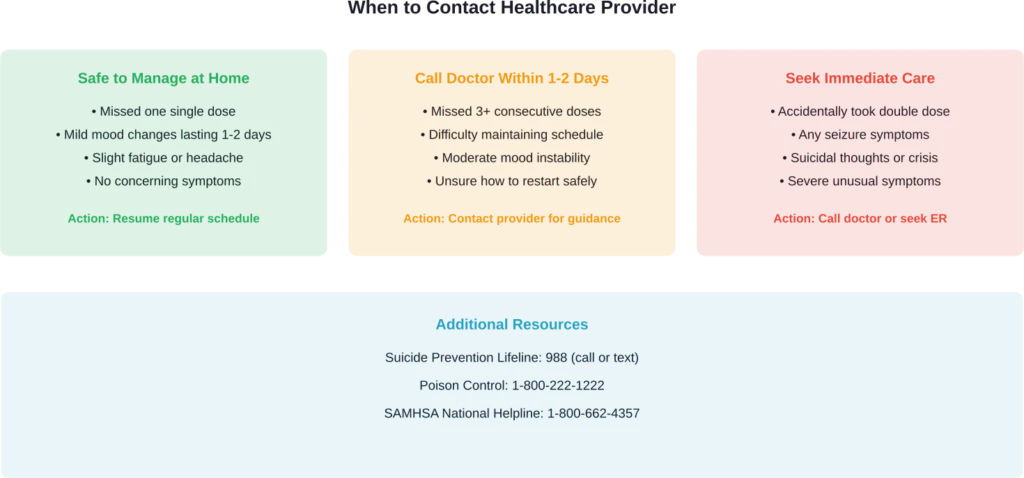
Most missed doses don’t require emergency medical attention. But certain situations warrant a call to your healthcare provider.
Contact your doctor if:
- You’ve accidentally taken two doses within 24 hours
- You’re experiencing severe mood changes or suicidal thoughts after missed doses
- You’ve missed multiple consecutive doses and aren’t sure how to restart
- You’re having difficulty maintaining a consistent schedule with the medication
- You’re experiencing unusual symptoms that concern you
Seek immediate medical attention if you experience signs of a seizure, including:
- Sudden uncontrolled shaking or convulsions
- Loss of consciousness
- Confusion or disorientation after a period you can’t remember
- Tongue biting or loss of bladder control
These symptoms are rare but serious. Seizures are a medical emergency.
Practical Strategies to Avoid Missing Doses
The best way to handle a missed dose is to prevent it from happening in the first place.
Consistency matters more with Wellbutrin XL than with many medications because of the seizure threshold issue. Building reliable habits reduces risk.
Effective strategies include:
Link medication to an existing habit. Take Wellbutrin XL at the same time every morning, tied to something you already do daily—making coffee, brushing teeth, feeding pets. The established routine becomes your reminder.
Use smartphone alarms or medication apps. Set a daily alarm with a specific label like “Wellbutrin” rather than just a generic time. Medication reminder apps can track doses and send persistent notifications.
Keep medication visible. Store your Wellbutrin bottle somewhere you’ll see it during your morning routine, not hidden in a cabinet. Visual cues are powerful memory triggers.
Use a pill organizer. Weekly pill organizers let you see at a glance whether you’ve taken today’s dose. This eliminates the “did I already take it?” uncertainty that sometimes leads to skipped or doubled doses.
Set up automatic refills. Running out of medication is a common cause of missed doses. Pharmacy auto-refill programs ensure your prescription is ready before you run out.
Keep backup doses accessible. If you travel or spend time away from home regularly, keep a few backup doses in your car, office, or travel bag. Just rotate them regularly to maintain freshness.
Understanding Wellbutrin XL Formulation and Timing
The “XL” in Wellbutrin XL stands for extended-release. This formulation uses proprietary technology to release bupropion slowly over 24 hours.
According to the official prescribing information, food does not affect the maximum concentration or total absorption of Wellbutrin XL. This means it can be taken with or without food based on personal preference.
Most people take Wellbutrin XL in the morning because bupropion can be activating or energizing. Taking it too late in the day may interfere with sleep for some individuals.
The tablets should be swallowed whole, not crushed, cut, or chewed. The extended-release mechanism is built into the tablet structure, and breaking it releases all the medication at once rather than gradually.
Wellbutrin XL is available in three strengths: 150 mg, 300 mg, and 450 mg. Treatment typically begins at 150 mg once daily, with increases after at least three days if needed.
Generic vs. Brand Name: Does It Matter for Missed Doses?
Bupropion XL is available as both brand-name Wellbutrin XL and generic versions from multiple manufacturers.
The FDA requires generic medications to be bioequivalent to brand-name versions, meaning they must deliver the same amount of active ingredient into the bloodstream at the same rate. However, the inactive ingredients and manufacturing processes can differ.
Some patients report different experiences with different generic manufacturers—variations in side effects, effectiveness, or how consistent the extended-release mechanism feels. These differences are generally subtle, but they can be noticeable for individuals who are sensitive to formulation changes.
Research comparing bupropion XL and SR formulations found similar effectiveness and adverse event profiles when used to treat smoking among patients at a comprehensive cancer center. The analysis examined 648 patients across treatment protocols.
Whether taking brand or generic, the guidance for missed doses remains the same: skip it and resume at the next scheduled time. Never double up.
Special Considerations for Different Patient Populations
Certain groups need additional caution with Wellbutrin XL dosing.
Older adults may metabolize bupropion more slowly, leading to higher blood levels from the same dose. Missed doses might have slightly longer-lasting effects, and the importance of not doubling up is even more critical.
People with liver or kidney impairment also clear the medication more slowly. Standard dosing guidelines often recommend lower maximum doses for these individuals, making dose-doubling particularly risky.
Patients taking multiple medications need to consider drug interactions. Some medications increase bupropion levels (like certain HIV drugs), while others are metabolized by the same liver pathways and can compete for processing.
People using bupropion for smoking cessation are typically on different dosing schedules than those using it for depression. The same missed-dose rules apply, but the lower typical doses used for smoking cessation carry slightly lower seizure risk.
The Relationship Between Adherence and Treatment Outcomes
Consistently taking antidepressants as prescribed significantly improves treatment outcomes.
Research on bupropion for ADHD in adults found low-quality evidence that bupropion decreased the severity of symptoms, but noted that small sample sizes and adherence issues affected study quality. Consistent dosing helps medications work as intended.
Depression treatment typically requires 4-6 weeks at therapeutic doses before full effects appear. Frequent missed doses can delay or prevent reaching this steady state, making it harder to assess whether the medication is actually working.
If adherence is consistently difficult—whether due to side effects, complicated schedules, cost barriers, or other factors—discussing this openly with a healthcare provider is important. Alternatives might include:
- Switching to a different antidepressant with more forgiving dosing
- Addressing side effects that make taking the medication unpleasant
- Exploring combination treatments that might be more effective
- Connecting with resources to address cost or access barriers
The goal is effective treatment, not perfect adherence to a regimen that isn’t working in real life.
Common Misconceptions About Missed Antidepressant Doses
Several myths persist about what happens when antidepressant doses are missed.
Myth: Missing one dose undoes all your progress. Treatment progress with antidepressants builds over weeks. Missing a single dose doesn’t reset this progress to zero, though very inconsistent dosing can interfere with maintaining therapeutic levels.
Myth: You should take the missed dose as soon as you remember, even if it’s been 20 hours. With Wellbutrin XL specifically, this is dangerous advice. If more than a few hours have passed since your usual dosing time, skip it entirely.
Myth: Generic medications don’t work as well, so missing a dose matters less. Generic bupropion XL must meet FDA bioequivalence standards. The rules for missed doses apply equally to brand and generic versions.
Myth: Withdrawal symptoms from one missed dose mean the medication isn’t right for you. Some people are more sensitive to plasma level fluctuations. This doesn’t necessarily mean the medication is wrong—it means consistency is especially important for those individuals.
Frequently Asked Questions
No, skip the missed dose entirely if it’s been more than a few hours since your normal dosing time. Taking Wellbutrin XL late in the day can interfere with sleep, and taking it too close to the next morning’s dose increases seizure risk. Resume with your regular dose the following morning.
Contact your healthcare provider or poison control immediately. Taking two doses within 24 hours significantly increases seizure risk. Watch for symptoms like tremors, confusion, rapid heartbeat, or agitation, and seek emergency care if you experience any signs of a seizure.
Most people won’t experience true withdrawal symptoms from a single missed dose. Bupropion has a moderate half-life, so some medication from previous doses remains in your system. Some individuals may notice mild mood changes or fatigue within 12-24 hours, but these effects are usually subtle and resolve when regular dosing resumes.
With a half-life of approximately 21 hours, bupropion takes about 4-5 days to be mostly eliminated from the body after the last dose. However, active metabolites can remain detectable for longer. This is why suddenly stopping the medication can cause discontinuation effects lasting one to two weeks.
Missing a dose is significantly safer than taking two doses within 24 hours. A single missed dose might cause temporary mild symptoms, but doubling up creates serious seizure risk. If you’re uncertain whether you took your morning dose, it’s safer to skip that day than risk taking a second dose.
No, Wellbutrin XL tablets must be taken whole and cannot be split. The extended-release formulation is designed for once-daily dosing. Splitting tablets destroys the controlled-release mechanism and can cause dangerous spikes in blood levels. If twice-daily dosing works better for your schedule, ask your doctor about Wellbutrin SR instead.
Backup reminders are wise even for consistent routines. Schedule changes, travel, illness, or stress can disrupt even well-established habits. A smartphone alarm or medication app provides a safety net that costs nothing and prevents the anxiety of wondering whether you remembered your dose.
Moving Forward With Confidence
Missing a dose of Wellbutrin XL isn’t a crisis, but it requires specific handling due to the medication’s unique seizure risk profile.
The core principle is simple: skip the missed dose and resume your regular schedule. Never try to catch up by taking extra medication.
Most people won’t experience significant effects from occasionally missing a single dose. Building consistent habits minimizes how often it happens, and knowing what to do when it does happen reduces stress and keeps treatment on track.
If missed doses become a pattern, that’s valuable information. It might signal that the current medication or dosing schedule isn’t the right fit, or that barriers to adherence need addressing. Either way, discussing it with a healthcare provider opens the door to solutions that work better for real life.
Depression treatment is a marathon, not a sprint. One missed dose along the way doesn’t define the journey.
Taking antidepressants consistently is important, but beating yourself up over occasional mistakes isn’t helpful. What matters is getting back on track, knowing when to seek help, and staying engaged with the process of finding what works best.
If you’re struggling with medication adherence, experiencing concerning symptoms, or wondering whether Wellbutrin XL is the right choice for your situation, reach out to your healthcare provider. These conversations are what they’re there for—and they’re often more helpful than you might expect.