
Quick Summary: Getting caught with a ghost gun can result in federal charges carrying up to 10 years in prison, especially if you’re a prohibited person. The Supreme Court’s 2025 ruling upheld ATF regulations requiring serial numbers on all firearms, including parts kits and 80% lowers. State penalties vary widely, with some states treating possession as a misdemeanor while others impose felony charges.
Ghost guns have gone from legal gray area to federal crime in a matter of years. The Supreme Court settled this debate in March 2025, upholding the ATF’s Frame and Receiver Rule by a 7-2 vote. What used to be a loophole is now clearly prosecutable under federal law.
So what actually happens if law enforcement finds you with an unserialized firearm? The answer depends on who you are, what state you’re in, and how you got the gun.
Let’s break down the real consequences, the federal regulations that changed everything, and what defense options exist.
What Qualifies as a Ghost Gun Under Federal Law
According to the ATF, privately made firearms (PMFs) are firearms completed, assembled, or produced by someone other than a licensed manufacturer. These guns lack serial numbers placed by licensed manufacturers at the time of production.
But here’s the thing—not all PMFs are illegal. The ATF clarifies that not all firearms are required to have serial numbers under certain circumstances.
The ATF’s Frame and Receiver Rule, which went into effect August 24, 2022, redefined what qualifies as a firearm under the Gun Control Act. Before this rule, manufacturers could sell unfinished frames and receivers—the core component that makes a gun function—as long as they were less than 80% complete.
That loophole is gone. The rule now treats weapon parts kits and unfinished frames as firearms requiring serialization, background checks, and dealer licensing.
The “80% Lower” Confusion
Plenty of people bought 80% lowers thinking they were operating within legal boundaries. The marketing promised these parts fell outside federal regulation because they weren’t “firearms” yet.
Wrong. After August 2022, those same parts became regulated items. And after the Supreme Court’s 2025 decision, anyone caught with completed ghost guns made from these parts faces serious federal exposure.
The rule applies to frames, receivers, and parts kits that can be readily converted into functional firearms. The phrase “readily converted” is doing a lot of legal heavy lifting here.
Federal Penalties for Ghost Gun Possession
Federal ghost gun charges typically fall under 18 U.S.C. § 922, the same statute covering most federal firearms violations.
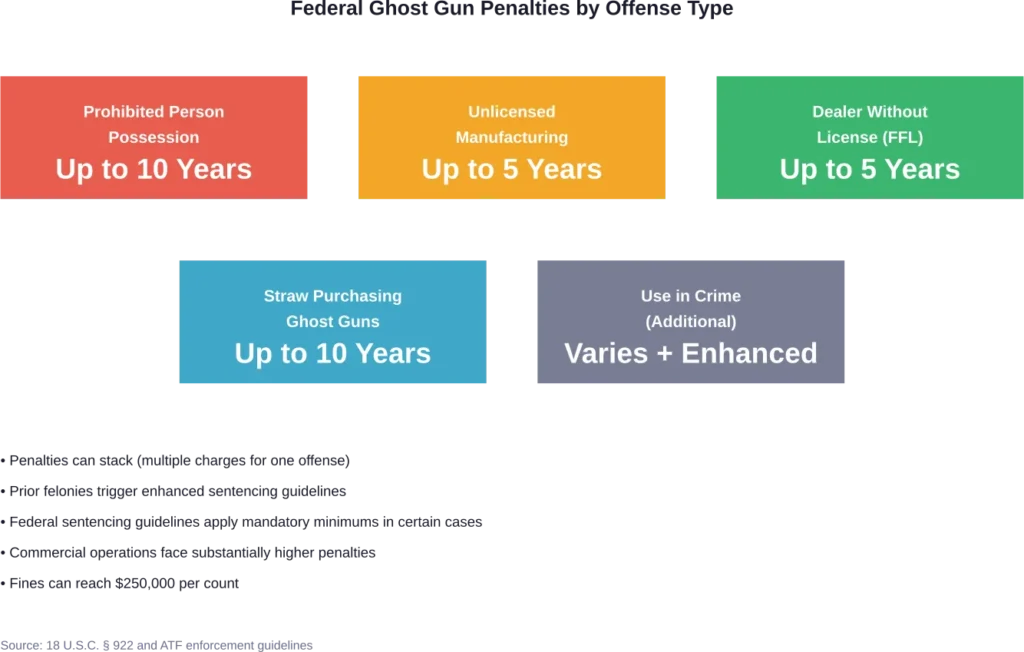
For a prohibited person—someone with a felony conviction, domestic violence misdemeanor, or other disqualifying factor—possessing any firearm, serialized or not, carries up to 10 years in federal prison.
But you don’t need to be a prohibited person to face charges. Manufacturing, selling, or distributing unserialized firearms without proper licensing violates federal law. The penalties escalate if you’re running a commercial operation.
Commercial vs. Personal Use
The ATF distinguishes between someone building a single gun for personal use and someone manufacturing guns for sale. If you’re making ghost guns to sell, you’re required to have a Federal Firearms License (FFL), serialize the firearms, and maintain proper records.
Operating without an FFL while engaging in the business of manufacturing firearms carries separate charges beyond simple possession. These charges can stack, meaning you face multiple counts simultaneously.
Real talk: federal prosecutors love stacking charges. One ghost gun can generate multiple violations—unlicensed manufacturing, dealing without a license, possession by a prohibited person, and failure to serialize.
Who Actually Gets Prosecuted
Federal prosecutors prioritize certain ghost gun cases over others. Based on available data, here’s who’s most likely to face charges:
Prohibited persons caught with ghost guns almost always face prosecution. The Bureau of Justice Statistics has documented steady increases in federal weapons prosecutions since the 1990s, and ghost guns now represent a growing share of those cases.
According to data from Minnesota, ghost guns traced by the ATF jumped from 187 between 2017-2021 to 631 between 2022-2023—a 237% increase. Minnesota ranked 16th nationally for ghost guns recovered in crimes during that period, with ghost guns comprising 6% of all crime guns submitted for tracing.
People selling ghost guns without a license are high-priority targets. Federal law enforcement aggressively pursues unlicensed dealers involved in ghost gun distribution.
Cases involving ghost guns used in violent crimes receive maximum attention. If your ghost gun was present during a robbery, assault, or other felony, expect the book thrown at you.
The Prohibited Person Trap
Many ghost gun prosecutions stem from this scenario: someone legally barred from owning firearms builds or buys a ghost gun thinking the lack of serial number provides cover.
It doesn’t. The serialization requirement exists for tracing purposes, but possession itself is the crime for prohibited persons. Whether the gun has a serial number is irrelevant to the underlying charge.
This trap catches people who assume ghost guns exist in some legal twilight zone. They don’t—not anymore.
State-Level Ghost Gun Laws
State laws vary dramatically. Sixteen states have adopted specific ghost gun regulations as of 2026, while others rely on federal enforcement or have no restrictions.
California leads with some of the strictest laws. California Attorney General Rob Bonta released an informational bulletin in December 2025 about Assembly Bill 1263 and Senate Bill 704, both addressing ghost guns and illegal firearm manufacturing effective January 1, 2026.
New York aggressively enforces ghost gun laws. On June 1, 2022, Attorney General Letitia James ordered 28 firearms sellers to stop selling and advertising ghost gun parts. Nine businesses were in Western New York, six on Long Island, five in Central New York, four in the Hudson Valley, two in the Southern Tier, and one in the Capital Region.
North Carolina, by contrast, has no state law restricting untraceable firearms or undetectable firearms as of December 2023, according to research from Giffords Law Center.
The District of Columbia saw ghost gun recoveries skyrocket from three in 2017 to 263 in 2020—representing 13% of all guns recovered by the Metropolitan Police Department.
| State Approach | Examples | Typical Penalties |
|---|---|---|
| Comprehensive regulation | California, New York, New Jersey | Felony charges, 2-5 years prison |
| Partial restrictions | Hawaii, Maryland, Connecticut | Misdemeanor to felony depending on circumstances |
| Federal enforcement only | North Carolina, Texas, Florida | Federal charges apply, state charges rare |
| No specific ghost gun laws | Wyoming, Montana, Alabama | General firearms laws apply |
The Supreme Court Ruling That Changed Everything
The Supreme Court’s March 2025 decision validated the ATF’s authority to regulate ghost guns under existing federal firearms law. The 7-2 vote rejected arguments that unfinished frames and parts kits fell outside the Gun Control Act’s scope.
This wasn’t the Court creating new law. It was the Court confirming that the ATF’s interpretation of existing law—specifically the definition of “firearm”—was reasonable and enforceable.
Before this ruling, some defendants argued that 80% lowers and parts kits didn’t meet the legal definition of firearms. That defense is now dead on arrival in federal court.
The ruling affects pending cases nationwide. People charged before March 2025 who were counting on challenging the ATF rule lost that option. Cases that might have resulted in dismissals or plea deals now proceed to trial or sentencing.
What the Law Actually Says Now
The ATF’s Frame and Receiver Rule requires that:
- Frames, receivers, and parts kits readily convertible to functional firearms must be serialized
- Anyone engaged in the business of manufacturing or dealing these items needs an FFL
- Background checks are required for sales of ghost gun parts and kits
- Proper recordkeeping and tracing mechanisms must be maintained
The definition of “readily convertible” includes parts that can be made functional with minimal tools, time, or expertise. This captures most 80% lowers and buy-build-shoot kits marketed online.
Real-World Ghost Gun Prosecutions
Federal ghost gun cases are hitting dockets across the country. While specific case details from the Department of Justice sources provided were limited due to technical issues, the pattern is clear: ghost gun charges are being actively prosecuted.
Convicted felons caught with ghost guns while awaiting sentencing on other charges face enhanced penalties. Using a ghost gun during supervised release or probation violates federal conditions and triggers additional charges.
Four defendants sentenced to prison on federal firearms charges represent the broader trend of multi-defendant conspiracies involving ghost gun manufacturing and distribution. These operations often span state lines, triggering federal jurisdiction.
According to national data, ghost guns recovered by law enforcement increased 1,588% from 2017 to 2023. More than 92,700 ghost guns were recovered across the country during that period.
That explosion in recoveries directly correlates with increased prosecutions. The federal government is dedicating substantial resources to ghost gun enforcement.

Defenses Against Ghost Gun Charges
Defense strategies exist, but they’re narrower after the Supreme Court ruling.
Challenging knowledge of the law rarely works. Ignorance isn’t a defense in federal court. Claiming you didn’t know the Frame and Receiver Rule applied won’t save you.
Challenging whether the item qualifies as a firearm under the definition might work in edge cases. If the parts truly can’t be readily converted without substantial machining or expertise, the defense could argue they don’t meet the regulatory definition.
But that’s a technical argument requiring expert testimony. And after the Supreme Court ruling, judges are far less receptive to challenges to the ATF’s definitional authority.
Fourth Amendment challenges to the search and seizure might suppress evidence. If law enforcement violated constitutional protections when they found the ghost gun, that evidence could be excluded. Without the evidence, the case collapses.
Negotiating plea deals remains common. Federal prosecutors may negotiate plea agreements in certain circumstances. If you’re not a prohibited person and weren’t engaged in commercial activity, a plea to reduced charges might be explored through legal counsel.
That said, defense options are limited. The best strategy is avoiding possession in the first place.
Penalty and Sentencing Considerations
Federal sentencing guidelines calculate penalties based on multiple factors: criminal history, offense characteristics, role in the offense, and acceptance of responsibility.
A first-time offender caught with a single ghost gun for personal possession faces different consequences than someone with prior felonies running a ghost gun manufacturing operation.
Acceptance of responsibility—pleading guilty and cooperating—can reduce sentences by up to three offense levels under federal guidelines. That’s substantial in terms of actual prison time.
Mandatory minimums apply in certain circumstances, particularly for prohibited persons with prior violent felonies. The Armed Career Criminal Act imposes a 15-year mandatory minimum for prohibited persons with three prior violent felony or serious drug offense convictions.
Fines can reach $250,000 per count. Multiple counts mean multiple fines. A conviction on three charges could theoretically carry $750,000 in fines, though actual fines imposed tend to be lower.
Supervised release follows prison time—typically three years. Violating supervised release conditions sends you back to prison.
What to Do If You’re Caught
First rule: don’t talk to law enforcement without an attorney. Anything you say will be used against you. Period.
People try to explain their way out of ghost gun charges. They tell officers they didn’t know the law changed, or they built the gun before the rule took effect, or they never intended to use it.
None of that helps. All of it creates statements prosecutors will use at trial or sentencing.
Invoke your Fifth Amendment right to remain silent. Request an attorney immediately. Then actually remain silent.
Second, contact a federal criminal defense attorney experienced in firearms cases. Ghost gun prosecutions involve complex regulatory frameworks. General criminal defense attorneys may lack the specific expertise needed.
Third, don’t destroy evidence or obstruct the investigation. That creates additional charges and eliminates any chance of cooperation credit.
Frequently Asked Questions
Federal law now requires ghost guns to be serialized, and sellers must conduct background checks. Some states ban them entirely, while others allow possession if the gun complies with federal serialization requirements. Generally speaking, owning a properly serialized PMF that you built for personal use may be legal in states without specific bans, but the legal landscape is complex and evolving.
The term “ghost gun” typically refers to firearms built from parts kits or unfinished frames without serial numbers. Older firearms manufactured before serialization requirements existed might lack serial numbers but aren’t ghost guns. The key distinction is whether the firearm was made to evade tracing, which is the concern with modern ghost guns.
No. Serializing a ghost gun after law enforcement discovers it doesn’t undo the prior violation. The crime is possessing the unserialized firearm, and that offense is complete once you possessed it. Retroactive compliance doesn’t erase criminal liability.
Not exactly. The ATF’s rule regulates how 80% lowers are sold and who can sell them. Licensed manufacturers can sell them, but they must serialize them, conduct background checks, and keep records. The unregulated sale of unfinished frames is what’s illegal—not the existence of the parts themselves.
Under federal law, individuals can still build firearms for personal use, but the gun must be serialized according to ATF requirements. You cannot build guns with the intent to sell them without an FFL. The line between personal use and engaging in the business of manufacturing is a major enforcement focus.
Possession is possession in the eyes of the law. How you acquired the ghost gun rarely matters to the underlying charge. If you’re a prohibited person, possessing any firearm—regardless of how you got it—violates federal law. If you discover a ghost gun, the safest course is contacting an attorney before handling it further.
Federal law exempts antique firearms (generally those manufactured before 1899) from many modern regulations. These guns often lack serial numbers but aren’t ghost guns under current definitions. The ATF’s Frame and Receiver Rule focuses on modern firearms and components designed to evade tracing.
The Bottom Line
Ghost gun possession carries serious federal consequences that only got more severe after the Supreme Court’s 2025 ruling. The legal ambiguity that once existed is gone.
Federal prosecutors are actively pursuing ghost gun cases, particularly involving prohibited persons and unlicensed dealers. State enforcement varies, but the trend is toward stricter regulation and harsher penalties.
If you’re caught with a ghost gun, expect federal charges carrying up to 10 years in prison for prohibited persons, or up to 5 years for unlicensed manufacturing or dealing. Fines can reach $250,000 per count. These aren’t abstract possibilities—they’re the actual penalties being imposed in federal courts right now.
The recovery data tells the story: over 92,700 ghost guns recovered from 2017 to 2023, with a 1,588% increase during that period. Law enforcement is finding these guns, and prosecutors are charging the people who possess them.
Defense options exist but are limited. The best defense is understanding the law and avoiding violations. If you already possess an unserialized firearm, consulting a firearms attorney about compliance options is critical.
The ghost gun era of legal uncertainty is over. What happens if you get caught? You face federal prosecution with very real prison time.