
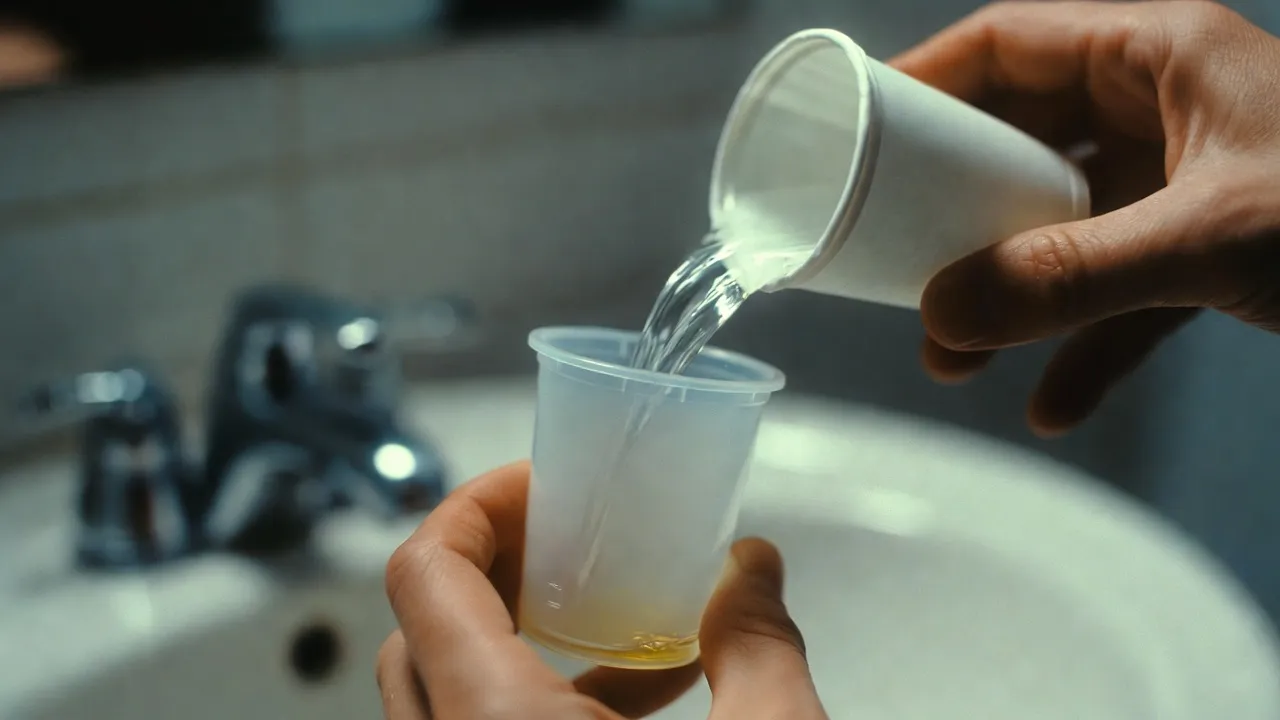
Quick Summary: Adding water directly to a urine sample or drinking excessive water before a drug test dilutes the specimen, triggering validity testing failures. Labs detect dilution through creatinine levels (below 20 mg/dL), specific gravity (below 1.003), and color analysis, treating flagged samples as positive results or requiring retests with serious employment consequences.
The internet overflows with claims about beating drug tests by diluting urine samples. Some people add water directly to the collection cup. Others chug gallons of water hoping to flush their system.
Here’s the thing though—modern drug testing labs aren’t fooled by these tactics. According to research published in the Journal of Food and Drug Analysis, specimen validity testing has become sophisticated enough to catch tampering attempts with remarkable accuracy.
The consequences go beyond just failing the test. Tampering with a urine sample can result in immediate job termination, legal issues, and permanent damage to professional reputation.
How Modern Labs Detect Diluted Urine Samples
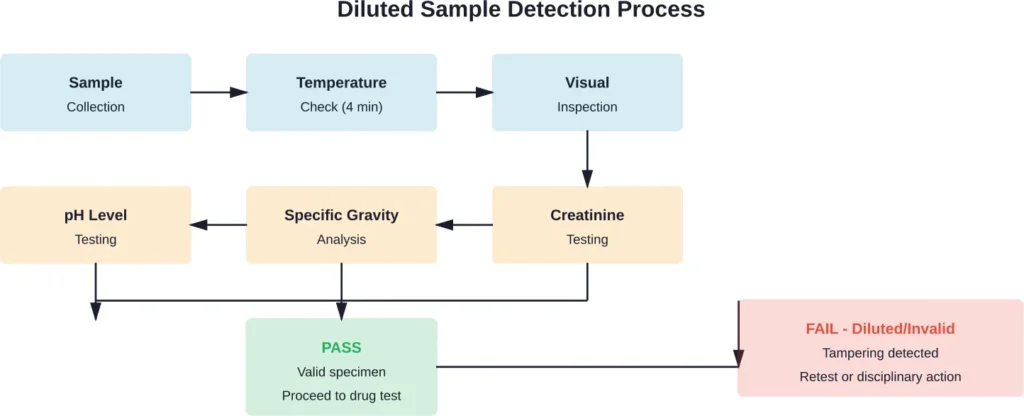
Drug testing facilities don’t just analyze urine for the presence of drugs. They run a complete specimen validity test (SVT) on every sample to ensure it’s authentic and hasn’t been tampered with.
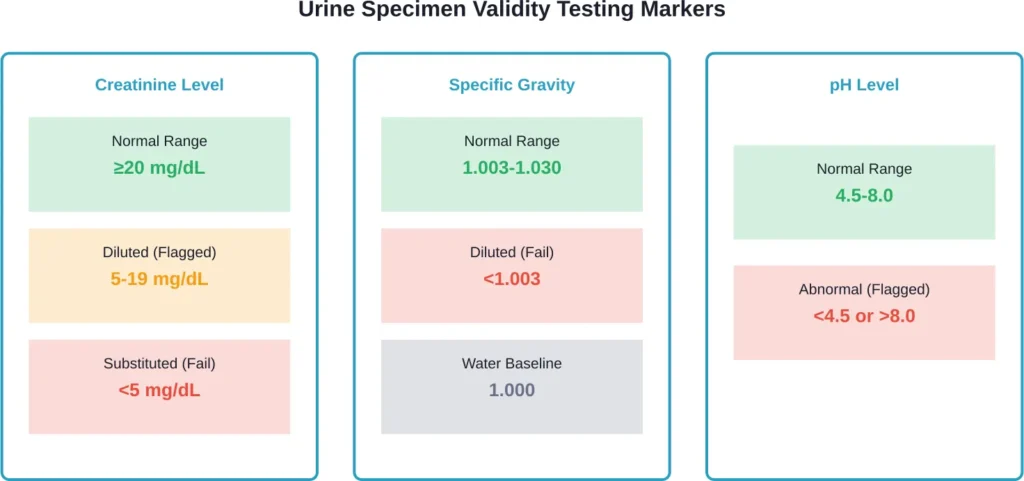
The detection system relies on three primary markers that reveal dilution immediately.
Creatinine Concentration Testing
Creatinine is a waste product produced by muscles and excreted through urine. Cutoff standards for valid specimens include creatinine levels (0.8–1.4 mg/dl for men; 0.6–1.1 mg/dl for women based on clinical normalcy ranges).
When water is added to urine—either directly or through excessive fluid consumption—creatinine levels drop dramatically. Labs flag any sample with creatinine below 20 mg/dL as diluted. Samples below 5 mg/dL are typically classified as substituted rather than just diluted.
This marker alone catches most dilution attempts because there’s no way to add creatinine to a sample that appears natural under laboratory scrutiny.
Specific Gravity Measurements
Specific gravity measures the density of urine compared to water. Normal human urine has a specific gravity between 1.003 and 1.030, with most samples falling between 1.010 and 1.025.
Water has a specific gravity of exactly 1.000. When water is added to urine, the specific gravity drops toward that baseline. Labs immediately flag samples with specific gravity below 1.003 as diluted.
Specific gravity testing combined with creatinine analysis provides a reliable method for detecting both direct water addition and excessive fluid intake.
Visual and pH Analysis
Lab technicians visually inspect urine samples before testing begins. Normal urine ranges from pale yellow to amber, depending on hydration levels. Clear, colorless urine raises immediate red flags.
But color alone isn’t the determining factor. A sample can appear yellow and still fail validity testing if creatinine and specific gravity measurements indicate dilution.
pH testing adds another layer. Normal urine pH ranges from 4.5 to 8.0. Samples outside this range suggest tampering with acidic or alkaline substances.
The Two Methods People Use (And Why Both Fail)
Tampering attempts fall into two categories: direct water addition and excessive fluid consumption before testing. Neither method works against modern screening protocols.
Adding Water Directly to the Sample
Some people pour water directly into the collection cup, either from the toilet bowl, sink, or a concealed container. This approach produces the most obvious red flags.
Direct water addition creates samples with creatinine levels far below the 20 mg/dL threshold and specific gravity readings approaching pure water at 1.000. The sample appears clear and colorless, and temperature readings may fall outside the required 90-100°F range for fresh urine.
Collection facilities have implemented safeguards against this method. Blue dye is added to toilet water. Sinks are disabled or removed from collection rooms. Temperature strips on collection cups verify samples are body temperature within four minutes of collection.
Drinking Excessive Water Before Testing
The alternative approach involves consuming large quantities of water hours before the test, hoping to dilute urine naturally through the body’s processing.
Research from Johns Hopkins University found that drinking water can produce diluted urine within 30 minutes to 1.5 hours. The effect is temporary but significant.
Here’s what happens physiologically: excess water intake reduces the concentration of everything in urine—not just drugs, but also creatinine and other natural waste products. The kidneys excrete the excess fluid, but the concentration of metabolites remains diluted for several hours.
Labs detect this internal dilution using the same creatinine and specific gravity markers. The sample may be warm and naturally produced, but it still fails validity testing.
| Water Consumed | Time to Dilution | Creatinine Impact | Detection Rate |
|---|---|---|---|
| 24 oz (2 glasses) | 30 minutes | Moderate reduction | High |
| 64 oz (8 glasses) | 1-2 hours | Significant reduction | Very High |
| 1 gallon+ | 2-3 hours | Severe reduction | Certain detection |
Real-World Detection Rates and Statistics
Medical research published by the National Institutes of Health analyzed thousands of workplace and court-mandated drug tests. The findings reveal just how effective specimen validity testing has become.
The study found that tampering attempts (including dilute, substituted, or invalid tests) showed a mean 5-year prevalence of 1.09% in workplace settings and 3.81% in court settings. Nearly all were detected through the validity testing protocols.
That higher rate in court settings makes sense. People facing legal consequences have stronger motivation to tamper with samples, but the detection methods remain equally effective.
Immunoassay screen-positive urine specimens were confirmed by gas chromatography/mass spectrometry (GC/MS). This two-stage process eliminates false positives while maintaining the ability to detect dilution attempts.
What Happens After a Diluted Sample Is Detected
The consequences of submitting a diluted sample depend on the testing context—workplace, legal, or medical—but none of the outcomes are favorable.
Workplace Testing Consequences
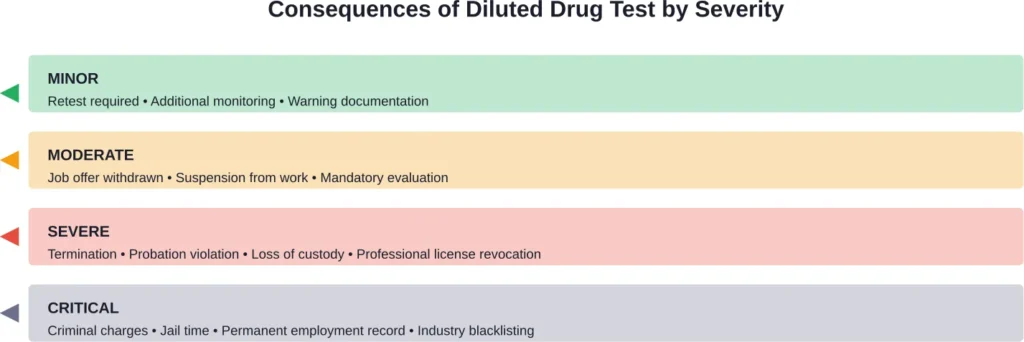
Most employers treat diluted samples according to their drug testing policy. Common responses include:
- Immediate retest under direct observation with no advance notice
- Presumption of positive result, leading to disciplinary action or termination
- Withdrawal of job offer for pre-employment screening
- Mandatory substance abuse evaluation and treatment
- Permanent notation in employment records
Some companies distinguish between negative-dilute (no drugs detected but diluted) and positive-dilute (drugs detected and diluted) results. A negative-dilute often triggers a retest, while positive-dilute is treated as a confirmed positive with tampering evidence.
Legal and Court-Ordered Testing
Probation, parole, child custody, and DUI monitoring programs view diluted samples as violations of court orders. Consequences escalate quickly:
- Probation or parole violation charges
- Jail time or extended supervision periods
- Loss of custody or visitation rights
- Additional fines and legal fees
- Presumption of guilt in pending cases
Courts interpret dilution attempts as consciousness of guilt, which can influence sentencing and credibility in ongoing legal proceedings.
Medical and Treatment Settings
Healthcare providers and addiction treatment programs use drug testing to monitor patient compliance and treatment effectiveness. Diluted samples undermine the therapeutic relationship and can result in:
- Discharge from treatment programs
- Denial of prescription medications
- Referral to more intensive treatment levels
- Loss of medical professional credibility regarding self-reported symptoms
Why People Attempt Dilution Despite Low Success Rates
Understanding the motivation behind tampering attempts reveals why people continue trying methods that rarely work.
Fear drives most decisions. Someone facing job loss, legal consequences, or loss of custody may feel desperate enough to try anything, even tactics with documented failure rates.
Misinformation contributes significantly. Online forums and social media spread anecdotal success stories without acknowledging the selection bias—people who got caught don’t typically post about their failures.
Some people genuinely don’t understand how sophisticated modern drug testing has become. They assume labs only test for drugs and don’t realize validity testing happens automatically on every sample.
The Science Behind Detection Speed
One common misconception is that dilution needs to be extreme to trigger detection. The reality is far more sensitive.
Creatinine testing can detect dilution from as little as two glasses of water consumed 30-90 minutes before sample collection. The body processes water quickly, and the dilution effect appears in urine within half an hour.
Specific gravity measurements are equally sensitive. The threshold of 1.003 allows for natural variation in hydration levels while catching deliberate dilution attempts. Normal daily hydration fluctuations rarely push specific gravity below this threshold.
Temperature monitoring adds another immediate checkpoint. Urine exits the body at approximately 94-96°F and cools about 1 degree per minute. Adding room-temperature water lowers the sample temperature below the acceptable 90-100°F range almost instantly.
Alternative Approaches for Those Facing Drug Tests
For individuals concerned about drug test results, legitimate options exist that don’t involve tampering.
Natural Elimination Through Abstinence
Different substances clear the body at different rates. Chronic use of such drugs as marijuana, PCP, and benzodiazepines may be detectable for up to 30 days, whereas alcohol remains in the system for 24 hours or less.
- Cocaine: 2-4 days for occasional use, up to 12 days for heavy use
- Amphetamines: 2-4 days
- Opioids: 2-3 days for most types
Abstinence before a scheduled test allows natural metabolism to eliminate substances without triggering validity test failures.
Medical Disclosure and Prescription Documentation
Many positive drug test results involve legitimate prescription medications. Amphetamines from ADHD medications, opioids from pain management, and benzodiazepines from anxiety treatment all trigger positive results.
Medical Review Officers (MROs) review all positive tests and contact individuals to verify legitimate prescriptions. Providing documentation prevents false positives without requiring sample manipulation.
Requesting Confirmation Testing
Initial drug screens use immunoassay testing, which can produce false positives from certain foods, supplements, or over-the-counter medications. Confirmation testing using gas chromatography/mass spectrometry eliminates these false positives.
Requesting confirmation testing is a legitimate right and provides accurate results without the risks associated with tampering.
Seeking Treatment and Support
For individuals struggling with substance use, treatment programs offer a path forward that addresses the underlying issue rather than just trying to hide it temporarily.
Many employers, courts, and treatment programs view proactive engagement with treatment more favorably than positive test results. Voluntary enrollment in substance abuse programs demonstrates accountability and commitment to change.
Common Myths About Beating Drug Tests
The internet spreads numerous myths about drug test manipulation. Most are not only ineffective but potentially dangerous.
Myth: Detox drinks mask drug metabolites. These products are essentially overpriced water with vitamins and creatine added. They work by causing dilution, which labs detect through validity testing. The added creatine doesn’t prevent detection because labs measure creatinine concentration, not absolute amount.
Myth: Vinegar, bleach, or other adulterants added to samples go undetected. Labs test for common adulterants including oxidizing agents, acids, and bases. Adding these substances triggers automatic failure and creates obvious evidence of tampering.
Myth: Synthetic urine is undetectable. While synthetic urine products exist, collection facilities use temperature monitoring, visual inspection, and sometimes observed collection to prevent substitution. Modern synthetic urine formulations must match specific gravity, pH, creatinine, and other markers exactly—and even then, collection protocols often catch the substitution attempt.
Myth: Exercise before the test helps. Vigorous exercise can temporarily release THC stored in fat cells into the bloodstream, actually increasing detection likelihood. Exercise is beneficial for long-term elimination but counterproductive immediately before testing.
Legal and Ethical Considerations
Beyond the practical failure of dilution attempts, legal and ethical implications deserve consideration.
Tampering with drug tests can constitute fraud in many jurisdictions, particularly in employment and legal contexts. Some jurisdictions may have legal consequences for tampering with drug tests.
Employment contracts often include language making drug test tampering grounds for immediate termination and potential legal action. The consequences extend beyond just the current job—termination for drug test fraud can affect future employment prospects and professional licensing.
In court-ordered testing scenarios, tampering can result in contempt of court charges, which carry their own penalties separate from the underlying case.
| Testing Context | Detection Method | Typical Consequence | Additional Risks |
|---|---|---|---|
| Pre-employment | Full SVT panel | Withdrawn job offer | Industry blacklisting |
| Workplace random | Full SVT panel | Termination | Loss of benefits, unemployment denial |
| Probation/parole | Enhanced SVT | Violation charge | Jail time, extended supervision |
| Child custody | Full SVT panel | Loss of custody/visitation | Court credibility damage |
| Medical treatment | Standard SVT | Program discharge | Medication denial |
How Collection Protocols Prevent Tampering
Testing facilities have implemented comprehensive collection protocols that address every known tampering method.
Controlled environments restrict access to water sources. Toilet water contains blue dye, sinks are disabled, and collection rooms are inspected before each use. These measures prevent direct water addition to samples.
Temperature monitoring happens immediately upon collection. The donor hands the sample to the collector who checks the temperature strip within four minutes. This timeline makes it nearly impossible to use substituted samples that have cooled below body temperature.
Direct observation collection occurs when previous tests were invalid or when testing is court-ordered. A same-gender observer watches the entire collection process, eliminating any opportunity for substitution or adulteration.
Chain of custody documentation tracks samples from collection through analysis. Tamper-evident seals and multiple signatures ensure sample integrity throughout the process.
The Future of Drug Testing Technology
Drug testing technology continues evolving to address new challenges and tampering methods.
Oral fluid testing is gaining adoption as an alternative to urine testing. Saliva samples are more difficult to adulterate, provide a shorter detection window that better indicates recent use, and can be collected under direct observation without privacy concerns.
Hair follicle testing provides detection windows of 90 days or longer and is virtually impossible to tamper with. While more expensive than urine testing, it’s becoming more common for positions requiring high security clearance.
Real-time validity testing instruments can now analyze samples at the collection site, providing immediate feedback about dilution, adulteration, or substitution. This eliminates the opportunity for individuals to claim their sample was contaminated during transport or storage.
Frequently Asked Questions
Labs cannot and do not distinguish between intentional dilution and natural hydration when creatinine and specific gravity fall below threshold levels. Any sample below 20 mg/dL creatinine or 1.003 specific gravity is flagged as diluted regardless of the cause. This is why maintaining normal hydration before a test is important—excessive water consumption, even if unintentional, triggers the same detection mechanisms as deliberate tampering.
Medical conditions like diabetes insipidus, kidney disease, or certain medications can legitimately affect urine concentration. If a medical condition causes chronically dilute urine, documentation from a physician should be provided to the Medical Review Officer before testing. Alternative testing methods like blood tests, hair follicle testing, or oral fluid testing may be appropriate in these cases. Never attempt to explain dilute results after the fact without prior medical documentation.
Dilution from drinking excess water typically affects urine concentration for 2-6 hours depending on the amount consumed and individual metabolism. The kidneys process excess fluid relatively quickly, and urine concentration gradually returns to normal levels. However, this timeframe is unpredictable enough that timing water consumption to avoid detection is unreliable and still triggers validity test failures during the dilution window.
Normal hydration—typically six to eight glasses of water spread throughout the day—will not cause diluted test results. Problems arise when people consume large quantities of water (a gallon or more) in the hours immediately before testing. Maintaining regular hydration habits rather than dramatically changing fluid intake before a test is the safest approach.
Retest policies vary by organization. Many employers allow one retest for negative-dilute results but treat it as a final opportunity. The retest typically occurs immediately or within 24 hours under direct observation. Court-ordered testing programs may or may not allow retests depending on the specific court order and monitoring requirements. Repeated diluted samples are typically treated as positive results regardless of the policy.
No legal products can mask drug metabolites in a way that evades modern testing protocols. Products marketed as detox drinks, flush kits, or cleansing supplements work primarily through dilution, which labs detect through specimen validity testing. The only reliable method to pass a drug test is abstinence for a sufficient period to allow natural elimination of drug metabolites from the body. Claims about masking products are marketing tactics that exploit fear and desperation.
If excessive water consumption was truly accidental and the test is scheduled, the best approach is to inform the collector before providing the sample. Some testing programs may allow rescheduling for later the same day when urine concentration has normalized. Attempting to provide a diluted sample and explaining afterward is viewed far less favorably than proactive communication. However, policies vary significantly, and rescheduling may not be permitted, particularly for random or court-ordered tests.
Understanding the Bigger Picture
Drug testing exists for legitimate workplace safety, legal compliance, and treatment monitoring purposes. While the process can feel invasive, the alternatives—impaired workers operating dangerous equipment, individuals on probation using prohibited substances, or patients misrepresenting their treatment compliance—create serious risks.
The sophistication of specimen validity testing reflects the stakes involved. Testing facilities invest in advanced detection methods because the consequences of undetected drug use extend beyond individual test-takers to coworkers, public safety, and vulnerable populations like children in custody cases.
For those facing drug tests while dealing with substance use issues, the solution isn’t tampering with samples. Treatment resources, employee assistance programs, and legal representation offer paths forward that address the underlying problem rather than temporarily masking symptoms.
Moving Forward: Making Informed Decisions
The evidence is clear: adding water to urine tests doesn’t work. Modern specimen validity testing catches dilution attempts with near certainty, and the consequences of getting caught typically exceed the consequences of a positive test result.
But beyond the practical failure, tampering represents a choice that compounds problems rather than solving them. It creates additional legal exposure, damages professional credibility, and delays addressing substance use issues that may benefit from treatment.
For anyone considering dilution as a strategy, the question isn’t whether it might work—the data shows it won’t. The real question is whether facing the situation honestly, exploring legitimate options like treatment or medical disclosure, and making sustainable changes offers a better path forward.
The answer, both from a practical standpoint and for long-term wellbeing, is consistently yes. Drug tests may feel like obstacles, but tampering with them creates far bigger problems than it solves. Understanding how the process works, why it’s designed the way it is, and what legitimate options exist provides the foundation for making decisions that serve long-term interests rather than short-term panic.
If substance use has created a situation where drug testing feels threatening, resources exist. Treatment programs, employee assistance services, legal counsel, and medical professionals can provide guidance that addresses root causes rather than just symptoms. That path requires courage and honesty, but it leads somewhere sustainable. Tampering with drug tests leads nowhere except deeper trouble.