
Quick Summary: Lying under oath, known as perjury, is a federal crime under 18 U.S.C. § 1621 that can result in up to five years in prison and substantial fines. Perjury requires proof that testimony was given under oath, the statement was materially false, the person knew it was false, and they acted willfully to deceive. Consequences extend beyond criminal penalties to include credibility damage, case dismissal, and professional sanctions.
A pivotal moment unfolds in the courtroom. The witness raises their right hand and solemnly swears to tell the truth, the whole truth, and nothing but the truth.
But what happens when that sacred promise gets broken?
The consequences aren’t just dramatic courtroom theatrics. Perjury is a serious federal crime that the justice system takes extremely seriously. According to the Department of Justice, perjury undermines the fundamental integrity of legal proceedings and can result in substantial criminal penalties.
Here’s what actually happens when someone lies under oath.
Understanding Perjury: The Legal Definition
Perjury isn’t just any lie told in a legal setting. It’s a specific criminal offense with precise requirements.
Under 18 U.S.C. § 1621, federal perjury law defines the crime as willfully stating or subscribing to material matter that the person does not believe to be true. The statute covers testimony given under oath before a competent tribunal, officer, or person authorized to administer oaths.
The key word here? Material.
Not every false statement constitutes perjury. The lie must relate to a material matter—something that could actually influence the proceeding or decision at hand. According to the Department of Justice, prosecutors must prove the false statement had a natural tendency to influence or was capable of influencing the decision of the tribunal.
So casual mistakes, misremembering details, or lying about irrelevant information typically won’t result in perjury charges.
What Prosecutors Must Prove
Securing a perjury conviction isn’t easy. The burden of proof rests entirely with the government, and they must establish specific elements beyond a reasonable doubt.
According to model jury instructions from the U.S. Courts for the Ninth Circuit, prosecutors must prove four critical elements:
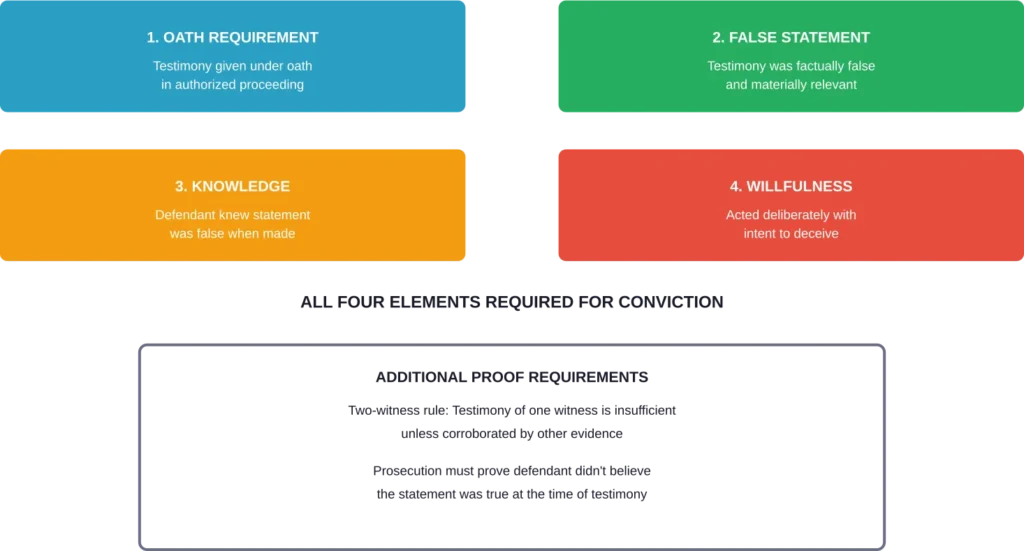
First, the defendant must have testified under oath, either orally or in writing. Second, the testimony must have been false. Third, the false testimony must have concerned a material matter. Fourth, the defendant must have acted willfully—meaning they knew the statement was false and made it with deliberate intent to deceive.
That willfulness requirement makes prosecution challenging. Honest mistakes, confusion, or faulty memory won’t support a conviction. The government must demonstrate the person deliberately lied, knowing the truth.
Criminal Penalties for Perjury
The consequences of a perjury conviction are severe and long-lasting.
Under federal law, perjury carries a maximum sentence of five years in federal prison. That’s the statutory maximum under 18 U.S.C. § 1621. Real-world sentences vary based on circumstances, criminal history, and the severity of the underlying case affected by the false testimony.
But prison time isn’t the only penalty.
Convicted perjurers face substantial fines, often reaching tens of thousands of dollars. They may also receive supervised release (similar to probation) after serving prison time, which can last several years with strict conditions.
A related offense, making false declarations under 18 U.S.C. § 1623 in bankruptcy proceedings, carries similar penalties. The Department of Justice actively prosecutes these cases to maintain the integrity of federal proceedings.
| Offense Type | Statute | Maximum Prison | Maximum Fine |
|---|---|---|---|
| General Perjury | 18 U.S.C. § 1621 | 5 years | Substantial fines under this title |
| False Declarations | 18 U.S.C. § 1623 | 5 years | Substantial fines under this title |
| Subornation of Perjury | 18 U.S.C. § 1622 | 5 years | Substantial fines under this title |
| Bankruptcy False Statements | 18 U.S.C. § 152 | 5 years | Substantial fines under this title |
Beyond Criminal Charges: Collateral Consequences
A perjury conviction doesn’t just mean prison and fines. The ripple effects can devastate professional and personal life.
For licensed professionals—attorneys, doctors, accountants, real estate agents—a perjury conviction often triggers disciplinary proceedings. Many professional licensing boards consider perjury a crime of moral turpitude, which can result in license suspension or permanent revocation.
Immigration consequences can be severe too. For non-citizens, perjury convictions may constitute grounds for deportation or inadmissibility, particularly if classified as an aggravated felony or crime involving moral turpitude.
Then there’s the credibility problem.
Once someone has been convicted of perjury, their testimony becomes virtually worthless in future legal proceedings. Courts and juries view convicted perjurers with extreme skepticism, making it nearly impossible to serve as a credible witness.
In the original case where the perjury occurred, the false testimony can lead to mistrials, case dismissals, or reversals of judgments. If perjury helped secure a conviction, that conviction may be overturned on appeal.
Subornation of Perjury: When Others Are Involved
It’s not just the person lying who faces consequences. Anyone who convinces or encourages someone else to commit perjury can be charged with subornation of perjury under 18 U.S.C. § 1622.
According to model jury instructions, prosecutors must prove the defendant voluntarily and intentionally persuaded another person to commit perjury, acted with intent that the person testify falsely, and the witness actually testified falsely in a proceeding.
Subornation carries the same penalties as direct perjury—up to five years in federal prison and substantial fines.
This statute targets attorneys who coach witnesses to lie, parties who pressure others to give false testimony, or anyone who orchestrates perjured statements. The Department of Justice treats these cases seriously because they represent deliberate corruption of legal proceedings.
When Perjury Gets Prosecuted (And When It Doesn’t)
Here’s the thing though—not every lie under oath results in prosecution.
Perjury prosecutions are relatively rare compared to the frequency of false testimony. Prosecutors face significant challenges: proving someone willfully lied (rather than misremembered) is difficult, juries are often reluctant to convict on perjury alone, and the two-witness rule creates evidentiary hurdles.
Generally speaking, prosecutors prioritize perjury cases where:
- The false testimony directly impacted a verdict or major decision
- Clear documentary evidence contradicts the sworn statement
- The lie involved serious underlying crimes or corruption
- The perjury obstructed justice in significant cases
- The witness brazenly lied about easily verifiable facts
Recent Department of Justice press releases demonstrate active prosecution. Cases include witnesses charged for lying during trials, defendants convicted for false statements during sentencing proceedings, and individuals prosecuted for perjury in bankruptcy and immigration proceedings.
But minor inconsistencies, memory lapses, or arguable interpretations of questions rarely trigger charges. Prosecutors must allocate limited resources to cases where perjury substantially undermined justice.
Defenses Against Perjury Charges
Being charged with perjury doesn’t guarantee conviction. Several defenses can defeat perjury charges if the evidence supports them.
The recantation defense allows someone who gave false testimony to correct it. If the person voluntarily admits the falsehood before it substantially affects the proceeding and before discovery of the falsification, they may avoid conviction. The key? Timing matters. The correction must come quickly and genuinely.
Lack of materiality provides another defense. If the prosecution can’t prove the false statement actually mattered to the case outcome, the materiality element fails. Lies about peripheral, irrelevant details don’t constitute perjury.
Honest mistake or memory failure defeats the willfulness requirement. If someone genuinely believed their testimony was true when given, even if objectively false, they lacked the required criminal intent. Confusion, poor memory, or misunderstanding the question can all negate willfulness.
Ambiguous questions create defense opportunities too. If the question asked was unclear or could be interpreted multiple ways, the answer may not be objectively false. Witnesses aren’t required to interpret vague questions favorably to opposing counsel.

Frequently Asked Questions
Yes. Perjury is a federal crime regardless of whether the proceeding is civil or criminal. Lying under oath in depositions, civil trials, or other civil proceedings can result in criminal perjury charges with up to five years in prison.
Perjury requires testimony under oath in an official proceeding. Lying to federal agents (18 U.S.C. § 1001) doesn’t require an oath—simply making false statements to federal investigators during an investigation constitutes a separate crime, also punishable by up to five years imprisonment.
Perjury prosecutions are relatively uncommon despite frequent false testimony. Prosecutors face evidentiary challenges proving willful intent and must prioritize cases where lies significantly impacted proceedings. Most prosecutions involve clear documentary contradictions or blatant lies in serious cases.
No. Invoking Fifth Amendment rights against self-incrimination is constitutionally protected and cannot form the basis for perjury charges. However, once someone waives that right and testifies, they must testify truthfully or face potential perjury charges.
If opposing witnesses commit perjury, attorneys can impeach their credibility, present contradictory evidence, and request the court to instruct the jury about credibility issues. In serious cases, attorneys can report suspected perjury to prosecutors, though the decision to charge rests with the government, not the affected party.
Potentially. If someone voluntarily corrects false testimony before it substantially affects the proceeding and before the falsification is discovered, the recantation may serve as a defense. Timing and voluntariness are critical—corrections made after getting caught typically don’t prevent prosecution.
Yes. Prosecutors can grant use immunity or transactional immunity to witnesses, which protects them from prosecution based on their testimony. Once granted immunity, witnesses must testify truthfully or face perjury charges, since their Fifth Amendment privilege no longer applies to immunized testimony.
The Bottom Line on Lying Under Oath
Perjury isn’t just a courtroom drama plot device. It’s a serious federal felony that carries substantial prison time and lasting consequences.
The oath to tell the truth represents the foundation of the entire justice system. When witnesses lie under oath, they corrupt legal proceedings, obstruct justice, and undermine public confidence in courts.
That said, not every false statement triggers prosecution. The government must prove willful, material lies—deliberate deception about matters that actually affect case outcomes. Honest mistakes, faulty memory, and peripheral inaccuracies typically don’t rise to criminal perjury.
But here’s the key takeaway: the risk simply isn’t worth it. Beyond criminal penalties, perjury convictions destroy credibility, damage professional licenses, and create lasting legal problems. For anyone facing testimony, the safest approach remains simple: tell the truth, request clarification for confusing questions, and invoke Fifth Amendment rights when necessary rather than lying.
The consequences of lying under oath extend far beyond the courtroom. When in doubt, consult with an experienced attorney before testifying—legal guidance protects both legal rights and freedom.