

Quick Summary: Getting caught with a fake ID can result in criminal charges ranging from misdemeanors to felonies, depending on jurisdiction and circumstances. Penalties may include jail time up to 3 years, fines reaching $10,000, community service, probation, and a permanent criminal record that affects employment, education, and housing opportunities.
That night out seemed harmless enough. A fake ID to get into a bar, buy alcohol, or just fit in with older friends. But the moment you hand over that forged identification, you’re committing a crime that can follow you for years.
Fake ID possession isn’t just a slap on the wrist anymore. Law enforcement, retailers, and universities have cracked down hard on fake identification documents. The consequences stretch far beyond getting kicked out of a bar.
Here’s what really happens when you get caught.
What Legally Qualifies as a Fake ID
According to the Department of Justice, fake identification encompasses more than you’d think. It’s not just poorly printed cards from sketchy websites.
The technical legal definition includes any driver’s license or identification card issued by a governmental agency that has been altered, falsified, forged, duplicated, reproduced, or counterfeited. That covers a lot of ground.
Common types of fake IDs include:
- Completely fabricated IDs created by private vendors
- Doctored versions of your real driver’s license with altered birthdates
- Someone else’s legitimate ID that you’re using
- Duplicate licenses obtained fraudulently from DMV offices
- IDs with your photo but someone else’s information
Even borrowing your older sibling’s real ID counts. You’re misrepresenting your identity, which falls under fake ID laws in most states.
Criminal Charges You’ll Face
The charges depend heavily on your state and the circumstances. But fake ID possession is a crime everywhere.
In California, possessing a fake ID can be charged as either a misdemeanor or a felony. The severity depends on your criminal record and what type of forgery you intended to commit.
Under 18 U.S. Code § 1028, federal law prohibits knowingly producing, transferring, or possessing false identification documents without lawful authority. This applies when fake IDs cross state lines or involve federal documents.
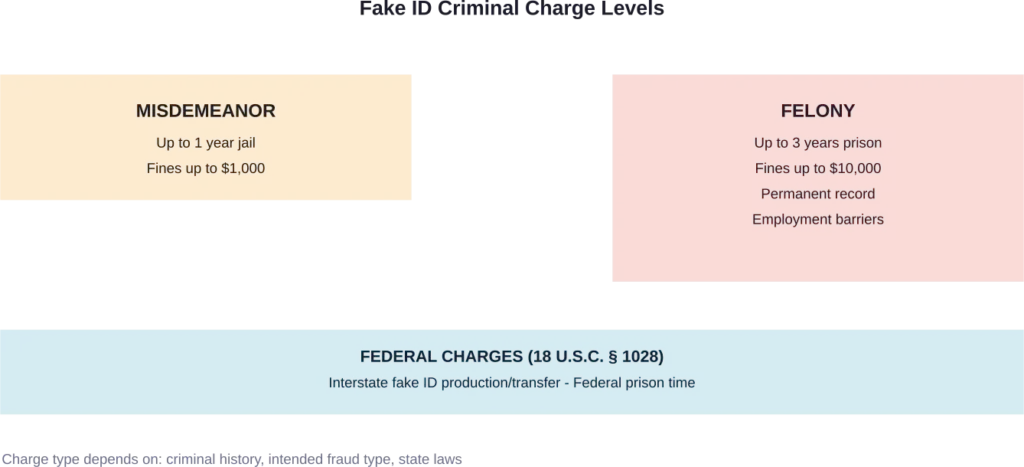
States categorize fake ID crimes differently. Some treat simple possession leniently while hammering down on manufacturing or selling fake IDs.
Penalties and Punishments by Severity
The consequences vary wildly depending on whether prosecutors charge you with a misdemeanor or felony.
Misdemeanor Penalties
For a misdemeanor conviction, expect:
| Penalty Type | Maximum Punishment |
|---|---|
| Jail Time | Up to 1 year in county jail |
| Fines | Up to $1,000 |
| Probation | Summary probation period |
| Community Service | Court-ordered hours |
Many first-time offenders receive probation instead of jail time. But that conviction still goes on your record.
Felony Penalties
Felony fake ID charges carry much heavier consequences:
| Penalty Type | Maximum Punishment |
|---|---|
| Prison Time | Up to 3 years in state prison |
| Fines | Up to $10,000 |
| Felony Probation | Extended supervision period |
| Restitution | Compensation to victims |
Under 18 U.S. Code § 1028A, aggravated identity theft charges add a mandatory 2-year prison sentence on top of other penalties. This applies when fake IDs involve stealing another person’s identity during felony crimes.
The distinction between misdemeanor and felony often hinges on intent. Using a fake ID to buy beer? Probably misdemeanor. Using it to commit fraud, steal someone’s identity, or manufacture fake IDs for others? That’s felony territory.
What Happens During the Arrest Process
Getting caught usually happens in one of three scenarios: at a bar or club, during a traffic stop, or when attempting to purchase alcohol.
Bouncers and store clerks can confiscate suspected fake IDs. They’re often trained to spot common forgery signs. Many establishments have relationships with local police and will call them immediately.
Police will typically:
- Confiscate the fake ID as evidence
- Question you about where you obtained it
- Issue a citation or make an arrest depending on circumstances
- Contact your parents if you’re a minor
- File charges with the prosecutor’s office
Real talk: anything you say can and will be used against you. Admitting you knew it was fake, explaining where you bought it, or naming friends who also have fake IDs gives prosecutors ammunition.
Long-Term Consequences Beyond Criminal Penalties
The courtroom isn’t where your problems end. A fake ID conviction creates a ripple effect that touches every part of your life.
Criminal Record Impact
That conviction becomes part of your permanent criminal record. It shows up on background checks for:
- Job applications, especially positions requiring trust or security clearances
- College admissions and scholarship opportunities
- Professional licensing in fields like law, medicine, or teaching
- Housing applications and rental agreements
- Military service eligibility
Employers see crimes involving dishonesty as major red flags. You’re competing against candidates without criminal records.
Educational Consequences
Universities take fake ID violations seriously. Penn State and the University of Iowa specifically warn students about carrying fake IDs in their official safety guidelines.
Academic consequences include:
- Suspension or expulsion from your university
- Loss of financial aid or scholarships
- Disciplinary notation on your academic transcript
- Removal from campus housing
- Prohibition from campus activities or leadership positions
Academic institutions’ disciplinary policies note that administrative penalties often stack on top of criminal charges.
Driver’s License Suspension
Many states automatically suspend your real driver’s license when convicted of fake ID possession. Suspension periods typically range from 90 days to one year.
That means no driving to work, school, or anywhere else. The inconvenience alone can derail your life.

Possible Legal Defenses
Not every fake ID case ends in conviction. Criminal defense strategies exist, though success depends heavily on circumstances.
Common defenses include:
- Lack of knowledge: You genuinely didn’t know the ID was fake (someone gave it to you claiming it was real)
- No intent to defraud: You possessed the ID but never attempted to use it
- Illegal search and seizure: Police violated your Fourth Amendment rights obtaining the ID
- Mistaken identity: Someone else possessed the fake ID, not you
- Coercion or duress: You were forced to carry or use the fake ID
But here’s the thing: these defenses require solid evidence. A skilled criminal defense attorney can evaluate your case and identify viable strategies.
First-time offenders sometimes negotiate plea deals involving diversion programs. Complete the program successfully, and prosecutors may dismiss charges.
State-by-State Variations
Fake ID laws differ significantly across states. What’s a misdemeanor in one state might be a felony in another.
California treats fake ID possession as a wobbler offense under Penal Code 470b. Prosecutors have discretion charging it as either a misdemeanor or felony based on circumstances.
Iowa law, according to the University of Iowa Student Legal Services, prohibits possessing revoked, suspended, fictitious, or fraudulently altered IDs under Iowa Code Section 321.216. It also criminalizes giving your real ID to someone else.
Pennsylvania law makes it illegal for anyone under 21 to use or possess a fake ID, with first offense convictions potentially resulting in summary offenses.
The penalties, enforcement priorities, and available defenses all vary by jurisdiction. That’s why location matters tremendously in fake ID cases.
What to Do If You’re Caught
The worst thing you can do? Panic and start talking without thinking.
Follow these steps:
- Remain calm and polite. Arguing with police or bouncers escalates the situation.
- Exercise your right to remain silent. Don’t explain where you got the ID or admit guilt.
- Don’t consent to searches. Police need probable cause or a warrant.
- Contact a criminal defense attorney immediately. Don’t wait until your court date.
- Don’t discuss your case on social media. Prosecutors regularly check defendant social media accounts.
Legal professionals note that casual statements made during arrest frequently come back to haunt defendants in court.
An experienced attorney can often negotiate reduced charges, alternative sentencing, or even dismissal for first-time offenders. But they need to get involved early.
Frequently Asked Questions
Yes. Misdemeanor convictions can result in up to 1 year in county jail, while felony convictions can lead to up to 3 years in state prison. First-time offenders often receive probation instead of jail time, but incarceration remains a real possibility depending on the circumstances and jurisdiction.
Yes. Fake ID convictions become part of your permanent criminal record and appear on employment, housing, and educational background checks. This can impact job opportunities, college admissions, professional licensing, and housing applications for years unless you successfully petition for expungement.
Misdemeanor charges typically involve simple possession or use of a fake ID and carry penalties up to 1 year jail and $1,000 fines. Felony charges apply when manufacturing fake IDs, using them to commit fraud, or stealing someone’s identity, with penalties up to 3 years prison and $10,000 fines.
Yes. Bouncers and retail employees can confiscate suspected fake IDs and are often required to turn them over to law enforcement. Many establishments have policies mandating they contact police immediately when fake IDs are discovered.
Potentially yes. Criminal convictions, especially drug and alcohol-related offenses, can impact federal financial aid eligibility. Additionally, universities may impose their own disciplinary actions including suspension or expulsion, which would affect continued enrollment and aid disbursement.
Without expungement, a fake ID conviction remains on your criminal record permanently. However, many states allow first-time offenders to petition for expungement after completing probation and maintaining a clean record for a specified period, typically 1-5 years depending on jurisdiction.
Yes, dismissal is possible through several avenues: successful completion of a diversion program, lack of evidence, procedural errors, illegal search and seizure, or plea negotiations. An experienced criminal defense attorney can evaluate your case and identify the best strategy for pursuing dismissal or reduced charges.
The Bottom Line
That fake ID isn’t worth it. The temporary thrill of getting into a bar or buying alcohol pales compared to years of criminal record consequences.
Prosecutors across the country have intensified enforcement. What used to result in confiscation and a warning now leads to criminal charges, court appearances, and permanent records.
The penalties range from hundreds to thousands of dollars in fines, potential jail time, probation, community service, license suspension, and a criminal record that follows you into job interviews and college applications.
If you’ve already been caught with a fake ID, don’t face the charges alone. Contact a criminal defense attorney immediately to protect your rights and explore your options. The sooner you get legal representation, the better your chances of minimizing the damage.
Your future is worth more than a night out.