
Quick Summary: Rubbing your eyes excessively can lead to serious complications including keratoconus (a progressive thinning of the cornea), retinal detachment, increased risk of infections, broken blood vessels, and potential worsening of existing eye conditions. While occasional gentle rubbing is generally harmless, chronic forceful eye rubbing can cause irreversible damage to delicate eye structures.
That satisfying relief when you rub itchy, tired eyes feels harmless enough. But here’s the thing—what seems like an innocent reflex can actually cause lasting damage to vision and eye health.
Research from institutions like Johns Hopkins University and Duke Eye Center has identified vigorous eye rubbing as a significant risk factor for keratoconus and other progressive eye conditions. According to academic research on keratoconus development, eye rubbing creates mechanical stress that weakens corneal structure over time.
The occasional gentle knuckle rub probably won’t cause problems. Chronic, forceful rubbing is where things get dangerous.
Why Do People Rub Their Eyes?
Before diving into the damage, it helps to understand why eye rubbing happens so reflexively. Several common triggers provoke the urge to rub:
- Allergies and seasonal irritation
- Dry eyes from screen time or environmental conditions
- Eye strain and fatigue
- Foreign particles like dust or eyelashes
- Contact lens discomfort
- Sleepiness and tiredness
- Bright light exposure
- Eye infections like conjunctivitis
Rubbing generates tears and provides temporary relief. That’s precisely why it feels so good—and why the habit becomes so hard to break.
The pressure stimulates tear production and can help redistribute tear film across the eye surface. Unfortunately, the short-term relief comes with long-term consequences.
The Most Serious Consequence: Keratoconus
Keratoconus represents the most alarming risk associated with chronic eye rubbing. This progressive eye disease causes the cornea—the clear front surface of the eye—to thin and bulge outward into a cone shape.
According to the National Keratoconus Foundation, keratoconus impacts a range between 1 in 400 to 1 in 200 people. NBA star Stephen Curry has publicly discussed managing keratoconus, bringing attention to this vision-threatening condition.
Research from Augusta University and Johns Hopkins demonstrates a connection between mechanical stress from eye rubbing and keratoconus development. When researchers applied uniaxial stretch to simulate eye rubbing in laboratory models, they observed reduced levels of Wnt10a and Col12a1 mRNA—proteins essential for maintaining corneal structure. Specifically, Wnt10a and Col12a1 mRNA levels were reduced by 67% and 65% respectively in stretched tissue compared to controls.
What does keratoconus actually do to vision? As the cornea becomes increasingly irregular:
- Double vision develops
- Nearsightedness worsens progressively
- Irregular astigmatism makes glasses ineffective
- Light sensitivity increases dramatically
- Vision becomes blurry and distorted
According to Duke cornea specialist Melissa Daluvoy, MD, keratoconus can occur in one or both eyes and tends to progress over time. Early intervention matters—but prevention through avoiding chronic eye rubbing matters even more.
Other Serious Risks of Excessive Eye Rubbing
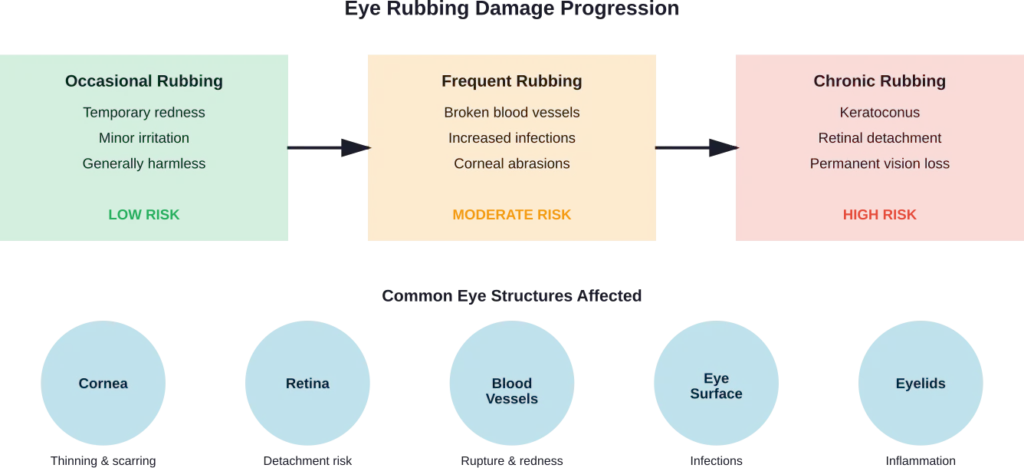
Retinal Detachment and Damage
Forceful rubbing creates significant pressure inside the eye. This pressure can cause the retina—the light-sensitive tissue at the back of the eye—to tear or detach from its supporting layers.
Retinal detachment constitutes a medical emergency. Without prompt treatment, permanent vision loss occurs. People with existing retinal weakness or high myopia face elevated risk when rubbing their eyes.
Broken Blood Vessels
The delicate blood vessels in and around the eyes rupture easily under pressure. When this happens, visible red spots appear on the white part of the eye.
While typically not dangerous, broken blood vessels indicate excessive force. Repeated episodes suggest a harmful pattern that could progress to more serious damage.
Increased Infection Risk
Hands carry bacteria, viruses, and other pathogens constantly. Every time fingers touch eyes, there’s potential for transferring infectious agents directly to vulnerable eye tissue.
This can lead to:
- Conjunctivitis (pink eye)
- Styes and chalazia
- Corneal infections
- Blepharitis (eyelid inflammation)
According to the American Academy of Ophthalmology’s information on blepharitis, this inflammatory condition causes itchy, red eyelids—which often triggers more rubbing in a vicious cycle.
Corneal Abrasions and Scratches
The cornea has no margin for error. Even minor scratches cause significant pain and increase infection susceptibility. Forceful rubbing—especially with jewelry, long nails, or while wearing contact lenses—can easily scratch the corneal surface.
These abrasions create entry points for bacteria and can lead to corneal ulcers if infected.
Worsening of Existing Eye Conditions
For people with glaucoma, eye rubbing can temporarily spike intraocular pressure—exactly what glaucoma treatment aims to control. This pressure increase potentially damages the optic nerve further.
Those with myopia may find their nearsightedness worsening with chronic eye rubbing, as the mechanical stress can elongate the eyeball slightly over time.
What to Do Instead of Rubbing
Breaking the eye-rubbing habit requires identifying triggers and implementing healthier alternatives. Here’s what actually works:
For Allergies and Itching
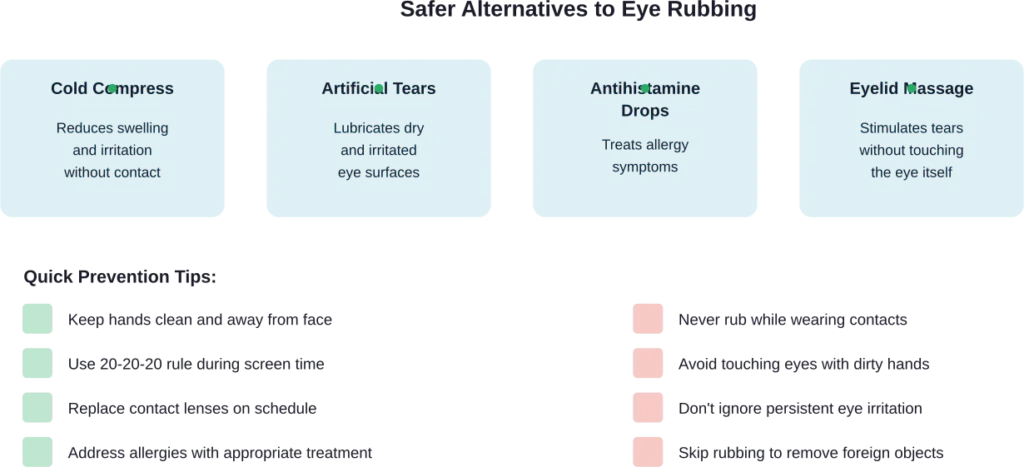
Cold compresses provide relief without the risks. Place a clean, cool washcloth over closed eyes for several minutes. Antihistamine eye drops formulated for allergies address the root cause rather than just symptoms.
For Dry Eyes
Artificial tears lubricate without preservatives that can irritate further. Use them throughout the day, especially during extended screen time. According to data on lacrimal occlusion from the American Academy of Ophthalmology, approximately 10% of patients with punctal plugs and 6.5% of those with intracanalicular plugs experience excessive tearing, so discuss options with an eye care professional.
Taking regular breaks from screens using the 20-20-20 rule helps too: every 20 minutes, look at something 20 feet away for 20 seconds.
For Foreign Particles
Flush eyes with sterile saline solution or artificial tears. Blinking repeatedly often dislodges particles naturally. Never rub to remove something—this can embed it deeper or scratch the cornea.
For Contact Lens Discomfort
Remove lenses immediately if discomfort occurs. Never rub eyes while wearing contacts—this dramatically increases infection risk and can cause the lens to scratch the eye or become displaced behind the eyelid.
Ensure lenses are properly cleaned and replaced according to schedule. Expired or dirty lenses often trigger the urge to rub.
For General Irritation
Sometimes eyes just feel tired or strained. Gentle eyelid massage—without touching the eye itself—can stimulate tear production. Close eyes and gently massage the eyelids in small circles.
Rest matters too. When eyes feel exhausted, they probably are. Taking a break from visual tasks often eliminates the urge to rub entirely.
When to See a Doctor
According to Mark Mifflin, MD, professor of ophthalmology at the University of Utah, chronic eye itching requires professional evaluation. Don’t wait for visible damage to develop.
Seek medical attention if experiencing:
- Persistent urge to rub eyes daily
- Noticeable vision changes or blurriness
- Pain that doesn’t resolve quickly
- Redness lasting more than a day or two
- Light sensitivity that seems worse than normal
- Discharge or excessive tearing
- Feeling of something stuck in the eye
An ophthalmologist can identify underlying conditions driving the urge to rub and recommend appropriate treatment. Early intervention prevents the progression from minor irritation to serious conditions like keratoconus.
Frequently Asked Questions
Yes, chronic forceful eye rubbing can cause permanent damage including keratoconus, retinal detachment, and progressive vision loss. While occasional gentle rubbing typically doesn’t cause lasting harm, repeated forceful rubbing creates cumulative damage to corneal structure and other delicate eye tissues that may be irreversible.
Warning signs include persistent blurred vision, increasing nearsightedness, double vision, light sensitivity, pain that doesn’t resolve, visible redness or broken blood vessels, and difficulty with night vision. Any vision changes warrant immediate evaluation by an eye care professional to assess potential corneal or retinal damage.
Keratoconus is a progressive thinning and bulging of the cornea that causes distorted vision. According to research from Duke Eye Center, treatments range from specialized contact lenses for mild cases to corneal cross-linking procedures that strengthen the cornea, and potentially corneal transplant for advanced cases. Early detection significantly improves treatment outcomes.
Rubbing stimulates tear production and temporarily redistributes the tear film, providing immediate relief from dryness and irritation. The pressure also stimulates the vagus nerve, which can feel soothing. Unfortunately, this short-term relief comes at the cost of potential long-term damage to eye structures.
Absolutely. Allergies trigger histamine release that causes intense itching, creating a strong urge to rub. But rubbing releases more histamines, worsening the itch in a cycle that’s hard to break. Antihistamine eye drops and cold compresses break this cycle more effectively without causing mechanical damage.
Occasional gentle rubbing with clean hands typically doesn’t cause harm. The danger lies in forceful, frequent rubbing—especially the kind done reflexively throughout the day. Even gentle rubbing carries infection risk if hands aren’t clean, so alternatives like artificial tears or cold compresses remain safer choices.
Never rub to remove foreign particles. Instead, flush with sterile saline solution or artificial tears, blink repeatedly to encourage natural tear flow, or gently pull the upper eyelid over the lower lid. If the particle doesn’t dislodge or pain persists, seek professional care immediately—attempting removal through rubbing can embed particles deeper or scratch the cornea.
Protecting Long-Term Eye Health
The eyes represent one of the body’s most remarkable and vulnerable systems. Their delicate structures perform incredible feats—but they can’t withstand chronic mechanical stress.
Breaking the eye-rubbing habit protects vision for decades to come. Start by identifying what triggers the urge: allergies, dry eyes, fatigue, or something else. Then implement targeted solutions that address the root cause rather than just seeking temporary relief through rubbing.
Keep artificial tears, antihistamine drops, and cold compresses readily available. Build awareness of how often hands approach the face. And don’t hesitate to consult an eye care professional about persistent symptoms—early intervention prevents minor irritation from becoming major vision problems.
The temporary satisfaction of rubbing itchy eyes simply isn’t worth risking conditions like keratoconus or retinal damage. Safer alternatives exist that provide relief without compromising eye health. Make the switch now, before chronic rubbing creates irreversible damage that no treatment can fully repair.