

Quick Summary: Missing a single day of creatine supplementation has no meaningful impact on muscle creatine stores or performance. Since creatine works by gradually saturating muscle tissue over weeks, one missed dose won’t reverse those accumulated levels. Simply resume regular supplementation the next day without doubling up—consistency over the long term matters far more than perfect daily adherence.
Creatine has become one of the most popular supplements among athletes and fitness enthusiasts, and for good reason. Research shows creatine supplementation can elevate resting total creatine levels by approximately 20%. But what happens when life gets in the way and a dose gets skipped?
The short answer? Nothing dramatic.
Understanding how creatine works in the body reveals why missing a single day won’t derail progress. Most of the body’s creatine pool resides in skeletal muscle—approximately 95%—where it exists as phosphocreatine (about two-thirds) and free creatine (the remaining third). This stored creatine doesn’t vanish overnight.
How Creatine Builds Up in Muscle Tissue
Creatine supplementation operates on a cumulative principle. When creatine monohydrate is consumed daily, muscle cells gradually accumulate higher concentrations over time. This process doesn’t happen instantly.
During a loading phase—typically 20 grams daily for 5-6 days—muscle creatine content can increase by approximately 20% by the end of that period. Without a loading phase, taking a standard maintenance dose of 3-5 grams daily achieves similar saturation, just over 3-4 weeks instead of one week.
Here’s the thing though—this gradual buildup works both ways. Just as saturation takes time, depletion also occurs slowly.

The Reality of Missing One Day
When a single dose gets skipped, muscle creatine stores remain essentially unchanged. The body naturally breaks down stored creatine through normal metabolic processes, converting it to creatinine that gets excreted in urine.
One missed dose doesn’t create a sudden drop. The creatine already stored in muscle tissue continues functioning normally, supporting ATP regeneration during high-intensity exercise just as it did the day before.
Community discussions consistently reflect this understanding. As one experienced lifter noted, once muscles reach full saturation, it takes several weeks before creatine stores become fully depleted again. Missing a single day—or even a weekend—doesn’t reverse weeks of consistent supplementation.
Should the Missed Dose Be Doubled?
No. Doubling up on creatine after missing a day provides no benefit and may cause unnecessary digestive discomfort.
The muscle tissue already holds near-maximum creatine levels. Cells have a saturation threshold—they can’t absorb unlimited amounts regardless of how much gets consumed. Taking 10 grams instead of 5 grams won’t compensate for yesterday’s missed dose because yesterday’s muscle stores haven’t significantly changed.
Simply resume the regular maintenance dose. Consistency matters more than compensating for occasional gaps.
What About Multiple Missed Days?
The timeline matters when evaluating missed doses. Here’s what research and practical experience suggest:
| Time Without Creatine | Expected Impact on Stores | Performance Effect |
|---|---|---|
| 1 day | No significant decrease | None |
| 2-4 days | Minimal decrease | Negligible |
| 1-2 weeks | Slight decrease (5-10%) | Minor reduction possible |
| 4+ weeks | Moderate to significant decrease | Noticeable reduction in benefits |
Missing several consecutive days starts to matter more than a single skipped dose, but even then, the decline happens gradually. Muscle creatine levels don’t crash after a few days off—they drift downward slowly.
For those who forget to take creatine during weekends, the impact remains minimal as long as weekday consistency continues. The five days of regular dosing maintain saturation levels sufficiently to offset two days without supplementation.
How Creatine Timing Actually Works
One common misconception involves creatine timing. Unlike pre-workout stimulants that provide immediate effects, creatine doesn’t work acutely. According to research on timing of creatine supplementation around exercise, the key factor is maintaining elevated muscle creatine stores over time—not when specifically the dose gets consumed each day.
Some evidence suggests taking creatine close to training sessions may offer slight advantages, but the difference pales in comparison to overall consistency. Whether creatine gets taken morning, afternoon, or evening matters far less than taking it regularly enough to maintain muscle saturation.
This explains why missing one day has negligible impact. The creatine consumed yesterday, last week, and last month has already accumulated in muscle tissue. Today’s dose contributes to maintaining that saturation, but yesterday’s missed dose doesn’t erase previous accumulation.
The Science Behind Creatine Storage
Understanding muscle physiology clarifies why one missed day doesn’t matter. Creatine enters target cells through a specific sodium-chloride dependent transporter. Once inside muscle cells, it gets phosphorylated to form phosphocreatine, which serves as a rapid energy buffer during intense muscular contractions.
This stored phosphocreatine doesn’t have a 24-hour shelf life. It remains stable in muscle tissue until metabolic processes gradually break it down or exercise depletes it. The natural turnover rate means roughly 1-2 grams of creatine get degraded daily, which is why a standard maintenance dose of 3-5 grams daily is typically recommended to maintain elevated levels.
High creatine levels exist naturally in cells with substantial energy demands—cardiomyocytes, hepatocytes, kidney cells, and photoreceptor cells all maintain creatine stores. Skeletal muscle contains the largest pool because of its mass and energy requirements during contraction.
Factors That Influence Creatine Retention
Several variables affect how quickly muscle creatine levels decline without supplementation:
- Muscle mass: Individuals with more muscle tissue store larger absolute amounts of creatine, creating a bigger reservoir that depletes more slowly
- Exercise intensity: High-intensity training depletes phosphocreatine faster, though it regenerates between sets
- Dietary creatine: People who consume red meat and fish get 1-2 grams of dietary creatine daily, which slows depletion when supplementation stops
- Individual response: Some people naturally maintain higher creatine levels or have more efficient transporters
These factors mean one person might maintain elevated levels for six weeks without supplementation while another experiences faster decline. But for everyone, one missed day falls well within the stability window.
Practical Strategies for Consistency
While missing a day won’t sabotage progress, maintaining consistency optimizes results. Here are evidence-based approaches:
Link supplementation to existing habits. Taking creatine with morning coffee, post-workout protein, or dinner creates a behavioral trigger that reduces forgetting. The specific timing doesn’t dramatically affect results, so convenience matters more than optimal timing windows.
Keep creatine visible. Storing the container next to frequently used items—coffee maker, protein powder, toothbrush—provides visual reminders. Out of sight often means out of mind.
Use smartphone reminders. Setting a daily alarm removes reliance on memory alone. This works particularly well for people with irregular schedules.
Pre-portion for travel. Measuring individual doses into small containers or bags before trips prevents the “forgot to pack it” scenario that derails consistency during vacations.
Real talk: Perfect adherence isn’t required. Research on creatine supplementation demonstrates benefits with regular use, not flawless daily consumption. Someone who takes creatine 6 days weekly still maintains adequate muscle saturation.
When to Actually Worry About Missed Doses
Missing one day produces no significant decrease in muscle creatine levels. Missing one week occasionally produces minimal impact. But certain patterns do compromise effectiveness:
Frequently skipping 3+ consecutive days prevents muscles from reaching or maintaining full saturation. The intermittent supplementation never allows creatine stores to stabilize at elevated levels.
Stopping entirely for a month or longer returns muscle creatine to baseline levels. At that point, benefits from previous supplementation have essentially disappeared, requiring another loading or gradual saturation phase.
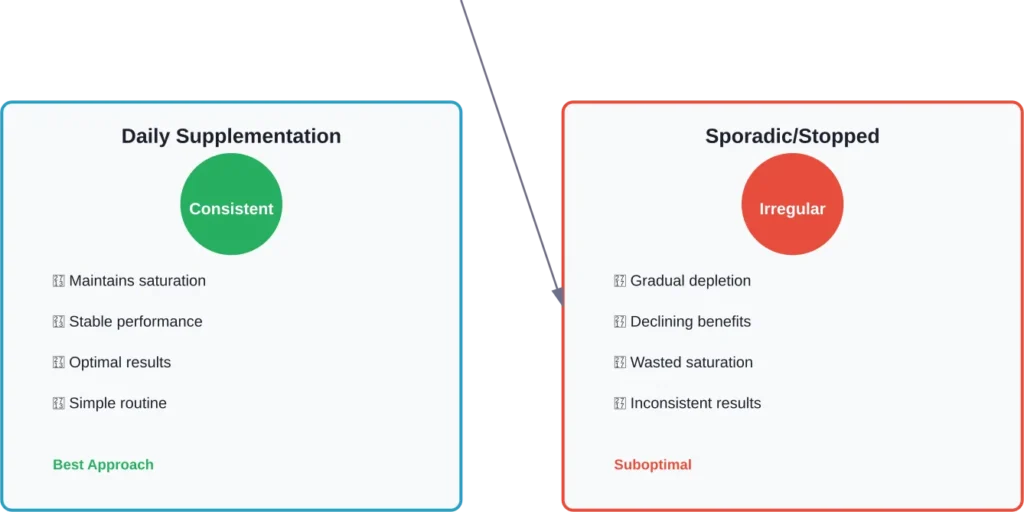
Taking creatine only on training days might seem logical but proves suboptimal. Since creatine works through muscle saturation rather than acute effects, daily dosing—including rest days—maintains elevated stores more effectively than intermittent high doses.
| Supplementation Pattern | Muscle Saturation Level | Effectiveness Rating |
|---|---|---|
| Daily (7 days/week) | Maximum (100%) | Optimal |
| 6 days/week | Near-maximum (95-98%) | Excellent |
| 5 days/week (weekdays only) | Good (85-90%) | Good |
| Training days only (3-4 days) | Moderate (60-75%) | Suboptimal |
| Sporadic/inconsistent | Low to none (20-40%) | Poor |
The Long-Term Perspective on Creatine Supplementation
Meta-analyses examining creatine supplementation and muscle strength gains reveal important insights about dosing patterns. Studies show that low-dose supplementation combined with regular training yields significant benefits—but these benefits accumulate over weeks and months, not days.
This long-term perspective explains why obsessing over one missed dose misses the point. Someone who takes creatine consistently for three months with occasional missed days will see substantially better results than someone who takes it perfectly for two weeks then stops.
The research also indicates that untrained individuals often show greater improvements from creatine supplementation compared to advanced athletes. But regardless of training status, consistency over months matters far more than perfect daily adherence over weeks.
Creatine and Different Training Goals
While creatine gained popularity for high-intensity strength training, research on creatine supplementation and endurance performance shows broader applications. Elevating resting total creatine levels by approximately 20% through supplementation benefits various training modalities—not just powerlifting and bodybuilding.
Endurance athletes may not experience the same magnitude of benefit as strength athletes, but creatine still supports performance during the intense intervals, hill repeats, and finishing sprints that determine race outcomes. Again, these benefits come from sustained elevated muscle creatine levels, not acute dosing around specific workouts.
Missing one day doesn’t significantly impact any training goal because the underlying mechanism—muscle saturation—remains stable across brief gaps in supplementation.

Frequently Asked Questions
No. Missing a single day of creatine has zero impact on muscle mass or strength. Muscle creatine stores remain stable for weeks, so one missed dose doesn’t affect training performance or muscle protein synthesis. Gains come from progressive training and adequate nutrition over months—not from perfect supplement timing over days.
No need to double the dose. Muscle cells already contain near-maximum creatine levels from previous supplementation. Taking twice the normal amount won’t compensate for yesterday’s missed dose because muscle saturation doesn’t work that way. Simply resume the regular 3-5 gram maintenance dose the next day and continue consistent supplementation.
Muscle creatine levels remain elevated for 2-4 weeks even without supplementation. Missing 1-4 days produces no meaningful decrease in muscle stores or performance. After 1-2 weeks without creatine, levels begin declining noticeably but still remain above baseline. Complete depletion back to pre-supplementation levels takes several weeks.
Yes, taking creatine on rest days maintains muscle saturation levels. Creatine works through sustained elevated muscle stores, not acute effects around workouts. Daily supplementation—including non-training days—keeps muscle creatine levels consistently high. Skipping rest days leads to gradual depletion and suboptimal results compared to daily dosing.
Missing one day during a loading phase slightly extends the time to reach full saturation but doesn’t prevent it. A typical loading phase involves approximately 20 grams daily for 5-6 days. Missing one day might mean reaching saturation in 7 days instead of 6—a negligible difference. Alternatively, skip loading entirely and use 3-5 grams daily for 3-4 weeks to achieve the same final saturation.
Every-other-day dosing works but proves less effective than daily supplementation. While muscle stores won’t completely deplete between doses, this pattern prevents achieving and maintaining maximum saturation. Daily dosing with 3-5 grams optimizes muscle creatine levels better than higher doses taken less frequently. Consistency beats sporadic higher doses.
Missing a full week causes a small decrease in muscle creatine levels—perhaps 5-10% from peak saturation—but doesn’t erase previous supplementation. Simply resume regular daily dosing without a new loading phase. Within several days of consistent supplementation, muscle stores return to maximum levels. One week off occasionally won’t significantly impact long-term results if overall consistency remains good.
Final Thoughts on Missing Creatine Doses
The evidence clearly shows that missing one day of creatine supplementation creates no meaningful consequence. Muscle creatine stores accumulate gradually through consistent supplementation and deplete slowly when supplementation stops. One skipped dose falls well within the stability range of saturated muscle tissue.
This doesn’t mean consistency doesn’t matter—it absolutely does. Regular daily supplementation maintains optimal muscle saturation and delivers the performance benefits research consistently demonstrates. But occasional missed doses don’t reverse weeks of accumulated saturation or require special compensatory measures.
The most effective approach remains simple: take 3-5 grams of creatine monohydrate daily, year-round, with minimal concern about perfect adherence. If a dose gets missed, resume regular supplementation the next day without overthinking it.
Focus energy on the factors that actually determine training results—progressive overload, adequate protein intake, sufficient sleep, and consistent effort over months and years. Creatine supplementation enhances those fundamentals when taken regularly, but obsessing over one missed dose distracts from what truly matters for long-term progress.
Ready to optimize your supplementation routine? Establish a consistent daily creatine habit using the practical strategies outlined above, then shift focus back to the training and nutrition consistency that drives real results.