
Quick Summary: Smoking during pregnancy significantly increases risks of premature birth, birth defects, stillbirth, and sudden infant death syndrome (SIDS). According to the CDC, babies exposed to cigarette smoke in utero face higher rates of low birth weight, respiratory problems, and developmental issues. Quitting smoking at any stage of pregnancy immediately improves outcomes for both mother and baby.
Most people understand that smoking damages health. But when pregnancy enters the picture, those risks multiply dramatically for two lives instead of one.
According to the Centers for Disease Control and Prevention, more than 400,000 live-born infants are exposed to tobacco from maternal smoking annually. That’s a staggering number considering what we now know about the consequences.
The truth is, cigarette smoke contains over 4,000 chemicals. Many of these are toxic, and several are known carcinogens. When a pregnant woman smokes, those chemicals cross the placenta and reach the developing baby.
Immediate Risks to Your Baby’s Development
Smoking during pregnancy restricts oxygen flow to the fetus. The carbon monoxide in cigarette smoke binds to hemoglobin more readily than oxygen does, essentially starving the baby of what it needs most.
Here’s what that oxygen deprivation causes:
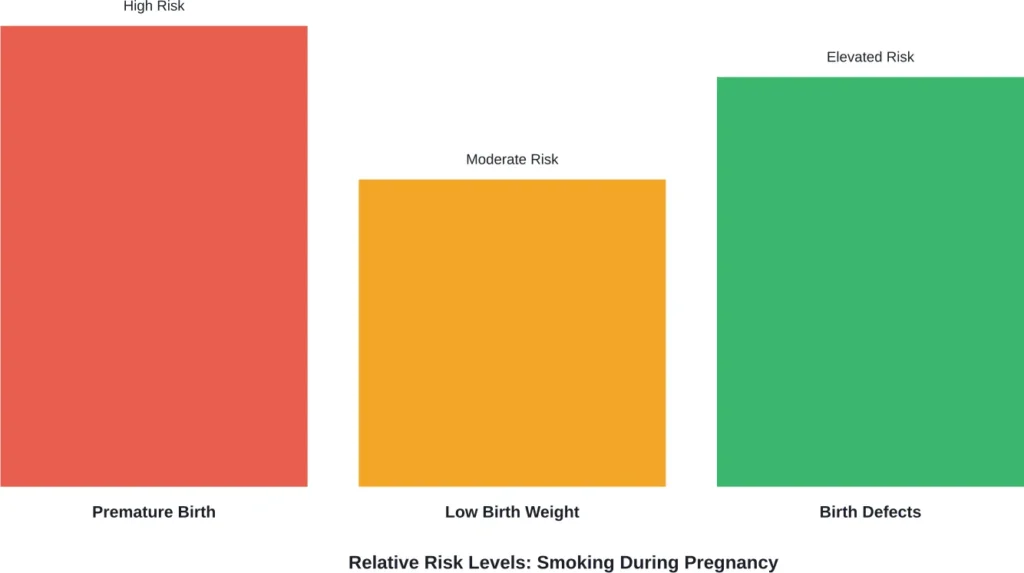
Restricted growth. Babies born to mothers who smoke have reduced birth weight compared to those born to non-smokers. Low birth weight creates complications that can last a lifetime.
Premature birth. Smoking increases the likelihood of delivery before 37 weeks. Premature babies face higher risks of breathing problems, feeding difficulties, and developmental delays.
Birth defects. A comprehensive systematic review analyzing 173,687 malformed cases and 11.7 million controls found significant associations between maternal smoking and cardiovascular malformations, limb defects, and orofacial clefts.
Long-Term Health Consequences
The damage doesn’t stop at birth. Children exposed to cigarette smoke in utero face elevated risks throughout childhood and beyond.
Sudden Infant Death Syndrome. SIDS rates are significantly higher among babies born to smokers. Research from Rutgers University found that infants exposed to maternal smoking throughout pregnancy were more than five times as likely as infants of never-smokers to suffer sudden unexpected infant death (SUID), with rates of 3.80 deaths per 1,000 live births for Black mothers who smoked throughout pregnancy compared to 1.07 for non-smokers.
That’s a fivefold increase.
Respiratory problems. These children experience higher rates of asthma, bronchiolitis, pneumonia, and other lung diseases. Their lung function is often permanently compromised.
Immune system changes. According to research published by the National Institute of Child Health and Human Development, infants whose mothers smoked throughout pregnancy had elevated levels of interleukin-8, an inflammation marker, at birth.
Childhood cancers. Long-term studies have identified increased risks for certain childhood malignancies among children exposed to maternal smoking during pregnancy.
Risks to Maternal Health
Pregnant women who smoke face their own serious complications beyond those affecting the baby.
| Complication | Description | Risk Level |
|---|---|---|
| Ectopic Pregnancy | Fertilized egg implants outside uterus | Elevated |
| Placental Abruption | Placenta separates from uterine wall | High |
| Placenta Previa | Placenta covers cervix | High |
| Stillbirth | Baby dies before delivery after 20 weeks | Elevated |
| Reduced Fertility | Difficulty conceiving | Moderate |
Placental abruption and placenta previa both cause dangerous bleeding. These conditions can be life-threatening for both mother and baby, often requiring emergency cesarean delivery.
Secondhand Smoke Matters Too
Even if a pregnant woman doesn’t smoke herself, exposure to secondhand smoke creates serious risks.
According to the World Health Organization, exposure to secondhand smoke during pregnancy is linked to approximately a 23% increased risk of stillbirth.
Secondhand smoke kills approximately 1.2 million people annually worldwide. Roughly 65,000 of those deaths are children and adolescents under 15.
This is particularly relevant in regions where few women smoke but male smoking rates are high. The pregnant woman might avoid cigarettes completely, yet still expose her developing baby to harmful chemicals.
Quitting Smoking During Pregnancy
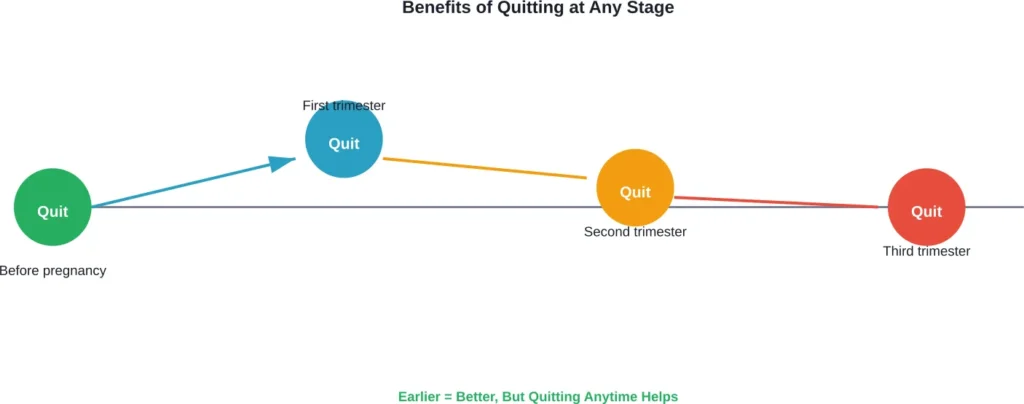
Here’s some good news: quitting smoking at any point during pregnancy improves outcomes.
The body begins repairing itself almost immediately. Within 20 minutes of the last cigarette, heart rate and blood pressure drop. Within 12 hours, carbon monoxide levels in the blood return to normal.
For the developing baby, those changes mean better oxygen supply and nutrient delivery. Growth improves. Risk levels for complications decrease.
According to the American College of Obstetricians and Gynecologists, healthcare professionals should treat tobacco use and dependence as a critical part of prenatal care. Behavioral interventions have proven effective, and various resources are available.
The CDC recommends that healthcare providers ask about cigarette smoking before, during, and after pregnancy at every visit. Data from the 2021 Pregnancy Risk Assessment Monitoring System showed that consistent provider inquiry improves quit rates.
Common Myths About Pregnancy and Smoking
Myth: Quitting causes stress that’s worse for the baby than smoking.
Fact: The stress from quitting is temporary and far less harmful than continued smoke exposure. Babies benefit immediately when mothers quit.
Myth: Cutting down is good enough.
Fact: Research shows duration matters. Smoking throughout pregnancy versus quitting early creates dramatically different risk profiles. Complete cessation is the goal.
Myth: Switching to e-cigarettes is safer.
Fact: E-cigarettes still contain nicotine, which restricts blood flow to the placenta. They haven’t been proven safe during pregnancy.
Myth: The damage is done in the first trimester.
Fact: Fetal development continues throughout all three trimesters. Quitting in the second or third trimester still provides significant benefits.
Getting Help to Quit
Nicotine is addictive. Quitting isn’t easy, especially during the physical and emotional challenges of pregnancy.
But support systems exist:
- Talk to healthcare providers about cessation programs
- Contact state quitlines for free counseling and resources
- Join support groups with other pregnant women quitting smoking
- Discuss evidence-based pharmacotherapy options with doctors
- Address underlying psychosocial stressors that contribute to tobacco use
Women facing low income, low education levels, or mental health challenges are less likely to quit during pregnancy and more likely to relapse postpartum. These vulnerable populations need targeted support and resources.
The ACOG recommends that available cessation services and resources should be discussed and documented regularly at prenatal and postpartum visits.
Frequently Asked Questions
There is no safe level of cigarette smoking during pregnancy. Even light smoking increases risks of complications. The WHO states clearly that no amount of tobacco exposure is safe for pregnant women or developing babies.
Many women smoke before pregnancy confirmation. The key is quitting as soon as possible after learning about the pregnancy. The body and baby begin benefiting immediately upon cessation, and quitting early significantly reduces risks.
Yes. Secondhand smoke exposure increases miscarriage risk along with stillbirth and congenital malformations. Pregnant women should avoid environments where smoking occurs.
Babies don’t experience nicotine withdrawal in utero when mothers quit. However, babies born to mothers who smoked throughout pregnancy can show signs of nicotine withdrawal after birth, which is another reason to quit.
Nicotine passes into breast milk and can affect infant sleep patterns and increase irritability. Secondhand smoke exposure also increases infant respiratory problems. Quitting smoking improves breastfeeding outcomes and infant health.
Research has found associations with cardiovascular defects, orofacial clefts including cleft lip and palate, limb reduction defects, and clubfoot. The comprehensive review of over 173,000 cases confirmed these connections.
Smoking reduces fertility in both men and women. Women who smoke take longer to conceive and face higher rates of infertility. Men who smoke have reduced sperm quality and count.
The Bottom Line
Smoking during pregnancy isn’t just risky—it’s one of the most preventable causes of pregnancy complications and infant death.
The evidence is overwhelming. Maternal smoking causes premature birth, low birth weight, birth defects, stillbirth, SIDS, and long-term health problems for children. Mothers face elevated risks of dangerous pregnancy complications.
But there’s hope. Quitting at any stage of pregnancy improves outcomes. Resources exist to help. Healthcare providers can offer evidence-based support and treatment.
If currently pregnant and smoking, talk to a healthcare provider today. Every day without cigarettes is a day of better health for both mother and baby. The best time to quit was before pregnancy. The second-best time is right now.