

Quick Summary: Using an expired condom significantly increases the risk of breakage during intercourse due to material degradation, compromising protection against both pregnancy and sexually transmitted infections. The latex or polyurethane breaks down over time, becoming brittle and less flexible. Always check the expiration date before use and discard any condoms that have passed their printed date.
So you found a condom in your wallet, nightstand, or bathroom drawer. Before you use it, there’s one critical detail you need to check—the expiration date.
Condoms don’t last forever. And using one that’s past its prime isn’t just ineffective. It’s genuinely risky.
Here’s what actually happens when you use an expired condom, why it matters, and how to make sure you’re protected.
Why Condoms Have Expiration Dates
Condoms are made from materials like latex, polyurethane, or polyisoprene. These materials are designed to be flexible, strong, and reliable barriers against pregnancy and sexually transmitted infections.
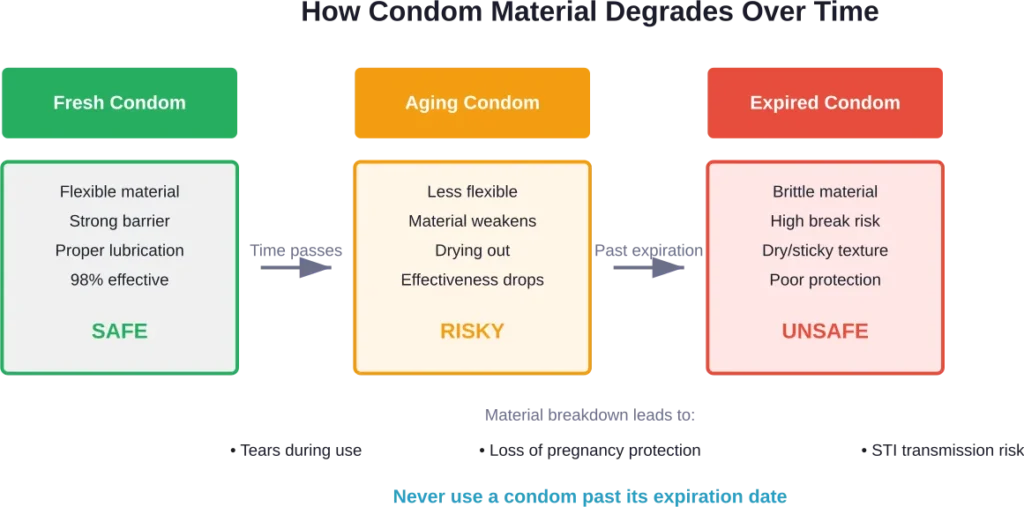
But over time, these materials degrade. Exposure to air, temperature fluctuations, and time itself causes the molecular structure to break down. The rubber becomes brittle. The flexibility disappears.
Expired condoms often feel noticeably different—drier, stiffer, sometimes even sticky or discolored.
Most condoms have a shelf life of three to five years from the date of manufacture, depending on the material and whether they contain spermicide. Condoms with spermicide typically expire faster because the chemical itself has a limited shelf life.
What Actually Happens When You Use an Expired Condom
Using a condom past its expiration date can significantly reduce how effective it is. The material degradation creates multiple points of failure.
Increased Breakage Risk
This is the biggest danger. Over time, the latex or polyurethane material becomes brittle and less flexible. During intercourse, the stress and friction that a fresh condom would normally handle easily can cause an expired one to tear.
Using an expired condom or incorrect size ranks among the common reasons for condom breakage.
When a condom breaks, you lose all protection. Both pregnancy and STI transmission become real possibilities.
Reduced Effectiveness Against Pregnancy
Male condoms that haven’t expired are about 98 percent effective with perfect use. But no one achieves perfect use consistently, so real-world effectiveness sits around 85 percent.
An expired condom? That effectiveness drops considerably. The structural integrity just isn’t there anymore.
Compromised STI Protection
Condoms serve double duty—they prevent pregnancy and provide a barrier against sexually transmitted infections. When the material breaks down, microscopic tears or complete breakage can occur.
That barrier you’re counting on? It’s compromised. Infections like HIV, chlamydia, gonorrhea, and others can be transmitted through these failures.
How Long Do Condoms Last?
The shelf life depends on several factors:
| Condom Type | Typical Shelf Life | Notes |
|---|---|---|
| Latex condoms | 3-5 years | Most common type, longer lasting without additives |
| Polyurethane condoms | 3-5 years | Good alternative for latex allergies |
| Condoms with spermicide | 2-3 years | Shorter shelf life due to chemical breakdown |
| Novelty condoms | 1-3 years | Varies widely, check packaging carefully |
Storage conditions matter enormously. Heat, humidity, and direct sunlight accelerate degradation. That condom in your glove compartment or wallet? It’s probably degrading faster than the expiration date suggests.
Where to Find the Expiration Date
Most condoms have the expiration date printed directly on the individual wrapper. Look for phrases like “EXP,” “Expiry,” or “Use by.”
The date might also appear on the outer box. When checking individual wrappers, examine the crimped edges or the flat surface of the package.
Can’t find an expiration date? Don’t use it. Legitimate condom manufacturers include this information for safety reasons.
What Causes Condoms to Expire Faster?
Several factors accelerate material breakdown:
- Heat exposure: Storing condoms in hot environments like cars, wallets, or direct sunlight breaks down the material rapidly
- Humidity: Moisture can degrade packaging and affect the condom itself
- Friction: Constant rubbing in wallets or pockets creates weak spots
- Spermicide content: The chemical itself has a shelf life and accelerates latex breakdown
- Improper storage: Temperatures above 100°F or below freezing damage the material
Improper storage including heat and direct sunlight are among common reasons for condom failure.
Is Using an Expired Condom Better Than Nothing?
This is a question many people face in the moment. The short answer? It’s complicated.
An expired condom provides some barrier protection, which is technically better than no barrier at all. But the risk of failure is high enough that it shouldn’t be considered reliable protection.
If the choice is between an expired condom and unprotected sex with a partner whose STI status you don’t know, the expired condom might reduce some risk. But understand that you’re taking a significant gamble with both pregnancy and infection transmission.
The better approach? Keep fresh condoms accessible. Check expiration dates when purchasing. Replace your stash every couple of years even if you haven’t used them all.
What to Do If You’ve Used an Expired Condom
Okay, so it happened. You used an expired condom. Now what?
For Pregnancy Prevention
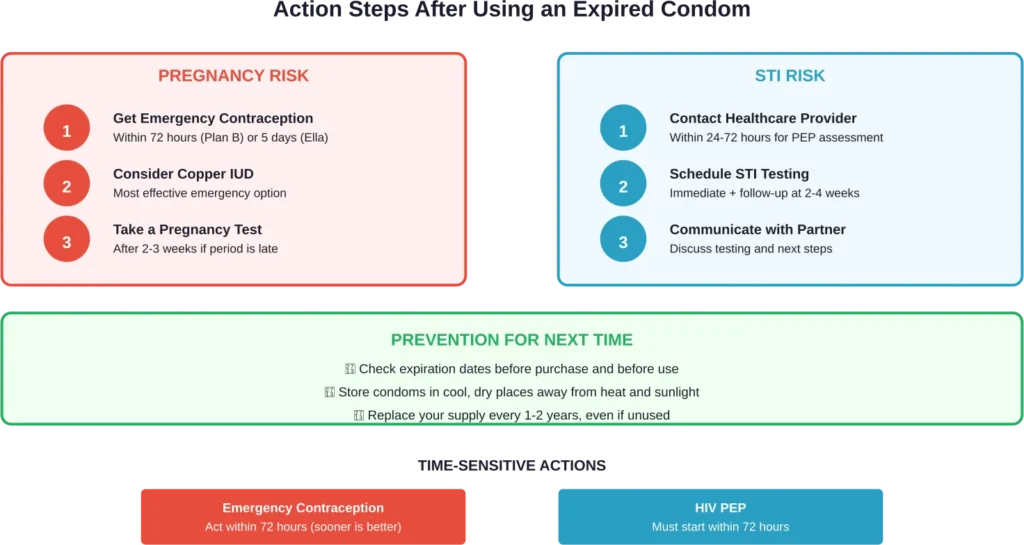
Emergency contraception is your next step. According to the University of Colorado Division of Student Life, you have options:
Plan B (levonorgestrel): Available over the counter, take as soon as possible within 72 hours. Effectiveness decreases with time and may not work as well for people over 195 pounds.
Ella (ulipristal acetate): More effective than Plan B and works up to 5 days (120 hours) after unprotected sex. Requires a prescription. Weight limit is approximately 195 pounds.
Copper IUD: According to the CDC, the copper IUD can be placed as emergency contraception and is the most effective option, regardless of weight.
Time matters. The sooner you act, the better these methods work.
For STI Prevention
Unfortunately, there’s no morning-after pill for infections. But you can take proactive steps:
- Contact a healthcare provider or sexual health clinic within 24-72 hours
- Ask about post-exposure prophylaxis (PEP) for HIV if there’s a known or suspected risk
- Get tested for STIs, keeping in mind that some infections have window periods before they show up on tests
- Communicate with your partner about testing and status
How to Store Condoms Properly
Proper storage extends condom life and maintains effectiveness:
- Keep them in a cool, dry place—bedroom drawers work well
- Avoid wallets, glove compartments, and anywhere exposed to temperature extremes
- Store away from direct sunlight and moisture
- Leave them in original packaging until use
- Don’t stack heavy objects on top of condom boxes
Think of condoms like medication. They need stable conditions to remain effective.
Signs a Condom Has Gone Bad
Beyond checking the date, watch for these warning signs:
- Wrapper appears damaged, torn, or punctured
- Condom feels brittle, stiff, or sticky when touched
- Material looks discolored or has visible damage
- Packaging appears bloated or vacuum seal is broken
- Unusual odor when opening the wrapper
When in doubt, throw it out. The cost of a new condom is nothing compared to the potential consequences.
Frequently Asked Questions
No, any condom past its expiration date should not be used. Material degradation doesn’t stop at the printed date—it’s an ongoing process. Even one month past expiration significantly increases breakage risk and reduces protection against pregnancy and STIs.
While exact effectiveness data for expired condoms isn’t widely published, material breakdown substantially reduces reliability. Fresh condoms are 98% effective with perfect use and 85% with typical use. Expired condoms have compromised structural integrity, making breakage much more likely and effectiveness considerably lower.
Never store condoms in wallets, cars, glove compartments, bathrooms with high humidity, or anywhere exposed to direct sunlight or temperature extremes. Heat above 100°F and freezing temperatures both damage the material. The best storage location is a cool, dry drawer away from light and heat sources.
No, shelf life varies by material and additives. Latex and polyurethane condoms typically last 3-5 years. Condoms with spermicide expire faster, usually within 2-3 years, because the chemical itself has a limited shelf life and accelerates latex breakdown. Always check the specific expiration date on your condoms.
According to the CDC, the copper IUD is the most effective emergency contraception option and works regardless of weight. It must be placed within 5 days of unprotected sex. For oral options, Ella (ulipristal acetate) is more effective than Plan B (levonorgestrel) and works for up to 5 days, though it requires a prescription.
Absolutely. Heat exposure accelerates material degradation regardless of the printed expiration date. Condoms stored in hot environments like cars often show signs of damage—brittleness, stickiness, or discoloration—even when technically not expired. Always inspect condoms that have been exposed to heat and discard questionable ones.
Not necessarily. Check each individual wrapper for its expiration date. Condoms in the same box should have similar dates, but always verify each one. If the box itself is past its date or has been stored improperly, it’s safest to replace the entire supply.
The Bottom Line on Expired Condoms
Using an expired condom isn’t worth the risk. Period.
The material breakdown that occurs over time creates real, measurable dangers—increased breakage, reduced effectiveness against pregnancy, and compromised protection against STIs. These aren’t theoretical risks. They’re documented failure points that can have serious consequences.
Make checking expiration dates part of your routine. When buying condoms, look at the dates. Before using one, check again. Store them properly in cool, dry places.
And if you find yourself with only expired condoms available? That’s your sign to restock. Keep fresh condoms accessible. Replace your supply before it expires. Your health—and your partner’s—depends on it.
If you’ve already used an expired condom, don’t panic, but do act quickly. Emergency contraception and STI testing are time-sensitive. The sooner you address potential risks, the better your outcomes will be.
Stay informed, stay prepared, and stay protected with condoms that are within their shelf life and properly stored.