

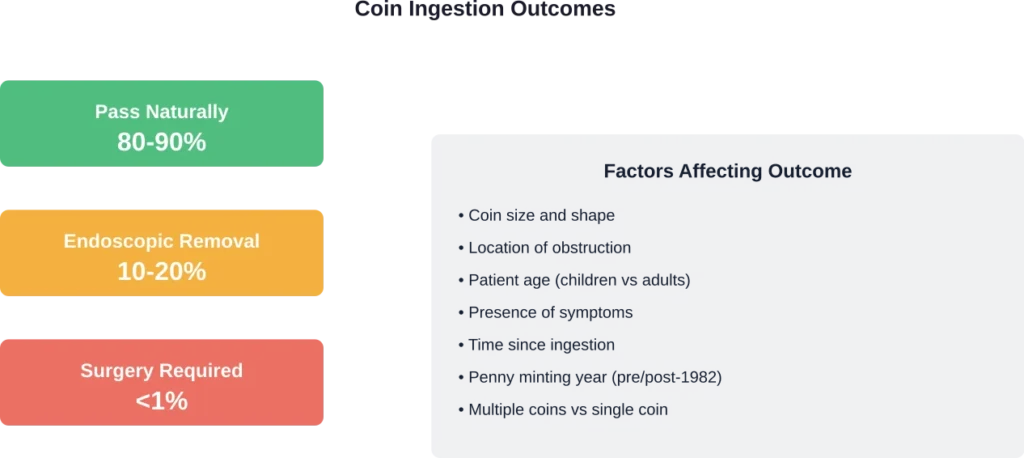
Quick Summary: Swallowing a penny usually isn’t life-threatening. According to the National Institutes of Health, 80-90% of swallowed coins pass through the digestive system naturally within a few days. However, coins can lodge in the esophagus causing serious tissue damage, or corrode in stomach acid (especially pennies minted after 1982), potentially causing complications that require medical attention.
Coins rank as the most frequently swallowed foreign objects requiring medical attention in the United States. Children between 6 months and 3 years old account for the majority of these incidents, though accidental ingestion happens across all age groups.
Understanding what happens after swallowing a penny can help determine whether a trip to the emergency room is necessary or if monitoring at home makes sense.
The Journey of a Swallowed Penny
When someone swallows a penny, it travels down the esophagus toward the stomach. This journey doesn’t always go smoothly.
The esophagus has three natural narrowing points where coins commonly get stuck. The most frequent obstruction site is the thoracic inlet, located at the upper chest area. According to research published by the NIH, approximately 10-15% of foreign bodies lodge in the midesophagus where the aortic arch and carina overlap. Objects can also become trapped at the gastroesophageal junction.
If the coin successfully passes into the stomach, it faces a new challenge: stomach acid. Here’s where the minting year matters significantly.
The Post-1982 Penny Problem
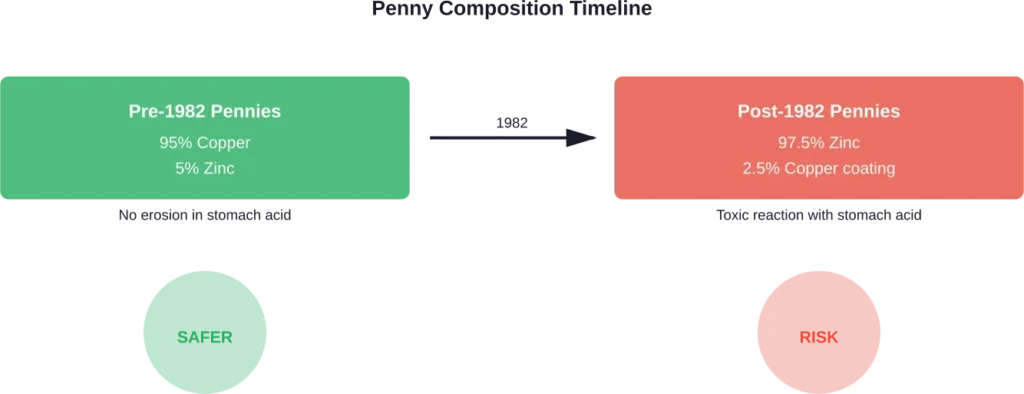
Duke University Medical Center researchers discovered something alarming about modern pennies. Pennies minted after 1982 are composed primarily of zinc with a copper coating, unlike pre-1982 pennies which were 95% copper and 5% zinc.
When stomach acid (hydrochloric acid) contacts these zinc-heavy pennies, a corrosive reaction occurs. The mixture becomes as toxic as car battery acid, leading to severe stomach inflammation and potentially causing ulcers.
Pre-1982 pennies show no such erosion when exposed to stomach acid, making them considerably safer if swallowed.
What Happens in Most Cases
The good news? Most swallowed coins don’t cause serious problems.
Research shows that 80-90% of foreign bodies pass spontaneously through the gastrointestinal tract without intervention. Less than 1% of cases require surgical removal.
When coins successfully reach the stomach and don’t cause complications, they typically pass through the entire digestive system. Sharp HealthCare reports that coins usually pass in less than four to five days, though the timeline varies.
Timeline for Coin Passage
| Location | Typical Duration | Action Required |
|---|---|---|
| Esophagus (symptomatic) | Immediate concern | Remove within 2 hours |
| Esophagus (no symptoms) | Up to 24 hours observation | Remove within 24 hours |
| Stomach to intestines | 4-5 days average | Monitor stool, watch for symptoms |
| Beyond stomach (no symptoms) | Up to 2 weeks | Follow-up imaging if not passed |
When Emergency Care Becomes Necessary
Not all swallowed pennies warrant a relaxed approach. Certain situations demand immediate medical attention.
Medical guidance emphasizes that coins stuck in the esophagus can cause serious tissue damage. If the coin remains lodged there for more than 24 hours, permanent tissue damage becomes increasingly likely.
Warning Signs That Require Immediate Care
Watch for these symptoms after someone swallows a penny:
- Difficulty swallowing or painful swallowing
- Excessive drooling
- Chest pain or discomfort
- Vomiting or gagging
- Difficulty breathing or wheezing
- Refusal to eat or drink
- Abdominal pain or distension
Any of these symptoms suggests the coin hasn’t passed into the stomach or is causing complications. Choking represents another serious risk—coins can lodge in the windpipe (trachea) rather than the esophagus.
Medical Diagnosis and Treatment
After a coin is swallowed, medical professionals typically order an X-ray to determine the coin’s location. This imaging helps guide treatment decisions.
Coins located in the esophagus require more urgent intervention than those that have reached the stomach. Research published in Clinical Endoscopy indicates that symptomatic children with coins in the esophagus should have them removed within 2 hours, while asymptomatic cases allow up to 24 hours.
Removal Methods
When coins don’t pass on their own, medical professionals have several removal options:
Endoscopic removal represents the most common intervention. Studies report endoscopic foreign body removal has a success rate of 88.5–100%. The procedure involves inserting a flexible tube with a camera and grasping tool through the mouth to retrieve the object.
Some medical centers allow up to 24 hours of observation for coins in the lower esophagus, as research shows approximately 28% of asymptomatic patients will pass the coin spontaneously into the stomach during this period.
Surgical removal becomes necessary in rare cases—less than 1% according to NIH data. Surgery typically occurs when endoscopic removal fails or complications develop, such as perforation or severe tissue damage.
Special Considerations for Children
Children face higher risks from swallowed coins for several reasons. Their esophagus is narrower, making obstruction more likely. They also can’t always communicate symptoms clearly, potentially delaying treatment.
Medical guidance emphasizes that coins shouldn’t be confused with button batteries, which require emergency removal regardless of symptoms. Button batteries can cause catastrophic tissue damage within hours.
Parents should look at their homes from a child’s eye level, keeping coins and small objects out of reach. Despite precautions, coins remain ubiquitous—making complete prevention challenging.
Can Swallowing a Penny Kill You?
Real talk: death from swallowing a single penny is extremely unlikely unless choking occurs.
The Poison Control Center states explicitly that swallowing a single coin is unlikely to result in death unless it obstructs the airway. However, serious complications can develop if coins remain in the esophagus for extended periods.
The greater concern involves the corrosive reaction between post-1982 pennies and stomach acid. While this can cause severe stomach inflammation and ulcers, these conditions are treatable with proper medical care.
Multiple coin ingestion presents higher risks, particularly if the coins stack or block passages. Each case requires individual medical assessment.
What to Do If Someone Swallows a Penny
Knowing the appropriate response can prevent unnecessary panic while ensuring safety.
For children 1 year and older who swallow a button battery (not a penny), honey may help prevent injury. The dose is 10 mL every 10 minutes until reaching emergency care. But this applies specifically to button batteries—not regular coins.
If someone swallows a penny and shows no symptoms, monitoring at home may be appropriate. Check stools for the coin’s passage and watch for warning signs.
However, seek immediate medical evaluation if:
- The person experiences any symptoms (difficulty swallowing, pain, breathing problems)
- A child swallows a quarter or larger coin
- Multiple coins were swallowed
- You’re uncertain whether it was a coin or button battery
- The coin doesn’t pass within 4-5 days
When in doubt, contact Poison Control at 1-800-222-1222 for free expert guidance available 24/7.
| Scenario | Recommended Action | Timeline |
|---|---|---|
| Any symptoms present | Seek immediate medical care | Within 1 hour |
| Child under 1 year, any coin | Medical evaluation recommended | Same day |
| No symptoms, penny swallowed | Monitor at home, check stools | 4-5 days observation |
| No symptoms, but quarter or larger | Contact doctor for guidance | Within 24 hours |
| Coin not passed after observation period | Follow-up X-ray needed | After 5-7 days |
Prevention Strategies
The best treatment for swallowed coins is prevention.
Keep loose change in closed containers rather than on countertops or low tables. Coin jars represent particular temptations for young children.
Teach children that coins aren’t toys or food. Even with education, supervision remains critical for children under 3 years old who explore the world by putting objects in their mouths.
Check floors, couch cushions, and other areas where coins accumulate. A single dropped penny might seem insignificant until a curious toddler finds it.
Frequently Asked Questions
Most pennies that successfully reach the stomach pass through the digestive system in 4-5 days. However, the timeline can extend up to two weeks in some cases. If the coin hasn’t appeared in stool after one week, medical follow-up with imaging is recommended to confirm its location.
Pennies minted before 1982 contain 95% copper and don’t react significantly with stomach acid. Post-1982 pennies are primarily zinc with a thin copper coating. When stomach acid erodes this coating, the zinc creates a toxic mixture as corrosive as battery acid, potentially causing severe stomach inflammation and ulcers.
Yes, pennies are radiopaque and clearly visible on X-rays. Medical professionals routinely use X-ray imaging to determine the location of swallowed coins and guide treatment decisions. The X-ray shows whether the coin is in the esophagus, stomach, or intestines.
No, never induce vomiting after someone swallows a coin. Vomiting can cause the coin to lodge in the throat or airway, creating a choking hazard. It can also cause the coin to damage the esophagus during its upward passage. Let medical professionals determine the safest removal method if intervention is needed.
While less common than in children, adults can experience complications from swallowed coins. Adults with esophageal narrowing from previous medical conditions face higher obstruction risks. The same toxic reaction between post-1982 pennies and stomach acid affects adults, though their larger anatomy generally allows easier passage.
Multiple coin ingestion requires immediate medical evaluation. Stacked coins are more likely to obstruct the digestive tract and less likely to pass spontaneously. Multiple coins also increase the surface area exposed to stomach acid in post-1982 pennies, potentially intensifying the corrosive reaction. Contact emergency services or Poison Control immediately.
Doctors typically use endoscopic removal for coins lodged in the esophagus. This procedure involves inserting a flexible endoscope through the mouth with a camera and grasping tool to retrieve the coin. The success rate is 88.5–100% according to medical literature. Symptomatic cases require removal within 2 hours, while asymptomatic cases allow up to 24 hours for observation before intervention.
Conclusion
Swallowing a penny triggers legitimate concern, but the outcome is usually positive with appropriate monitoring and medical care when needed.
The majority of swallowed coins pass naturally without complications. Understanding warning signs helps determine when emergency care becomes necessary versus when home observation suffices.
The year a penny was minted matters—post-1982 pennies pose greater risks due to their zinc composition reacting with stomach acid. Location matters too, with esophageal coins requiring more urgent intervention than those reaching the stomach.
If someone swallows a penny, assess for symptoms, contact Poison Control for guidance if uncertain, and seek immediate medical care for any breathing difficulties, pain, or inability to swallow. Prevention through vigilant supervision and keeping coins out of children’s reach remains the best strategy.