
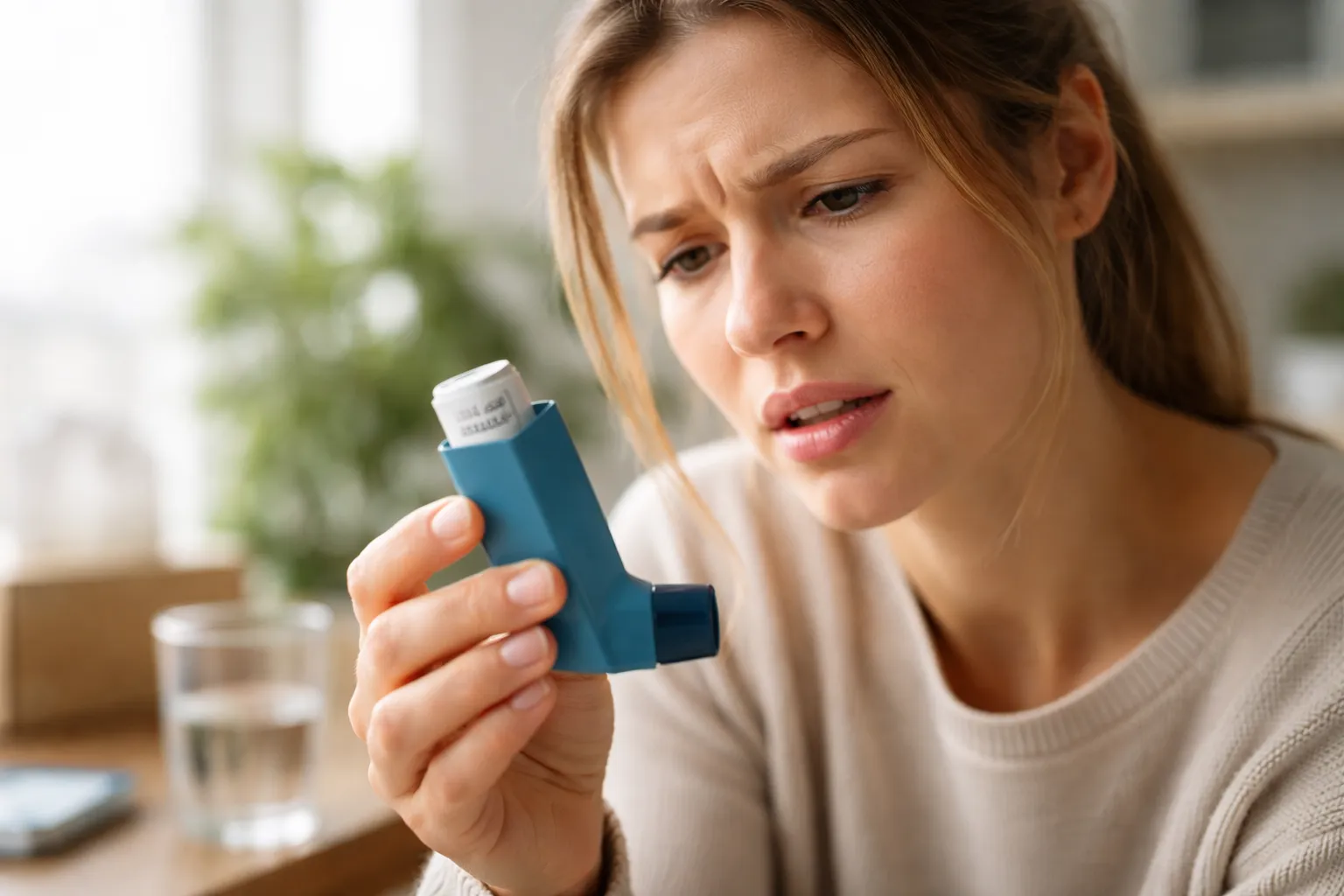
Quick Summary: Using an expired inhaler may be safe in emergencies, but effectiveness decreases over time. Most inhalers remain stable for about 12-13 months after opening or past their printed expiration date. While FDA research shows some medications retain potency beyond expiration, reduced effectiveness means symptoms may not be properly controlled.
Finding an expired inhaler in the medicine cabinet raises an immediate question: can it still work when needed? For people managing asthma or COPD, this isn’t just academic curiosity. It’s about whether that device will actually deliver relief during an attack.
The short answer? It’s complicated.
Here’s the thing though—expired doesn’t automatically mean useless. But it doesn’t mean safe or effective either. The reality sits somewhere in between, depending on factors most people never consider.
Understanding Inhaler Expiration Dates
According to the FDA, drug expiration dates reflect the time period during which a product is known to remain stable, meaning it retains its strength, quality, and purity when stored according to labeled conditions.
Manufacturers establish these dates through stability testing data submitted during FDA application processes. The guidelines consist of accelerated stability studies at temperatures of 40°C and 75% humidity for 6 months to understand how environmental conditions affect the medication.
For inhalers specifically, expiration typically occurs about one year after the device is first used or removed from its foil pouch. Some inhalers like ProAir RespiClick are considered safe to use for up to 13 months after removal from their foil pouch or after the expiration date, whichever comes first.
But does that mean the medication becomes dangerous the day after expiration?
Not exactly.
What Actually Happens to Expired Inhalers
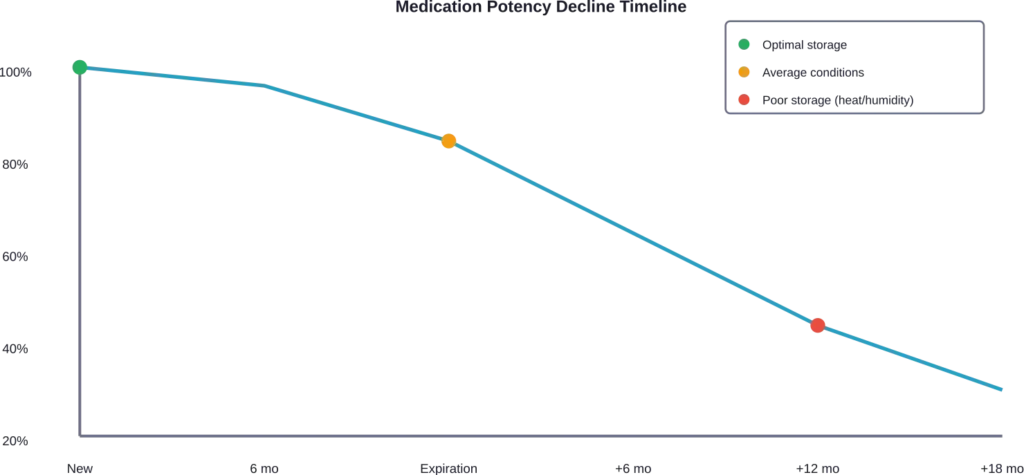
The primary concern with expired inhalers isn’t sudden toxicity. It’s reduced potency.
Research conducted on medications stored at the International Space Station provides revealing insights. One study examined nine medications stored over 550 Earth days in extreme conditions. Four of the nine medications (44% of those tested) met USP requirements 8 months post-expiration. Another three medications (33%) met USP guidelines 2–3 months before expiration.
This demonstrates that degradation isn’t uniform across all medications or storage conditions.
Chemical Breakdown Over Time
Medications degrade over time, and degradation is hastened by extreme storage conditions. For albuterol inhalers specifically, the active ingredient can break down when exposed to heat, moisture, or direct sunlight.
The propellant in metered-dose inhalers (MDIs) can also lose pressure over time, meaning fewer medication particles get delivered with each puff. Even if the chemical formula remains intact, delivery mechanism failure renders the inhaler less effective.
Real talk: an inhaler that delivers only 70% of its intended dose might feel like it’s working. But that 30% reduction could be the difference between controlled symptoms and a trip to the emergency room.
The Potency Problem
Studies show that up to 29% of medication can remain unused in some inhaler models. This residual medication faces ongoing degradation even in an unopened device.
Temperature fluctuations accelerate this process. An inhaler left in a car during summer or stored in a humid bathroom degrades faster than one kept in a climate-controlled bedroom.
Is Using an Expired Inhaler Dangerous?
The good news: expired inhalers rarely become toxic or harmful. The chemical breakdown of albuterol and similar bronchodilators doesn’t typically produce dangerous compounds.
The bad news: an inhaler that doesn’t work when needed creates serious risk.
A systematic review examining expired resuscitation medications for life-threatening first aid conditions analyzed 17 studies covering albuterol, aspirin, epinephrine, and naloxone. After screening 1,398 records, researchers found two studies specifically on albuterol.
The research indicates that while safety generally persists, efficacy becomes unreliable.
When Emergency Use Might Be Justified
In urgent situations where no unexpired inhaler is available and breathing difficulty is severe, using an expired inhaler as a temporary measure beats doing nothing. But this should only serve as a bridge until proper medical treatment is available.
The US Department of Defense established the FDA Shelf-Life Extension Program (SLEP) in 1986 to defer replacement costs of expiring medications. This program exists specifically because some medications remain viable beyond printed dates—but it involves careful testing under controlled conditions, not guesswork.
Similarly, the German armed forces (Bundeswehr) maintain protocols for using expired drugs in shortage situations, but always with documentation and monitoring.
That’s not the same as casually using an expired rescue inhaler found in a drawer.
Different Inhaler Types and Expiration
Not all inhalers expire at the same rate. Understanding the differences helps manage expectations.
| Inhaler Type | Typical Expiration After Opening | Key Considerations |
|---|---|---|
| Albuterol MDI (ProAir, Ventolin, Proventil) | 1 year after first use | Check printed date on canister; propellant pressure degrades |
| Dry Powder Inhaler (Advair Diskus, Symbicort) | Varies; see product-specific guidance | Moisture exposure degrades powder quickly |
| Soft Mist Inhaler (Spiriva Respimat) | Check product-specific guidance for expiration timeline | Mechanical components and solution stability limited |
| Nebulizer Solutions | Varies; check individual vials | Opened vials expire within 24 hours typically |
ProAir RespiClick, mentioned earlier, has a 13-month window. Ventolin HFA replaced it as the preferred Medicaid option, but ProAir RespiClick remains available with its specific expiration guidelines.
Dry powder inhalers face unique challenges. Moisture exposure rapidly degrades the powder formulation, making proper storage even more critical than with MDIs.
Proper Storage Extends Inhaler Life
Storage conditions dramatically impact whether an inhaler reaches its expiration date with full potency intact.
Best practices include:
- Store at room temperature, typically between 68-77°F (20-25°C)
- Keep away from direct sunlight and heat sources
- Avoid humid environments like bathrooms
- Don’t leave inhalers in cars where temperature fluctuates wildly
- Keep the cap on when not in use to prevent contamination
- Store upright when possible
For households managing asthma, maintaining humidity below 50 percent helps prevent mold and preserves medication integrity. Using a dehumidifier and monitoring humidity levels with a simple hygrometer makes this manageable.
Now, this is where it gets interesting. Even perfect storage can’t extend an inhaler beyond its chemical stability limits. But poor storage can cause failure well before the printed date.
Signs Your Inhaler Has Gone Bad
How can someone tell if an inhaler is no longer effective?
Watch for these indicators:
- Dose counter shows empty or near-empty: Many modern inhalers include counters. When it reads zero, the inhaler is done regardless of expiration date.
- Weak spray or no spray: If the mist feels weak or doesn’t spray at all, propellant has likely failed.
- Clumping in dry powder inhalers: Moisture exposure causes powder to clump, preventing proper dosing.
- Unusual taste or smell: Chemical breakdown can alter taste or create off-odors.
- Lack of symptom relief: The clearest sign—if the inhaler doesn’t relieve symptoms as expected, potency has likely declined.
Testing an inhaler by spraying into the air wastes doses and doesn’t provide reliable information about medication content. The propellant may spray while medication potency has degraded.
What to Do With Expired Inhalers
Tossing expired inhalers in the trash seems simple. But it’s actually problematic.
Studies show that up to 29% of medication remains in some inhaler models even when the counter reads empty. Pharmaceutical contamination becomes an issue when rainwater or moisture in landfills dissolves residual medication, allowing active ingredients to leach into groundwater.
Additionally, inhalers contain propellants—often hydrofluoroalkanes (HFAs)—that can contribute to environmental issues if not properly disposed.
Proper Disposal Methods
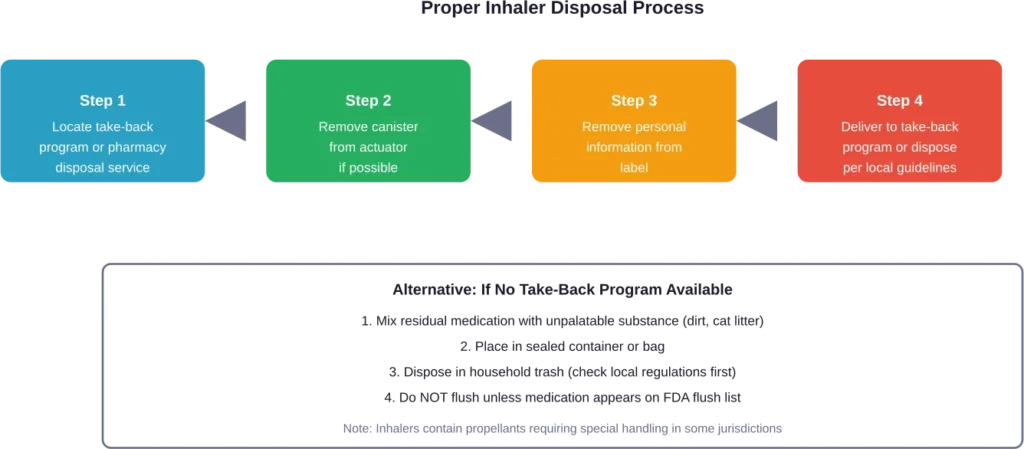
The safest disposal route involves medication take-back programs. Many pharmacies, hospitals, and community organizations run these programs, accepting expired or unused medications for proper destruction.
Check with local pharmacies first. National chains like CVS and Walgreens often participate in take-back initiatives.
If no take-back program is accessible, the FDA recommends:
- Remove the canister from the inhaler actuator if possible
- Check if the medication is on the FDA flush list (most inhalers are not)
- If not flushable, mix the medication with unpalatable substances like dirt or cat litter
- Place in a sealed container before discarding
- Remove personal information from the medication label
Some municipalities classify expired inhalers as medical waste requiring specialized disposal. Local regulations vary, making it worth checking municipal guidelines.
When to Replace Your Inhaler
Don’t wait for complete expiration. Replace inhalers when:
- The expiration date passes
- The dose counter indicates the inhaler is empty
- Symptoms aren’t controlled as well as they used to be
- The inhaler has been exposed to extreme temperatures
- Visible damage or defects appear
- A healthcare provider prescribes a new inhaler
Many insurance plans cover inhaler replacements before full expiration if medical necessity is documented. A conversation with the prescribing physician about needing an early refill can facilitate this.
Some pharmaceutical manufacturers maintain patient assistance programs that may provide free or reduced-cost inhalers to qualifying individuals.
The Bottom Line on Expired Inhalers
Sound familiar? Finding an expired inhaler and wondering if it’s still good enough.
Here’s what matters most: while expired inhalers rarely pose direct safety risks, their effectiveness becomes unreliable. Reduced potency means symptoms may not be adequately controlled, creating risk during asthma attacks or COPD exacerbations.
In absolute emergencies with no alternative, an expired inhaler beats no treatment. But it’s a stopgap measure, not a long-term solution.
The smarter approach involves proactive replacement before expiration, proper storage to maintain potency, and responsible disposal when inhalers reach end-of-life.
Check expiration dates now. If any inhalers have passed their prime, schedule a pharmacy visit to obtain fresh replacements. It’s a small step that could make a significant difference when breathing matters most.
Frequently Asked Questions
Research indicates some albuterol formulations may retain significant potency beyond expiration dates under certain storage conditions. The FDA research on medications stored at the International Space Station found 44% of tested medications met requirements 8 months post-expiration. However, potency degrades unpredictably, making expired inhalers unreliable for consistent symptom control. Replace expired inhalers rather than depending on degraded medication during breathing emergencies.
Expired inhalers typically don’t cause toxicity or make users sick. The chemical breakdown of albuterol and similar bronchodilators doesn’t usually produce harmful compounds. The primary risk involves inadequate symptom relief rather than poisoning. An ineffective inhaler during an asthma attack creates danger by failing to open airways, not through toxic effects. That said, contamination from improper storage could potentially cause issues, so inspect expired inhalers for visible contamination before any use.
Expired inhalers typically don’t cause toxicity or make users sick. The chemical breakdown of albuterol and similar bronchodilators doesn’t usually produce harmful compounds. The primary risk involves inadequate symptom relief rather than poisoning. An ineffective inhaler during an asthma attack creates danger by failing to open airways, not through toxic effects. That said, contamination from improper storage could potentially cause issues, so inspect expired inhalers for visible contamination before any use.
Metered-dose inhalers (MDIs) typically expire 12-13 months after opening. Dry powder inhalers have shorter windows—often just 1-2 months after removing from foil packaging because moisture exposure rapidly degrades powder formulations. Soft mist inhalers like Spiriva Respimat usually expire 3 months after first use due to solution stability and mechanical component limitations. Always check the specific expiration guidance printed on each inhaler type, as formulations and delivery mechanisms vary significantly.
Store inhalers at room temperature between 68-77°F (20-25°C), away from direct sunlight, heat sources, and humidity. Avoid bathrooms where moisture accumulates and never leave inhalers in cars where temperatures fluctuate dramatically. Keep caps on when not in use to prevent contamination. Store upright when possible. Even with perfect storage, inhalers can’t extend beyond their chemical stability limits, but poor storage causes premature failure well before printed expiration dates.
The only justifiable scenario involves life-threatening breathing difficulty with no unexpired inhaler available and no immediate access to emergency medical care. In that specific circumstance, an expired inhaler used as a temporary bridge to proper treatment beats no intervention. This shouldn’t become standard practice. The US Department of Defense and German armed forces maintain protocols for expired medication use during shortages, but always with careful documentation and monitoring—not casual home use of expired rescue inhalers.
Modern inhalers include dose counters showing remaining doses. When the counter reads zero, the inhaler is empty regardless of expiration date. For older inhalers without counters, track doses manually from the first use. Never test by spraying into the air, as this wastes doses without providing reliable information about medication content. Propellant may spray while medication potency has degraded. If symptom relief decreases noticeably, assume potency has declined and obtain a replacement.
Don’t panic. Expired inhalers rarely cause harm—the concern is ineffectiveness. Monitor symptoms closely. If breathing difficulty persists or worsens, seek medical attention immediately and use emergency services if needed. Replace the expired inhaler as soon as possible with a current prescription. Inform healthcare providers about using expired medication so they can assess whether symptoms are adequately controlled. Going forward, check expiration dates regularly and set reminders to obtain replacements before inhalers expire.