

Quick Summary: Eating too many bananas can lead to hyperkalemia (excess potassium), causing heart rhythm issues, muscle weakness, and digestive problems. While bananas are nutritious, consuming more than two per day may result in nutrient imbalances, blood sugar spikes, and dental issues. Most healthy adults should limit intake to one or two bananas daily.
Bananas are everywhere. They’re the world’s most popular fruit, packed into lunch boxes, blended into smoothies, and sliced onto breakfast bowls. And for good reason—one medium banana delivers about 422 mg of potassium and 10 mg of vitamin C, and a solid dose of vitamin B6.
But here’s the thing: just because something’s healthy doesn’t mean unlimited quantities are harmless.
So what actually happens when banana consumption goes from reasonable to excessive? The answer involves potassium levels, blood sugar, digestive chaos, and in extreme cases, genuine medical emergencies.
The Potassium Problem: Hyperkalemia Explained
Bananas are potassium powerhouses. According to the U.S. Department of Agriculture, one medium banana provides about 375 milligrams of potassium, which is approximately 11% of the recommended daily potassium for men and 16% for women.
Potassium is essential for heart health, muscle function, and blood pressure management. But too much creates a serious condition called hyperkalemia—when serum or plasma potassium concentration exceeds the upper normal limit, typically greater than 5.0 to 5.5 mEq/L.
According to the National Institutes of Health, hyperkalemia is marked by serum potassium concentrations above the normal range. Clinical presentation varies with the absolute potassium level and the rate of change.
The symptoms? Cardiac arrhythmias, muscle weakness, and paralysis. In documented medical cases, excessive banana consumption has triggered hospitalization.
Medical case studies from the National Center for Biotechnology Information document instances where excessive banana consumption has resulted in hyperkalemia and other electrolyte imbalances.
How Many Bananas Cause Hyperkalemia?
For most healthy people with normal kidney function, the body efficiently eliminates excess potassium through urine. That’s protective.
But problems emerge when kidney function is compromised or when consumption reaches extreme levels rapidly. The NIH notes that hyperkalemia may result from primary renal dysfunction or secondary factors including acute volume depletion.
Research published in the Journal of Athletic Training (2012) examined whether ingesting 0, 1, or 2 servings of bananas after 60 minutes of moderate to vigorous exercise in the heat alters plasma potassium concentration and plasma glucose concentration.
Real talk: while the claim that eating more than six bananas can kill you is sometimes cited, medical evidence indicates this is highly unlikely for healthy people with normal kidney function, though individual tolerance varies significantly.
Blood Sugar Spikes and Weight Gain
One medium banana contains about 27 grams of carbohydrates, mostly from natural sugars. That’s not inherently bad—but it adds up fast.
Eating multiple bananas daily can trigger blood sugar spikes, especially when consumed without protein or fat to slow digestion. For people with diabetes or insulin resistance, this creates blood glucose management challenges.
And then there’s weight. Bananas aren’t particularly calorie-dense at roughly 105 calories each. But three bananas daily adds 315 calories—and if those aren’t accounted for, weight gain follows.
According to competitor analysis, bananas are very low in protein and fat. The vast majority of calories come from carbohydrates, making them an incomplete nutritional source when overconsumed at the expense of other foods.
Digestive Distress and Nutrient Imbalance
Here’s what community discussions reveal: eating excessive bananas wreaks havoc on digestion.
Bananas contain resistant starch and pectin, particularly when slightly underripe. These act as prebiotic fiber, feeding beneficial gut bacteria. In moderation, that’s excellent for digestive health.
But too much fiber too quickly causes bloating, gas, and constipation. The digestive system needs balance—and a banana-heavy diet lacks variety.
The Nutrient Displacement Problem
When bananas dominate dietary intake, other essential nutrients get crowded out. Bananas provide vitamin C, vitamin B6, potassium, and manganese—but they’re virtually devoid of protein, healthy fats, iron, calcium, and vitamins A, D, E, and K.
Relying heavily on one food source, regardless of its nutritional profile, creates imbalances. Dietary diversity matters.
| Nutrient | Amount per Banana | Daily Value % |
|---|---|---|
| Vitamin C | 10 mg | 11% |
| Vitamin B6 | 0.43 mg | 25% |
| Potassium | 422 mg | 9% |
| Manganese | 0.32 mg | 14% |
| Magnesium | 32 mg | 8% |
| Protein | 1.3 g | 3% |
| Fat | 0.4 g | <1% |
Dental Health Concerns
Bananas are sticky and sugar-rich—a combination that dental enamel doesn’t love.
Eating multiple bananas daily without proper oral hygiene allows natural sugars to linger on teeth, feeding bacteria that produce enamel-eroding acids. Over time, this contributes to cavities and tooth decay.
It’s not that bananas are uniquely destructive to teeth—but volume matters. Three bananas expose teeth to significantly more sugar than one.
Who’s Most at Risk?
Certain groups face heightened risks from excessive banana consumption:
- People with chronic kidney disease who can’t efficiently eliminate potassium
- Individuals taking potassium-sparing diuretics or ACE inhibitors
- Those with diabetes managing blood sugar levels
- Anyone with reduced kidney function from dehydration or illness
According to the CDC and NIH, potassium homeostasis is particularly challenging for people with chronic kidney disease. The agencies note that while potassium-rich foods reduce stroke, hypertension, and osteoporosis risk in healthy populations, those with reduced kidney function require different guidelines.
The National Institutes of Health emphasizes that there’s no uniform guideline for potassium intake among adults with chronic kidney disease—individualized medical guidance is essential.
So How Many Bananas Are Safe?
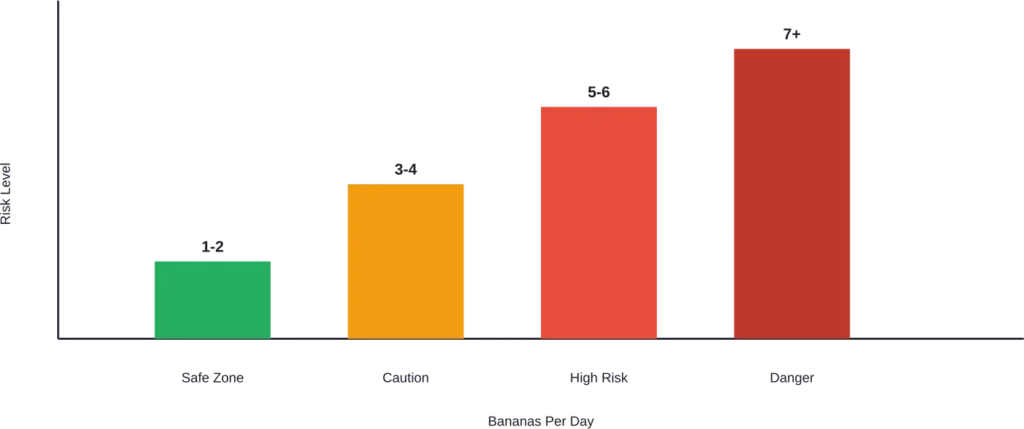
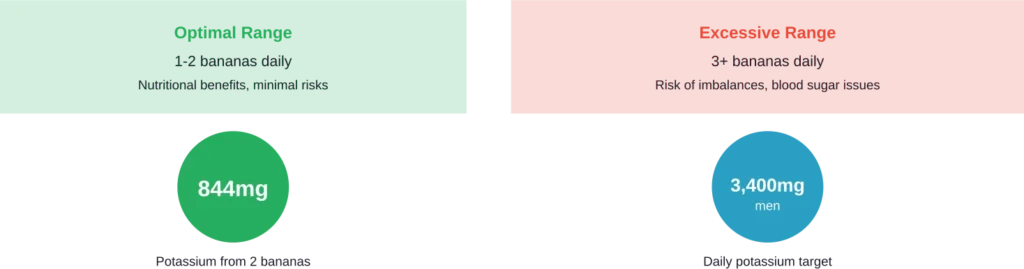
For most healthy adults, one to two bananas per day fits comfortably within a balanced diet.
According to the Dietary Guidelines for Americans 2020–2025, men should consume at least 3,400 mg of potassium per day while women should consume at least 2,600 mg of potassium per day. Two bananas (using 422 mg per banana as stated earlier) provide approximately 844 mg of potassium—leaving plenty of room for potassium from vegetables, legumes, and other fruits.
But more than two? That’s when diminishing returns kick in. The benefits plateau while risks gradually increase.
Frequently Asked Questions
It’s highly unlikely for a healthy person. While eating six or more bananas rapidly can elevate potassium levels, the body typically eliminates excess through urine. However, individuals with kidney problems or those taking certain medications could experience dangerous hyperkalemia from this amount.
Symptoms include digestive issues like bloating and constipation, fatigue, muscle weakness, irregular heartbeat, and nausea. Severe cases may present with tingling sensations, breathing difficulties, or chest pain—requiring immediate medical attention.
For healthy adults with normal kidney function, hyperkalemia from bananas alone is rare and would typically require consuming six or more in a short period. People with compromised kidney function face risks at much lower quantities and should consult healthcare providers about potassium intake.
Yes, bananas can cause blood sugar increases due to their natural sugar and carbohydrate content. Eating multiple bananas amplifies this effect. Pairing bananas with protein or healthy fats slows digestion and moderates blood glucose response.
Not inherently, but eating multiple bananas daily adds significant calories. Three bananas provide over 300 calories from primarily carbohydrates. For weight loss, moderation and dietary variety matter more than eliminating specific foods.
Yes, paradoxically. While ripe bananas generally support digestion, excessive consumption—especially of underripe bananas high in resistant starch—can slow digestive transit and cause constipation. Balance and hydration are key.
Not necessarily avoid, but carefully moderate. According to the CDC and NIH, people with chronic kidney disease have impaired potassium elimination and require individualized dietary guidance. Consult a nephrologist or registered dietitian for personalized recommendations.
The Bottom Line
Bananas are nutritious, convenient, and delicious. They belong in a healthy diet.
But balance matters. Eating one or two bananas daily provides valuable nutrients without triggering the adverse effects associated with overconsumption—hyperkalemia, blood sugar fluctuations, digestive problems, and nutrient imbalances.
More than two? That’s when the risks start outweighing the benefits for most people.
If bananas dominate dietary choices, it’s time to diversify. Incorporate other potassium sources like sweet potatoes, spinach, and white beans. Add protein and healthy fats. Variety isn’t just the spice of life—it’s the foundation of optimal nutrition.
Check with healthcare providers before making significant dietary changes, especially when managing chronic conditions or taking medications that affect potassium levels. Because when it comes to bananas, more definitely isn’t always better