

Quick Summary: Divorcing a disabled spouse involves complex considerations around spousal support, disability benefits, health insurance, property division, and caregiving arrangements. Courts evaluate each spouse’s financial capacity, medical needs, and ability to maintain independence post-divorce. The disabled spouse’s government benefits like SSI or SSDI may be affected by property settlements and support orders, requiring careful planning to avoid benefit loss.
Divorce is never simple. But when one spouse has a disability, the process becomes significantly more complex.
Courts don’t just look at assets and income anymore. They examine medical needs, caregiving responsibilities, benefit eligibility, and long-term care requirements. The disabled spouse’s quality of life becomes a central concern, not just a footnote in settlement negotiations.
And here’s the thing—disability changes nearly every aspect of the divorce process. From support calculations to custody arrangements to insurance coverage, standard divorce formulas don’t always apply.
How Disability Fundamentally Changes Divorce Proceedings
When disability enters the equation, courts shift their focus. They’re not just dividing a household. They’re ensuring the disabled spouse maintains access to essential care, benefits, and support systems.
This means the non-disabled spouse faces different obligations than in a traditional divorce. Financial support calculations become more nuanced. Property division considers accessibility and practical needs, not just market value.
Community discussions reveal that many people don’t realize how thoroughly disability reshapes the process until they’re in the middle of it. The standard “50/50 split” mentality rarely works when one party requires ongoing medical care or assistive services.
Question of Legal Capacity
Before divorce proceedings can even begin, courts may need to establish whether the disabled spouse has the legal capacity to consent to divorce. This applies particularly when cognitive or intellectual disabilities are involved.
If capacity is questioned, the court may appoint a guardian ad litem to represent the disabled spouse’s interests. This guardian investigates whether divorce serves the person’s best interests and whether they understand what’s happening.
The Special Needs Alliance notes that studies indicate divorce rates increase with the onset of a disability. But capacity concerns can complicate these proceedings significantly.
Spousal Support: The Disability Factor
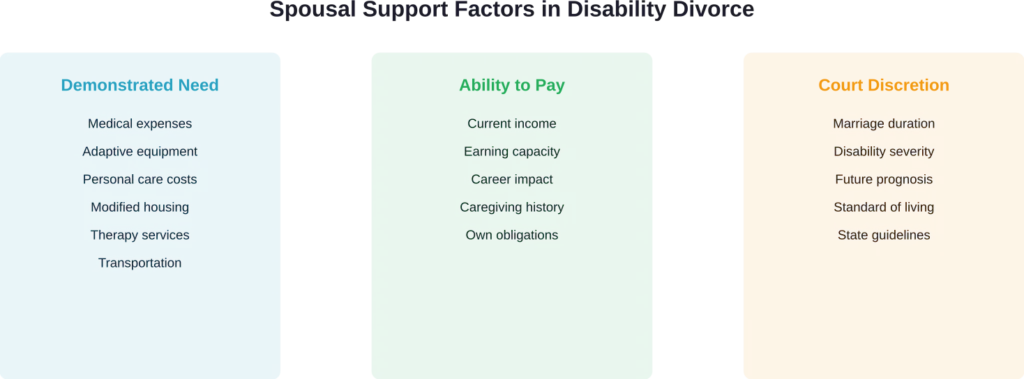
Spousal support calculations get complicated fast when disability is involved. Courts balance two competing factors: the paying spouse’s ability to pay and the disabled spouse’s demonstrated need.
The disabled spouse’s need often extends far beyond basic living expenses. Medical treatments, therapies, adaptive equipment, personal care assistants, and modified housing all factor into the calculation.
But there’s a catch. The paying spouse’s ability to pay might be limited if they’ve been the primary caregiver and left the workforce to provide care. Courts examine these circumstances carefully.
Duration and Amount Considerations
For marriages between five and ten years, a spouse may ask for up to 60 percent of the months of marriage in some states. The longer the marriage, the greater the percentage typically allowed.
When disability is present, courts may extend support duration beyond standard guidelines. Permanent or long-term support becomes more likely, especially if the disability prevents the spouse from achieving financial independence.
Real talk: judges have wide discretion here. They’ll look at the disability’s severity, treatment costs, earning capacity limitations, and whether the condition will improve or worsen over time.
Government Benefits: Navigating the Minefield
Here’s where things get tricky. Many disabled individuals rely on Supplemental Security Income (SSI) or Social Security Disability Insurance (SSDI) for survival.
These benefits have strict eligibility rules. And divorce settlements can accidentally disqualify someone from benefits they desperately need.
SSI, for instance, is means-tested. If the disabled spouse receives too much property or cash in the settlement, they could lose benefits entirely. SSDI operates differently but comes with its own complications.
Divorced Spouse Social Security Benefits
According to the Social Security Administration’s Code of Federal Regulations § 404.331, divorced spouses may be entitled to benefits based on their former spouse’s earnings record under specific conditions.
The marriage must have lasted at least ten years. The divorced spouse must be unmarried and at least age 62. And the insured former spouse must be entitled to old-age or disability benefits—or be at least age 62 themselves.
This provision helps divorced spouses who may have sacrificed their own careers to care for their disabled partner. But it only kicks in under these specific circumstances.
Protecting Benefit Eligibility
Smart divorce planning considers benefit preservation from the start. Instead of lump-sum property settlements that push someone over asset limits, structured support payments may be preferable.
Special needs trusts offer another solution. These legal instruments can hold assets for the disabled spouse’s benefit without disqualifying them from means-tested programs.
But wait. Special needs trusts must be drafted carefully. State Medicaid agencies may seek estate recovery after the beneficiary’s death, recouping costs they paid during the person’s lifetime.
Health Insurance and Medical Coverage
Loss of health insurance ranks among the most serious consequences of divorcing a disabled spouse. If the disabled spouse was covered under their partner’s employer plan, they’ll lose that coverage upon divorce finalization.
COBRA continuation coverage provides a temporary bridge—typically 36 months for divorced spouses.
For disabled individuals with ongoing treatments, specialists, or expensive medications, insurance continuity isn’t optional. It’s essential.
Medicare and Medicaid Considerations
Some disabled individuals qualify for Medicare regardless of age if they’ve received Social Security disability benefits for 24 months. Others may be eligible for Medicaid based on disability and financial need.
Divorce can affect Medicaid eligibility by changing household composition and countable income. Settlement agreements should address how medical coverage will be maintained and who bears responsibility for premiums or uncovered expenses.
| Coverage Type | Duration | Cost Consideration | Eligibility Impact |
|---|---|---|---|
| COBRA | Up to 36 months | Often 102% of full premium | Not affected by divorce |
| Medicare | Ongoing if qualified | Part B premium required | Based on disability status |
| Medicaid | Ongoing if qualified | Usually low or no cost | Affected by income and assets |
| ACA Marketplace | Annual enrollment | Varies by income | Divorce triggers special enrollment |
Property Division With Practical Needs in Mind
Standard property division rules focus on fair market value. But when disability is involved, practical utility matters more than dollar amounts.
The disabled spouse may need the accessible home even if it represents a larger share of marital assets. They might require the adapted vehicle, specialized furniture, or assistive technology they’ve been using.
Courts increasingly recognize that equal division doesn’t mean identical division. Accessibility and functionality drive decision-making.
Disability Settlements and Marital Property
What happens when the disabled spouse received a personal injury settlement or disability benefits during the marriage? Classification becomes critical.
Some states treat disability settlements as separate property belonging only to the injured spouse. Others consider them marital property subject to division, especially if the settlement compensates for lost wages or family expenses.
The answer depends heavily on state law and how the settlement was structured. Compensation for pain and suffering typically remains separate. Compensation for lost income often becomes marital property.
Child Custody When a Parent Has a Disability
Disability alone cannot disqualify a parent from custody or visitation. Federal disability rights laws prohibit discrimination based solely on disability status.
But courts do examine whether a parent can meet a child’s needs. Can they provide physical care? Respond to emergencies? Manage the child’s schedule and activities?
The standard remains “best interests of the child.” If the disabled parent can meet those interests—with or without reasonable accommodations—disability shouldn’t bar custody.
Caregiving Plans and Support Services
Parenting plans might incorporate additional supports when a parent has a disability. Personal care attendants, adaptive equipment, or modified visitation schedules can enable safe, meaningful parent-child relationships.
Some arrangements involve the non-disabled parent providing certain physical care tasks during the disabled parent’s parenting time while respecting that parent’s decision-making authority and relationship with the child.
Sound complicated? It is. But courts have become more creative in structuring custody arrangements that serve children’s needs while respecting parents’ rights.

Child Support Obligations
Child support follows different rules than spousal support. Under 18 U.S.C. § 228, willfully failing to pay legal child support obligations is a federal crime.
Even when disability limits income, child support obligations don’t automatically disappear. Courts expect parents to contribute according to their means, even if those means are limited.
That said, disability can affect child support calculations. If disability benefits constitute the paying parent’s only income, courts may calculate support based on those benefits. For veterans, however, VA disability compensation received special treatment in a Supreme Court case where a veteran refused to pay $800 monthly in child support, claiming constitutional protection for VA benefits.
When the Disabled Spouse Receives Support
If the disabled spouse has primary custody, child support from the non-disabled parent becomes even more critical. These funds help cover the child’s needs while the disabled parent manages their own care requirements.
Courts may order higher support amounts when the custodial parent’s disability creates additional household expenses or limits their earning capacity.
Legal Representation and Advocacy
Divorcing a disabled spouse demands specialized legal knowledge. Standard family law expertise isn’t enough.
Attorneys handling these cases need familiarity with disability benefits systems, special needs planning, accessibility law, and medical insurance regulations. They’re navigating family law and disability law simultaneously.
For the disabled spouse, independent legal representation proves essential. Their attorney must advocate for their specific needs while ensuring they understand the proceedings and can meaningfully participate.
Emotional and Practical Realities
Beyond the legal mechanics, divorcing a disabled spouse carries profound emotional weight. Guilt, relief, fear, and grief often intermingle.
The non-disabled spouse may have spent years as a caregiver, with identity and daily routines built around that role. Separation doesn’t just end a marriage—it transforms an entire way of life.
The disabled spouse faces uncertainty about future care, housing stability, and financial security. Even when divorce is the right choice, the practical challenges are daunting.
Community support groups and counseling can help both parties process these transitions. Many find that connecting with others who’ve navigated similar situations provides validation and practical guidance.
State-Specific Variations
Family law is primarily state law. This means disability divorce rules vary significantly by jurisdiction.
Some states have more generous spousal support provisions. Others offer stronger protections for separate property. A handful have enacted specific statutes addressing disability in custody determinations.
Anyone facing this situation must consult with an attorney licensed in their state who understands local family court practices and precedents.
Frequently Asked Questions
No. Disability doesn’t eliminate the right to divorce. However, courts will scrutinize support obligations and benefit protections more carefully than in standard divorces. The process may take longer and require additional documentation, but divorce remains legally available.
It depends on the benefit type and settlement structure. SSI has strict asset and income limits that property settlements or support payments could trigger. SSDI benefits based on the disabled spouse’s work record generally aren’t affected. Careful planning with an attorney experienced in disability benefits can help structure settlements to preserve eligibility.
Possibly. Courts consider the disabled spouse’s demonstrated financial need, which often exceeds that of non-disabled spouses due to medical expenses, adaptive equipment, and care costs. However, they also evaluate the paying spouse’s ability to pay. Support must be reasonable based on both parties’ circumstances.
Yes. Disability alone cannot disqualify a parent from custody. Courts must evaluate the best interests of the child and whether the parent can meet the child’s needs, possibly with reasonable accommodations or supports. Federal disability rights laws prohibit discrimination based solely on disability status.
Treatment varies by state and settlement type. Personal injury settlements compensating for pain and suffering typically remain separate property. Settlements compensating for lost wages or family expenses may be considered marital property subject to division. State law governs these classifications.
No legal obligation exists to provide health insurance post-divorce unless the settlement agreement specifically requires it. However, the disabled spouse may elect COBRA continuation coverage for up to 36 months, though they’ll pay the full premium. Some settlement agreements include provisions for the non-disabled spouse to cover COBRA premiums for a specified period.
Yes, if specific conditions are met. According to Social Security Administration regulations, the marriage must have lasted at least ten years, the divorced spouse must be unmarried and at least age 62, and the insured former spouse must be entitled to Social Security benefits or be at least age 62.
Moving Forward With Care and Clarity
Divorcing a disabled spouse isn’t just legally complex—it’s emotionally fraught and practically challenging. But it’s also navigable with proper planning, knowledgeable legal counsel, and attention to both parties’ long-term needs.
The key is approaching the process with eyes wide open. Understanding how disability affects support, benefits, custody, and property division allows for informed decision-making rather than reactive crisis management.
Both spouses deserve futures where their needs are met and their rights protected. With careful planning and skilled advocacy, divorce can lead to new chapters for everyone involved.
If this situation applies to your circumstances, consult with a family law attorney experienced in disability-related divorces. They can evaluate your specific situation under your state’s laws and help structure a settlement that protects essential benefits while facilitating a fair resolution.