

Quick Summary: Amazon PPC tools automate campaign management, bid optimization, and keyword analysis to replace manual spreadsheets. Top options include WisePPC, Helium 10 Adtomic for integrated sellers, Perpetua for enterprise brands, and Jungle Scout for data-driven research, with pricing from $49/month to custom enterprise plans. Choose based on your ad spend range, automation needs, and whether you need Amazon-only focus or multi-platform support.
Managing Amazon PPC campaigns manually burns through weekends and ad budgets.
Spreadsheets pile up. Bids drift out of control. ACoS creeps higher while nobody’s watching. The daily login to Seller Central becomes a chore that steals hours from actually growing the business.
Amazon PPC software connects to Amazon’s API to analyze ad performance, adjust bids, and optimize keywords around the clock. The right tool replaces manual checks with automated rules or AI-driven decisions that respond faster than any human can.
But here’s the thing—most “best tools” lists rank by affiliate commission, not real-world performance. This guide breaks down what each major platform actually does, what it costs, and which seller stage it fits.
What Amazon PPC Software Actually Does
Amazon PPC tools connect directly to the Amazon Ads API. That API access lets software pull campaign data, analyze metrics, and push bid changes back to Amazon without opening Seller Central.
At the basic level, tools automate simple rules: “If ACoS exceeds 30%, lower the bid by 10%.” More advanced platforms use machine learning to predict which keywords will convert and adjust bids preemptively.
The core functions include:
- Bid automation based on performance thresholds
- Keyword harvesting from search term reports
- Negative keyword discovery to block wasted spend
- Budget pacing to avoid mid-month budget exhaustion
- Profit analytics that factor in COGS, fees, and true margin
The Amazon Ads API enables programmatic management of advertising campaigns and reporting at scale.
The Amazon Ads API itself carries no additional charges beyond standard account and campaign costs—it’s the software layer on top that charges subscription fees.
How to Choose Based on Your Business Stage
Not every tool fits every seller. Ad spend volume, team size, and profit margins dictate which platform makes sense.
For New Sellers ($1K–$5K Monthly Ad Spend)
Look for simple rule-based automation with transparent pricing. If monthly ad spend sits below $5K, paying $300+ per month for enterprise features wastes money.
What new sellers need: basic bid rules, clear ACoS tracking, and profit calculators that include Amazon fees. Avoid platforms that require contacting sales for pricing—that signals they’re built for brands spending $100K+.
For Growing Sellers ($5K–$50K Monthly Ad Spend)
At this stage, manual management stops scaling. Time becomes the constraint, not budget.
Mid-tier tools should offer dayparting (adjusting bids by hour), cross-campaign budget shifting, and product launch features that ramp new ASINs quickly. Integrated profit dashboards matter more here—understanding true ROI separates good spend from wasted spend.
For Established Brands ($50K+ Monthly Ad Spend)
Enterprise sellers need multi-marketplace support, advanced attribution modeling, and API access for custom reporting. White-glove onboarding and dedicated account managers become worth paying for.
These brands often run campaigns across Amazon, Walmart, and other channels simultaneously. Cross-platform tools that unify reporting across marketplaces save hours of manual reconciliation.

Top Amazon PPC Tools Compared
The following platforms represent the most widely used solutions across different seller segments as of 2026. Pricing and features reflect current publicly available information.
1. WisePPC

WisePPC is a specialized Amazon PPC management platform focused on deep analytics and full campaign control. As an Amazon Ads Verified Partner, it connects directly via the official API and stores historical data for years — far beyond Amazon’s standard 60–90 day limit.
The platform delivers 30+ custom metrics, hourly granularity, bulk editing of 10,000+ campaigns and ad groups in one click, gradient performance highlighting, multi-metric charts, and inline editing. Powerful filters, segmentation, and visualization help sellers quickly identify losing and winning elements. AI-driven automation and smart bidding are currently in development.
Pricing is currently in open beta with free access. Full pricing plans will be released after beta.
Best for: Amazon sellers and teams who need powerful, data-heavy analytics and bulk management without unnecessary extras. Ideal for those frustrated with Amazon’s limited data history who want complete control through a clean, professional PPC-focused interface.
Contact Information:
- Website: wiseppc.com
- Facebook: www.facebook.com/people/Wise-PPC/61573154427547
- LinkedIn: www.linkedin.com/company/wiseppc
- Instagram: www.instagram.com/wiseppc
2. Helium 10 Adtomic

Helium 10 integrates PPC management into its broader seller suite. Adtomic sits inside the same dashboard sellers already use for product research and listing optimization.
The tool offers AI-driven bid automation, keyword harvesting, and campaign creation templates. For sellers already paying for Helium 10’s product tools, adding Adtomic makes sense—no learning a second interface.
Pricing starts at $49/month on the Starter Plan or $39/month billed annually. The Platinum Plan costs $129/month or $99/month annually, while the Diamond Plan reaches $359/month or $279/month annually. Advanced PPC features typically require the Diamond tier.
Best for: Sellers who already use Helium 10 for research and want PPC in the same ecosystem.
3. Jungle Scout PPC Management

Jungle Scout built its reputation on product research. Over 1 million sellers and brands use Jungle Scout to start and scale their Amazon business.
Its PPC tools layer on top of that research foundation, letting sellers launch campaigns based on the same keyword and niche data they used to source the product. The approach focuses on data accuracy first, automation second, emphasizing understanding which keywords drive profit, not just which drive clicks.
Best for: Data-focused sellers who want research and PPC tied together in one subscription.
4. Perpetua
Perpetua targets enterprise brands and agencies managing multiple accounts. The platform handles Amazon, Walmart, Instacart, and other retail media channels from one dashboard.
Machine learning models predict optimal bids based on conversion likelihood, not just historical performance. The software adjusts budgets across campaigns dynamically to maximize total return rather than optimizing each campaign in isolation.
Perpetua doesn’t publish pricing—contact sales for quotes. That model signals the platform’s focus on high-spend accounts where custom onboarding and dedicated support justify the complexity.
Best for: Brands spending $100K+ monthly across multiple marketplaces who need unified cross-channel reporting.
5. Pacvue
Pacvue positions itself as commerce acceleration software for brands and agencies. The platform extends beyond PPC into retail media strategy, covering sponsored ads, DSP, and Walmart Connect.
Advanced features include Amazon Marketing Cloud (AMC) integration for audience insights. According to Amazon, UNICEF achieved 366% ROAS using AMC, while Poppi grew new-to-brand orders 16x with AMC and Tinuiti. SimpliSafe saw 109% ROAS growth using AMC Audiences and Shopping Insights.
AMC is a secure, privacy-safe, cloud-based clean room solution built on AWS Clean Rooms. It unifies signals across Amazon properties and advertiser inputs, enabling flexible analytics over pseudonymized data. All data handling follows strict privacy policies, and signals cannot be exported or accessed by Amazon—only aggregated, anonymous outputs emerge.
Pacvue pricing requires contacting sales, similar to Perpetua. The platform targets enterprise clients who need AMC access and cross-retailer campaign coordination.
Best for: Large brands running Amazon DSP campaigns alongside sponsored ads and seeking advanced attribution modeling.
6. Scale Insights

Scale Insights focuses exclusively on Amazon PPC automation. The tool doesn’t bundle product research or listing optimization—it does one thing.
Automation runs on AI models trained specifically for Amazon’s auction dynamics. The platform claims to reduce time spent managing campaigns by handling bid adjustments, budget pacing, and keyword discovery automatically.
Pricing follows a tiered model based on ad spend volume, with transparent pricing displayed on the website. No contact-sales gatekeeping for mid-tier sellers.
Best for: Sellers who want standalone PPC automation without paying for bundled tools they won’t use.
7. PPC Entourage (Now Teikametrics)

Teikametrics acquired PPC Entourage and folded its features into the broader Teikametrics platform. The software uses machine learning to automate bidding while offering granular manual controls for sellers who want both automation and override capability.
The platform includes inventory management features that tie PPC spend to stock levels—automatically reducing bids when inventory runs low to avoid stockouts from ad-driven demand spikes.
Pricing varies by account size and requires a demo, placing it in the mid-to-enterprise tier.
Best for: Sellers who need PPC tied to inventory forecasting to avoid running out of stock mid-campaign.
AI-Based vs. Rule-Based Automation
The debate between AI and rule-based systems matters less than understanding what each actually does.
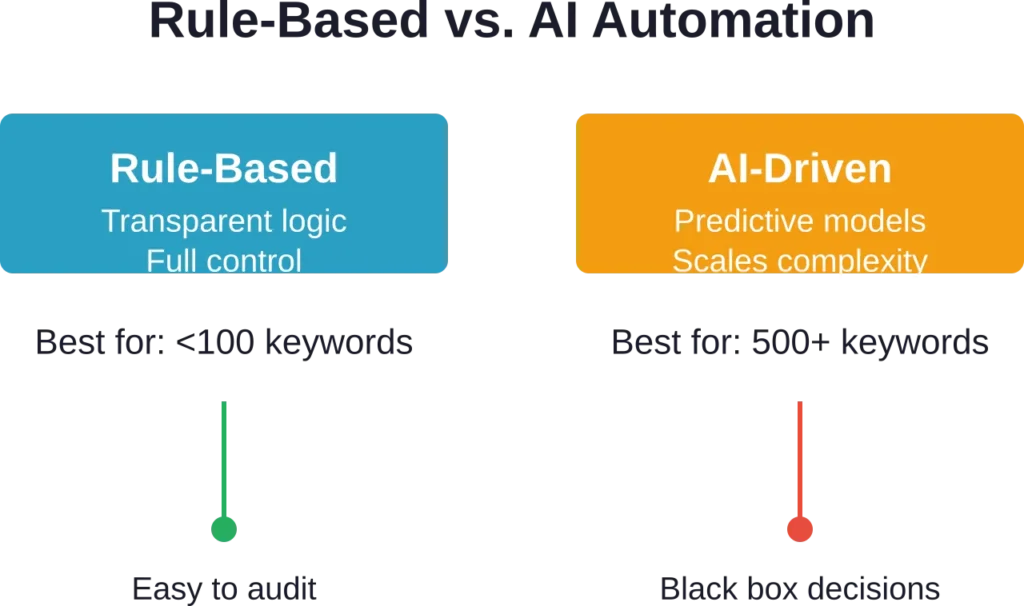
Rule-based tools execute fixed logic: “If keyword ACoS exceeds target by 20%, reduce bid by 15%.” Rules provide transparency—sellers know exactly why a bid changed. But rules can’t predict future performance or adapt to competitive shifts without manual updates.
AI-based tools use machine learning models to predict which bids will generate the best return. These systems analyze hundreds of variables simultaneously—time of day, competitor activity, conversion trends, seasonality—and adjust bids preemptively.
The downside? AI decisions often feel like a black box. When a bid drops 40% overnight, understanding why requires trusting the model.
Real talk: most mid-tier sellers don’t need cutting-edge AI. Rule-based automation handles 80% of optimization work effectively. AI becomes valuable when managing 500+ keywords across dozens of campaigns where manual rule creation becomes impossible.
PPC Software vs. Hiring an Agency
Software automates execution. Agencies provide strategy.
PPC tools adjust bids, harvest keywords, and pace budgets—but they don’t decide which products to launch, how to position against competitors, or when to expand into new categories. That strategic layer still requires human judgment.
Some agency-style services charge 5–10% of monthly ad spend, with minimums varying by firm. A seller spending $10K on ads might pay differently depending on the firm’s structure. Software subscriptions usually cost $100–$500 monthly regardless of spend.
The math shifts at different scales. Below $5K monthly spend, software wins on cost. Above $50K monthly spend, paying an agency 15% might deliver better strategic oversight than software alone.
Some sellers split the difference: use software for bid automation and hire a consultant for quarterly strategy reviews instead of full ongoing management.
Key Features to Prioritize
Not every feature matters equally. Sellers waste money on tools with 40 features when they only use six.
Bid Automation
The core function. Without automated bid adjustments, the tool is just a reporting dashboard. Look for platforms that adjust bids at keyword or product targeting level, not just campaign-wide changes.
Profit Tracking
ACoS alone doesn’t reveal profitability. Tools that factor in COGS, Amazon fees, shipping, and storage show actual margin. Optimizing for lowest ACoS sometimes kills profit if it pushes high-margin products into obscurity while promoting low-margin winners.
Dayparting
Adjusting bids by hour captures peak conversion windows. If sales spike from 7–10 PM, dayparting raises bids during those hours and lowers them overnight when traffic converts poorly.
Negative Keyword Automation
Search term reports reveal which queries burn budget without converting. Tools that auto-add negative keywords after configurable thresholds (e.g., 10 clicks, zero sales) prevent repeat waste.
Campaign Templates
Pre-built structures for product launches, competitor targeting, or category defense speed up campaign creation. Templates ensure consistent structure across ASINs instead of reinventing setup each time.
| Feature | Priority Level | Why It Matters |
|---|---|---|
| Bid Automation | Critical | Core time-saving function |
| Profit Tracking | Critical | True ROI vs. vanity metrics |
| Dayparting | High | Captures peak conversion hours |
| Negative Keyword Automation | High | Prevents repeat waste |
| Campaign Templates | Medium | Speeds up launches |
| Multi-marketplace Support | Low | Only for brands on Walmart, etc. |
Common Pitfalls When Choosing Tools
Sellers make predictable mistakes when evaluating PPC software.
Choosing Based on Feature Count
A tool with 50 features sounds better than one with 15. But if only six features actually get used, the extra 44 just clutter the interface. Prioritize depth in core functions over breadth across niche use cases.
Ignoring Onboarding Complexity
Enterprise platforms require weeks of setup, custom integrations, and training calls. Mid-tier sellers who need to launch campaigns this week can’t afford three weeks of onboarding. Check implementation timelines before committing.
Overlooking Profit Analytics
Many tools optimize for ACoS targets without checking whether products remain profitable at that ACoS. A 25% ACoS looks great until factoring in that the product only has 30% margin after all fees—leaving 5% net profit that barely covers the risk.
Trusting Free Trials Without Real Data
A seven-day trial with two campaigns doesn’t reveal how the tool handles 50 campaigns under budget pressure during Prime Day. Trials work for testing the interface, not for validating performance under real conditions.
Amazon’s Official Tools: Ads API and Marketing Cloud
Third-party software isn’t the only option. Amazon provides direct tools for advertisers who want unfiltered access.
Amazon Ads API
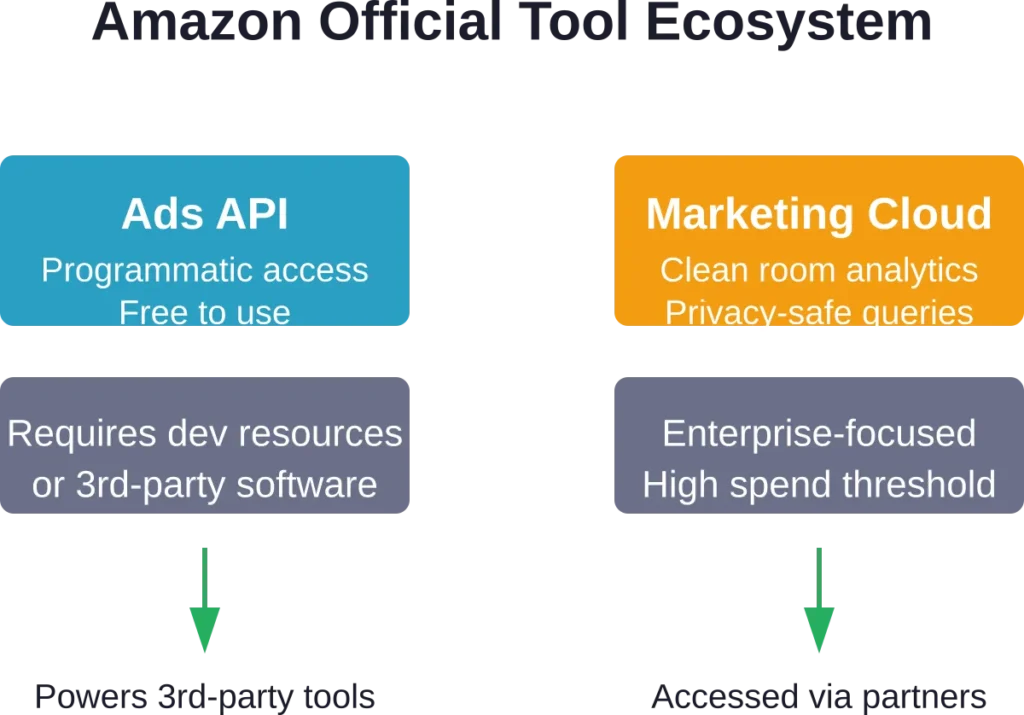
The Amazon Ads API enables programmatic management of advertising resources through a REST API. Developers build custom applications that pull campaign data, adjust bids, and create reports without using the Ads Console interface.
Building through the API provides direct access to Amazon’s signals, supply, and technology. Teams unlock more customization and scaled opportunities for managing campaigns compared to manual console work.
The API itself is free—no additional charges beyond standard account and campaign costs. But leveraging it requires development resources. Sellers without in-house developers typically access the API through third-party software built on top of it.
Amazon Marketing Cloud
Amazon Marketing Cloud (AMC) is a secure, privacy-safe, cloud-based clean room solution. Advertisers perform analytics and build audiences across pseudonymized signals, including Amazon Ads signals and their own inputs.
AMC runs on AWS Clean Rooms and unifies rich signals across Amazon properties, advertiser data, and onboarded third-party providers. Flexible querying enables custom analysis without exposing raw customer data.
All information in an advertiser’s AMC instance follows strict privacy policies. Advertiser signals cannot be exported or accessed by Amazon—only aggregated, anonymous outputs emerge from queries.
Case studies show strong results. According to Amazon, UNICEF achieved 366% ROAS using AMC. Poppi grew new-to-brand orders 16x with AMC and agency partner Tinuiti. SimpliSafe saw 109% ROAS growth using AMC Audiences and Shopping Insights.
AMC access typically requires working with an Amazon Advertising Partner or reaching minimum spend thresholds. It’s not a self-serve tool for new sellers—it targets brands with substantial budgets and analytics teams.
Pricing Models Explained
PPC tool pricing follows several models. Understanding the structure prevents surprise bills.
Flat Monthly Subscription
Most tools charge a fixed monthly fee regardless of ad spend. Helium 10 Starter costs $49/month whether managing $500 or $5,000 in ads. This model favors higher-spend sellers—the percentage cost drops as spend rises.
Percentage of Ad Spend
Some platforms charge 5–10% of monthly ad spend, common among agency-style services. A seller spending $20K pays $1K–$2K monthly. This scales with the account but can become expensive fast.
Tiered by Features
Platforms like Helium 10 offer multiple tiers—Starter at $49/month, Platinum at $129/month, Diamond at $279/month. Higher tiers unlock advanced features like multi-user access, API access, or unlimited usage limits.
Custom Enterprise Pricing
Enterprise tools hide pricing behind “contact sales.” These platforms build custom packages based on ad spend volume, number of marketplaces, and support requirements. Expect quotes starting around $1K–$5K monthly.
Check for hidden costs: setup fees, overage charges when exceeding plan limits, or per-user fees for team access. Some tools charge extra for features like profit analytics or hourly bid adjustments that should be standard.
Implementation and Setup
The best tool becomes worthless if setup takes six weeks and requires a systems integrator.
Self-serve platforms like Helium 10 and Jungle Scout connect via Amazon’s API authorization in minutes. Grant access, sync campaigns, and start setting automation rules within an hour.
Enterprise platforms like Perpetua and Pacvue assign onboarding specialists who schedule multiple calls to configure account structure, import historical data, and train teams. Implementation stretches across 2–4 weeks but delivers custom workflows.
The middle tier—Teikametrics, Scale Insights—typically requires a demo call followed by a one-week setup period with email support. Faster than enterprise, more guided than self-serve.
Before committing, ask how long from signup to first automated bid change. If the answer exceeds two weeks and the business needs results this month, look elsewhere.
When to Switch Tools
Outgrowing current software happens. Recognizing the signs prevents wasting months on a platform that no longer fits.
Switch when the tool can’t handle the account’s scale—hitting keyword limits, campaign caps, or processing delays that leave bids unadjusted for hours.
Switch when pricing no longer makes sense. A seller who started at $2K monthly spend paying $49/month for software now spends $50K monthly—percentage-based agency pricing might cost less than maintaining multiple software subscriptions.
Switch when missing critical features blocks growth. If expanding to Walmart but the current tool only handles Amazon, multi-platform tools become necessary.
Don’t switch for minor inconveniences. Learning a new platform takes weeks. The grass isn’t always greener—sometimes it’s just differently brown.
FAQ
Helium 10 Adtomic and Jungle Scout offer the easiest entry points for new sellers. Both provide simple interfaces, transparent pricing starting around $49/month, and integration with product research tools. Rule-based automation gives beginners full visibility into why bids change without requiring trust in black-box AI.
Entry-level tools start at $49/month for basic automation. Mid-tier platforms range from $129–$299/month for advanced features. Enterprise solutions require custom quotes, typically starting around $1,000–$5,000 monthly. Some tools charge a percentage of ad spend instead of flat fees—expect 5–15% of monthly ad spend for agency-style platforms.
No tool guarantees specific ACoS results. Software automates bid adjustments based on performance data, but market conditions, competition, product positioning, and listing quality all impact ACoS independently. Tools improve efficiency by responding faster than manual management, but they can’t overcome poor product-market fit or weak conversion rates.
Software handles execution—bid adjustments, keyword harvesting, budget pacing. Agencies provide strategy—competitive analysis, product launch planning, portfolio optimization. Below $10K monthly ad spend, software alone usually suffices. Above $50K monthly spend, combining software for automation with agency strategy reviews often delivers better results than either alone.
Initial optimization typically shows measurable changes within 7–14 days as the tool adjusts bids based on performance data. Full optimization requires 30–60 days of data collection across different days of the week, promotional periods, and competitive shifts. Expect incremental improvements rather than overnight transformation—legitimate tools compound gains over months.
Rule-based tools execute fixed logic set by the seller—if ACoS exceeds 30%, reduce bid by 10%. Rules provide transparency and control but require manual updates as conditions change. AI tools use machine learning to predict optimal bids across hundreds of variables simultaneously, adapting automatically but with less visibility into decision logic. Rule-based works well for under 100 keywords; AI scales better beyond 500 keywords.
Technically possible but rarely advisable. Running two tools that both adjust bids creates conflicts—one raises a bid while the other lowers it, triggering a loop. Multiple tools make sense when they serve different functions: one for automation, another for reporting analytics. But two automation platforms managing the same campaigns causes more problems than it solves.
Conclusion
Amazon PPC tools replace spreadsheets and manual bid checks with automated optimization that runs continuously. The right choice depends on ad spend scale, team resources, and whether campaigns run on Amazon alone or across multiple marketplaces.
New sellers spending under $5K monthly benefit most from transparent, affordable platforms like Helium 10 or Jungle Scout that offer rule-based automation and integrated research tools. Growing sellers managing $5K–$50K in monthly ad spend need AI-driven optimization and profit tracking that scales beyond manual management. Enterprise brands exceeding $100K monthly should evaluate multi-platform solutions like Perpetua or Pacvue that unify cross-channel reporting and provide dedicated support.
Avoid choosing tools based on feature count alone. Prioritize depth in bid automation, profit analytics, and negative keyword management over breadth across niche capabilities that rarely get used.
Check current pricing on official websites before committing—subscription costs, tier structures, and feature availability change frequently. What cost $99/month last year might now cost $129/month or have moved to a higher tier.
Start with the tool that matches current needs, not aspirational scale. Switching platforms later is easier than overpaying for enterprise features that won’t get used for two years.