

Quick Summary: Quartile is an e-commerce advertising platform primarily focused on Amazon PPC management, but many sellers seek alternatives due to high costs, limited pricing transparency, and platform-specific constraints. Leading alternatives include WisePPC, atom11 for transparent pricing and retail-focused PPC, Teikametrics for multi-channel advertising, Perpetua for advanced automation, and Skai for enterprise-scale Amazon and Walmart campaigns. Each platform offers distinct pricing models, feature sets, and service levels that cater to different seller needs, budgets, and growth stages.
Quartile has established itself as a recognized player in the Amazon PPC management space, offering automated bidding and campaign optimization for e-commerce sellers. But the platform isn’t the right fit for everyone.
High costs, opaque pricing structures, and limited transparency around how quotes are calculated have pushed many sellers to explore alternatives. Some need better inventory management integrations, while others want more control over their bidding strategy or simply a more predictable cost structure.
This guide breaks down the best Quartile alternatives available in 2026, comparing pricing models, feature sets, platform capabilities, and ideal use cases. Whether you’re managing a $5,000 monthly ad budget or scaling into six figures, there’s a tool here that’ll align better with your needs.
Why Sellers Look for Quartile Alternatives
Before diving into the alternatives, it’s worth understanding what drives sellers away from Quartile in the first place. Community discussions and user experiences highlight several recurring pain points.
First, pricing transparency is a major issue. Quartile doesn’t publish its pricing structure publicly, requiring sellers to go through a sales process to receive a custom quote. According to available data, the following factors directly influence Quartile costs: monthly ad spend volume dictates how many bid updates Quartile must run and how frequently the system needs to optimize campaigns.
For instance, a seller spending $5,000 per month may generate a few thousand bidding updates, while a seller at $50,000 per month triggers tens of thousands of optimizations. This volume-based approach means costs scale aggressively as your advertising spend grows, and sellers don’t always see proportional value increases.
Second, platform limitations come into play. Quartile is heavily optimized for Amazon advertising but offers less robust support for other e-commerce channels like Walmart, Target Plus, or Instacart. Sellers running multi-channel operations often need a more versatile solution.
Third, inventory management integration remains a gap. As noted in platform review discussions, sellers frequently prioritize tools that automatically pause bids when products go out of stock—a critical feature for maintaining ad efficiency and preventing wasted spend on unavailable items. While some platforms have addressed this, it’s not universally available across all PPC tools.
Finally, the level of service and support varies. Some sellers want a fully managed service where the platform handles strategy and execution, while others prefer self-service tools with robust dashboards and controls. Quartile leans more toward automation and managed service, which doesn’t suit everyone’s operating style.
Top Quartile Alternatives: Platform-by-Platform Breakdown
Here’s a detailed look at the leading alternatives, covering pricing structures, key features, ideal user profiles, and what sets each apart.
1. WisePPC

WisePPC positions itself as the transparent, hands-on alternative to Quartile for sellers who want full control, deep visibility, and powerful bulk tools instead of “black-box” AI automation. It centralizes ad, sales, and inventory data with long-term historical storage and real-time analytics.
WisePPC uses a transparent subscription model with usage-based pricing rather than a high percentage of ad spend, making costs more predictable and independent of advertising budget fluctuations.
Key features include bulk editing of thousands of campaigns/targets in one go, inline bid/budget adjustments directly in tables, multi-layered advanced filters, gradient-highlighted performance tables, charts supporting up to 6 metrics simultaneously, placement-level analysis, and long-term historical data storage (years of data vs Amazon’s 60-90 days). It also tracks organic + paid performance together.
The platform supports Amazon, Shopify, and other marketplaces, making it ideal for multi-channel sellers. It offers a clean, self-service dashboard focused on speed and control — no constant account manager required, though support is available.
Ideal for: Mid-to-large Amazon and multi-marketplace sellers ($5,000–$150,000+ monthly ad spend) who manage large numbers of campaigns/keywords and want granular control, long-term data insights, and efficient bulk operations without over-reliance on full automation.
Contact Information:
- Website: wiseppc.com
- Facebook: www.facebook.com/people/Wise-PPC/61573154427547
- LinkedIn: www.linkedin.com/company/wiseppc
- Instagram: www.instagram.com/wiseppc
2. atom11

atom11 positions itself as the transparent alternative to Quartile, explicitly designed for retail-focused sellers who want clarity around costs and control over their PPC strategy.
According to published comparison data, atom11 offers fully published, tier-based, value-focused pricing—a stark contrast to Quartile’s custom-quote-only model. The platform uses flat monthly fees plus optional pay-per-use modules, giving sellers predictable costs regardless of ad spend fluctuations.
Key features include retail-aware bidding algorithms that account for sell-through rates, inventory levels, and profitability metrics beyond basic ROAS. The platform supports Amazon, Walmart, and Instacart advertising, making it a solid choice for sellers operating across multiple retail channels.
atom11 also emphasizes ease of use with a self-service dashboard that doesn’t require a steep learning curve. Sellers can launch campaigns, adjust bids, and review performance without needing constant support from an account manager—though managed service options are available for those who prefer hands-off operations.
Ideal for: Mid-market sellers ($10,000–$100,000 monthly ad spend) who want transparent pricing, multi-channel support, and retail-specific optimization features.
3. Teikametrics

Teikametrics is one of the more established names in the Amazon advertising space, offering both automation tools and managed services. The platform has been around since the early days of Amazon PPC and has built a reputation for data-driven optimization.
Teikametrics uses a percentage-of-ad-spend pricing model, typically ranging from 2% to 5% depending on the level of service and ad spend volume. This approach means costs scale with your advertising budget, similar to Quartile, but Teikametrics tends to be more transparent about rate structures upfront.
The platform’s Flywheel 2.0 technology uses machine learning to optimize bids across Amazon Sponsored Products, Sponsored Brands, and Sponsored Display campaigns. It also integrates with Walmart advertising and offers inventory forecasting tools to help sellers avoid stockouts.
One standout feature is the marketplace analytics dashboard, which provides insights into organic rank, buy box percentage, and competitor pricing—going beyond pure advertising metrics to give sellers a fuller picture of their marketplace performance.
Ideal for: Established Amazon sellers and brands with $20,000+ monthly ad spend who want a blend of automation and strategic advisory services.
4. Perpetua
Perpetua focuses on enterprise-level Amazon advertising with advanced automation, goal-based bidding, and creative optimization features. The platform supports Amazon, Walmart, and Instacart, plus newer channels like Amazon DSP for display advertising.
Pricing follows a percentage-of-spend model, generally starting around 3% for self-service plans and climbing to 5%+ for fully managed services. Perpetua’s enterprise tier includes dedicated account management, quarterly business reviews, and strategic planning sessions.
Perpetua’s goal engine is a key differentiator. Instead of simply optimizing for ROAS or ACoS, sellers can set custom goals like maximizing profitability, increasing market share, or clearing excess inventory. The platform then adjusts bidding strategies to align with those objectives.
The platform also offers creative testing tools for Sponsored Brands and Sponsored Display campaigns, allowing sellers to A/B test headlines, images, and landing pages to improve click-through and conversion rates.
Ideal for: Brands and large sellers ($50,000+ monthly ad spend) who need sophisticated goal-based optimization, creative testing capabilities, and enterprise-level support.
5. Skai (formerly Kenshoo)
Skai is an enterprise-grade advertising platform that extends far beyond Amazon, supporting Google Ads, Facebook, Instagram, and dozens of other channels. For Amazon-specific needs, Skai offers robust campaign management, automation, and reporting tools.
Pricing is custom and typically requires a minimum commitment—Skai targets larger brands and agencies rather than individual sellers. The platform’s strength lies in cross-channel campaign orchestration, unified reporting, and advanced attribution modeling.
Skai’s Amazon module includes automated bid management, keyword harvesting, product targeting optimization, and integration with Amazon Marketing Cloud for advanced audience insights. The platform also supports Walmart and Target advertising.
For brands running integrated campaigns across search, social, and retail media, Skai provides a single interface to manage everything—though the complexity and cost make it overkill for smaller operations.
Ideal for: Enterprise brands and agencies managing $200,000+ monthly ad spend across multiple channels who need unified cross-platform campaign management and advanced attribution.
6. Pacvue

Pacvue is a retail media platform designed for brands selling on Amazon, Walmart, Instacart, Target, and other emerging marketplaces. The platform combines advertising management with broader e-commerce analytics and content optimization tools.
Pacvue’s pricing is custom-quoted based on ad spend, number of marketplaces, and feature access. The platform positions itself as a “command center” for retail media, offering not just bid management but also content audits, review monitoring, and supply chain insights.
One unique feature is the organic-paid integration, which analyzes how paid advertising impacts organic search rank and buy box win rate. This holistic view helps sellers understand the full ROI of their ad spend, including secondary effects on organic traffic.
Pacvue also offers competitive intelligence tools that track competitor pricing, promotions, and advertising activity—valuable for brands operating in highly competitive categories.
Ideal for: Brands managing multiple retail channels ($30,000+ monthly ad spend) who want integrated advertising, content, and competitive intelligence tools in one platform.
7. SellerApp

SellerApp is a more budget-friendly option that combines PPC management with broader Amazon seller tools like product research, keyword tracking, and listing optimization. It’s designed for small to mid-sized sellers who want an all-in-one solution without breaking the bank.
Pricing is subscription-based with tiers ranging from around $99 to $399 per month, depending on feature access and the number of supported marketplaces. This flat-rate model makes costs predictable and accessible for sellers with limited budgets.
SellerApp’s PPC automation includes rule-based bid adjustments, negative keyword discovery, and campaign performance alerts. While less sophisticated than enterprise platforms, it covers the essentials and integrates seamlessly with the platform’s other seller tools.
The product research and keyword tracking features are particularly useful for sellers who want to identify new opportunities and monitor their organic performance alongside paid campaigns.
Ideal for: Small to mid-sized sellers ($5,000–$30,000 monthly ad spend) who want affordable, integrated tools for both advertising and general Amazon seller management.
8. Ad Badger
Ad Badger started as a managed service provider and evolved into a hybrid platform offering both software and hands-on management. The company focuses on Amazon PPC exclusively, with a strong emphasis on education and community support.
Ad Badger’s software subscription uses a tiered pricing model, with managed services priced as a percentage of ad spend depending on spend level and service tier.
The platform’s software includes automated rules for bid adjustments, dayparting controls, and a bulk campaign editor for making large-scale changes quickly. The user interface is straightforward, making it accessible for sellers who aren’t PPC experts.
What sets Ad Badger apart is the focus on education. The company offers extensive training resources, weekly webinars, and an active community forum where sellers can ask questions and share strategies. For sellers who want to learn and eventually manage campaigns themselves, this educational component adds real value.
Ideal for: Beginner to intermediate Amazon sellers ($5,000–$50,000 monthly ad spend) who value education and community support alongside software and managed services.
Feature Comparison: What Each Platform Offers
Beyond pricing, feature sets differ significantly across platforms. Here’s what matters most when evaluating alternatives.
Automation and Bidding Strategies
All modern PPC platforms offer some level of bid automation, but the sophistication and flexibility vary widely.
Quartile’s approach is heavily automated with limited manual override options—the system takes control and makes continuous micro-adjustments based on performance data. This works well for sellers who want hands-off management but frustrates those who prefer direct control.
Perpetua and Teikametrics offer similar automation but with more granular controls. Sellers can set guardrails, define custom goals, and intervene manually when needed. Perpetua’s goal engine is particularly flexible, allowing sellers to optimize for metrics beyond standard ROAS or ACoS.
atom11 strikes a middle ground with retail-aware algorithms that factor in inventory levels and profitability, plus full manual control for sellers who want it. The platform doesn’t force automation—it’s available when helpful but never mandatory.
SellerApp and Ad Badger lean more toward rule-based automation, where sellers define conditions and triggers rather than relying on black-box machine learning. This approach is more transparent and easier to understand, though potentially less adaptive to rapid market changes.
Multi-Channel Support
Amazon is the dominant platform, but Walmart, Instacart, Target Plus, and other retail channels are growing fast. Multi-channel capability is increasingly important.
Quartile primarily focuses on Amazon with limited Walmart support. For sellers expanding beyond Amazon, this becomes a constraint.
Pacvue, Perpetua, and Skai offer the broadest multi-channel coverage, supporting Amazon, Walmart, Instacart, Target, and in Skai’s case, traditional digital channels like Google and Facebook. These platforms provide unified dashboards and cross-channel reporting, making it easier to manage complex retail media strategies.
atom11 supports Amazon, Walmart, and Instacart—covering the core retail media channels most sellers prioritize. Teikametrics covers Amazon and Walmart, with Instacart in beta for select customers.
SellerApp and Ad Badger remain Amazon-exclusive, making them less suitable for sellers with multi-channel ambitions.
Inventory and Stock Management Integration
Pausing bids when products go out of stock is a frequent request in community discussions. Wasted ad spend on unavailable items frustrates sellers and drags down overall campaign efficiency.
Teikametrics and Pacvue offer robust inventory integrations that automatically pause campaigns or reduce bids when stock levels fall below defined thresholds. These systems sync with seller central inventory data and adjust advertising in near real-time.
atom11 includes inventory-aware bidding as a core feature, factoring stock levels and sell-through rates into optimization decisions. The platform won’t aggressively bid up products that are at risk of stockout, preserving inventory for organic sales.
Perpetua and Skai offer inventory integrations through third-party connectors or custom API setups, though configuration can be complex and may require technical support.
SellerApp and Ad Badger have more limited inventory capabilities—sellers typically need to monitor stock levels manually and adjust campaigns accordingly.
Reporting and Analytics
Data visibility and reporting depth vary significantly. Some platforms provide basic campaign metrics, while others offer deep analytics across advertising, organic performance, and competitive intelligence.
Skai and Pacvue lead in reporting sophistication, offering customizable dashboards, advanced attribution modeling, and cross-channel performance views. Skai’s enterprise reporting suite includes data exports, API access, and integration with business intelligence tools like Tableau.
Teikametrics and Perpetua provide solid reporting with a focus on advertising KPIs—ACoS, ROAS, impression share, conversion rate—plus some organic metrics like search rank and buy box percentage.
atom11 emphasizes profitability-focused reporting, showing not just advertising metrics but also contribution margin, inventory turns, and overall unit economics. This retail-centric view helps sellers make more informed decisions about where to allocate ad budget.
SellerApp and Ad Badger offer straightforward campaign reporting with clear visualizations and trend analysis, suitable for sellers who want actionable insights without overwhelming detail.
Choosing the Right Alternative: Decision Framework
With so many options, how do you actually choose? Here’s a practical framework based on the factors that matter most.
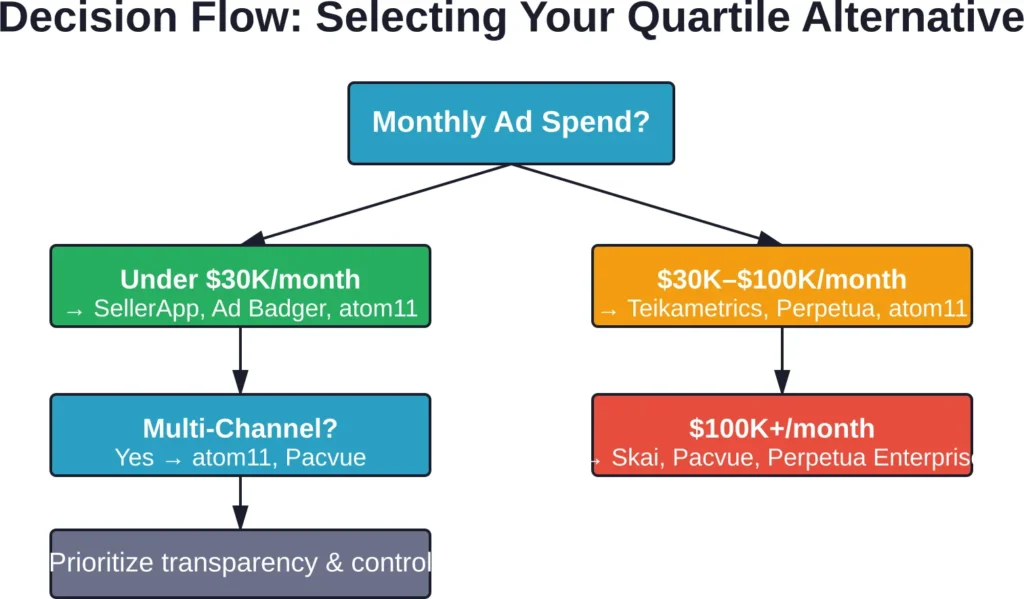
1. Define Your Budget and Spend Level
Start with your current monthly ad spend and projected growth. This determines which platforms are financially viable and which pricing models work best.
For sellers spending under $10,000 per month, flat-rate or low-percentage platforms like SellerApp, Ad Badger, or atom11’s entry tier make the most sense. At this level, percentage-based pricing can still be manageable, but flat rates offer more predictability.
Between $10,000 and $50,000 monthly spend, most platforms become viable. Compare percentage-based costs carefully—a 3% rate on $30,000 is $900 per month, which might be more or less than a platform’s flat fee depending on features and service level.
Above $50,000 monthly spend, enterprise platforms like Perpetua, Skai, and Pacvue start making sense, especially if you need advanced features, dedicated support, or multi-channel capabilities. At this scale, percentage-based pricing can climb into thousands per month, so evaluate the ROI carefully.
2. Assess Your Need for Control vs. Automation
Some sellers want full control and transparency, while others prefer to delegate and trust the algorithm.
If you’re hands-on and want to understand and adjust every bidding decision, look for platforms with strong manual controls and rule-based automation—atom11, SellerApp, and Ad Badger fit this profile.
If you prefer a more hands-off approach where the platform handles most decisions, Teikametrics, Perpetua, and Quartile (despite its drawbacks) offer sophisticated automation that requires minimal day-to-day involvement.
For a middle ground with flexible controls and optional automation, atom11 and Perpetua provide the best balance.
3. Evaluate Channel Requirements
Are you Amazon-only, or do you sell across multiple retail channels?
Amazon-only sellers have the widest range of options, including specialized tools like Ad Badger and SellerApp that excel within that ecosystem.
Multi-channel sellers should prioritize platforms with robust support for Walmart, Instacart, and Target—Pacvue, Perpetua, Skai, and atom11 lead here. Using separate tools for each channel creates fragmentation and makes holistic optimization nearly impossible.
4. Consider Service and Support Needs
Do you need a fully managed service with strategic guidance, or are you comfortable with self-service software?
Fully managed options include Teikametrics’ managed tier, Perpetua’s enterprise plans, and Skai’s agency-style approach. These come with dedicated account managers, regular strategy reviews, and hands-on campaign management.
Self-service platforms include SellerApp, Ad Badger’s software-only tier, and atom11’s standard plans. You’ll have access to support for technical issues, but you’re responsible for strategy and day-to-day management.
Hybrid models—where you can start self-service and add managed services later—offer flexibility as your business evolves. atom11, Teikametrics, and Ad Badger all offer hybrid approaches.
Real-World Considerations and Trade-Offs
No platform is perfect. Each alternative involves trade-offs that affect your daily experience and long-term results.
Learning Curve and Onboarding
Switching platforms means a learning curve—some steeper than others.
SellerApp and Ad Badger are designed for ease of use with intuitive interfaces and extensive educational resources. Most sellers can get up to speed within a week or two.
Teikametrics and atom11 fall in the middle—reasonably intuitive but with enough depth that it takes a few weeks to fully master all features and optimization strategies.
Perpetua, Skai, and Pacvue have steeper learning curves due to their enterprise-grade feature sets. Expect a month or more of onboarding, training sessions, and experimentation before you’re operating efficiently. Managed service tiers mitigate this by having experts handle the complexity for you.
Data Migration and Historical Performance
When switching from Quartile to a new platform, you’ll lose access to historical data and insights built up over time.
Most platforms can import campaign structures and basic settings, but performance history, attribution models, and optimization baselines need to be rebuilt from scratch. This means a few weeks of suboptimal performance as the new system gathers data and calibrates.
Plan for a transition period where results may dip slightly before improving. Run both platforms in parallel for a short overlap if budget allows, or switch during a slower sales period to minimize impact.
Contract Terms and Lock-In
Contract flexibility varies. Some platforms require annual commitments, while others offer month-to-month terms.
SellerApp and Ad Badger typically offer monthly subscriptions with no long-term commitment, making them low-risk options for testing and evaluation.
Teikametrics and Perpetua often push for annual contracts, especially for managed services, though month-to-month options exist at higher rates.
Skai and Pacvue generally require annual commitments with minimum spend thresholds—appropriate for enterprise buyers but inflexible for smaller sellers who want to test before fully committing.
atom11 offers flexible terms with both monthly and annual options, balancing commitment with accessibility.
Common Pitfalls When Switching Platforms
Sellers often make avoidable mistakes when transitioning away from Quartile. Here’s what to watch out for.
Over-Optimizing Too Soon
New platforms need time to learn your products, customer behavior, and market dynamics. Making aggressive manual adjustments during the first few weeks can disrupt the learning process and lead to worse performance.
Let the system gather data for at least two to three weeks before making major strategic changes. Monitor performance, but resist the urge to tinker constantly.
Ignoring Total Cost of Ownership
Platform fees are just one part of the cost equation. Factor in the time you or your team spend managing campaigns, the cost of learning and training, and any additional tools or integrations needed.
A cheaper platform that requires 10 extra hours per week of manual work may actually cost more in total than a higher-priced managed service that handles everything.
Underestimating the Importance of Support
When something breaks or performance suddenly drops, responsive support makes the difference between a minor hiccup and a major loss of revenue.
Evaluate support quality during the trial or demo phase. How quickly do they respond to questions? Do they provide actionable answers or just generic advice? Are there dedicated account managers or just a shared support queue?
Enterprise platforms like Skai and Perpetua typically offer strong support as part of their premium pricing. Mid-tier platforms vary widely—atom11 and Teikametrics generally get positive feedback for responsiveness, while others have more mixed reviews.
Not Testing Before Fully Committing
Most platforms offer free trials or pilot programs. Use them. Run campaigns in parallel with your current setup for a few weeks to compare results directly.
Look at not just aggregate performance but also how the platform handles edge cases—stockouts, seasonal spikes, sudden price changes, competitor activity. Does it adapt quickly or lag behind?
Trial periods also reveal how well the platform’s interface and workflows fit your team’s habits. A powerful tool that nobody wants to use won’t deliver results.
Future-Proofing Your PPC Strategy
The retail media landscape is evolving fast. Choosing a platform isn’t just about today’s needs—it’s about positioning for where the market is headed.
Emerging Channels and Retail Media Networks
Walmart, Instacart, and Target are growing their advertising platforms rapidly. Kroger, CVS, and other retailers are launching their own retail media networks. A platform that supports only Amazon today will limit your options tomorrow.
Prioritize platforms with demonstrated multi-channel capabilities and a roadmap for adding new retail media networks as they emerge. Pacvue and Skai lead here, with atom11 and Perpetua close behind.
Privacy and Attribution Changes
Third-party cookies are disappearing, and attribution models are shifting toward first-party data and retail media platforms’ own measurement tools. Platforms that integrate deeply with Amazon Marketing Cloud, Walmart’s insights, and other retailer-owned data environments will have an advantage.
Ask potential platforms how they’re adapting to privacy changes and what attribution capabilities they’re building for a post-cookie world.
AI and Automation Evolution
Machine learning and AI are already central to PPC management, and they’ll only become more sophisticated. Platforms investing heavily in R&D—like Teikametrics, Perpetua, and Skai—will likely stay ahead of the curve with better predictive capabilities and smarter optimization.
But don’t assume more automation is always better. The best platforms balance AI-driven efficiency with human strategic oversight and the flexibility to intervene when needed.
Frequently Asked Questions
The primary differences lie in pricing transparency, multi-channel support, and control flexibility. Quartile uses a custom-quote pricing model with limited public transparency, focuses heavily on Amazon, and emphasizes automated management with less manual control. Alternatives like atom11 offer published flat-rate pricing, support multiple retail channels including Walmart and Instacart, and provide more flexible control options. Platforms like Teikametrics and Perpetua offer similar automation levels but with more transparent rate structures and broader feature sets.
Switching costs include platform migration time (typically 1-2 weeks of setup and learning), potential short-term performance dips as the new system gathers baseline data (budget for 10-15% temporary efficiency loss for 2-4 weeks), and any overlap period if running both platforms simultaneously. Hard costs vary by platform—flat-rate tools like SellerApp start around $99-$399 monthly, while percentage-based platforms charge 2-5% of ad spend. Factor in 20-40 hours of team time for initial setup, training, and optimization across the first month.
Several platforms offer inventory-aware bidding or automatic pause features. Teikametrics and Pacvue provide robust real-time inventory integration that automatically adjusts or pauses campaigns when stock levels fall below defined thresholds. atom11 includes inventory-aware bidding as a core feature, reducing bids on low-stock items to preserve inventory for organic sales. Perpetua and Skai can implement inventory controls through API integrations, though setup may require technical configuration. SellerApp and Ad Badger have more limited inventory capabilities, typically requiring manual monitoring and campaign adjustments.
For sellers spending under $10,000 per month on advertising, SellerApp and Ad Badger offer the most accessible entry points with flat subscription pricing starting around $99-$399 monthly. SellerApp provides an all-in-one solution combining PPC management with product research and listing optimization tools. Ad Badger focuses on Amazon PPC exclusively but includes extensive educational resources and community support. atom11’s entry tier also works well for budget-conscious sellers who want transparent pricing and retail-focused optimization without percentage-based fees that scale with ad spend.
Technical requirements vary significantly. SellerApp and Ad Badger are designed for ease of use with intuitive interfaces requiring minimal technical knowledge—most sellers can navigate effectively after a few hours of familiarization. Teikametrics and atom11 require moderate technical comfort but include onboarding support and educational resources. Perpetua, Skai, and Pacvue have steeper learning curves and benefit from dedicated PPC expertise on your team. However, all platforms offer managed service tiers where experts handle the technical complexity, making them accessible regardless of your technical background if you choose the managed option.
Expect a transition period of 2-4 weeks as the new platform gathers baseline data and calibrates its optimization algorithms. During this period, performance may remain flat or dip slightly compared to your previous setup. After the initial learning phase, most sellers see stabilization within 4-6 weeks and meaningful improvements by 8-12 weeks as the system fully optimizes and your team masters the platform’s capabilities. Factors affecting timeline include campaign complexity, product catalog size, and whether you’re using automated or manual management approaches. Running a parallel test during the first few weeks can help benchmark performance and accelerate optimization.
Running multiple platforms simultaneously is technically possible but generally not recommended for the same campaigns or products. Competing bid adjustments from different systems create conflicts, inefficient spending, and attribution confusion. However, some sellers successfully use different platforms for different purposes—for example, one tool for Amazon advertising and another for Walmart, or a managed service for core products and self-service software for long-tail SKUs. If running multiple tools, ensure clear separation of responsibility and avoid overlap where systems might compete or contradict each other’s optimization decisions.
Conclusion: Making Your Decision
Quartile has served many sellers well, but it’s far from the only option—and often not the best fit depending on your specific needs, budget, and growth trajectory.
For sellers prioritizing transparency and predictable costs, atom11 stands out with published flat-rate pricing and retail-focused optimization that goes beyond basic ROAS metrics. The platform’s multi-channel support and flexible control options make it a solid choice for mid-market sellers expanding beyond Amazon.
Teikametrics remains a strong all-around option for established sellers who want sophisticated automation with strategic advisory support, particularly if you’re focused on Amazon and Walmart.
Perpetua and Skai cater to enterprise brands with complex needs, advanced goal-based optimization requirements, and budgets that support premium service levels.
For budget-conscious sellers or those just starting to scale advertising, SellerApp and Ad Badger provide accessible entry points with straightforward tools and strong educational resources.
The right choice depends on where you are today and where you’re headed. Start by defining your budget, channel priorities, and management preferences. Trial two or three platforms that fit your profile. Compare not just features and pricing but also support quality, ease of use, and how well the platform’s approach aligns with your business model.
Switching platforms involves short-term disruption, but the long-term benefits—better control, lower costs, and improved performance—make it worthwhile when you find the right fit. Take the time to evaluate thoroughly, test rigorously, and choose strategically.