
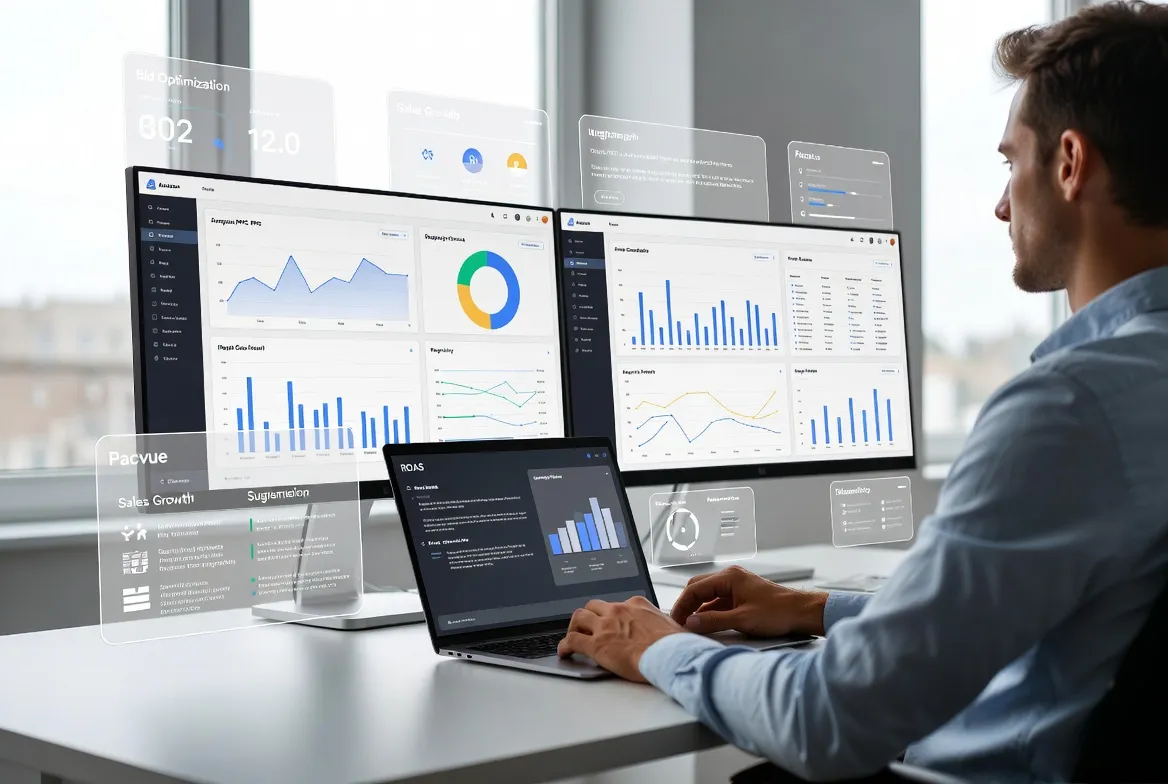
Quick Summary: Amazon advertising tools span native platforms (Sponsored Products, AMC, Marketing Stream) and third-party software (WisePPC, Perpetua, Pacvue, AdLabs, Teikametrics) that automate bid management, keyword harvesting, and budget pacing. The best choice depends on business size, ad spend, and need for control versus automation—tools like AdLabs offer surgical precision for hands-on advertisers, while Quartile and Perpetua provide AI-driven autopilot for sellers wanting set-it-and-forget-it optimization.
Amazon held a dominant share of U.S. digital retail media spend, and the gap keeps growing. With retail media projected to reach $61.15 billion by 2024, representing significant growth in digital advertising, sellers face a paradox: more opportunity, but fiercer competition and rising costs.
The right advertising tools determine whether campaigns bleed budget or scale profitably. But the landscape splits into two worlds: Amazon’s native platforms (Sponsored Products, DSP, Amazon Marketing Cloud) and third-party software that automates what Amazon’s consoles weren’t built to handle—hourly bid adjustments, cross-campaign budget pacing, keyword mining from search term reports.
This guide catalogs both. Native tools for baseline functionality, third-party platforms for automation and intelligence. No fluff, no fake pricing. Every feature claim and number comes from verified sources or official documentation.
Why Amazon Advertising Tools Matter in 2026
Amazon’s native ad console handles basic campaign setup just fine. Create a Sponsored Products campaign, set a daily budget, pick automatic or manual targeting. Done.
But that workflow crumbles under scale. Managing 50 campaigns across 200 SKUs with manual bid adjustments twice a week leaves 60% of optimization opportunities on the table. More frequent bid adjustments capture real-time CPC fluctuations that less frequent manual updates miss.
Third-party tools fill the gap with automation Amazon deliberately omits. Automatic bid adjustments based on ACoS thresholds, keyword harvesting from search terms every hour, dayparting that cuts spend during low-conversion windows, budget reallocation between campaigns based on real-time ROAS.
Here’s what changed by 2026. AI tools are increasingly adopted by Amazon sellers. Full-funnel campaigns—Amazon’s new agentic AI offering launching this year—promise to automate targeting across Sponsored Products, Sponsored Brands, and DSP from a single interface. Early full-funnel campaign tests show 144% conversion rate lifts and 35% cost-per-acquisition improvements.
The toolslandscape now splits into three tiers. Native Amazon platforms for data and reach. Lightweight automation software for small teams managing under $10K monthly spend. Enterprise solutions for agencies and brands running six-figure budgets across multiple marketplaces.
Choosing wrong costs real money. A seller locked into a platform charging 5% of ad spend on a $50K monthly budget pays $2,500/month whether the tool adds value or not.
Top Third-Party Amazon Advertising Tools
Now the software layer. These platforms connect via Amazon Ads API to pull performance data, push bid changes, automate keyword mining, and consolidate reporting across Sponsored Products, Brands, and Display in unified dashboards.
Pricing models vary: flat monthly fees, percentage of ad spend, tiered plans based on active campaigns or SKU counts. Feature sets range from lightweight automation (scheduled bid rules, basic dayparting) to enterprise-grade AI (predictive bidding algorithms, multi-marketplace consolidation, custom attribution models).
1. WisePPC

Amazon Ads Verified Partner focused on deep analytics, long-term data history, and powerful bulk operations. The platform provides access to years of historical data (Amazon only keeps 60–90 days), hourly granularity by placement, and detailed keyword-level insights.
Supports all major Amazon ad formats: Sponsored Products, Sponsored Brands, and Sponsored Display. Offers AI-assisted bid automation (available and expanding), but the core strength is full transparency and user-controlled optimization rather than black-box decisions. Features ultra-fast bulk editing of thousands of campaigns in a spreadsheet-style interface, smart gradient highlighting, custom dashboards, and multi-metric trend charts.
Excellent filtering, segmentation, and trend detection tools. Multi-account support (Amazon + Shopify). Currently in open beta with free access and a lifetime 25% discount for early users.
Best for hands-on sellers and mid-sized teams who value maximum data transparency, historical performance analysis, and speed of bulk actions. Strikes a great balance between automation and control — ideal if you don’t want fully autonomous AI (like Perpetua) or enterprise-level pricing (like Pacvue). Perfect for advertisers who prefer to stay in the driver’s seat while having strong tools to work faster.
Contact Information:
- Website: wiseppc.com
- Facebook: www.facebook.com/people/Wise-PPC/61573154427547
- LinkedIn: www.linkedin.com/company/wiseppc
- Instagram: www.instagram.com/wiseppc
2. Perpetua
AI-driven campaign optimization with goal-based bidding. Set target ACoS or ROAS thresholds; Perpetua adjusts bids every 15 minutes to hit goals while maximizing spend efficiency.
Supports all Amazon ad formats (Sponsored Products, Brands, Display, DSP) plus Walmart and Instacart advertising. Consolidates cross-marketplace performance in a single dashboard.
Keyword harvesting can be automated—search terms triggering conversions may become exact-match keywords while low-performers are negated. Dayparting schedules bids by hour and day-of-week based on historical conversion patterns.
Perpetua offers tiered pricing plans, scaling with ad spend and feature access. Enterprise tiers include white-glove onboarding and dedicated strategy support.
Best for sellers wanting AI autopilot without deep PPC expertise. The tradeoff: less granular control compared to tools like AdLabs.
3. Pacvue
Enterprise-grade platform for agencies and brands managing large portfolios. Advanced keyword clustering, competitor intelligence, and custom reporting frameworks.
Machine learning models predict optimal bids based on SKU-level profit margins, inventory levels, and competitive landscape shifts. Integrates Amazon ad data with Shopify, Walmart, Target, and Instacart for unified retail media management.
Custom enterprise pricing starting at 3% of ad spend. Built for teams managing $50K+ monthly budgets across multiple brands or clients.
The depth: granular placement-level bid adjustments (top-of-search vs. product pages vs. rest-of-search), bulk campaign cloning with customizable rule sets, API access for custom integrations.
Best for agencies needing white-label reporting and multi-client management under one roof.
4. AdLabs

Designed for advertisers who want surgical control backed by smart workflows. Ultra-fast interface for bulk bid editing, campaign actions, and custom dashboards.
Hybrid automation: you set the rules (if ACoS exceeds X%, decrease bid by Y%), AdLabs executes them. Dayparting with real-time ACoS insights by hour. Search term analysis with one-click conversion to exact-match keywords or negative additions.
Pricing details vary—check the official site for current plans. Positioned between lightweight tools (limited features) and expensive enterprise platforms (overkill for mid-sized sellers).
Best for hands-on advertisers who know PPC fundamentals and want speed + precision without black-box AI making unilateral decisions.
5. Teikametrics
Flywheel 2.0 platform combines advertising optimization with inventory management and profitability analytics. Bid algorithms account for landed cost, storage fees, and contribution margin—not just revenue.
AI adjusts bids based on inventory velocity. Low stock triggers bid decreases to avoid stockouts; high inventory increases bids to clear excess units before long-term storage fees hit.
Teikametrics uses custom enterprise pricing models.
Best for sellers juggling advertising performance and supply chain logistics. The inventory-aware bidding prevents the classic mistake: driving sales when stock is days from depletion.
6. Quartile

Full-service managed platform. Upload campaigns, set goals, let Quartile’s AI handle the rest. Minimal hands-on management required.
Adaptive algorithms adjust bids continuously based on time-of-day, competitive activity, and conversion likelihood scores. Keyword expansion and negative match automation run in the background.
Pricing based on percentage of ad spend model. Includes account management and performance consulting.
Best for brands wanting set-it-and-forget-it automation with human support. The cost: less transparency into bid logic and fewer manual override options compared to self-serve platforms.
7. BidX

Rule-based automation with transparent bid logic. Create custom rules (if keyword converts below X%, pause it; if search term hits Y conversions, add as exact match) and BidX executes them hourly.
Portfolio-level budget management redistributes spend between campaigns based on performance. Dayparting schedules pause low-converting hours automatically.
Pricing starts at $495/month plus a percentage of ad spend for higher tiers. Mid-market sweet spot for sellers managing $10K-$50K monthly budgets.
Best for teams wanting automation control without building custom scripts. The rule builder is visual—no coding required.
8. Scale Insights

Lightweight automation for small teams. AI-driven bid adjustments, keyword harvesting, and negative match suggestions delivered via a clean interface.
Handles repetitive tasks—search term mining, bid tweaks based on ACoS targets—without enterprise complexity. Integrates with Amazon Ads API for real-time data sync.
Pricing unknown—check official site. Positioned as affordable entry point for sellers graduating from manual campaign management.
Best for small businesses managing 10-50 campaigns without dedicated PPC specialists.
9. Helium 10 Adtomic

Part of the Helium 10 seller suite. Combines PPC automation with product research, keyword tracking, and listing optimization tools.
AI adjusts bids based on target ACoS. Keyword tracker monitors organic and paid rank shifts. Integrates with Helium 10’s Cerebro and Magnet tools for keyword discovery workflows.
Tiered pricing with multiple plan levels available. Many advanced features locked behind higher-tier plans.
Best for sellers already using Helium 10 who want consolidated tooling. The tradeoff: PPC features lag behind standalone platforms like Perpetua or Pacvue.
10. Skai (formerly Kenshoo)
Enterprise omnichannel platform covering Amazon, Google, Facebook, Walmart, Instacart, and 30+ retail media networks. Unified reporting and cross-channel budget optimization.
Advanced attribution modeling tracks shopper journeys across paid search, social, and retail media. Budget allocation algorithms shift spend toward highest-ROAS channels dynamically.
Custom enterprise pricing. Built for large brands and agencies managing seven-figure annual ad budgets.
Best for organizations running integrated campaigns across Amazon and external channels who need consolidated intelligence.
11. Atomic (formerly M19)

Full-service agency model. Dedicated account teams build and manage campaigns, with proprietary software handling bid automation and reporting.
Combines human strategy (keyword research, creative testing, promotional calendar alignment) with algorithmic optimization. Monthly business reviews and proactive campaign adjustments included.
Pricing on request—typically retainer-based with performance incentives. Requires minimum ad spend thresholds.
Best for brands wanting outsourced Amazon advertising without hiring in-house PPC specialists.
Amazon’s Native Advertising Platforms
Start with what Amazon provides. These aren’t optional—every advertiser uses at least two of these platforms. Understanding what they do (and what they deliberately don’t do) clarifies why third-party tools exist.
Sponsored Products
The foundational ad format. Cost-per-click product listing ads that appear in search results, product detail pages, the cart area, and the highly-rated products section.
Campaign setup takes minutes. Choose automatic targeting (Amazon picks keywords and products) or manual (you specify exact keywords, product targets, or categories). Set daily budgets and optional bid adjustments by placement (top of search, product pages, rest of search).
New sellers can get up to a $1,000 credit to create Sponsored Products ads for up to 90 days. Budgets and bids are fully customizable—no minimums beyond the $1 daily budget floor for active campaigns.
What it doesn’t do: bulk bid editing across campaigns, automated budget pacing, scheduled bid changes, cross-campaign performance comparisons in a single view. The native console forces one-campaign-at-a-time workflows that collapse under scale.
Sponsored Brands
Banner ads featuring custom headlines, logos, and up to three products. Appear at top-of-search positions, driving brand awareness alongside direct response.
Three creative formats: Product Collection (logo + headline + 3 products), Store Spotlight (drives traffic to your Amazon Store), and video (auto-play product videos in search results).
Available only to brand-registered sellers enrolled in Amazon Brand Registry. Minimum daily budget $1, same CPC model as Sponsored Products.
The gap: no built-in A/B testing framework for headlines or creative variants. Manual performance tracking across creative versions requires external spreadsheets or third-party tools.
Sponsored Display
Self-service display ads that retarget shoppers who viewed your products or competitor listings. Ads appear on Amazon, Twitch, IMDb, and third-party sites via Amazon’s demand-side platform integrations.
Two targeting modes: views remarketing (shoppers who viewed your detail pages) and product/category targeting (contextual placement on related product pages).
No creative production required—Amazon auto-generates display ads from product images and copy. Performance tracks views, click-throughs, and attributed sales within 14-day windows.
The limitation: attribution windows are fixed. Custom conversion windows or cross-device tracking require Amazon Marketing Cloud (see below).
Amazon DSP (Demand-Side Platform)
Programmatic display and video advertising across Amazon-owned properties (Prime Video, Kindle, Fire TV, IMDb) and third-party publisher inventory. Managed-service model for smaller advertisers; self-service available for accounts spending $50K+ annually.
Access Amazon’s first-party shopper data for audience targeting: in-market segments, lifestyle cohorts, retargeting pools, lookalike audiences. Supports video pre-roll, display banners, and OTT/CTV placements.
Pricing uses CPM (cost per thousand impressions) rather than CPC. Managed-service clients work with Amazon’s internal teams; self-service requires API integrations or third-party DSP management platforms.
Streaming TV represents a significant and growing portion of U.S. TV viewing time, making DSP video placements increasingly critical for upper-funnel brand campaigns.
Amazon Marketing Cloud (AMC)
A clean room environment for privacy-safe data analysis. Upload first-party data (email lists, CRM records, conversion events) and join it with Amazon’s pseudonymized shopper signals to build custom audiences and measure cross-channel attribution.
Runs on AWS infrastructure using SQL-based queries. No raw customer data leaves the clean room—only aggregated, anonymized insights return to advertisers.
Use cases include multi-touch attribution across Sponsored Products, DSP, and external channels; incrementality testing; audience overlap analysis; custom conversion window modeling beyond Amazon’s standard 14-day windows.
Access requires enterprise-level ad spend or partnership with an AMC-certified agency. Amazon provides a sandbox environment for testing queries before deploying in production.
The learning curve is steep. SQL fluency is mandatory. Pre-built query templates exist, but custom analyses require data engineering skills.
Amazon Marketing Stream
Near-real-time data feeds delivering campaign performance metrics (impressions, clicks, spend, attributed sales) via push notifications to external systems.
Replaces hourly or daily batch exports with sub-15-minute data refresh cycles. Enables third-party tools to react to performance shifts before budgets drain or opportunities expire.
Integrates with PPC automation platforms, business intelligence dashboards, and custom data warehouses. Available to advertisers using Amazon Ads API credentials.
The unlock: hourly bid adjustments miss 60% of optimization windows. Marketing Stream enables 15-minute reactions, capturing CPC fluctuations and conversion rate spikes before they normalize.
Emerging Tools and Amazon’s AI Innovations
The landscape shifts fast. Amazon announced several AI-powered capabilities at its UnBoxed 2025 conference that change how campaigns get built and measured.
Full-Funnel Campaigns
Launching in 2026. Agentic AI tool that automates targeting across Sponsored Products, Sponsored Brands, and DSP from a single campaign setup interface.
Advertisers set business goals (awareness, consideration, conversion), and the platform distributes budget and creative across ad formats automatically. Early full-funnel campaign testing shows 144% conversion rate lifts and 35% cost-per-acquisition improvements.
The promise: eliminate manual campaign duplication across ad types. The risk: less granular control over placement-level bidding and budget allocation.
Creative Studio
AI creative partner inside Amazon’s ads console. Researches brand positioning, generates campaign concepts, and autonomously produces video ads for Amazon properties.
Designed for mid-market brands lacking in-house creative teams. Input brand guidelines and product details; Creative Studio outputs video ads, display banners, and Sponsored Brands creative variants in hours instead of weeks.
Removes traditional creative bottlenecks but raises questions about brand differentiation when AI generates ads for competing products using similar training data.
Rufus Sponsored Placements
Amazon integrated Sponsored Products into Rufus, its conversational AI shopping assistant. Sponsored recommendations now appear within chat interactions as shoppers ask product questions.
Measurement framework tracks conversions from Rufus placements separately from search and detail page ads. Early reporting (leaked pitch deck shared with ad buyers) positions Rufus as a “virtual product expert” surfacing sponsored products contextually.
Ad buyers remain cautious—conversational placements are unproven, and attribution models are still evolving.
Amazon Nova for Advertising
Foundation models delivering frontier intelligence for ad creative generation, audience segmentation, and campaign optimization. Multimodal understanding combines text, images, and video inputs.
Helps agencies and brands create high-impact, on-brand content at scale. Reduces production timelines for video campaigns from weeks to days.
Available to advertisers and partners via AWS integrations. Pricing and access details vary by use case.
Key Features to Evaluate When Choosing Tools
Not all automation is equal. A tool advertising “AI optimization” might adjust bids once daily—useless when CPC fluctuates hourly. Here’s what actually matters.
Bid Refresh Cycle Speed
Sub-15-minute bid adjustments capture real-time CPC spikes and conversion rate shifts. Hourly adjustments miss 60% of optimization windows. Daily changes are worse than manual management.
Amazon Marketing Stream enables 15-minute data refresh for tools that integrate it. Without Stream access, most platforms refresh hourly at best.
Ask vendors: what’s the actual bid update frequency, and does it use Marketing Stream or rely on batch API pulls?
Keyword Management Automation
Automatic harvesting converts high-performing search terms to exact-match keywords. Negative match automation blocks spend-draining terms before they burn budgets.
Advanced platforms cluster keywords semantically—grouping “running shoes,” “athletic footwear,” and “jogging sneakers” into themed ad groups with tailored messaging.
The gap between basic and advanced: basic tools flag search terms for manual review. Advanced platforms create new campaigns, write ad copy variants, and adjust bids without human intervention.
Dayparting and Scheduling
Bid adjustments by hour and day-of-week based on conversion patterns. If Thursday mornings convert at 8% ACoS but Saturday nights hit 40%, dayparting cuts Saturday spend automatically.
Real-time dayparting (reacting to live ACoS shifts) beats static schedules (fixed bid changes at set times regardless of current performance).
Budget Pacing and Reallocation
Portfolio-level budget management prevents campaigns from exhausting daily budgets by noon. Reallocation shifts unspent budget from low-performing campaigns to high-ROAS winners dynamically.
Without pacing, campaigns with strong morning performance drain budgets early, missing afternoon conversions. With pacing, spend distributes across the full day based on conversion probability scores.
Cross-Campaign Analytics
Consolidated dashboards comparing Sponsored Products, Brands, and Display performance side-by-side. Visualizations showing keyword overlap, audience duplication, and incremental lift from upper-funnel campaigns.
Native Amazon reporting silos each ad type. Third-party tools unify them, revealing insights like “Sponsored Brands drives 30% of Sponsored Products attributed conversions via assisted conversions.”
Inventory-Aware Optimization
Bid adjustments based on stock levels. High inventory triggers bid increases to clear units. Low stock decreases bids to avoid stockouts and missed conversion opportunities.
Teikametrics pioneered this. Now several platforms integrate inventory feeds from Seller Central to prevent the classic mistake: driving sales when fulfillment is impossible.
Profit-Based Bidding
Algorithms optimizing for contribution margin—not just revenue. Adjusts bids based on landed cost, Amazon fees, storage charges, and net profit per SKU.
Revenue-based bidding can scale unprofitable products. Profit-based bidding prioritizes margin, even if total sales dip. The latter builds sustainable growth.
Multi-Marketplace Support
Unified management across Amazon U.S., UK, Germany, and other international marketplaces. Plus Walmart, Instacart, Target, and emerging retail media networks.
Enterprise brands advertising on 5+ platforms need consolidated reporting and cross-channel budget optimization. Single-marketplace tools force fragmented workflows.
| Feature | Why It Matters | Tools with Best Implementation |
|---|---|---|
| 15-Min Bid Refresh | Captures hourly CPC fluctuations before budgets drain | Perpetua, AdLabs, Pacvue (via Marketing Stream) |
| Keyword Harvesting | Auto-converts high-performing search terms to exact keywords | Perpetua, BidX, Teikametrics |
| Dayparting | Cuts spend during low-conversion hours automatically | AdLabs, BidX, Pacvue |
| Budget Pacing | Prevents morning budget depletion, spreads spend evenly | Teikametrics, Pacvue, Skai |
| Inventory Integration | Adjusts bids based on stock levels to avoid stockouts | Teikametrics, Pacvue |
| Profit-Based Bidding | Optimizes for margin, not revenue—sustainable growth | Teikametrics, Pacvue |
| Multi-Marketplace | Manages Amazon + Walmart + others in one dashboard | Perpetua, Pacvue, Skai |
How to Choose the Right Tool for Your Business
Start with spend level. Under $10K monthly? Lightweight tools like Scale Insights or Helium 10 Adtomic provide core automation without enterprise costs. Between $10K-$50K? AdLabs, BidX, or Perpetua offer deeper control and faster refresh cycles. Above $50K? Pacvue, Skai, or managed services (Atomic, Quartile) handle portfolio complexity and multi-marketplace consolidation.
Next: control versus automation preference. Hands-on advertisers who know PPC fundamentals prefer transparent rule-based platforms (AdLabs, BidX). Sellers wanting AI autopilot choose black-box optimization (Perpetua, Quartile, Teikametrics).
Inventory complexity matters. Brands juggling 100+ SKUs across multiple categories need inventory-aware bidding (Teikametrics) to prevent stockout-driven wasted spend. Single-SKU sellers can ignore this feature.
Multi-channel strategy determines tool scope. Advertising only on Amazon? Single-platform tools work fine. Running Walmart, Instacart, Google Shopping, and Amazon? Unified platforms (Pacvue, Skai, Perpetua multi-channel) consolidate reporting and budget allocation.
Budget model impacts total cost. Flat monthly fees ($39-$495/month for entry/mid-tier tools) beat percentage-of-spend pricing when budgets exceed $20K/month. A 3% fee on $50K spend costs $1,500/month—5x more than a $300 flat-rate tool delivering similar features.
Trial periods reveal usability gaps. Test interfaces, support responsiveness, and data accuracy during free trials before committing annual contracts.
Here’s the decision tree. Small seller, limited PPC knowledge, want automation → Perpetua or Quartile. Mid-sized seller, strong PPC skills, want control → AdLabs or BidX. Large brand, multi-marketplace, need enterprise features → Pacvue or Skai. Agency managing clients → Pacvue (white-label reporting) or Atomic (full-service model).
Common Pitfalls to Avoid
Paying for features never used. Diamond-tier plans unlock advanced analytics, but if weekly reporting suffices, cheaper tiers deliver identical bid automation.
Trusting black-box AI without validation. Platforms claiming “proprietary algorithms” sometimes just adjust bids based on simple ACoS thresholds. Demand transparency: what signals trigger bid changes, and can strategies be customized?
Ignoring data sync delays. Tools refreshing data every 4-6 hours react slower than platforms using Marketing Stream’s 15-minute feeds. The lag costs money when CPC spikes mid-day.
Over-automating too quickly. Handing full control to AI before establishing baseline performance metrics prevents diagnosing when automation fails. Start with rule-based automation, validate results, then expand AI decision-making.
Forgetting attribution windows. Amazon’s default 14-day window undercounts upper-funnel impact. Tools offering custom attribution (via AMC integration) reveal incremental lift from Sponsored Brands and DSP that native reporting misses.
Locking into annual contracts without trial validation. Monthly plans cost more per month but allow fast exits if tools underdeliver. Test monthly, commit annually only after ROI proof.
The Role of Amazon Marketing Cloud in Advanced Strategies
AMC unlocks attribution insights impossible in native reporting. Multi-touch attribution reveals which ad touchpoints (Sponsored Products, DSP video, Sponsored Brands) drive conversions across 30-60-90 day windows.
Incrementality testing measures lift from advertising versus organic baseline. Holdout groups (shoppers excluded from ad targeting) compared against exposed groups quantify true advertising impact.
Audience overlap analysis identifies wasted spend. If 70% of DSP video viewers already clicked Sponsored Products ads, video budgets shift toward net-new reach.
Custom conversion windows extend beyond Amazon’s 14-day standard. High-consideration products (furniture, electronics) convert over 30+ days. AMC tracks full customer journeys, crediting ads appropriately.
The barrier: SQL skills required. Pre-built query templates exist, but custom analyses demand data engineering fluency. Agencies and enterprise brands justify the investment; small sellers typically don’t.
Third-party tools now offer AMC integrations with visual query builders, lowering technical barriers. Pacvue, Perpetua, and Skai connect AMC insights to campaign dashboards without requiring SQL expertise.
Pricing Models Explained
Flat monthly fees range from $39 (Helium 10 Starter) to $495+ (BidX, enterprise tiers). Simple budgeting, but features lock behind higher tiers.
Percentage of ad spend pricing charges 3-5% of monthly budgets. Quartile, Atomic, and some Pacvue plans use this model. Cost scales with spend—$50K budget at 3% costs $1,500/month. Aligns vendor incentives with performance growth but gets expensive fast.
Tiered by active campaigns or SKUs. Some platforms charge per campaign count or SKU volume. Works for focused catalogs but penalizes diversification.
Custom enterprise pricing hides costs until sales calls. Typical for Pacvue, Skai, Teikametrics at scale. Negotiable but opaque.
The math: percentage-of-spend models break even against flat fees around $10K-$15K monthly spend. Below that, flat fees win. Above that, negotiate hybrid models (lower percentage with minimum monthly fee).
Amazon offers up to $1,000 in Sponsored Products credits for new sellers within 90 days of listing. Factor credits into total cost calculations when evaluating tools.
| Pricing Model | Example Tools | Best For | Watch Out For |
|---|---|---|---|
| Flat Monthly ($39-$495) | Helium 10 Adtomic, BidX, AdLabs | Predictable budgets, mid-tier spend | Feature limits on lower tiers |
| % of Ad Spend (3-5%) | Quartile, Pacvue, Atomic | Large budgets, full-service models | Costs scale fast—$50K budget = $1,500-$2,500/mo |
| Per Campaign/SKU | Some mid-market platforms | Focused catalogs under 50 SKUs | Penalizes diversification |
| Custom Enterprise | Pacvue, Skai, Teikametrics (at scale) | $100K+ annual ad budgets | Opaque until sales negotiation |
Integrating Tools with Broader Amazon Strategy
Advertising tools don’t operate in isolation. Effective strategies connect PPC automation with listing optimization, inventory planning, and pricing strategies.
Listing quality determines conversion rates—ads driving traffic to poorly optimized detail pages waste spend. Tools like Helium 10 combine PPC automation with listing analyzers, A+ content builders, and review management.
Inventory velocity impacts bid strategy. Slow movers need reduced bids to avoid excess stock and long-term storage fees. Fast movers justify aggressive bidding to maintain Buy Box share. Teikametrics integrates inventory feeds to automate these adjustments.
Pricing elasticity affects ACoS targets. Products with high price sensitivity (commodity categories) require tighter ACoS targets and conservative bidding. Differentiated products with brand loyalty support higher ACoS and aggressive top-of-search bidding.
Promotional calendars sync with ad spend. Prime Day, Black Friday, and Lightning Deals demand bid increases and budget reallocations. Tools with event-based automation (scheduled bid multipliers for specific dates) capture promotional lift without manual overnight adjustments.
The unlock: viewing advertising as one lever in a unified growth system. Tools that integrate PPC, SEO, inventory, and pricing data outperform single-function platforms.
What the Data Says About Tool Performance
Video advertising formats show strong performance metrics compared to static display. Tools supporting video creative automation (Creative Studio, Amazon Nova integrations) capture this lift.
Brands are shifting budgets toward diversified retail media strategies. Multi-marketplace tools (Perpetua, Pacvue, Skai) align with this trend.
Recommended testing allocation: 15-25% of ad budgets for alternatives and new platforms. The remaining 75-85% funds proven channels while testing explores emerging opportunities like Rufus placements and streaming video.
Amazon’s audience reach capabilities support large-scale targeting. DSP campaigns leveraging this reach for upper-funnel awareness drive measurable mid-funnel lift when paired with Sponsored Products retargeting.
The pattern: brands using full-funnel strategies (DSP awareness + Sponsored Brands consideration + Sponsored Products conversion) see 144% conversion rate lifts and 35% CPA improvements versus single-tactic approaches.
Frequently Asked Questions
Helium 10 Adtomic and Scale Insights offer affordable entry points with AI-driven automation that doesn’t require deep PPC expertise. Both provide keyword harvesting, bid adjustments based on target ACoS, and simple dashboards. Helium 10’s Starter plan starts at $39/month, bundling PPC tools with product research features. Scale Insights pricing varies—check the official site. For sellers wanting hands-off management, Quartile’s model includes account support, though costs scale with ad spend.
Depends on scale and goals. Managing under 10 campaigns with manual bid adjustments twice weekly? Native console suffices. Running 50+ campaigns across multiple ad types? Third-party tools automate tasks Amazon’s console wasn’t built for: 15-minute bid refresh cycles, automated keyword mining from search terms, portfolio-level budget pacing, dayparting, and cross-campaign analytics. Without automation, hourly CPC fluctuations and conversion rate shifts drain budgets before manual adjustments happen.
Rule-based platforms (AdLabs, BidX) execute strategies defined by users: “if ACoS exceeds 25%, decrease bid by 10%.” Transparent logic, full control, but requires PPC knowledge to set effective rules. AI-driven tools (Perpetua, Quartile, Teikametrics) use machine learning to optimize bids automatically based on goals like target ACoS or ROAS. Less manual work, but black-box algorithms reduce transparency. Hybrid models (AdLabs’ smart workflows, BidX’s AI-assisted rule suggestions) blend both approaches.
Entry-level tools cost $39-$250/month (Helium 10, Scale Insights, Perpetua basic plans). Mid-tier platforms run $250-$695/month (BidX, AdLabs, Perpetua advanced tiers). Enterprise solutions charge 3-5% of ad spend or custom pricing (Pacvue, Skai, Atomic)—expect $1,500-$5,000+/month for $50K+ budgets. Flat fees make sense under $15K monthly spend; negotiate percentage models or hybrid structures above that. Factor Amazon’s $1,000 new seller credit (first 90 days) into initial cost calculations.
Yes. Pacvue, Perpetua, and Skai offer AMC integrations with visual query builders that eliminate SQL requirements. They pull multi-touch attribution data, incrementality test results, and custom conversion windows into campaign dashboards. Without these integrations, AMC requires data engineering skills—most sellers lack the resources. Third-party AMC wrappers democratize access, though they add subscription costs on top of base tool pricing.
Bid refresh frequency (15-minute cycles beat hourly), keyword harvesting automation (auto-converts search terms to exact keywords), dayparting granularity (hourly adjustments versus fixed schedules), budget pacing accuracy (prevents morning depletion), and data sync speed (Marketing Stream integration beats 4-6 hour batch imports). Also evaluate whether profit-based bidding (margin optimization) is available versus revenue-only optimization. Support responsiveness during trials reveals whether vendors deliver advertised service levels.
For mid-market brands lacking creative teams, yes—Creative Studio generates video ads and display creative in hours versus weeks of traditional production. The tradeoff: AI-generated creative lacks human nuance and risks generic output when competitors use identical tools. Test AI-generated ads against custom creative to measure performance gaps. Amazon Nova foundations models show promise for high-volume content needs (seasonal campaigns, product launch surges), but brand differentiation still requires human creative direction.
Conclusion
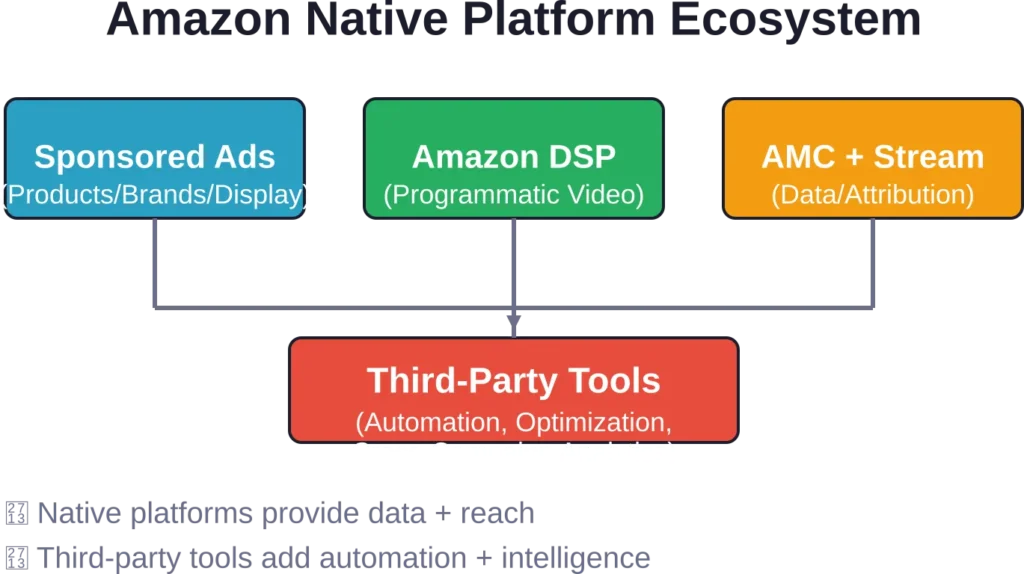
The Amazon advertising ecosystem offers two paths. Native platforms—Sponsored Products, DSP, AMC, Marketing Stream—provide foundational data access and ad delivery. Third-party tools layer automation, intelligence, and cross-campaign optimization on top.
Small sellers managing under $10K monthly spend get sufficient automation from lightweight platforms like Scale Insights or Helium 10 Adtomic. Mid-market advertisers running $10K-$50K budgets benefit from transparent control (AdLabs, BidX) or goal-based AI (Perpetua). Enterprise brands and agencies managing six-figure budgets need consolidated multi-marketplace platforms (Pacvue, Skai) or full-service models (Atomic, Quartile).
The decision hinges on three variables: ad spend scale, desired control level, and channel breadth. Match tool capabilities to business needs rather than chasing feature lists. A $5K/month seller doesn’t need AMC integrations. A $200K/month brand can’t survive without them.
Test before committing. Monthly trials reveal interface usability, support quality, and data accuracy better than sales demos. Validate ROI over 60-90 days before signing annual contracts.
The landscape keeps shifting. Amazon’s full-funnel campaigns, Creative Studio, and Rufus placements change how ads get built and where they appear. Tools integrating these innovations early capture first-mover advantages. Those lagging behind force advertisers into fragmented workflows across multiple platforms.
Start with clear goals. Revenue growth, margin optimization, or market share expansion? Each demands different tool configurations and bidding strategies. Revenue-focused campaigns tolerate higher ACoS for volume. Margin-focused strategies cut unprofitable spend ruthlessly. Share-focused plays invest in top-of-search dominance regardless of short-term efficiency.
The right tools amplify strategy. The wrong ones automate bad decisions faster. Choose deliberately, test rigorously, and optimize continuously. That’s how sustainable Amazon advertising growth happens in 2026.