

Quick Summary: Amazon market research tools help sellers identify profitable products, analyze competition, and optimize pricing strategies. The best tools in 2026 include WisePPC, Jungle Scout, Helium 10, SmartScout, and Amazon’s native Brand Analytics, each offering unique features from product discovery to advertising analytics. Most platforms cost between $29-$69 monthly, with Amazon’s built-in tools providing free first-party data for registered sellers.
Selling on Amazon isn’t what it used to be. Competition grows fiercer each quarter, advertising costs creep upward, and profit margins shrink unless sellers make smarter, data-driven decisions.
The difference between stagnant sales and triple-digit growth isn’t luck or a bigger advertising budget. It’s data mastery.
Amazon market research tools bridge the gap between guesswork and informed strategy. They reveal which products actually sell, what customers search for, how competitors price their inventory, and where untapped opportunities hide in plain sight.
But here’s the thing: not all research tools deliver equal value. Some excel at product discovery but fall short on advertising analytics. Others provide granular keyword data yet lack inventory tracking. And with dozens of platforms competing for seller dollars, choosing the right stack matters more than ever.
This guide breaks down the most effective Amazon market research tools available in 2026, what they do best, and how to match them to specific business goals.
Why Market Research Tools Matter More in 2026
Amazon’s marketplace has matured. The low-hanging fruit—those easy product wins with minimal competition—mostly disappeared years ago.
Today’s sellers face a fundamentally different environment. Rising ad costs squeeze margins. Algorithm changes shift traffic patterns overnight. Customer expectations around shipping speed, product quality, and review authenticity continue climbing.
Manual research simply can’t keep pace anymore. Scrolling through search results, manually tracking competitor prices in spreadsheets, or guessing at keyword volume might’ve worked in 2018. In 2026, that approach leaves money on the table.
Market research tools automate the heavy lifting. They track thousands of data points simultaneously, spot trends before they peak, and surface insights that would take weeks to compile manually.
Based on available data, AI-assisted customer support tools can improve agent productivity by up to 50% in support routing and response management, particularly around customer support routing and response management. That kind of productivity boost compounds over time.
The right toolset doesn’t just save time. It fundamentally changes which opportunities sellers can identify and act on before competitors do.
Top Third-Party Amazon Research Tools
While Amazon’s native analytics provide solid foundational data, third-party platforms add layers of functionality that Seller Central doesn’t offer: historical trend analysis, competitor tracking, advanced keyword research, and cross-marketplace comparisons.
WisePPC

WisePPC has positioned itself as one of the strongest advertising-focused analytics platforms for Amazon sellers. The tool specializes in deep PPC management, historical performance data, and actionable advertising research that goes far beyond Amazon’s native Ads Console.
The platform pulls and stores years of advertising and sales data, allowing sellers to analyze campaign performance, keyword efficiency, placement results, and ROAS trends over extended periods. Its bulk operations features let users manage hundreds of campaigns, keywords, and ad groups across multiple accounts simultaneously.
WisePPC’s keyword research and spy tools reveal competitor ad spend patterns, winning keywords in Sponsored Products and Sponsored Brands, and search term performance that competitors are successfully bidding on. The placement analyzer shows exactly which ad positions deliver the best return, helping sellers shift budgets from underperforming areas.
Additional modules include organic sales tracking, ACoS/ROAS forecasting, listing-level profitability analysis, and automated rules for bid management. The interface is clean and built specifically for sellers who already have products live and want to scale profitably through advertising.
Real talk: WisePPC shines brightest for mid-to-large sellers who run serious Amazon advertising and need powerful post-launch research and optimization. It’s not the best choice for complete beginners doing initial product research, but it’s one of the most effective tools for turning advertising data into a competitive advantage and consistently improving profitability. If your main goal is mastering Amazon PPC and digging deep into performance intelligence, WisePPC belongs in your core toolkit.
Contact Information:
- Website: wiseppc.com
- Facebook: www.facebook.com/people/Wise-PPC/61573154427547
- LinkedIn: www.linkedin.com/company/wiseppc
- Instagram: www.instagram.com/wiseppc
Jungle Scout

Jungle Scout established itself as one of the most comprehensive product research platforms for Amazon sellers. The tool combines database searching, keyword research, listing optimization, and supplier tracking in a single interface.
The product database lets sellers filter through millions of Amazon listings based on criteria like price range, review count, monthly sales estimates, and competition level. The accuracy of sales estimates has improved significantly, though they remain estimates rather than exact figures.
Jungle Scout’s keyword research module identifies high-volume search terms with manageable competition, helping sellers optimize product titles, bullet points, and backend keywords for better organic visibility.
The platform also tracks inventory levels for competitors, alerting sellers when rivals run out of stock—creating temporary opportunities to capture additional market share.
Real talk: Jungle Scout works exceptionally well for product discovery and initial market validation. It’s particularly valuable for newer sellers still learning what product characteristics signal opportunity versus risk.
Helium 10

Helium 10 offers one of the most feature-dense toolsets in the Amazon seller ecosystem. The platform includes 30+ individual tools covering product research, keyword optimization, listing quality, inventory management, and financial analytics.
Based on available pricing data, the platform offers entry-level access starting around $37 monthly for limited features, with full suite access available at higher tiers.
The Black Box tool functions similarly to Jungle Scout’s product database but offers more granular filtering options. Sellers can search by specific criteria combinations that would be difficult to replicate manually.
Cerebro, Helium 10’s reverse ASIN lookup tool, reveals which keywords competitors rank for organically and through advertising. This intelligence helps sellers identify keyword gaps in their own listings and find terms competitors may have overlooked.
Frankenstein and Scribbles assist with keyword processing and listing optimization, ensuring sellers use character limits efficiently without keyword stuffing.
The tool density can feel overwhelming initially. New users often benefit from focusing on 3-4 core features rather than trying to master the entire suite at once.
SmartScout

SmartScout takes a different approach than traditional product research tools by focusing on brand and category mapping rather than individual product listings.
The platform identifies which brands dominate specific subcategories, reveals their entire product catalogs, and estimates revenue at the brand level rather than just per-ASIN.
This broader perspective helps sellers understand competitive landscapes more holistically. Instead of evaluating products in isolation, SmartScout shows how they fit within brand portfolios and category ecosystems.
The tool also surfaces subcategories with high revenue but relatively few competing brands—a strong signal for product opportunity.
Based on available competitor research, SmartScout pricing starts around $29 monthly, making it one of the more accessible premium research platforms.
The brand-centric view makes SmartScout particularly valuable for sellers planning multi-product launches or building cohesive brand identities rather than operating standalone SKUs.
Perpetua

Perpetua specializes in advertising optimization rather than product research, but the distinction matters less than it used to. In 2026, effective product research includes understanding advertising feasibility from day one.
The platform uses machine learning to adjust bids dynamically based on performance data, moving ad spend toward keywords and placements that convert while scaling back on underperformers.
Perpetua’s goal-based campaign management lets sellers optimize for specific outcomes—total revenue, profit margin, new customer acquisition—rather than just managing ACoS in isolation.
The reporting dashboard aggregates performance across organic and paid channels, providing a unified view of product performance that most analytics platforms still segment.
Teikametrics

Teikametrics combines advertising management with inventory forecasting, addressing two critical pain points for growing sellers.
The Flywheel 2.0 algorithm optimizes advertising bids while factoring in inventory levels, profit margins, and business goals. The system won’t aggressively push products that risk stock-outs or carry low margins, preventing scenarios where advertising drives unprofitable volume.
Inventory management features forecast demand based on historical sales, seasonal trends, and promotional calendars, helping sellers maintain optimal stock levels without tying up excessive capital.
The integrated approach reduces the need for separate advertising and inventory tools, streamlining workflows for sellers managing dozens or hundreds of SKUs.
Intentwise

Intentwise focuses on advertising analytics and automation for sellers running complex sponsored product campaigns across multiple marketplaces.
The platform pulls data from Amazon Ads Console and Marketing Stream, then layers on additional analysis around dayparting, competitor activity, and cross-campaign performance.
Intentwise’s interface shows advertising performance alongside organic rank changes, helping sellers understand how paid and organic traffic interact rather than treating them as separate channels.
The tool works best for established sellers with significant advertising budgets who need granular control and sophisticated reporting beyond what Amazon’s native console provides.
Amazon’s Native Research Tools: Start Here
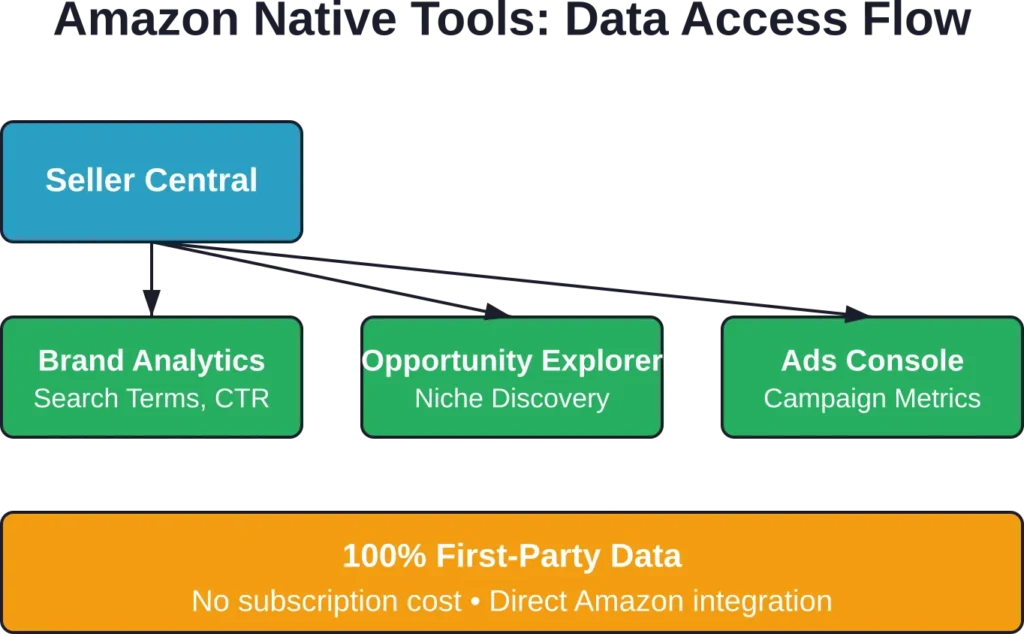
Before spending a dollar on third-party platforms, sellers should maximize Amazon’s built-in analytics. These native tools provide 100% first-party accurate data pulled directly from Amazon’s systems at no extra cost.
Amazon Brand Analytics
Available to registered brand owners through Seller Central, Brand Analytics offers critical marketplace insights that used to require expensive third-party subscriptions.
The platform surfaces top search terms, click share, and conversion share data. Sellers can see exactly which keywords drive the most searches in their category, which products capture clicks, and which convert browsers into buyers.
This is a critical metric for understanding customer lifetime value and brand loyalty. The data comes straight from Amazon’s internal systems, making it more reliable than any third-party estimate.
Brand Analytics also tracks repeat purchase behavior, showing which products customers reorder and how frequently. That intelligence informs inventory planning and helps identify products with strong retention potential.
The seamless integration into Seller Central eliminates the need to manage another login or subscription. For brand-registered sellers, it’s the most authoritative data source available.
Product Opportunity Explorer
Product Opportunity Explorer helps sellers identify high-demand, low-competition niches within Amazon’s vast catalog.
The tool analyzes search volume trends, customer review sentiment, and competitive density to surface product opportunities that match specific criteria. Sellers can filter by category, price range, search volume, and competition level.
What makes this tool particularly valuable? It shows emerging trends before they saturate. By the time a product niche appears on third-party trend reports, dozens of sellers have already jumped in. Product Opportunity Explorer gives brand owners an earlier signal.
The interface integrates directly with existing product listings, making it simple to evaluate whether a new product fits within current brand architecture or requires a separate launch strategy.
Amazon Ads Console & Marketing Stream
For sellers running sponsored product campaigns, the Ads Console provides essential performance data around impressions, clicks, conversions, and advertising cost of sale.
Marketing Stream takes this further by offering near-real-time advertising data through an API. Sellers with technical resources can pipe this data into custom dashboards or combine it with external analytics platforms for deeper analysis.
The granularity here matters. Instead of waiting for daily reports, Marketing Stream delivers hourly updates on campaign performance, enabling faster bid adjustments and budget reallocation.
Choosing the Right Tool Stack
No single platform handles every research need perfectly. Most successful sellers combine 2-3 complementary tools rather than trying to force one solution to do everything.
The right combination depends on business stage, product strategy, and budget constraints.
For New Sellers
Start with Amazon’s native tools—Brand Analytics and Product Opportunity Explorer if brand-registered, or just the standard Seller Central reports if not. These cost nothing and provide solid baseline data.
Add one comprehensive product research tool. Jungle Scout or Helium 10 both work well, though Jungle Scout’s interface tends to be more beginner-friendly. The goal at this stage is validating product ideas and understanding basic market dynamics, not mastering every advanced feature.
Hold off on specialized advertising tools until monthly ad spend exceeds a few thousand dollars. Amazon’s native Ads Console handles basic campaign management adequately for smaller budgets.
For Established Sellers
Sellers managing 10+ SKUs with consistent monthly revenue benefit from a broader stack.
Keep using Amazon’s native tools for first-party data, then add a comprehensive research platform (Helium 10 or Jungle Scout) plus an advertising optimization tool (Perpetua, Teikametrics, or Intentwise depending on specific needs).
At this stage, the time saved through automation and the incremental improvements from better bid management typically justify the additional subscription costs.
For Multi-Brand Operators
Sellers managing multiple brands or private label portfolios should consider adding SmartScout for brand-level competitive intelligence.
Understanding how entire brands perform across categories helps inform portfolio decisions that individual product research can’t surface: which categories support multiple SKUs, which brands dominate through advertising versus organic ranking, and where brand consolidation opportunities exist.
Budget Considerations
Research tools represent an ongoing operational expense, so the cost needs to make sense relative to business revenue.
As a rough guideline, many sellers find that allocating 1-2% of monthly revenue to research and analytics tools provides good value without becoming excessive. A seller generating $50,000 monthly might justify $500-$1,000 in tool subscriptions; someone doing $5,000 monthly should probably keep tool costs under $100.
The subscription amounts found across competitor research indicate most comprehensive platforms fall in the $37-$69 monthly range, with entry-level plans starting around $29 monthly.
Many platforms offer annual billing discounts of 15-25%, which makes sense for tools that become part of core workflows.
Features That Actually Matter
Marketing materials for research tools often emphasize feature counts—”50+ tools in one platform!” or “unlimited data access!” But feature quantity matters far less than having the right core capabilities.
Historical Trend Data
Snapshots of current market conditions help, but trend data reveals whether a product’s popularity is growing, stable, or declining.
Tools that track historical search volume, sales estimates, and review velocity over 12+ months let sellers distinguish between sustainable opportunities and temporary spikes that won’t support long-term businesses.
Competitor Tracking
Markets shift constantly. Competitors launch new variations, adjust pricing, run promotions, or go out of stock.
Automated competitor monitoring alerts sellers to these changes without requiring manual checks. The faster a seller knows a competitor went out of stock or raised prices, the faster they can adjust their own strategy.
Keyword Difficulty Scoring
High search volume means nothing if 50 established sellers with thousands of reviews already dominate that keyword.
Good keyword research tools combine volume data with competition metrics, helping sellers identify terms where they can realistically rank on page one within a reasonable timeframe.
Integration Capabilities
Research tools work best when they connect to other systems rather than operating in isolation.
Look for platforms that integrate with Seller Central, pull data from Amazon Ads, export to spreadsheets or business intelligence tools, and ideally connect with inventory management or accounting software.
These integrations reduce manual data transfer, minimize errors, and create more complete pictures of business performance.
| Feature | Why It Matters | Best Tools |
|---|---|---|
| Historical Trends | Identifies growing vs. declining markets | Jungle Scout, Helium 10, Keepa |
| Competitor Monitoring | Surfaces tactical opportunities in real-time | Jungle Scout, Helium 10, SmartScout |
| Keyword Difficulty | Separates realistic ranking targets from impossible keywords | Helium 10 Cerebro, Jungle Scout Keyword Scout |
| Brand-Level Intelligence | Reveals portfolio strategies and category dominance patterns | SmartScout, Brand Analytics |
| Ad Performance Analytics | Optimizes spend and improves ACoS | Perpetua, Teikametrics, Intentwise |
| Inventory Forecasting | Prevents stock-outs and reduces excess inventory costs | Teikametrics, RestockPro |
Common Research Mistakes
Even with excellent tools, research processes can produce misleading conclusions if sellers approach the data incorrectly.
Trusting Sales Estimates as Facts
Third-party platforms estimate sales volumes based on observable signals like Best Seller Rank changes, review velocity, and pricing patterns. These estimates have improved significantly and often fall within a reasonable accuracy range.
But they remain estimates, not actual sales figures. Two products with identical BSRs might have different sales volumes depending on category dynamics, seasonality, or promotional activity.
Use sales estimates for directional guidance and comparative analysis, not as precise revenue forecasts.
Ignoring Seasonality
A product showing strong sales in October might look completely different in March. Holiday items, outdoor gear, fitness equipment, and dozens of other categories exhibit predictable seasonal patterns.
Always check at least 12 months of historical data before committing to a product. A tool showing current high demand for camping gear in May needs context from November data to understand the full picture.
Overlooking Review Quality
High average ratings don’t tell the complete story. Reading actual reviews reveals product weaknesses, common complaints, and unmet customer needs that competitors haven’t addressed.
This qualitative research often surfaces the best product improvement opportunities—add a feature competitors lack, fix a common problem, or improve packaging based on recurring feedback.
Chasing Saturated Niches
Tools surface high-revenue products easily. But high revenue with 200 established competitors rarely represents good opportunity for new sellers.
Better opportunities often hide in smaller niches with moderate demand but minimal competition. A product category generating $100,000 monthly with 15 sellers offers better entry potential than one doing $500,000 with 75 competitors.
Research Workflows That Work
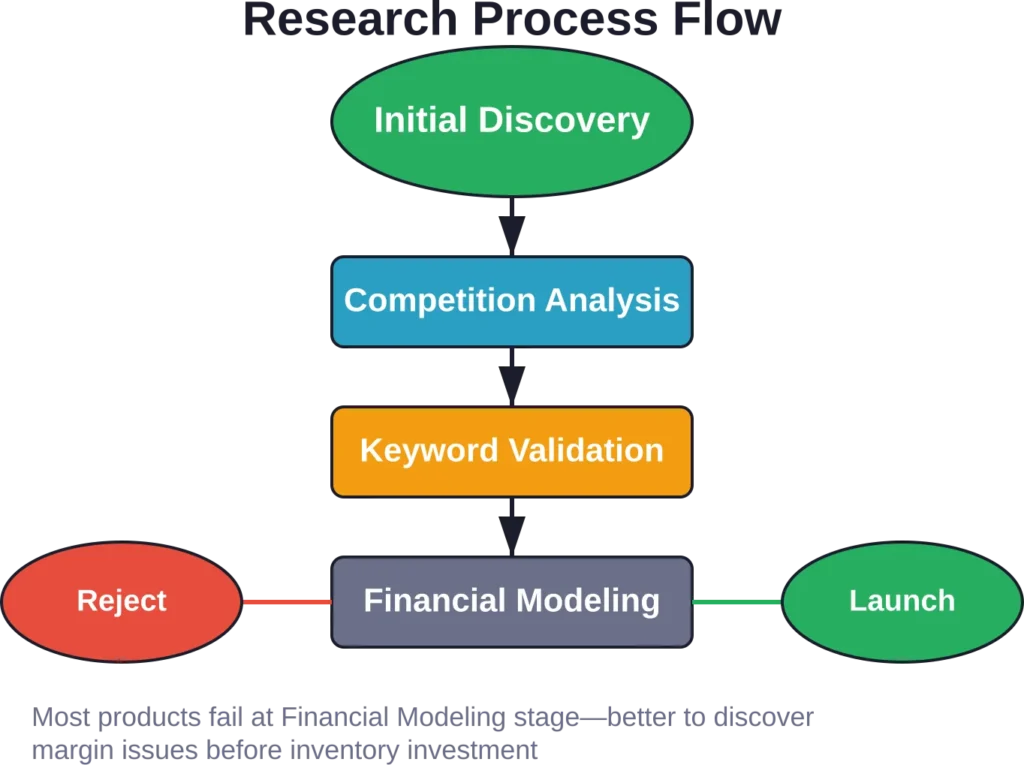
Having the right tools matters, but structured workflows ensure research stays focused and actionable rather than degenerating into endless data browsing.
Initial Product Discovery
Start broad, then narrow systematically. Begin with Product Opportunity Explorer or a product database search in Jungle Scout or Helium 10.
Set initial filters: price range aligned with target margins, review counts indicating manageable competition (typically under 500 reviews for the top-ranked products), estimated monthly sales meeting minimum volume thresholds.
This first pass might yield 50-100 potential products. Don’t evaluate each deeply yet—just compile the initial list.
Competition Analysis
For products that pass initial screening, dive deeper into competitive dynamics.
Examine the top 10 organic search results for the primary keyword. Check review counts, ratings, pricing, FBA status, and seller types (Amazon direct, established brands, or other private label sellers).
Use competitor tracking features to monitor these listings over 7-14 days. Do they fluctuate in rank? Change prices frequently? Run out of stock?
Products with unstable competition or frequent stock-outs signal opportunity. Highly stable, well-stocked competitors with massive review counts signal difficult entry.
Keyword Validation
Reverse ASIN lookups reveal which keywords drive traffic to successful competitors.
Run top competitors through tools like Helium 10’s Cerebro or Jungle Scout’s Keyword Scout. Export the keyword lists, then filter for terms with reasonable search volume (depends on category, but typically 500+ monthly searches) and lower competition.
Build a target keyword list of 10-20 terms mixing high-volume primary keywords with longer-tail variations that might be easier to rank for initially.
Financial Modeling
Before committing to a product, build a simple financial model incorporating all costs: product cost, shipping, FBA fees, referral fees, estimated advertising cost, and any additional overhead.
The research tools provide estimated sales volumes. Apply conservative assumptions—assume sales 30% below the estimate initially, and advertising costs 20% higher than current market ACoS for similar products.
If the model still shows acceptable margins under these conservative assumptions, the product merits further consideration. If margins evaporate with realistic cost assumptions, move on regardless of how attractive the market opportunity appears.
Data Privacy and Accuracy Considerations
Market research tools collect, process, and present vast amounts of data. Understanding where that data comes from and how accurate it is matters for making informed decisions.
First-Party vs. Third-Party Data
Amazon’s native tools provide first-party data—information collected directly from Amazon’s systems. This is the most accurate data available. When Brand Analytics shows a search term received 10,000 searches last month, that number comes straight from Amazon’s search logs.
Third-party tools provide estimated data based on observable signals. They might track BSR changes every hour, monitor price fluctuations, scrape public review counts, or use algorithmic models to estimate sales volumes.
These estimates have improved substantially and generally fall within reasonable accuracy ranges, but they remain estimates. The gap between estimated and actual figures can widen during promotional periods, holiday spikes, or other irregular events.
Data Collection Methods
Understanding how tools collect data helps evaluate their reliability.
Some platforms scrape Amazon’s public-facing pages. Others integrate with Amazon’s advertising API for ad-related data. A few have formal data partnerships or licensing arrangements.
The collection method affects data freshness and accuracy. API-based data tends to be more current and reliable than scraped data, which can lag behind real-time changes.
Research Standards and Reliability
Academic research has examined the reliability of fast survey platforms like Amazon Mechanical Turk compared to traditional market research surveys. Studies indicate these platforms can achieve results within approximately a 10% accuracy margin of larger traditional surveys, though this varies by study design and participant pool.
According to academic research comparing survey platforms, studies indicate these platforms can achieve results within approximately a 10% accuracy margin of traditional surveys, indicating mainstream academic acceptance of the platform for certain research applications.
While these studies focus on consumer surveys rather than product research tools specifically, they illustrate the broader trend toward fast, technology-enabled research methods that trade some precision for dramatic improvements in speed and cost efficiency.
Frequently Asked Questions
Amazon’s Product Opportunity Explorer offers the most powerful free product research capability for brand-registered sellers. It provides first-party data on search volume, customer demand, and competitive density across product categories. Non-brand-registered sellers can use the basic sales and traffic reports in Seller Central, though these provide less detailed market intelligence. Jungle Scout and Helium 10 both offer limited free tiers with restricted features and data access that work for initial exploration.
Third-party sales estimates typically fall within a reasonable accuracy range for established products with stable ranking patterns, though exact figures vary by tool and category. These platforms estimate sales based on Best Seller Rank fluctuations, review velocity, and pricing data rather than accessing actual sales figures. Accuracy decreases during promotional periods, seasonal spikes, or for newly launched products with unstable ranking. Use these estimates for comparative analysis and directional guidance rather than precise revenue forecasting. Amazon’s native analytics provide the only truly accurate sales data.
New sellers can validate initial product ideas using free tools—Amazon’s Product Opportunity Explorer, basic Seller Central reports, and manual competitor analysis through Amazon search. However, paid tools significantly accelerate research and reduce risk by surfacing insights that manual methods miss or would take weeks to compile. For sellers serious about building sustainable businesses rather than testing with one-off products, a basic subscription to Jungle Scout or Helium 10 typically pays for itself by helping avoid costly product selection mistakes. Start with Amazon’s free tools, then add paid platforms once initial sales justify the expense.
Product research tools help identify which physical products to sell by analyzing market demand, competition levels, pricing dynamics, and sales volumes across Amazon’s catalog. Keyword research tools help optimize listings and advertising for products already selected by revealing which search terms customers use, how often they search those terms, and how difficult ranking for specific keywords might be. Most comprehensive platforms like Jungle Scout and Helium 10 include both capabilities since product selection and keyword optimization are interconnected—understanding keyword difficulty helps evaluate whether a product category is realistically accessible for new sellers.
Market dynamics shift constantly, so research shouldn’t be a one-time activity. For product discovery and initial validation, current data plus 12 months of historical trends provide adequate context. Once products launch, ongoing monitoring matters more—track competitor pricing weekly, review advertising performance at least twice weekly, and reassess category trends monthly. Most research platforms update their databases daily or weekly, though real-time data matters most for advertising optimization. Amazon’s Marketing Stream provides near-hourly advertising updates for sellers who need that granularity.
Most Amazon-focused research tools concentrate exclusively on Amazon’s U.S. marketplace, though many now support Amazon’s international sites including Canada, UK, Germany, France, Italy, Spain, Japan, and Australia. Different tools vary in their international coverage—check specific platform documentation for current marketplace support. Very few Amazon research tools provide meaningful data for non-Amazon marketplaces like eBay, Walmart, or Shopify. Sellers operating across multiple channels typically need separate research tools for each platform since the competitive dynamics, search behaviors, and ranking algorithms differ substantially.
ROI varies dramatically based on how effectively sellers use the tools and their business scale. For new sellers, research tools that prevent even one bad product selection easily justify annual subscription costs—the typical inventory commitment for a failed product ranges from $2,000-$5,000, far exceeding tool costs. For established sellers, incremental improvements in keyword targeting, advertising efficiency, or inventory management from better data often yield 5-10x returns on tool subscriptions. The key is actually using the tools consistently rather than subscribing then ignoring them. Sellers who integrate research tools into weekly workflows typically see clear positive ROI within 3-6 months.
Moving Forward with Better Data
Amazon’s marketplace rewards sellers who make decisions based on solid data rather than intuition or guesswork. Market research tools provide that data foundation.
But the tools themselves don’t create success. They reveal opportunities that still require execution—sourcing quality products, building effective listings, managing inventory, optimizing advertising, and delivering excellent customer experiences.
Research platforms work best as strategic inputs informing decisions, not as magic solutions that guarantee outcomes. The seller who combines good data with strong operational execution will always outperform competitors who have great tools but poor follow-through.
Start with Amazon’s native analytics to establish a baseline understanding of category dynamics and customer behavior. Those tools cost nothing and provide the most authoritative data available.
Add one comprehensive third-party platform when ready to accelerate product discovery or access historical trend data that Amazon doesn’t surface. Match the tool to specific business needs—Jungle Scout for straightforward product research, Helium 10 for broader feature sets, SmartScout for brand-level intelligence, or advertising-focused platforms once ad spend justifies specialized optimization.
Build structured research workflows that move systematically from initial discovery through competition analysis, keyword validation, and financial modeling. That process filters hundreds of potential opportunities down to the handful worth launching.
Then track results, adjust based on actual performance data, and refine the research approach over time. The tools and tactics that work for one seller might not suit another. The goal is building a research system that consistently identifies opportunities aligned with specific business strengths and market positioning.
Ready to upgrade your Amazon research process? Start by auditing your current toolset and workflows against the frameworks outlined here, identify the biggest gaps, and make one improvement this month. Incremental progress compounds into significant competitive advantages over time.