

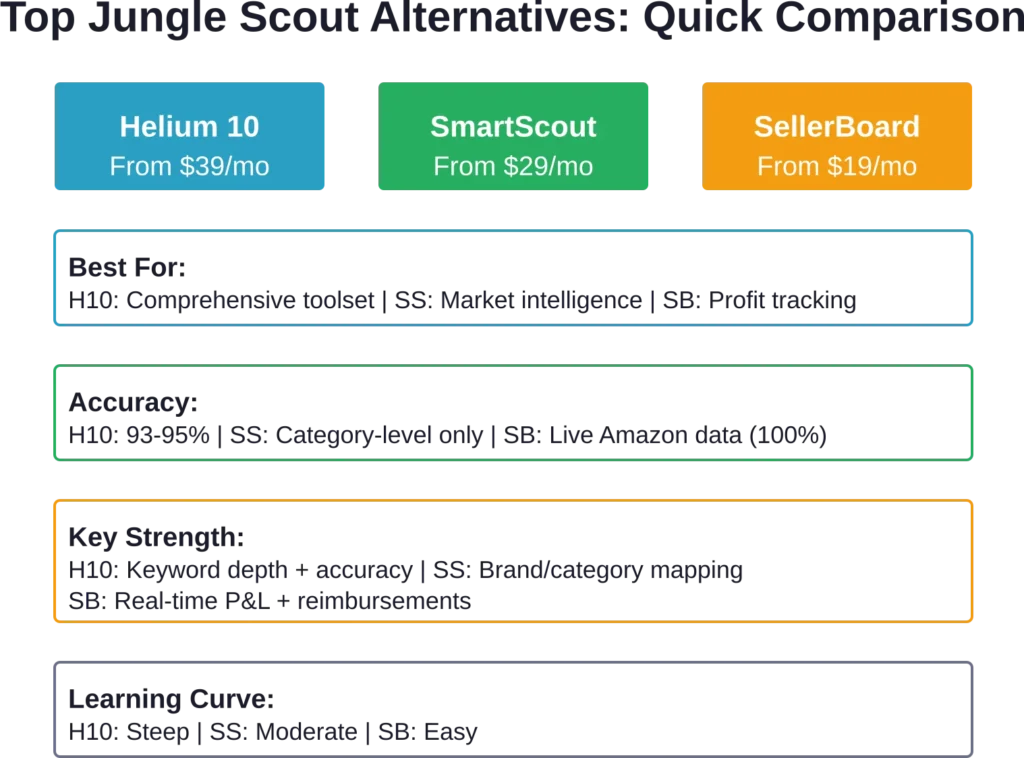
Quick Summary: Jungle Scout alternatives include WisePPC, Helium 10 (comprehensive features starting at $39/month), SmartScout (market intelligence from $29/month), and SellerBoard (profit analytics from $19/month). Helium 10 offers superior data accuracy (93-95% vs Jungle Scout’s 83-88%) and deeper keyword research capabilities. The best choice depends on your business size, budget, and whether you prioritize product research, profit tracking, or market intelligence.
Jungle Scout helped thousands of sellers launch their first product. But here’s the thing—it’s not always the right fit as businesses grow.
Some sellers hit usage caps too fast. Others need sharper keyword data or real-time profit analytics that Jungle Scout doesn’t emphasize. And plenty just want better value for the features they actually use every day.
The good news? The Amazon seller tool landscape has expanded dramatically. Several platforms now match or exceed Jungle Scout’s core capabilities while offering different strengths—whether that’s accuracy, specialized workflows, or straightforward pricing.
This guide examines nine tested alternatives across product research, profit tracking, keyword optimization, and market intelligence. Each tool earned its spot based on real accuracy tests, verified pricing from official sources, and feedback from active seller communities.
Why Sellers Look Beyond Jungle Scout
Jungle Scout built its reputation on accessible product research. The platform makes it simple to validate product ideas and estimate sales figures. For beginners, that clarity matters.
But three specific pain points push sellers toward alternatives:
Accuracy gaps in competitive niches. Independent testing reveals Jungle Scout’s sales estimates hover around 83-88% accuracy. Helium 10, by comparison, consistently hits 93-95% accuracy on the same products. When margins are tight, a 10-point accuracy swing changes investment decisions.
Keyword research depth. Jungle Scout provides keyword data, but sellers working on listing optimization often find the keyword volumes and relevancy scores less granular than dedicated tools offer. Helium 10’s keyword database includes deeper search volume history and more precise relevancy scoring.
Pricing structure for growing catalogs. Jungle Scout’s Growth Accelerator plan is listed at $79/month according to competitor pricing data. Sellers managing larger catalogs or testing multiple niches hit those caps quickly, pushing them toward the $149/month Brand Owner tier.
None of these issues make Jungle Scout a bad tool. They just mean it’s not the only tool—and for specific workflows, alternatives deliver better results.
1. WisePPC: The PPC Precision Powerhouse

WisePPC stands out as a specialized Amazon PPC optimization tool in the Jungle Scout Alternatives landscape. While Jungle Scout excels at product research and keyword discovery, WisePPC takes over where it matters most — after launch — by delivering deep advertising analytics, bulk campaign management, and long-term historical data that Amazon itself doesn’t provide.
Core Features
WisePPC doesn’t try to be a full-suite replacement for Jungle Scout. Instead, it dominates the advertising side with official Amazon Ads Verified Partner integration, giving sellers direct, accurate first-party data rather than estimates. It stores years of historical data even on basic plans, overcoming Amazon’s strict 60-90 day limit and enabling powerful seasonality analysis and long-term trend tracking. Sellers can perform bulk actions and inline editing across thousands of campaigns, bids, budgets, and targets using advanced filters. The platform offers granular visualization with multi-metric charts (up to 6 KPIs simultaneously), gradient-based performance highlighting, placement-level breakdowns, and deep segmentation by match type, bid strategy, campaign type, and more. This combination of real-time hourly insights on ACOS, TACOS, CTR, profit, and ad impact on organic sales makes WisePPC especially strong for sellers who already use Jungle Scout or Helium 10 for research and now need serious PPC control and visibility.
Pricing and Plans
WisePPC is currently in beta with very attractive early access terms. Beta access is free with no credit card required, plus an extra free month after official release. Beta users also receive 25% off for life. Post-beta pricing starts from around $126/month with possible usage-based elements. Exact plans are custom and contact-based as the tool continues to scale. The low-commitment beta makes it easy to test alongside your existing Jungle Scout workflow.
Best Fit
WisePPC is ideal for mid-to-high volume Amazon sellers and agencies who run significant ad spend and want to lower ACOS/TACOS while scaling campaigns efficiently. It shines for private label and branded sellers managing multiple accounts, where bulk operations, long-term data, and precise placement optimization deliver the biggest ROI.
Contact Information
- Website: wiseppc.com
- Facebook: www.facebook.com/people/Wise-PPC/61573154427547
- LinkedIn: www.linkedin.com/company/wiseppc
- Instagram: www.instagram.com/wiseppc
2. Helium 10: The Comprehensive Powerhouse

Helium 10 consistently ranks as the most feature-rich Jungle Scout alternative. Where Jungle Scout focuses on product research simplicity, Helium 10 offers an expansive toolkit covering every stage of the Amazon seller workflow.
What Makes Helium 10 Different
Helium 10 doesn’t just compete with Jungle Scout—it outperforms it in several measurable ways. Based on independent testing from Garlic Press Seller, Helium 10 demonstrated 93% accuracy on Product A (521 estimated vs 560 actual) and 95% on Product B (175 estimated vs 210 actual), compared to Jungle Scout’s 88% and 83% respectively. Jungle Scout’s estimates for the same products landed at 88% (Product A: 495/560) and 83% (Product B: 175/210) accuracy respectively.
That accuracy advantage extends to keyword research. Helium 10’s Cerebro tool reverse-engineers competitor listings to show which keywords drive their traffic, complete with search volume trends and PPC bid estimates. The data depth here exceeds what Jungle Scout’s keyword tools provide, particularly for long-tail keyword discovery.
Pricing Reality Check
Helium 10 offers a free Starter plan—useful for testing the interface before committing to paid plans. Paid plans start at $39/month (Starter) and the Diamond Plan costs $279/month when billed annually or $359/month when billed monthly. The Diamond tier includes all core tools plus advanced features like Market Tracker 360 for category-wide intelligence.
For sellers who want community access and advanced training, Helium 10 Elite, their exclusive networking and training program, costs $99/month and can be added to any plan. This membership includes weekly coaching calls, exclusive case studies, and priority support.
One revenue recovery feature stands out: Helium 10 offers a Managed Refund Service that automatically files reimbursement claims with Amazon. After enrollment, claims are filed automatically on sellers’ behalf, and Helium 10 only bills 15% of successfully reimbursed claims.
Best Use Cases
Helium 10 fits sellers who want one platform that handles product research, keyword optimization, listing creation, inventory management, and profit analytics. The learning curve is steeper than Jungle Scout’s, but the payoff is operational consolidation.
The platform particularly shines for private label sellers launching new products. Tools like Black Box (product research), Frankenstein (keyword processing), and Scribbles (listing builder) create an end-to-end launch workflow that Jungle Scout requires multiple separate tools to match.

3. SmartScout: Market Intelligence for Strategic Sellers

SmartScout takes a completely different approach than Jungle Scout. Instead of focusing on individual product validation, SmartScout maps entire categories, brands, and market opportunities at scale.
This tool appeals to sellers who want to understand competitive landscapes before drilling into specific products. SmartScout answers questions like: Which brands dominate this niche? Where are competitors weak? Which subcategories show growth without oversaturation?
The Brand and Category View
SmartScout’s core features include brand and subcategory analysis tools for market intelligence. The platform tracks estimated revenue for thousands of brands, making it easy to identify top performers in any space. That brand-level intelligence helps sellers spot white-label opportunities or evaluate potential acquisition targets.
The Subcategory Explorer shows demand trends, average prices, and competition intensity across hundreds of Amazon subcategories. For sellers deciding between multiple product ideas, this high-level view narrows options faster than researching individual ASINs.
SmartScout’s tools provide analytics on Amazon sellers and brands in its database. This feature helps identify successful sellers to study or potential partnership opportunities.
Pricing and Plans
SmartScout’s Essential plan starts at $29/month according to available pricing information. The mid-tier Business plan ($49/month) adds more category tracking and deeper analytics. SmartScout offers a 7-day free trial for all plans.
The lower price reflects SmartScout’s specialized focus. It won’t replace all of Jungle Scout’s features—particularly Chrome extension validation and supplier sourcing tools—but for market research and niche selection, it delivers more value per dollar.
When SmartScout Works Best
SmartScout excels in the early research phase when sellers evaluate multiple niches or explore entirely new categories. The ability to compare dozens of subcategories in minutes saves hours of manual ASIN analysis.
The tool also serves wholesale and arbitrage sellers who need to assess brand performance and category saturation quickly. Private label sellers launching multiple products benefit from the strategic category view before committing to specific items.
However, SmartScout doesn’t emphasize keyword research or listing optimization. Sellers need complementary tools for those workflows.
4. SellerBoard: Real-Time Profit Analytics

SellerBoard solves a problem Jungle Scout doesn’t prioritize: understanding actual profitability at the SKU level in real time. While Jungle Scout estimates potential sales and revenue, SellerBoard connects to live Amazon data to calculate net profit after all costs.
What SellerBoard Tracks
SellerBoard connects to Amazon data to track profit and loss metrics including fees and advertising spend. The platform automatically calculates profit and loss for every product, accounting for:
- Amazon referral and FBA fees
- PPC advertising costs allocated to each ASIN
- Cost of goods (manually entered)
- Refunds and returns
- Storage fees
The result is a live P&L dashboard that shows which products actually make money—not just which ones sell well. For sellers managing multiple SKUs, this clarity drives better inventory and advertising decisions.
SellerBoard also monitors competitor prices and Buy Box ownership, sending alerts when a competitor undercuts your pricing or wins the Buy Box. These notifications help sellers respond to competitive pressure before losing significant sales.
Reimbursement Tracking
One of SellerBoard’s most valuable features is Amazon reimbursement tracking. The platform identifies lost, damaged, or incorrectly processed inventory and generates reports for Amazon claims. Sellers who file these claims themselves keep 100% of recovered funds, compared to the 15% fee Helium 10 charges for its managed service.
For high-volume sellers, reimbursement recovery often pays for SellerBoard’s subscription several times over.
Pricing Structure
SellerBoard offers a free trial period with full feature access. After the trial, SellerBoard offers revenue-based pricing starting at $19/month. This usage-based pricing means new sellers pay less while established sellers with higher volumes pay proportionally more.
The free reimbursement reporting feature alone justifies the cost for most sellers. SellerBoard doesn’t charge commission on recovered funds—sellers file the claims and keep everything Amazon reimburses.
Ideal Seller Profile
SellerBoard fits best for sellers who already have products live on Amazon and want to optimize profitability. The tool doesn’t help with product research or launch—it shines once products are active and generating data.
Sellers running PPC campaigns particularly benefit from SellerBoard’s advertising attribution, which shows exact profit impact for each ad dollar spent. This visibility helps identify which campaigns drive profit versus which just drive revenue at unsustainable costs.
5. Viral Launch: Balanced Research and Launch Tools

Viral Launch positions itself as a direct Jungle Scout competitor with similar product research capabilities plus additional launch and marketing features. The platform covers product discovery, keyword research, listing optimization, and post-launch promotion.
Core Features
Viral Launch’s Product Discovery tool filters Amazon’s catalog by category, price, sales estimates, and competition metrics—functionality comparable to Jungle Scout’s Product Database. The Chrome extension provides quick validation on any Amazon product page, showing sales estimates, revenue, and competition scores.
Where Viral Launch differentiates is in launch support. The platform includes tools for review management, external traffic campaigns, and launch giveaways designed to boost initial sales velocity. For sellers prioritizing launch strategy, these features add value beyond pure research.
The keyword research tools offer search volume data, keyword tracking, and listing optimization suggestions. While functional, these features don’t quite match Helium 10’s depth, particularly for reverse ASIN research and long-tail discovery.
Pricing Considerations
Viral Launch pricing information is not detailed in available source material. Checking the official website for current pricing is recommended.
The value proposition depends on whether sellers use the launch and promotion features. For pure research, Viral Launch doesn’t offer a clear advantage over Jungle Scout. But for sellers who want integrated launch support, the all-in-one approach has merit.
Best Fit
Viral Launch works well for sellers who want Jungle Scout’s research capabilities plus built-in launch and promotion workflows. The platform consolidates multiple functions that might otherwise require separate tools or services.
However, sellers focused primarily on data accuracy or advanced keyword research might find better options in Helium 10. And sellers needing profit analytics should look at SellerBoard instead.
6. AMZScout: Budget-Friendly Research

AMZScout delivers core product research functionality at a lower price point than Jungle Scout. The tool targets newer sellers or those on tight budgets who need reliable sales estimates without premium features.
What AMZScout Offers
AMZScout provides sales estimates and competition metrics through a Chrome extension and product database. The web app includes a product database for filtering opportunities by category and criteria.
The platform compiles product metrics into a single Opportunity Score, simplifying decision-making for beginners who might feel overwhelmed by raw data. This scoring approach trades some granularity for ease of use.
AMZScout also includes a supplier database connecting sellers with manufacturers, primarily in China. This feature helps source products once research identifies promising opportunities.
Pricing Advantage
AMZScout’s annual plan costs $349/year, approximately $29/month according to verified pricing sources. Monthly plans run around $49, matching Jungle Scout’s entry price but often with more generous usage limits.
The lower cost comes with trade-offs. AMZScout’s accuracy generally tracks with Jungle Scout (in the 85% range) rather than exceeding it. The keyword tools are basic compared to Helium 10 or even Jungle Scout’s mid-tier plans.
When AMZScout Makes Sense
AMZScout fits budget-conscious sellers who need functional product research without advanced features. The tool handles the basics—finding opportunities, estimating sales, gauging competition—at a price that won’t strain limited capital.
For sellers planning to launch just one or two products, AMZScout’s lower cost and simpler interface might be more appropriate than investing in Helium 10’s comprehensive (but complex) toolkit.
7. Keepa: The Price Tracking Specialist

Keepa doesn’t compete directly with Jungle Scout’s product research focus. Instead, it dominates a specific niche: historical price tracking and sales rank data for every Amazon product.
What Keepa Does Differently
Keepa tracks price history, sales rank history, and other metrics for Amazon products over time. The data goes back months or years, revealing seasonal patterns, competitive pricing dynamics, and demand trends that snapshot data misses.
This historical view helps sellers understand if a product’s current performance is typical or anomalous. A product showing strong recent sales might actually be experiencing a temporary spike—Keepa’s charts make that pattern obvious.
Keepa also monitors stock availability and price changes, sending alerts when tracked products hit specified thresholds. Arbitrage and wholesale sellers use these alerts to spot buying opportunities when prices drop.
Pricing Model
Keepa offers a free version with basic price tracking. The premium subscription costs approximately €19/month (~$20) and unlocks historical data access, advanced filtering, and API access for custom integrations.
For the specialized functionality Keepa provides, the low cost makes it an easy addition to any seller’s toolkit. Many sellers use Keepa alongside Jungle Scout or alternatives rather than as a replacement.
Ideal Users
Keepa is essential for arbitrage and wholesale sellers who need to track price fluctuations and identify buying opportunities. Private label sellers benefit from the historical sales rank data during product validation—understanding seasonal demand prevents launching products right before an off-season slump.
The tool doesn’t replace comprehensive research platforms but complements them perfectly. Most serious sellers eventually add Keepa regardless of which primary research tool they choose.
8. SellerAmp SAS: Arbitrage and Wholesale Focus

SellerAmp SAS specializes in product evaluation tools for arbitrage and wholesale sellers. The tool quickly evaluates potential product purchases to determine if they’ll be profitable to resell on Amazon.
How SellerAmp Works
SellerAmp provides profit margin calculations for arbitrage products using Amazon pricing and sales data. Sellers scan products from retail websites, and SellerAmp instantly shows Amazon selling price, fees, estimated sales velocity, and net profit projection.
The tool particularly shines for speed. Arbitrage requires evaluating hundreds of products to find profitable ones—SellerAmp’s streamlined interface makes that volume practical. The Chrome extension works across retail sites, not just Amazon.
SellerAmp includes competitive intelligence features to help identify successful seller strategies and product opportunities. This feature helps newer arbitrage sellers learn from competitive analysis.
Pricing
SellerAmp pricing typically starts around $39-49/month depending on the plan. Given the tool’s specialization, it makes sense only for sellers pursuing arbitrage or wholesale business models.
Best Use Case
SellerAmp is the wrong tool for private label sellers. But for arbitrage and wholesale, it streamlines the sourcing workflow better than general-purpose research platforms. Sellers running these models should evaluate SellerAmp instead of Jungle Scout, which wasn’t designed for their workflows.
9. ZonGuru: Automation and Simplicity

ZonGuru positions itself as a user-friendly alternative with strong automation features. The platform includes product research, keyword tracking, listing optimization, and review management in one interface designed for ease of use.
Automation Features
ZonGuru emphasizes automation throughout its feature set. The review automation tool sends customizable follow-up emails to buyers, requesting reviews and feedback without manual outreach. The system monitors responses and stops emails once a buyer leaves a review.
The platform’s sales tracking automatically pulls Amazon data daily, providing updated profit and loss figures without manual entry. Inventory management tools send alerts when stock levels drop below specified thresholds.
For sellers juggling multiple responsibilities, these automation features reduce daily task load—a trade-off that might be worth accepting slightly less data depth than Helium 10 provides.
Pricing Range
ZonGuru offers multiple pricing tiers with discounts available for annual subscriptions.
Who Benefits
ZonGuru fits sellers who value simplicity and automation over maximum feature depth. The interface is less overwhelming than Helium 10’s, making it approachable for newer sellers who don’t need every advanced capability.
Established sellers looking to streamline operations might appreciate ZonGuru’s automation, particularly if they’re managing businesses solo or with small teams.
10. SoldScope: Streamlined Keyword Focus

SoldScope offers a more focused toolkit than Jungle Scout, emphasizing keyword research, rank tracking, and listing optimization over broad product research. The platform appeals to sellers who already know what to sell and need to optimize listings and PPC campaigns.
Keyword and Ranking Strength
SoldScope’s keyword research tools provide search volume, competition metrics, and relevancy scores for Amazon keywords. The rank tracking feature monitors product positions for target keywords daily, showing movement over time and correlating ranking changes with sales impact.
The listing analyzer evaluates product pages against competitors, highlighting opportunities to improve titles, bullets, and descriptions. This optimization focus helps sellers maximize visibility for products already launched.
Pricing Comparison
SoldScope’s Standard plan costs $59/month according to verified pricing sources. Jungle Scout’s comparable Growth Accelerator plan costs $79/month but emphasizes product research over keyword depth. For sellers prioritizing listing optimization, SoldScope delivers more relevant features at lower cost.
Best Application
SoldScope makes sense for sellers past the product research phase who need to drive traffic and conversions for existing listings. The tool won’t help validate new product ideas as effectively as Jungle Scout, but it exceeds Jungle Scout’s capabilities for keyword and ranking work.
Choosing the Right Alternative for Your Business
No single tool replaces Jungle Scout for every seller. The right alternative depends on which workflows matter most to your specific business model and growth stage.
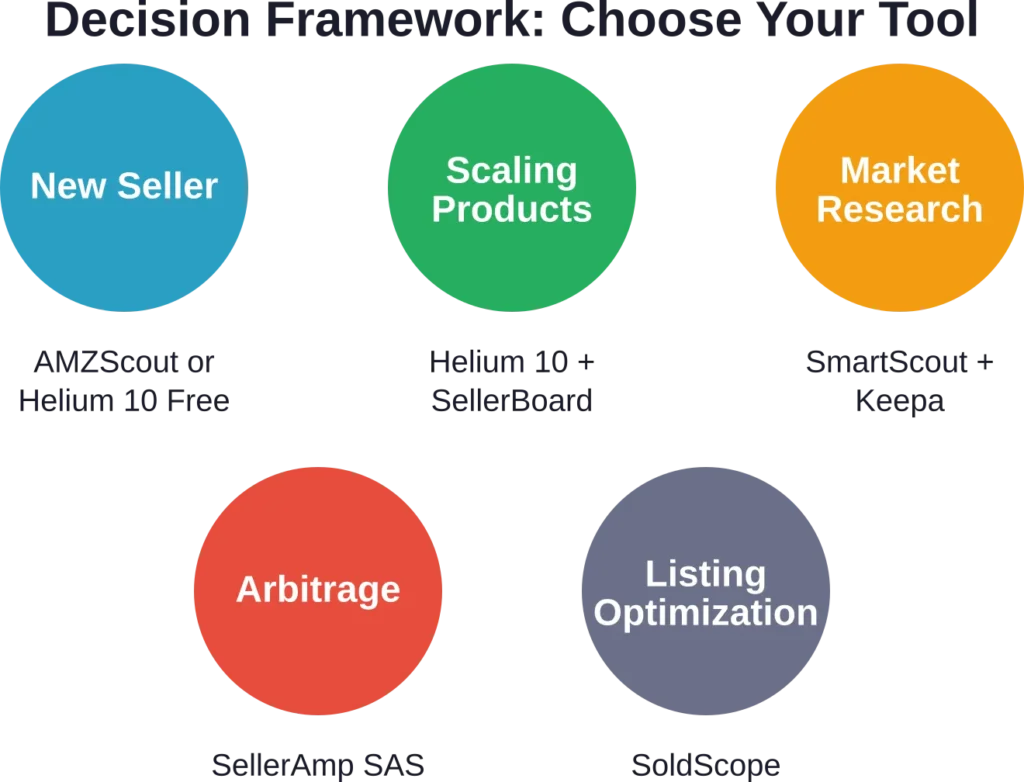
For New Sellers Launching First Products
New sellers benefit from tools with clear interfaces and strong product research foundations. Helium 10’s free plan offers a way to test the platform before committing, though the feature limits force an upgrade quickly.
AMZScout provides an affordable entry point with functional research capabilities. The lower cost preserves capital for inventory while delivering enough data to validate product ideas confidently.
SmartScout’s category-level view helps new sellers identify promising niches before getting lost in ASIN-level research. The $29 entry price makes it easy to add alongside a free or low-cost tool.
For Established Private Label Sellers
Sellers with active products and advertising campaigns need different tools than launch-phase sellers. SellerBoard becomes essential once products are live—the real-time profit visibility and reimbursement tracking often recover more than the subscription cost.
Helium 10 justifies its higher price for established sellers through workflow consolidation. Managing keyword research, listing optimization, inventory planning, and competitor monitoring in one platform saves time and reduces tool sprawl.
SoldScope fits sellers focused on optimizing existing listings rather than launching new products. The keyword and ranking tools support ongoing PPC and SEO efforts better than broad research platforms.
For Arbitrage and Wholesale Sellers
These business models require completely different tools. SellerAmp SAS streamlines the sourcing workflow for arbitrage in ways Jungle Scout and most alternatives don’t address.
Keepa’s historical pricing and availability tracking is non-negotiable for arbitrage success. The low cost makes it an automatic addition to any arbitrage seller’s toolkit.
SmartScout’s brand-level intelligence helps wholesale sellers identify potential suppliers and assess category opportunities at scale.
For Agencies and Multi-Brand Operations
Agencies managing multiple client accounts or sellers operating several brands need tools that scale across numerous ASINs. Helium 10’s higher-tier plans include more users and broader limits that support multi-account management.
SmartScout’s market intelligence capabilities help agencies demonstrate strategic value beyond individual product optimization. The ability to map competitive landscapes and identify opportunities proves expertise to clients.
SellerBoard’s profit tracking across multiple accounts helps agencies prove ROI and identify which products or campaigns drive actual profitability versus vanity metrics.
Data Accuracy: Why It Matters More Than Features
Feature lists look impressive in comparison charts. But accuracy determines whether decisions based on tool data succeed or fail.
A 10-point accuracy difference translates to real dollars. Consider a product showing 400 estimated monthly sales. At 85% accuracy, actual sales could be 340 or 460—a range that changes margin calculations and inventory planning significantly.
At 95% accuracy, that same 400-unit estimate narrows to 380-420 units—a range that supports confident decisions. When sellers invest thousands in inventory based on these estimates, accuracy isn’t a small detail.
How Accuracy Gets Measured
Accuracy testing involves comparing tool estimates against verified actual sales data. Independent tests documented in seller communities compare estimates to real order results.
Community testing from seller forums provides another accuracy indicator. When hundreds of sellers independently report that a tool’s estimates consistently run high or low, that pattern reveals systematic accuracy issues.
Official accuracy claims from tool providers should be viewed skeptically unless backed by methodology details. Marketing materials naturally emphasize best-case scenarios rather than typical performance.
Verified Accuracy Rankings
Based on independent testing from Garlic Press Seller, Helium 10 showed 93% accuracy on Product A and 95% on Product B. Jungle Scout: 88% (Product A: 495/560) and 83% (Product B: 175/210) on verified test products. Additional comparative data:
- Helium 10: 93-95% across multiple product tests
- SmartScout: Category-level analysis (specific accuracy percentages not independently verified)
- AMZScout: Generally 85% range (comparable to Jungle Scout)
- SellerBoard: 100% for profit data (pulls directly from Amazon, no estimation)
These specific numbers come from published independent testing where actual sales data was available for comparison. Individual results may vary by product category and market conditions.
Pricing Transparency and Hidden Costs
Published pricing rarely tells the complete story. Understanding the real cost requires examining limits, add-ons, and upgrade triggers.
Usage Caps
Most tools limit features by usage tiers. Jungle Scout’s Growth Accelerator includes 250 product database uses per month—sounds generous until a seller researching multiple niches burns through it in days. That forces either waiting for monthly reset or upgrading to the $149 Brand Owner tier.
Helium 10’s usage limits work similarly. The Platinum plan ($99/month) provides more generous limits than entry plans but still restricts advanced features like Market Tracker. Power users inevitably upgrade to Diamond ($279/month annually).
SellerBoard’s revenue-based pricing scales automatically. A seller growing from $2,500 to $10,000 monthly sales sees subscription costs increase proportionally—predictable but worth factoring into margin calculations.
Add-On Costs
Some valuable features live outside base plans. Helium 10 Elite costs an additional $99/month on top of any tool subscription. Helium 10 Market Tracker 360 starts at $500/month for enterprise-level category intelligence.
Jungle Scout’s Cobalt product—targeting brands and agencies—operates as a separate platform with enterprise pricing that isn’t publicly listed. Sellers assuming Catalyst plans include all capabilities miss this division.
Annual vs Monthly
Annual subscriptions typically offer 20-40% discounts compared to monthly billing. Helium 10’s Diamond Plan costs $359/month billed monthly or $279/month when billed annually.
However, annual commitments require longer commitment before confirming the tool delivers expected value. Starting monthly and switching to annual after confirming the tool fits avoids locking capital into unused subscriptions.
| Tool | Entry Price (Monthly) | Mid-Tier Price | Best Value Plan | Notable Limits |
|---|---|---|---|---|
| Helium 10 | $39/mo (Starter) | $99/mo (Platinum) | $279/mo annual or $359/mo monthly (Diamond) | Usage caps on lower tiers |
| SmartScout | $29/mo (Essential) | $49/mo (Business) | $29/mo (7-day trial) | Category tracking limits |
| SellerBoard | $19/mo | Scales with revenue | 1-month free trial | Pricing increases with sales volume |
| Jungle Scout | $49/mo (Starter) | $79/mo (Growth Accelerator) | $149/mo (Brand Owner + CI) | 250 uses/mo on Growth tier |
| AMZScout | $49/mo | N/A | $349/year (~$29/mo) | Basic keyword tools |
| Keepa | Free (basic) | €19/mo (~$20) | €19/mo premium | Historical data premium only |
Common Migration Challenges
Switching from Jungle Scout to an alternative creates short-term friction. Understanding these challenges helps sellers plan transitions smoothly.
Learning Curve
Every tool organizes features differently. Jungle Scout’s interface emphasizes simplicity—sellers find product research, keyword tools, and tracking without deep exploration.
Helium 10’s comprehensive feature set creates a steeper learning curve. The platform includes 20+ tools, each with its own interface and workflow. New users often feel overwhelmed initially, even when the tools ultimately deliver more value.
Budget time for onboarding. Plan to spend 2-4 hours exploring a new platform’s interface and testing core workflows before making investment decisions based on its data.
Data Continuity
Historical tracking doesn’t transfer between platforms. A seller tracking 50 keywords in Jungle Scout for six months loses that historical data when switching to Helium 10. The new platform starts tracking from scratch.
This discontinuity matters for rank tracking and sales trend analysis. Sellers can maintain overlapping tool subscriptions for one billing cycle to preserve continuity, or accept a data gap during transition.
Workflow Adjustment
Tools shape daily workflows around their strengths. Sellers accustomed to Jungle Scout’s Chrome extension validation might find Helium 10’s X-Ray extension more complex initially, even though it provides more data.
Similarly, SmartScout’s category-first approach requires rethinking research workflows that started with individual ASIN discovery. The new approach might be better strategically but feels unfamiliar at first.
Real Seller Experiences
Community discussions reveal patterns in how sellers use these alternatives after switching from Jungle Scout.
Why Sellers Switch
The most common migration triggers include:
Hitting usage caps. Sellers who outgrow Jungle Scout’s limits often switch rather than upgrading to expensive tiers. Helium 10’s Platinum plan provides more generous limits at comparable pricing to Jungle Scout’s Growth Accelerator.
Needing specialized features. Sellers focused on profit optimization add SellerBoard because Jungle Scout doesn’t emphasize post-launch analytics. The platforms serve different workflow stages, making both valuable.
Data accuracy concerns. Sellers who made poor investment decisions based on inaccurate estimates prioritize accuracy improvements. The 10-point accuracy gain Helium 10 provides over Jungle Scout reduces risk on future launches.
Better value perception. SmartScout’s $29 entry point attracts sellers who found Jungle Scout’s pricing steep for the features they actually used. Category intelligence at half the cost makes strategic sense.
What Sellers Keep
Interestingly, many sellers don’t completely replace Jungle Scout. They add complementary tools that strengthen specific workflows:
- Jungle Scout for product research + SellerBoard for profit tracking
- Jungle Scout for research + Keepa for historical data
- Helium 10 for keywords + SmartScout for market intelligence
This tool stacking reflects the reality that no single platform excels at everything. Sellers serious about optimization invest in 2-3 specialized tools rather than forcing one platform to handle all workflows.
Regrets and Lessons
Common migration regrets mentioned in seller communities include:
Switching too early. New sellers sometimes abandon Jungle Scout for cheaper alternatives before mastering basic workflows. The cost savings don’t offset the confusion from learning multiple platforms simultaneously.
Underestimating learning curves. Helium 10’s power comes with complexity. Sellers expecting to master it in a weekend get frustrated. The investment pays off over months, not days.
Ignoring specific needs. Sellers influenced by popular recommendations sometimes adopt tools that don’t fit their business model. Arbitrage sellers adopting private label tools or vice versa waste money on irrelevant features.
Free Trials and Testing Before Committing
Most alternatives offer trial periods that allow hands-on evaluation before financial commitment. Taking advantage of these trials prevents expensive mistakes.
What to Test During Trials
Don’t just browse features during trial periods. Run specific workflows that match actual business needs:
Compare accuracy on known products. If you have products with verified sales data, run them through the trial tool’s estimator. This comparison reveals the tool’s accuracy on your specific products.
Test your specific research workflow. Walk through a complete product research session using the tool. Note where the interface feels intuitive versus confusing. Identify any missing features that would interrupt typical workflows.
Validate keyword data. Pull keyword suggestions for your active products. Compare search volumes and competition metrics to your current campaign performance. Keyword tools can be validated by comparing suggested volumes and competition metrics to real-world PPC campaign performance.
Assess data export options. Many sellers need to move data into spreadsheets or other systems. Test whether the tool exports cleanly and includes all relevant fields.
Trial Length Matters
Seven-day trials force quick evaluation—probably too quick for thorough testing while managing an active business. SmartScout’s 7-day trial gives a taste but doesn’t allow for comprehensive workflow validation.
SellerBoard’s 1-month trial provides realistic evaluation time. A full month of profit tracking reveals whether the insights justify ongoing costs and whether the platform handles your business complexity.
Helium 10 offers a free Starter plan that allows interface exploration before upgrading to paid tiers.
Frequently Asked Questions
Yes, based on independent testing. Based on independent testing from Garlic Press Seller, Helium 10 demonstrated 93% accuracy on Product A (521 estimated vs 560 actual) and 95% on Product B (175 estimated vs 210 actual), compared to Jungle Scout’s 88% and 83% respectively. This 10-point accuracy advantage means more reliable data for investment decisions. The accuracy improvement comes from Helium 10’s larger data set and more sophisticated estimation algorithms.
SmartScout at $29/month offers the lowest entry price among comprehensive alternatives. For even cheaper options, AMZScout’s annual plan costs $349/year, approximately $29/month. Keepa’s premium subscription costs approximately €19/month (~$20) and specializes in price tracking rather than product research. The “cheapest that works” depends on which specific features matter most for your workflows.
Absolutely, and many successful sellers do exactly that. Common combinations include Helium 10 for product and keyword research plus SellerBoard for profit analytics. Or SmartScout for market intelligence plus Keepa for historical price data. Specialized tools often deliver better results in their specific domains than all-in-one platforms. The key is ensuring the combined subscription costs justify the additional insights gained.
Yes, the business models require fundamentally different workflows. Private label sellers need product research, keyword optimization, and listing tools—Helium 10, Jungle Scout, and similar platforms serve these needs. Arbitrage sellers need rapid profit calculators and price tracking—SellerAmp SAS and Keepa fill those roles better. Using private label tools for arbitrage wastes money on irrelevant features, and vice versa.
Plan for 2-4 hours of initial exploration to understand the interface and locate core features. Allow 2-3 weeks of regular use before the new tool feels as comfortable as Jungle Scout. Helium 10’s comprehensive feature set extends this timeline—expect a month before mastering its full capabilities. Simpler tools like AMZScout or SmartScout require less adjustment time, often just a few days of regular use.
Yes, historical data doesn’t transfer between platforms. Keyword rankings, sales trends, and other tracked metrics start fresh with a new tool. To preserve continuity, either maintain overlapping subscriptions for one billing cycle while the new tool builds history, or accept a gap in historical tracking. Some sellers export critical historical data to spreadsheets before canceling old tools to maintain manual records.
Prioritize accuracy for product research and investment decisions. A 10-point accuracy improvement prevents costly mistakes on inventory purchases—more valuable than additional features you might not use. However, if you already have reliable research capabilities and need specialized functions like profit tracking or market intelligence, feature specialization becomes more important than marginal accuracy gains. Match the priority to your current business bottleneck.
The Bottom Line on Jungle Scout Alternatives
Jungle Scout remains a solid product research platform, particularly for newer sellers who value simplicity. But it’s no longer the only viable option—and for many workflows, it’s not the best option.
Helium 10 offers superior accuracy and more comprehensive features for sellers willing to invest time in mastering its complexity. The platform justifies its higher price through workflow consolidation and data reliability that reduces costly mistakes.
SmartScout delivers strategic market intelligence at a fraction of typical tool costs. The category-first approach helps sellers identify opportunities before competitors saturate them.
SellerBoard solves the profitability tracking problem that product research tools ignore. Real-time profit analytics and reimbursement recovery often pay for the subscription several times over.
Specialized tools like Keepa, SellerAmp SAS, and SoldScope excel in specific workflows where general platforms fall short. The right specialized tool often delivers more value than adding expensive tiers to an all-in-one platform.
The best alternative depends entirely on individual business needs. New sellers benefit from affordable entry points like AMZScout or SmartScout. Established sellers gain more from Helium 10’s depth and SellerBoard’s profit visibility. Arbitrage sellers require completely different tools than private label sellers.
Rather than searching for a single perfect replacement, consider which specific workflows need improvement. Target tools that strengthen those workflows rather than trying to replicate Jungle Scout exactly.
Take advantage of free trials to test alternatives with your actual products and data. Accuracy claims and feature lists matter less than how the tool performs with your specific business reality.
The Amazon selling landscape grows more competitive every year. According to a 2025 Deloitte survey, 53% of surveyed consumers are experimenting with generative AI or using it regularly. The tools that help sellers succeed are evolving just as rapidly. Choosing the right research and analytics platform isn’t about finding the most popular option—it’s about matching capabilities to the specific challenges your business faces right now.
Start with one alternative that addresses your biggest current pain point. Master that tool. Then layer in additional specialized tools as new bottlenecks emerge. This incremental approach builds capability without overwhelming your workflow or budget.