

Quick Summary: Perpetua is a leading Amazon PPC automation platform, but its pricing starting at $695/month and black-box optimization approach drive many sellers to seek alternatives. Top Perpetua competitors in 2026 include WisePPC, SellerApp for budget-conscious brands, Teikametrics for enterprise-level automation, Pacvue for multi-channel advertising, and M19 for transparent rule-based bidding, each offering distinct advantages in pricing, control, and feature sets.
The Amazon advertising landscape has shifted dramatically. What worked eighteen months ago—manually adjusting bids twice a week, chasing ACoS targets with spreadsheets—doesn’t cut it anymore.
92% of Fortune 500 companies have embraced generative AI and implemented it in their operations, and that wave has crashed hard into ecommerce advertising. Sellers face mounting pressure: do more with tightening budgets while algorithms grow increasingly opaque.
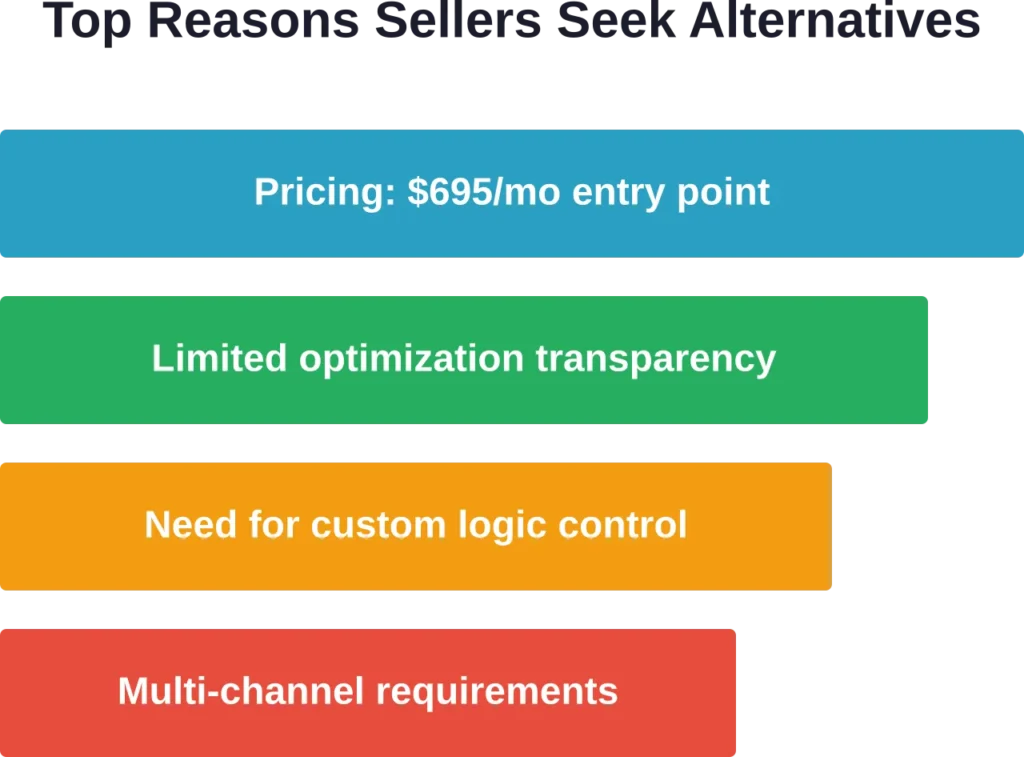
Perpetua emerged as a frontrunner in this automation race. But here’s the thing—its premium pricing and limited transparency into decision-making have pushed many sellers to explore alternatives that better match their budget, control requirements, and growth stage.
This guide breaks down the most viable Perpetua alternatives in 2026, examining what each platform actually delivers beyond the marketing copy.
Why Sellers Look Beyond Perpetua
Perpetua built its reputation on AI-driven Amazon PPC automation. The platform handles campaign optimization, bid adjustments, and budget allocation without constant manual intervention.
So why are brands shopping around?
Pricing That Scales Aggressively
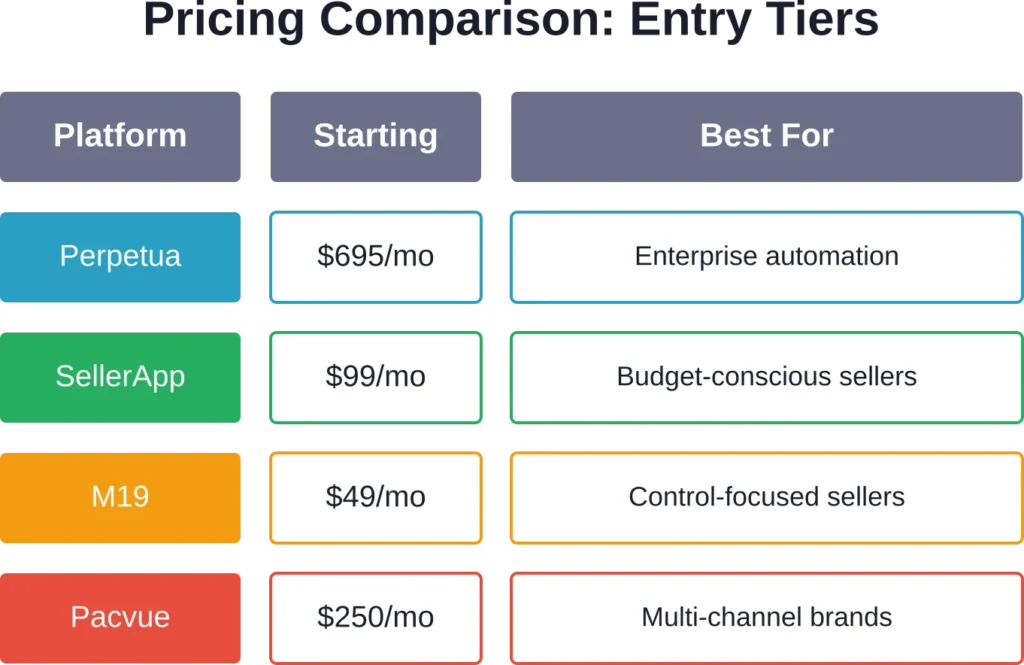
Perpetua’s Essentials plan starts at $695/month for up to $10K in monthly ad spend. For sellers testing new products or operating on thin margins, that’s a significant fixed cost before any ad dollars hit the marketplace.
The Growth tier scales with ad spend percentages. Once monthly advertising crosses $50K, the math gets challenging fast. Compare that to alternatives starting at $99-$199/month with flat-fee structures.
Black-Box Optimization Concerns
Many PPC practitioners express concerns about black-box campaign technology and lack of transparency in optimization decisions. Perpetua’s AI makes thousands of micro-adjustments, but understanding why a specific keyword’s bid dropped 30% or why budget shifted between campaigns requires digging through layers of reporting.
Brands scaling past $50K monthly ad spend who need transparency into optimization decisions for leadership reporting and quarterly reviews often find this frustrating.
The Profit Engineer Shift
The role of PPC practitioners has evolved. As one LinkedIn analysis noted, practitioners are no longer just media buyers—they must become profit engineers who map accounts to P&L statements and engineer signals that feed algorithmic bidding.
This requires tools that expose the underlying logic, allow custom signal engineering, and integrate deeply with business metrics beyond platform-native ROAS.
What Makes a Strong Perpetua Alternative?
Not every Amazon PPC tool qualifies as a genuine alternative. The best competitors share specific characteristics that address Perpetua’s gaps while maintaining automation quality.
Transparent Decision Logic
Strong alternatives show why optimization decisions happen. This means audit trails for bid changes, clear rule documentation, and dashboards that expose the relationship between inputs and outcomes.
When ACoS spikes 20% for seven days, sellers need to trace that back to specific keyword performance, competitive pressure, or inventory changes—not just accept that “the algorithm adjusted.”
Flexible Pricing Models
The ideal alternative offers entry points below $200/month for smaller sellers while scaling more predictably for larger operations. Flat-fee tiers, usage-based pricing, or hybrid models that don’t penalize growth all work better than aggressive percentage-of-spend escalation.
Customizable Automation Rules
Sellers need the ability to encode business logic into campaigns. Create conditional logic like “if keyword ACoS exceeds target by 20% for 7 days, reduce bid by 15%” with full transparency in execution.
This bridges the gap between fully manual management and opaque AI black boxes.
Multi-Channel Capabilities
Brands rarely advertise on Amazon alone. Walmart, Target Plus, and retail media networks are expanding rapidly. Alternatives that unify cross-channel reporting and optimization deliver compounding value.
Top Perpetua Alternatives for 2026
The following platforms represent the strongest alternatives based on feature depth, pricing accessibility, and user feedback from brands at various scale points.
1. WisePPC

WisePPC positions itself as a transparent, data-heavy Amazon PPC optimization platform with deep analytics and bulk control, giving sellers full visibility and manual oversight rather than black-box automation.
The platform excels in long-term historical data storage (years beyond Amazon’s 60-90 day limit), multi-metric customizable charts, gradient-based anomaly highlighting, placement-level analysis, advanced filtering, inline editing, and powerful bulk actions on campaigns, ad groups, targets, keywords, bids, and budgets. It combines ad performance with sales and organic insights in one unified dashboard.
Pricing: Contact vendor for custom plans (freemium elements available, tiered based on features and ad spend volume). Often positioned as significantly more affordable than enterprise tools for mid-tier spend.
Best for: Small to mid-size sellers and agencies who want granular control, transparency, and powerful bulk tools without overpaying for heavy AI automation. Ideal for those managing large numbers of campaigns who need to analyze long-term trends and make precise, data-driven adjustments at scale.
Key differentiator: Extreme data transparency and control — unlimited historical storage, color-coded anomaly detection, multi-metric visualization, and one-click bulk operations on thousands of elements, allowing sellers to truly understand and own every decision instead of relying on opaque algorithms.
Contact Information:
- Website: wiseppc.com
- Facebook: www.facebook.com/people/Wise-PPC/61573154427547
- LinkedIn: www.linkedin.com/company/wiseppc
- Instagram: www.instagram.com/wiseppc
2. SellerApp

SellerApp positions itself as the complete Amazon growth platform, extending beyond PPC into product research, listing optimization, and profitability analytics.
The PPC automation module emphasizes transparency and control. Sellers define custom rules for bid adjustments, budget allocation, and campaign pacing. The system executes automatically but logs every decision with clear rationale.
Pricing: Plans start at approximately $99/month for basic PPC features, with advanced tiers scaling to $399/month. This represents significant savings versus Perpetua for sellers under $50K monthly ad spend.
Best for: Small to mid-size sellers who want an all-in-one platform combining PPC automation with broader account management tools. Particularly strong for brands still optimizing listings and conducting competitive research alongside advertising.
Key differentiator: The unified dashboard that connects ad performance to organic rank changes, inventory velocity, and profit margins. This holistic view supports the profit engineer mindset rather than treating ads in isolation.
3. Teikametrics (Flywheel 2.0)

Teikametrics built Flywheel 2.0 around the concept that advertising and organic performance feed each other. The platform’s AI optimizes for total account profitability, not just ad-specific ROAS.
The system factors in inventory levels, seasonality, competitor activity, and organic rank momentum when making bid decisions. If a product’s organic rank is climbing, Flywheel may reduce ad spend to capture that momentum without overspending.
Pricing: Enterprise-focused with custom pricing typically starting around $1,000/month or percentage-of-spend models. Not the budget option, but competitive with Perpetua at scale.
Best for: Established brands spending $30K+ monthly who need sophisticated multi-goal optimization. Companies that view advertising as one component of a broader marketplace strategy rather than an isolated channel.
Key differentiator: The Flywheel Effect algorithm that dynamically balances advertising investment against organic performance trajectory, inventory constraints, and profitability targets across the entire catalog.
4. Pacvue

Pacvue dominates the multi-channel retail media space. The platform supports Amazon, Walmart, Instacart, Target, and a growing list of retail media networks from a single interface.
For brands managing advertising across multiple marketplaces, Pacvue eliminates the nightmare of juggling separate platforms, normalizing reporting, and manually reconciling performance data.
Pricing: Starts around $250/month for standard tiers, with advanced plans incorporating percentage-of-ad-spend fees. Mid-market and enterprise pricing is custom quoted.
Best for: Brands advertising on three or more channels who need unified reporting, cross-channel budget optimization, and consistent rule application across marketplaces. Agencies managing multiple clients across diverse retail media networks.
Key differentiator: True omnichannel campaign management with unified budgeting, cross-channel audience insights, and the ability to test creative and messaging strategies across marketplaces simultaneously.
5. M19

M19 emphasizes rule-based automation with full transparency. The platform positions itself as the antidote to black-box AI, giving sellers complete visibility into every optimization decision.
Sellers build custom automation rules using conditional logic: “If keyword X exceeds target ACoS by Y% for Z days, then reduce bid by N%.” The system executes these rules precisely and logs all actions.
Pricing: Entry-level plans start at $49/month with full AI automation available at higher tiers. Competitive for sellers at any scale who prioritize control over pure AI delegation.
Best for: Sellers who want to maintain strategic control while automating tactical execution. Brands with unique business logic that doesn’t fit cookie-cutter AI optimization approaches.
Key differentiator: The rules engine that lets sellers encode proprietary strategies, combined with transparent audit trails showing exactly why and when the system takes action.
6. Quartile

Quartile uses machine learning to manage campaigns with minimal seller input. The platform targets brands that want to completely offload PPC management rather than maintain strategic oversight.
The AI analyzes account history, competitive benchmarks, and marketplace trends to make autonomous decisions about campaign structure, bidding, and budget allocation.
Pricing: Percentage-of-spend model typically ranging from 3-12% depending on monthly ad budget. No flat monthly fees.
Best for: Brands willing to trade control for hands-off automation. Companies without in-house PPC expertise or dedicated advertising managers.
Key differentiator: True set-it-and-forget-it automation where the AI handles campaign creation, structure changes, and strategic pivots without requiring seller configuration or oversight.
7. Skai (formerly Kenshoo)
Skai is an enterprise-grade platform supporting search, social, retail media, and app advertising from a unified interface. The Amazon module is one component of a much broader marketing technology stack.
For large organizations running coordinated campaigns across Google, Facebook, Amazon, and retail media networks, Skai provides executive-level reporting and unified budget management.
Pricing: Enterprise custom pricing, typically starting above $2,000/month. This is not a platform for small sellers.
Best for: Large brands and agencies managing complex, multi-channel advertising programs requiring unified reporting for C-suite stakeholders. Organizations that need one platform for all paid media.
Key differentiator: Enterprise-grade governance, workflow automation, and reporting that spans far beyond Amazon to encompass the entire paid media ecosystem.
8. BidX

BidX focuses exclusively on Amazon advertising with deep expertise in Sponsored Products, Sponsored Brands, and Sponsored Display automation.
The platform uses proprietary algorithms that emphasize rapid response to performance changes. When a keyword’s conversion rate drops, BidX adjusts within hours rather than days.
Pricing: Percentage-of-spend model starting around 2.5% for larger accounts, with minimums typically around $500/month.
Best for: Mid-size sellers spending $20-100K monthly who want specialized Amazon expertise without enterprise complexity or multi-channel features they won’t use.
Key differentiator: Fast-reaction algorithms combined with Amazon-specific strategic guidance from account managers who understand marketplace dynamics beyond generic PPC principles.
9. Intentwise

Intentwise specializes in Amazon Marketing Cloud (AMC) integration, connecting advertising data to broader customer journey analytics.
For brands that want to understand how advertising influences customer lifetime value, repeat purchase rates, and cross-category shopping behavior, Intentwise unlocks insights unavailable in standard campaign reporting.
Pricing: Custom enterprise pricing based on account complexity and AMC usage requirements.
Best for: Sophisticated brands with dedicated analytics resources who want to leverage AMC for advanced attribution, audience building, and customer journey analysis.
Key differentiator: Deep AMC expertise that transforms raw advertising data into strategic insights about customer behavior, competitive dynamics, and long-term value creation.
10. Atom11

Atom11 combines PPC automation with retail analytics, focusing heavily on profitability optimization rather than pure advertising metrics.
The platform factors in inventory costs, storage fees, fulfillment expenses, and margin calculations when optimizing campaigns. This prevents the common trap of driving high-volume sales on low-margin products that actually hurt overall profitability.
Pricing: Mid-market positioning with pricing typically in the $300-800/month range depending on catalog size and feature requirements.
Best for: Brands with complex unit economics who need to optimize for profit contribution rather than revenue or ROAS. Sellers managing private label portfolios with varying margins across products.
Key differentiator: Profit-first optimization logic that incorporates full unit economics into bidding decisions, preventing the revenue-growth-at-all-costs trap.
11. Ad Badger

Ad Badger emphasizes simplicity and education, targeting sellers who want to understand PPC strategy while automating tactical execution.
The platform includes extensive training resources, strategic frameworks, and community support alongside automation features. This hybrid approach helps sellers build expertise rather than becoming completely dependent on black-box systems.
Pricing: Plans start around $149/month with flat fees rather than percentage-of-spend scaling.
Best for: Sellers who want to learn PPC strategy while automating routine tasks. Brands building in-house expertise without hiring dedicated full-time PPC managers yet.
Key differentiator: The educational component that transforms sellers from passive automation users into informed strategists who understand the “why” behind optimization decisions.
Choosing the Right Alternative for Your Business
Selecting among Perpetua alternatives requires honest assessment of your current situation, growth trajectory, and organizational capabilities.
Budget Considerations
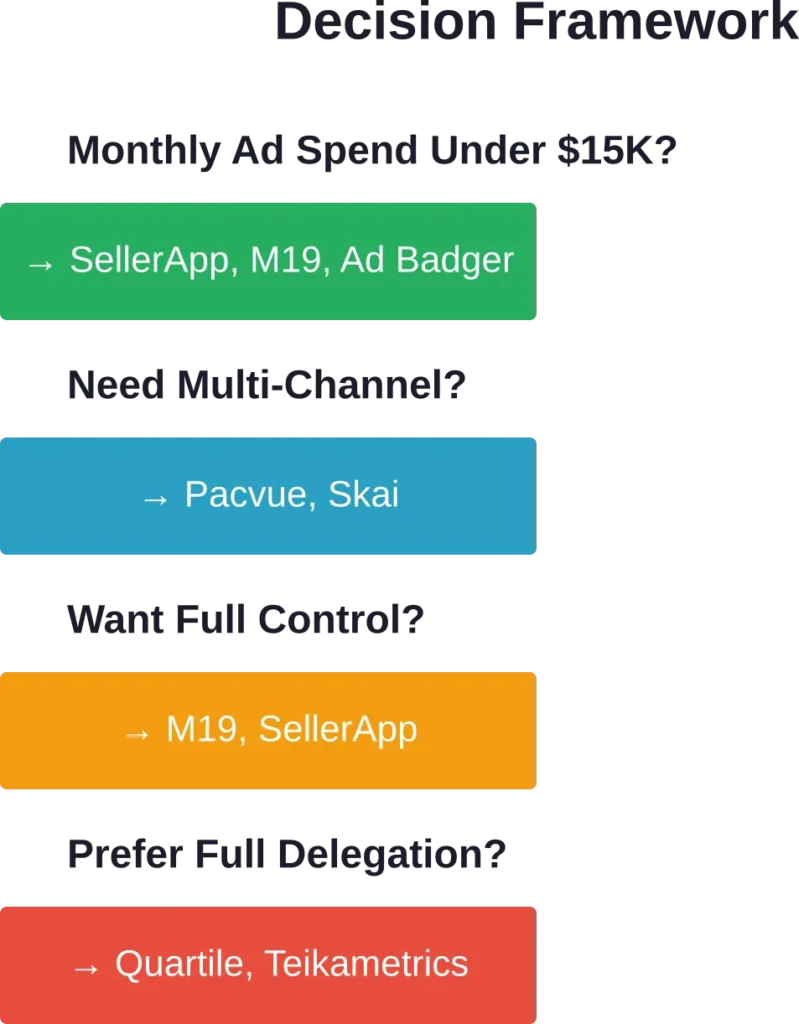
If monthly ad spend sits below $15K, premium platforms charging $695+ monthly consume disproportionate budget. Options like M19, SellerApp, or Ad Badger deliver solid automation at $49-199/month, preserving capital for actual advertising.
Above $50K monthly spend, the absolute dollar difference between platforms matters less than ROI improvement. A platform that improves ROAS by 15% while costing $200/month more pays for itself immediately.
Control vs. Delegation
Some sellers want complete control over strategy with automation handling execution. Others prefer to delegate both strategy and tactics to AI.
M19 and SellerApp suit control-oriented sellers who want to encode custom rules and maintain oversight. Quartile and BidX work better for delegation-focused brands willing to trust algorithmic decision-making.
Technical Sophistication
Platforms like Intentwise and Pacvue offer advanced capabilities around AMC integration, multi-channel optimization, and custom attribution modeling. These features deliver value only if your team has the analytical chops to interpret and act on the insights.
Smaller teams without dedicated data analysts benefit more from simpler platforms that deliver actionable recommendations without requiring PhD-level interpretation.
Multi-Channel Requirements
Brands advertising across Amazon, Walmart, Target, and retail media networks need platforms that unify reporting and optimization. Pacvue and Skai dominate this category.
Amazon-only sellers gain no value from paying for multi-channel features. BidX, M19, and SellerApp focus specifically on Amazon, avoiding feature bloat.
The Broader Context: PPC in 2026
Understanding Perpetua alternatives requires grasping how Amazon advertising has evolved and where it’s heading.
Automation Is Table Stakes
Manual bid management is functionally dead for anyone managing more than 50 keywords. The auction dynamics shift too rapidly, competitive pressure fluctuates hourly, and human reaction times can’t compete.
The question isn’t whether to automate, but how to automate and what level of transparency and control to maintain.
Measurement Challenges Intensify
Privacy changes have created measurement challenges for PPC practitioners in 2026. iOS tracking limitations, cookie deprecation, and privacy regulations make attribution increasingly fuzzy.
Platforms that offer robust first-party data integration, probabilistic attribution modeling, and multi-touch analysis deliver increasing value as third-party tracking degrades.
The Skills Gap Widens
Up to 4 in 5 employers now prioritize hiring AI-skilled talent; however, as many as 75% of those employers are struggling to find workers with the necessary credentials. This creates two paths: invest heavily in talent acquisition and retention, or choose platforms that embed expertise into the system.
Smaller organizations increasingly opt for AI-embedded platforms that don’t require data science teams, while enterprises build in-house capabilities around more flexible tools.
Marketing Budgets Under Pressure
Marketing budgets have contracted from historical levels, with one source noting that marketing budgets once averaged around 11% of company revenue. This compression intensifies pressure to demonstrate clear ROI from every dollar spent.
Platforms that connect advertising performance to broader business outcomes—customer lifetime value, inventory velocity, profit contribution—gain strategic importance beyond pure campaign optimization tools.
Implementation Considerations
Switching from Perpetua to an alternative requires planning beyond simple feature comparison.
Data Migration
Most platforms can import historical performance data from Amazon Advertising Console, but custom optimization rules, saved reports, and campaign structures don’t transfer between platforms.
Budget 2-4 weeks for proper setup, rule configuration, and validation that the new system interprets your catalog correctly.
Performance Validation
New automation systems require learning periods. Performance may dip slightly for the first 7-14 days as algorithms calibrate.
Plan transitions during non-peak periods—avoid switching platforms two weeks before Prime Day or Black Friday. The validation period matters more than rushing to escape current costs.
Team Training
Different platforms use different terminology, reporting structures, and workflow logic. Budget time for team members to complete platform training and adjust to new interfaces.
Platforms with strong onboarding programs (SellerApp, Ad Badger, Teikametrics) reduce this friction significantly compared to self-service tools.
Integration Requirements
Evaluate how alternatives integrate with existing tools—inventory management systems, analytics platforms, financial reporting software.
Breaking integrations during migration can create blind spots in reporting or disrupt workflows more disruptive than the platform switch itself.
What Campaign Managers Should Know
If you’re managing campaigns directly, several patterns separate strong alternatives from mediocre ones.
Signal Engineering Capabilities
As LinkedIn analysis emphasized, algorithms aren’t inherently smart—they’re hungry for quality signals. The best platforms let you engineer signals beyond basic conversion tracking.
For lead generation, assign differential values to pipeline stages: raw lead ($10), marketing qualified lead ($50), sales qualified lead ($200), closed deal (actual revenue). Value-based bidding then optimizes for quality, not just volume.
For ecommerce, use custom labels in product feeds to flag return rates, inventory velocity, and true margin. This prevents the platform from aggressively pushing high-return or low-margin products just because they convert.
Post-Click Pipeline Debugging
If the sales handoff is slow or checkout flow is clunky, advertising performance becomes a lie. Platforms that help diagnose post-click problems deliver more value than those optimizing only the ad side.
Features like landing page heat mapping, funnel drop-off analysis, and conversion path visualization expose where campaigns fail due to website issues rather than advertising targeting.
Executive Reporting
Speaking the language of the boardroom means replacing “click-through rate” with “pipeline velocity” and “margin stability.” Use the “so what?” reporting model: for every metric, explain exactly how it impacts the bottom line before executives have to ask.
Platforms with customizable executive dashboards that connect advertising to P&L line items make this transition easier.
Common Pitfalls to Avoid
Sellers switching platforms often make predictable mistakes that undermine the transition.
Chasing Features You Won’t Use
Enterprise platforms offer impressive feature lists. But if your team lacks the time or expertise to leverage advanced attribution modeling or AMC integration, those capabilities deliver zero value.
Choose platforms aligned with your actual workflow, not your aspirational one.
Ignoring Support Quality
When campaign performance tanks during Prime Day, responsive support makes the difference between rapid recovery and catastrophic losses.
Community discussions consistently highlight support quality as a major differentiator. Platforms with dedicated account managers, fast response times, and knowledgeable teams justify higher costs.
Underestimating Learning Curves
Complex platforms deliver powerful capabilities but require significant investment in learning. If your team is already stretched thin, simpler tools with narrower feature sets may deliver better practical outcomes.
Failing to Define Success Metrics
Before switching, establish clear benchmarks: current ACoS, conversion rates, advertising cost of sale by product category, and organic rank for target keywords.
Without baseline metrics, evaluating whether the new platform actually improves performance becomes impossible.
The Future of Amazon Advertising Automation
Looking ahead, several trends will shape the competitive landscape for Amazon PPC platforms.
AI Becomes Infrastructure
A significant majority of Chief Marketing Officers report generative AI delivered positive impact on marketing efficiency. AI transitions from differentiator to baseline expectation.
Competitive advantage shifts to teams that combine machine output with human interpretation—strategic imagination, empathy, and brand storytelling remain uniquely human capabilities.
Integration Depth Matters More
Standalone PPC tools lose relevance as brands demand unified platforms connecting advertising, inventory, supply chain, and financial systems.
Winners will be platforms that sit at the center of operational workflows, not peripheral optimization tools.
Profit Optimization Replaces ROAS Fixation
As margins compress and competition intensifies, pure ROAS targets become insufficient. Platforms that optimize for contribution margin, customer lifetime value, and inventory ROI gain strategic importance.
The shift from media buyer to profit engineer accelerates.
Frequently Asked Questions
M19 offers the lowest entry point at $49/month with full AI automation capabilities. SellerApp starts at $99/month but includes broader account management tools beyond PPC. For sellers spending under $10K monthly on ads, these represent significant savings versus Perpetua’s $695/month starting point.
M19 emphasizes rule-based automation with complete visibility into every optimization decision. The platform logs all bid changes, budget shifts, and campaign adjustments with clear rationale. SellerApp also provides strong transparency through customizable rules and detailed audit trails.
Technically possible but rarely advisable. Running multiple automation platforms on the same campaigns creates conflicting optimization logic—one system raises a bid while another lowers it. This erratic behavior confuses Amazon’s algorithm and typically degrades performance. Choose one primary platform or clearly segment campaigns between tools.
Most platforms require 7-14 days for initial algorithm calibration. Meaningful performance comparison requires 30-45 days to account for weekly seasonality and build sufficient data volume. Plan switches during non-critical periods and avoid judging new platforms during their learning phase.
Not for most sellers. AMC delivers value primarily for large brands analyzing complex customer journeys, building custom audiences, or conducting sophisticated attribution analysis. Sellers spending under $100K monthly typically gain more value from optimizing core campaign fundamentals than investing in AMC capabilities.
Campaign performance data from Amazon Advertising Console remains accessible regardless of platform changes—it’s owned by Amazon, not the third-party tool. Custom rules, saved reports, and platform-specific configurations don’t transfer between systems. Most alternatives can import historical Amazon data to inform initial optimization but require rebuilding custom configurations.
SellerApp and Ad Badger excel for new product launches due to their educational resources and strategic guidance alongside automation. These platforms help newer sellers understand launch strategy rather than just executing tactics. For experienced sellers wanting aggressive automated launch campaigns, Teikametrics offers sophisticated new product acceleration features.
Making Your Decision
The best Perpetua alternative depends entirely on your specific situation. There’s no universal winner—only the right fit for your budget, scale, team capabilities, and strategic priorities.
Start by honestly assessing where Perpetua falls short for your business. Is it primarily cost? Lack of transparency? Insufficient control over optimization logic? Multi-channel requirements?
Then prioritize 2-3 alternatives that specifically address those gaps. Most platforms offer trials or demo periods—take advantage of them. Run small test campaigns, evaluate reporting workflows, and assess whether the interface aligns with how your team actually works.
Real talk: switching platforms involves short-term disruption. The transition takes time, performance may dip briefly during calibration, and teams need to learn new workflows.
But continuing with a poorly-fit platform compounds problems. The compression in marketing budgets, intensifying competition, and rising complexity of Amazon advertising make the right toolset increasingly critical to profitability.
The Amazon PPC landscape has matured far beyond its early days. Automation is no longer optional, but neither is strategic oversight. The platforms that balance powerful automation with transparency, flexible pricing with robust features, and AI capabilities with human interpretability will dominate the next phase of marketplace advertising.
Choose tools that empower your team to become profit engineers, not just bid managers. The competitive advantage in 2026 belongs to sellers who master the combination of machine execution and human strategy.