

Quick Summary: Amazon sourcing research tools help sellers identify profitable products, analyze supplier pricing, verify demand, and assess competition. The top tools in 2026 include Jungle Scout, Helium 10, Seller Assistant, SellerAmp SAS, RevSeller, and Analyzer.Tools, each offering unique features for product discovery, bulk analysis, and supplier verification. Choosing the right tool depends on your business model, budget, and whether you focus on private label, online arbitrage, or retail arbitrage.
The Amazon marketplace has evolved into a fiercely competitive ecosystem. With over 30% of global e-commerce sales flowing through Amazon, sellers face mounting pressure to identify products that actually turn a profit.
That’s where sourcing research tools come in.
These platforms transform what used to be weeks of manual spreadsheet work into automated analysis. They scan thousands of ASINs for demand signals, calculate profit margins after Amazon’s fees, flag intellectual property risks, and even connect sellers with verified suppliers.
But here’s the thing: not all tools are built the same. Some excel at private label research, others shine for online arbitrage, and a few specialize in retail arbitrage scanning.
This guide breaks down the top Amazon sourcing research tools available in 2026, comparing their core capabilities, pricing structures, and ideal use cases so sellers can match the right platform to their business model.
Integrate Advertising Intelligence into Your Sourcing Strategy

Effective Amazon sourcing relies on accurate profitability forecasting, yet many sellers struggle to connect product research with actual advertising performance. Integrating WisePPC into your workflow allows you to validate sourcing decisions by analyzing real-world ad costs and conversion data, ensuring that new inventory aligns with profitable advertising benchmarks.
The platform provides a centralized environment for granular control over performance metrics:
- Extended Data Retention: Maintains years of historical advertising performance, overcoming the limitation of Amazon’s standard short-term data windows.
- Bulk Management: Enables the simultaneous adjustment of thousands of bids and budgets across campaigns, significantly reducing manual overhead.
- Unified Analytics: Segments revenue drivers between advertising and organic reach, allowing for precise budget allocation.
- Advanced Filtering: Identifies specific performance trends across campaigns, ad groups, and individual targets to highlight actionable optimization opportunities.
To begin optimizing your advertising performance alongside your sourcing research, register for an account at WisePPC.
Why Amazon Sourcing Research Matters More Than Ever
The e-commerce sector has experienced significant growth projections, with multiple studies indicating sustained expansion through 2027. That growth attracts new sellers daily, intensifying competition for the same product opportunities.
Manual product research simply doesn’t scale anymore.
Sellers who rely on gut instinct or basic Amazon browsing miss critical data points: historical pricing trends, seasonal demand fluctuations, the true number of active competitors, and accurate ROI calculations that account for storage fees, referral fees, and inbound shipping costs.
Research tools automate this analysis. They pull data directly from Amazon’s catalog, cross-reference it with sales estimators, and surface products that meet specific profit criteria—often in seconds rather than hours.
The difference shows up in launch velocity. Community discussions among Amazon sellers frequently indicate that those using dedicated research platforms identify viable products faster than those doing manual research.
What Makes an Effective Sourcing Research Tool
Before diving into specific platforms, let’s establish what capabilities actually matter.
Real-Time Data Accuracy
Stale data kills margins. The best tools refresh pricing, inventory levels, and sales rank multiple times daily. They catch price drops from competitors before those opportunities disappear and alert sellers when buy box ownership shifts.
Comprehensive Profit Calculation
Surface-level profit estimates don’t cut it. Effective tools account for every fee Amazon charges: referral percentages, FBA fulfillment costs, monthly storage, long-term storage surcharges, and inbound shipping estimates. They factor in landed costs from suppliers and calculate true net margins.
Bulk Analysis Capabilities
Online arbitrage and wholesale sellers can’t evaluate products one at a time. Tools must support bulk ASIN uploads, process hundreds or thousands of listings simultaneously, and export actionable data for purchasing decisions.
Supplier Identification
Finding a product is only half the battle. Top-tier platforms integrate supplier databases, connect sellers with U.S. distributors, or provide manufacturer contact information so sellers can move from research to ordering without switching tools.
Risk Flagging
Not every profitable-looking product is actually viable. Tools should flag intellectual property restrictions, brand gating, hazmat classifications, and categories that require approval before sellers waste time sourcing inventory they can’t legally sell.
Top Amazon Sourcing Research Tools for 2026
Here’s a breakdown of the platforms that consistently rank among sellers’ top choices, based on feature sets, user adoption, and capabilities verified across multiple sources.
Jungle Scout

Jungle Scout remains one of the most recognized names in Amazon product research. The platform offers a full suite covering product discovery, keyword research, and supplier databases.
Its Product Database allows filtering across millions of Amazon listings by category, price range, sales estimates, and review count. The Opportunity Score metric combines demand, competition, and listing quality into a single 1-10 rating.
For supplier sourcing, Jungle Scout’s Supplier Database connects sellers with manufacturers, though the depth varies by product category. The tool also includes Chrome extensions for on-page analysis while browsing Amazon.
Pricing tiers span from basic plans focused on product research to premium packages that add advanced analytics and team collaboration features.
Helium 10

Helium 10 bundles product research with a broader Amazon seller toolkit. Its Black Box tool filters products by revenue, price, review count, and dozens of other parameters, while the Xray Chrome extension provides instant analytics on any Amazon search results page.
The platform stands out for its Trendster feature, which graphs historical pricing and sales rank data so sellers can spot seasonal patterns before committing inventory dollars.
Helium 10’s pricing structure includes a free tier with limited monthly searches, making it accessible for new sellers testing tools before upgrading. Paid plans range upward based on search volume and feature access.
Seller Assistant

Seller Assistant positions itself as a comprehensive research tool comparison option for 2026, emphasizing bulk product research and sourcing AI capabilities.
The platform enables analysis of thousands of ASINs simultaneously, calculating profit margins, demand indicators, and risk factors across entire supplier catalogs. Its AI-driven sourcing component claims to identify verified U.S. suppliers by ASIN, brand, or model number.
This makes Seller Assistant particularly relevant for online arbitrage sellers who evaluate large inventories from distributors and need rapid filtering to surface only the profitable, low-risk items.
Integration with Chrome allows real-time analysis while browsing supplier websites or Amazon listings.
SellerAmp SAS

SellerAmp SAS focuses heavily on mobile-first research, catering to retail arbitrage sellers scanning products in physical stores.
The app provides instant profit calculations, sales rank history, and buy box analysis from a smartphone. Barcode scanning accelerates the evaluation process when walking store aisles looking for clearance items or discounted inventory.
Desktop functionality complements the mobile app, supporting bulk list processing and deeper historical data analysis for online arbitrage workflows.
Pricing includes short-term passes (2-day and 5-day options) alongside monthly subscriptions, offering flexibility for sellers who source intermittently rather than daily.
RevSeller

RevSeller targets online arbitrage and wholesale sellers with bulk analysis as its core strength. The platform processes large ASIN lists quickly, flagging hazmat items, IP complaints, and restricted categories before sellers place orders.
Historical pricing charts help identify products with stable margins versus those prone to price volatility. The tool also tracks buy box percentage to gauge how often third-party sellers can compete against Amazon Retail.
Integration with major wholesaler sites allows RevSeller users to analyze supplier catalogs without manual ASIN extraction.
Analyzer.Tools
Analyzer.Tools combines product research with profit calculation and bulk analysis functionality. According to verified pricing data, plans start at $49 monthly for the standard web app, with a Pro tier at $69 monthly offering expanded features.
Short-term access options include 2-day and 5-day passes, making the platform accessible for sellers testing it or conducting intensive but infrequent sourcing sessions.
The tool emphasizes speed, processing bulk ASIN lists and returning profit estimates, sales data, and risk warnings within minutes. Chrome extension support enables on-page analysis while browsing Amazon or supplier sites.
Pricing Models and Cost Considerations
Tool costs vary significantly based on feature depth and target user.
Entry-level plans typically start around $29-$49 monthly and include basic product research with search limits. Mid-tier subscriptions in the $49-$99 range usually unlock bulk analysis, historical data, and supplier databases. Premium tiers exceeding $100 monthly add team collaboration, API access, and unlimited searches.
Some platforms offer short-term passes. Analyzer.Tools provides short-term access options including 2-day and 5-day passes, while SellerAmp SAS and similar platforms offer short-term pass options.
Free trials exist across several tools, but they often cap monthly searches or restrict access to advanced features like bulk processing or supplier contact information.
For sellers just starting out, free tiers and trial periods provide enough functionality to validate product ideas. Established sellers moving significant inventory typically find the ROI justifies premium subscriptions—a single well-researched product that avoids IP issues or margin erosion pays for months of tool access.
Matching Tools to Your Seller Business Model
Not every tool fits every business model. Here’s how different seller types should approach selection.
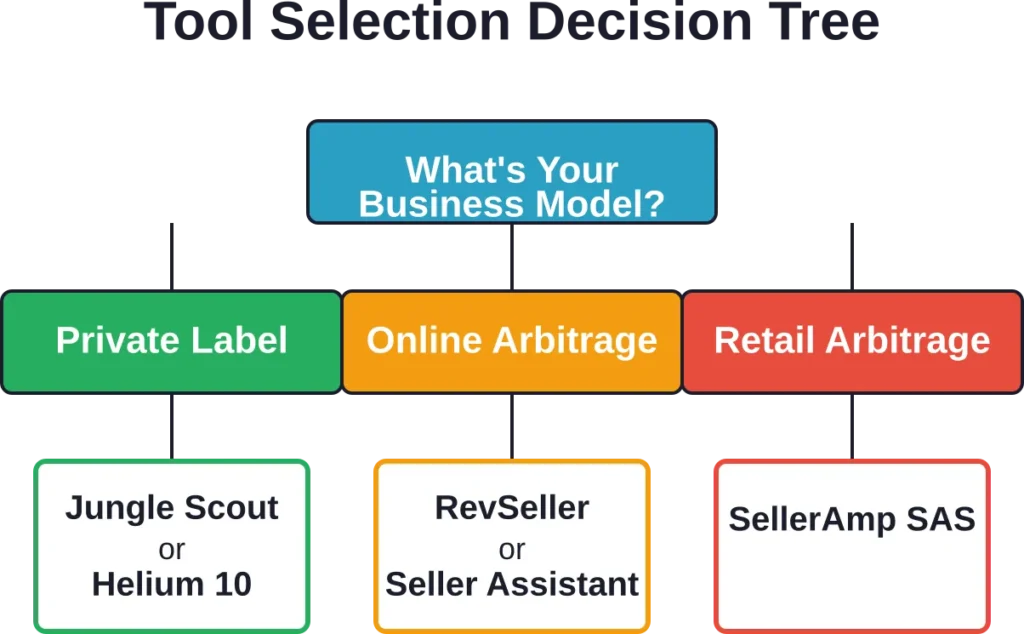
Private Label Sellers
Private label requires deep product research and reliable supplier connections. Tools with robust Product Databases, historical trend analysis, and integrated supplier directories deliver the most value.
Jungle Scout and Helium 10 both provide strong foundation-level research for identifying product opportunities with sufficient demand and manageable competition. Supplier databases within these platforms help connect sellers with manufacturers who can produce customized products.
Online Arbitrage Sellers
Speed and bulk processing define online arbitrage workflows. Sellers evaluate hundreds of products daily from distributor websites, needing rapid profit calculations and risk flagging.
Seller Assistant, RevSeller, and Analyzer.Tools all emphasize bulk ASIN analysis. Their Chrome extensions integrate directly with supplier sites, allowing sellers to analyze entire catalogs without manual ASIN entry.
Retail Arbitrage Sellers
Mobile functionality is non-negotiable for retail arbitrage. Sellers scanning products in stores need instant profit calculations on smartphones.
SellerAmp SAS leads here with its mobile-first design and barcode scanning. Quick access to historical sales rank and buy box data lets sellers make purchasing decisions while standing in store aisles.
Wholesale Sellers
Wholesale requires bulk processing similar to online arbitrage but often with larger ASIN counts from established distributor relationships.
Tools that handle bulk uploads efficiently and provide detailed historical pricing to identify stable products perform best. RevSeller and Seller Assistant both cater to this use case with high-volume analysis capabilities.
| Business Model | Priority Features | Recommended Tools |
|---|---|---|
| Private Label | Product database, supplier connections, trend analysis | Jungle Scout, Helium 10 |
| Online Arbitrage | Bulk analysis, Chrome extension, risk flagging | Seller Assistant, RevSeller, Analyzer.Tools |
| Retail Arbitrage | Mobile scanning, instant profit calc, barcode support | SellerAmp SAS |
| Wholesale | High-volume bulk processing, historical pricing stability | RevSeller, Seller Assistant |
Common Pitfalls When Using Research Tools
Even the best tools produce misleading results when misused.
Over-Reliance on Sales Estimates
Sales estimators use algorithms based on Best Seller Rank, but they’re approximations, not guarantees. Actual sales vary by seasonality, competitive actions, and external factors no tool can perfectly predict.
Treat estimates as directional indicators rather than precise forecasts. Cross-reference multiple tools when possible and apply conservative estimates to financial projections.
Ignoring Historical Data
A product might show strong current demand but terrible long-term stability. Price wars, seasonal spikes, or temporary trends distort snapshot views.
Always check historical pricing and sales rank charts. Products with stable, consistent performance over 6-12 months carry far less risk than those with volatile graphs.
Skipping Risk Flags
Profitable metrics mean nothing if Amazon suspends your listing. IP complaints, hazmat restrictions, and category gating can halt sales instantly.
Never skip the risk assessment features. Tools flag these issues for a reason—ignoring them to chase margins almost always backfires.
Forgetting About Fees
Amazon’s fee structure is complex. Referral percentages vary by category, FBA fulfillment costs change with product dimensions and weight, and storage fees fluctuate seasonally.
Use tools that calculate net profit after all fees, not just gross margin. A product with 40% gross margin might yield 10% net profit once Amazon takes its cut.

Integrating Tools Into Your Sourcing Workflow
Standalone tools only deliver value when integrated into a systematic workflow.
Step 1: Define Your Criteria
Before opening any tool, establish clear filtering parameters. Set minimum ROI thresholds, maximum competition levels, preferred product categories, and acceptable sales rank ranges.
These criteria prevent analysis paralysis. Tools can surface thousands of products—predefined filters focus research on items that actually match business goals.
Step 2: Initial Screening
Run broad searches using Product Database features. Apply your predefined filters to generate an initial list of candidates.
For private label, filter by categories with lower competition and established demand. For arbitrage, focus on products with stable pricing and sufficient sales velocity to clear inventory quickly.
Step 3: Deep Analysis
Take the initial list and dig deeper. Review historical pricing trends, check review sentiment, analyze competitor listings for optimization opportunities, and verify supplier availability.
This is where Chrome extensions prove valuable—analyze products while viewing actual Amazon listings to spot details database searches might miss.
Step 4: Risk Validation
Cross-check every product against IP databases, restricted categories, and hazmat classifications. Verify brand registry status if applicable.
This step saves money. Ordering inventory only to discover listing restrictions after shipment arrives wipes out margins instantly.
Step 5: Supplier Confirmation
Use supplier database features or manual outreach to confirm product availability, minimum order quantities, and landed costs.
Tool estimates often use generic cost assumptions. Actual supplier quotes determine true profit margins.
Step 6: Test and Iterate
Start with small orders to validate tool predictions. Track actual sales against estimates, monitor margin stability, and assess competitive responses.
Refine filter criteria based on real-world results. Tools improve with feedback—sellers who track performance data make better sourcing decisions over time.
Advanced Features Worth Paying For
Premium tiers often include capabilities that justify higher costs for serious sellers.
API Access
APIs let sellers automate data pulls, integrate research tools with inventory management systems, and build custom dashboards.
High-volume sellers managing hundreds of SKUs benefit significantly from automation. Manual research doesn’t scale past a certain point.
Team Collaboration
Multi-user accounts with shared notes, tagging systems, and collaborative filtering streamline team-based sourcing.
Agencies and brands with dedicated sourcing teams rely on these features to coordinate research across multiple analysts.
Custom Alerts
Automated notifications when products meet specific criteria, when competitor prices change, or when new opportunities appear in favorite categories keep sellers ahead of market shifts.
Time-sensitive opportunities like lightning deals or sudden stock-outs create short windows for profit. Alerts ensure sellers don’t miss them.
Advanced Filters
Beyond basic price and rank filtering, premium tools offer nuanced parameters: exclude brands, filter by review rating distribution, search by specific keywords in titles, or isolate products with low review counts.
These granular filters surface niche opportunities competitors overlook.
| Feature | Benefit | Best For |
|---|---|---|
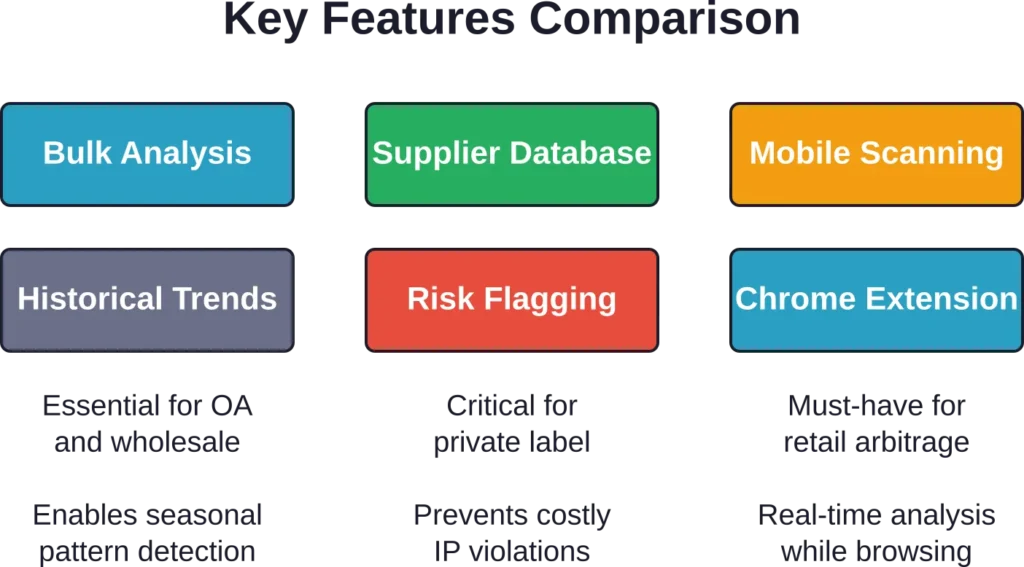
| Bulk ASIN Analysis | Process hundreds/thousands of products simultaneously | Online arbitrage, wholesale |
| Mobile App | Real-time scanning and analysis in physical stores | Retail arbitrage |
| Supplier Database | Direct manufacturer/distributor connections | Private label, wholesale |
| Historical Trends | Identify seasonal patterns and price stability | All business models |
| Chrome Extension | On-page analysis without leaving Amazon | All business models |
| API Access | Automation and custom integration | High-volume sellers, agencies |
Free vs. Paid: What Actually Matters
Free tools and trial periods help beginners learn platform interfaces and validate basic product ideas, but they carry limitations.
Search caps restrict how many products can be analyzed monthly. Many free tiers exclude bulk processing, historical data beyond 30 days, and supplier contact information.
For casual research or initial validation, free tools suffice. Testing 10-20 product ideas monthly fits within most free tier limits.
Once sourcing becomes a regular activity—whether weekly online arbitrage sessions or continuous private label development—paid subscriptions deliver better ROI.
The real question isn’t free versus paid. It’s whether the tool’s capabilities match the seller’s volume and business model. A retail arbitrage seller scanning 50+ products weekly needs a paid plan with mobile access. A private label seller launching 2-3 products annually might succeed with free tier limitations.
Data Privacy and Security Considerations
Research tools require access to Amazon seller accounts or API credentials to pull data. That creates security considerations.
Reputable platforms use read-only API access, preventing any write permissions that could modify listings or account settings. Still, sellers should verify permission scopes before connecting accounts.
Data storage policies matter too. Some tools retain search history, product lists, and profit calculations indefinitely. Others delete data after set periods.
For competitive reasons, sellers might prefer tools with stronger data retention limits or options to purge history manually. Product research represents competitive intelligence—keeping that data secure maintains strategic advantage.
Tool Accuracy: Verification Methods
No tool is 100% accurate. Sales estimators, profit calculators, and supplier databases all contain approximations.
Smart sellers verify tool outputs through multiple methods.
Cross-Reference Multiple Tools
Run the same ASIN through 2-3 platforms. Consistent estimates across tools increase confidence. Wildly divergent numbers signal deeper investigation is needed.
Compare Against Known Products
Test tools using products with known performance metrics. If a tool estimates 300 monthly sales for a product the seller knows moves 450 units, that calibration helps interpret future estimates.
Track Actual Performance
Record tool predictions alongside actual sales data post-launch. Over time, patterns emerge showing whether specific tools over-estimate or under-estimate for particular categories or price points.
This feedback loop refines decision-making. Sellers learn which tools align best with their specific product mix and can weight data accordingly.
Emerging Trends in Sourcing Research Tools
Tool capabilities continue evolving as technology advances and Amazon’s marketplace grows more complex.
AI-Powered Product Discovery
Machine learning algorithms now analyze thousands of data points simultaneously to surface opportunities human researchers might miss. These systems identify emerging trends before they saturate, spot gap products with high demand but low competition, and predict which seasonal items will perform well in upcoming quarters.
Seller Assistant’s sourcing AI represents one implementation of this approach, connecting sellers with suppliers based on pattern recognition across successful product launches.
Enhanced Supplier Verification
Fake suppliers and dropship scams have proliferated, making supplier verification increasingly critical. Newer tools integrate business registry checks, review aggregation from multiple sources, and direct manufacturer validation to reduce fraud risk.
Tighter Amazon Integration
As Amazon’s own analytics improve, third-party tools integrate more deeply with official data sources. This reduces estimation error and provides access to metrics previously unavailable outside Seller Central.
Sustainability and Ethics Tracking
Consumer demand for ethically sourced, sustainable products drives tool development in this area. Emerging features flag supplier labor practices, environmental certifications, and carbon footprint estimates.
While still niche, these capabilities matter for brands building around sustainability messaging.
Implementation Timeline: What to Expect
Onboarding with research tools varies by platform complexity and seller experience level.
Basic setup—creating accounts, connecting Amazon APIs, installing browser extensions—typically takes 30-60 minutes for most platforms.
Learning core features requires another 2-4 hours of exploration. Running sample searches, testing bulk uploads, and familiarizing yourself with data outputs ensures the tool actually delivers expected insights.
Achieving proficiency where research becomes efficient and accurate generally takes 2-3 weeks of regular use. Sellers develop intuition for reading data, recognizing which metrics matter most, and spotting red flags in otherwise attractive products.
Advanced mastery—leveraging APIs, building custom workflows, and fine-tuning filters to surface consistently profitable products—develops over months. This level of expertise separates casual users from sellers who extract maximum ROI from their tool subscriptions.
When to Use Multiple Tools Simultaneously
Some sellers subscribe to multiple platforms, using each for specific strengths.
A common combination pairs a broad product discovery tool like Jungle Scout with a specialized bulk analyzer like RevSeller. The discovery tool identifies initial opportunities, while the bulk analyzer processes large lists from suppliers quickly.
Another approach uses one platform for desktop research and another with strong mobile capabilities for in-store scanning.
The cost of multiple subscriptions adds up, so this approach makes sense primarily for established sellers with sufficient revenue to justify the expense and workflows complex enough to benefit from specialized tools.
Beginners should master one platform thoroughly before adding others. Tool proliferation without clear use case separation creates complexity without proportional benefit.
Questions to Ask Before Subscribing
Before committing to a paid plan, sellers should evaluate several factors.
Does the tool support your specific business model? A retail arbitrage seller gains nothing from supplier databases, while a private label seller rarely needs mobile barcode scanning.
What’s the actual all-in cost? Look beyond base subscription fees to consider add-ons, per-search charges, or team member fees if applicable.
How current is the data? Tools pulling information weekly versus daily produce different accuracy levels. For fast-moving categories, data freshness matters significantly.
What’s the learning curve? Complex platforms with steep learning curves might offer more features but delay time-to-value. Simpler tools might lack advanced capabilities but deliver immediate usability.
Does the pricing model match usage patterns? Monthly subscriptions make sense for continuous sourcing. Short-term passes work better for intermittent, intensive research sessions.
What’s the cancellation policy? Flexible cancellation without penalties allows sellers to test tools during high-activity periods without long-term commitment.
Wrapping Up
Amazon sourcing research tools transformed from nice-to-have conveniences into essential infrastructure for competitive selling. The platforms covered here—Jungle Scout, Helium 10, Seller Assistant, SellerAmp SAS, RevSeller, and Analyzer.Tools—each bring distinct strengths to different seller workflows.
The right choice depends on business model, budget, and specific workflow requirements. Private label sellers prioritize supplier databases and trend analysis. Online arbitrage demands bulk processing speed. Retail arbitrage requires mobile functionality.
But tools alone don’t guarantee success.
They amplify research efficiency, surface opportunities faster, and reduce costly mistakes. The sellers who extract maximum value combine these platforms with systematic workflows, verify data across multiple sources, and continuously refine selection criteria based on actual performance.
Start with clear criteria for what makes a product viable for your business. Test tools during free trials or with short-term passes. Focus on mastering one platform before expanding. Track predictions against real results to calibrate accuracy.
The Amazon marketplace continues growing more competitive. Sellers who leverage data-driven research tools maintain advantages over those relying on intuition alone.
Ready to find your next profitable product? Pick the tool that matches your model and start analyzing.
Frequently Asked Questions
Jungle Scout and Helium 10 both offer free tiers with limited monthly searches. These work well for beginners validating initial product ideas or sellers researching only a few products monthly. Free versions typically restrict access to advanced features like bulk analysis, extended historical data, and supplier databases. For serious, ongoing research, paid plans deliver better ROI through unlimited searches and comprehensive data access.
Sales estimators provide directional guidance rather than exact predictions. They calculate estimates based on Best Seller Rank algorithms, but actual sales fluctuate due to seasonality, competitive actions, advertising spend, and external market factors. Cross-referencing estimates across multiple tools increases confidence. Most experienced sellers treat estimates as ranges rather than precise numbers and apply conservative projections when calculating inventory orders and financial forecasts.
Yes, the feature priorities differ significantly. Private label sellers benefit most from tools with product discovery databases, supplier connections, keyword research, and long-term trend analysis to identify sustainable product opportunities. Online arbitrage sellers need bulk ASIN processing, rapid profit calculations, Chrome extensions for analyzing supplier websites, and risk flagging for IP restrictions. While some platforms handle both use cases, specialized tools often perform better for specific workflows.
Industry reports suggest that tools paying for themselves require avoiding just one bad product decision or identifying one additional profitable product per month. A $50 monthly subscription that prevents ordering $2,000 of restricted inventory delivers 40x ROI instantly. Similarly, a tool that surfaces one product generating $500 net profit monthly pays for itself ten-fold. High-volume sellers often report that systematic tool use increases profitable product identification by 30-50% compared to manual research.
No tool guarantees complete protection from intellectual property issues because Amazon’s brand registry and restriction databases update continuously. However, quality tools flag known IP risks, identify brand-gated products, and warn about categories requiring approval before listing. Sellers should still conduct independent verification through Amazon’s Brand Registry search, trademark databases, and direct brand authorization when applicable. Tools reduce risk significantly but don’t eliminate it entirely.
Update frequency varies by platform and data type. Pricing and inventory availability typically refresh multiple times daily on premium tools. Sales rank estimates update at least daily, while historical trend data accumulates over weeks and months. Supplier databases update less frequently—often quarterly or when suppliers actively refresh their listings. Check each tool’s documentation for specific update schedules, as data freshness directly impacts decision accuracy for time-sensitive opportunities.
Mobile apps prioritize speed and scanning functionality over comprehensive analysis. They excel at real-time profit calculations and quick evaluations while browsing stores or supplier sites. Desktop versions typically offer deeper historical analysis, bulk processing, advanced filtering, and more detailed reporting. Most serious sellers use both: mobile for on-the-go scanning and initial screening, desktop for in-depth analysis and batch processing. The combination provides flexibility across different sourcing scenarios.