

Quick Summary: AI tools are transforming Amazon selling in 2026, enabling automation across product research, listing optimization, inventory management, and customer service. The best AI tools for Amazon sellers include Amazon’s native Project Amelia and generative AI listing creators, third-party solutions like WisePPC, Jungle Scout for product research, Helium 10 for keyword optimization, and specialized tools for dynamic pricing and supplier sourcing.
Selling on Amazon isn’t what it used to be. The platform has evolved into a sophisticated marketplace where artificial intelligence drives everything from product discovery to customer recommendations. For sellers trying to compete in 2026, AI isn’t optional anymore—it’s the baseline.
The good news? AI-powered tools have democratized capabilities that used to require entire teams. Listing optimization that once took hours now happens in minutes. Product research that demanded spreadsheet expertise now runs automatically. Pricing strategies that required constant monitoring now adjust in real-time.
But here’s the thing—not all AI tools deliver equal value. Some solve critical bottlenecks. Others just add noise. This guide cuts through the hype to identify the AI tools that actually move the needle for Amazon sellers in 2026.
Amazon’s Native AI Tools: Start Here First
Before exploring third-party solutions, sellers should understand what Amazon already provides. The platform has invested heavily in AI capabilities designed specifically for its marketplace, and these tools integrate seamlessly with Seller Central.
Generative AI for Product Listings

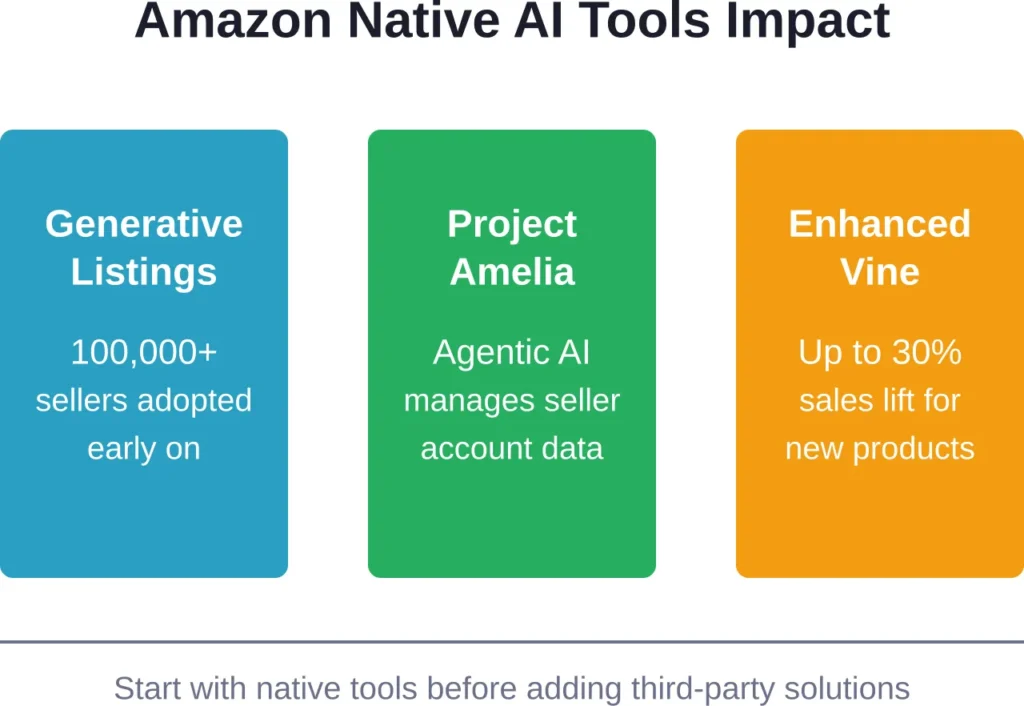
Amazon rolled out generative AI capabilities for product listing creation in March 2024, and the adoption numbers tell the story. According to Amazon Seller Central news, more than 100,000 sellers had used one or more of Amazon’s new generative AI tools since they were announced.
The system works remarkably well. Sellers can create product titles, descriptions, and other details from product images or just a few descriptive words. The AI analyzes your input and generates listings tailored to Amazon’s store requirements and customer expectations.
What makes this particularly powerful is the continuous learning aspect. Amazon’s generative AI tools evolve based on performance data across millions of listings, meaning the quality improves over time without any additional effort from sellers.
For sellers with existing direct-to-consumer websites, Amazon now offers automated listing translation. The AI reads your website product pages and creates Amazon-optimized listings automatically—no manual rewriting required.
Project Amelia: Your AI Business Assistant

Project Amelia represents Amazon’s push toward agentic AI—systems that don’t just respond to queries but actively help manage business operations. Think of it as a conversational assistant that understands your seller account data.
Sellers can ask Amelia questions about their business metrics, get insights into sales trends, and receive recommendations for optimization opportunities. The system pulls from your actual account data, making its suggestions specific rather than generic.
The conversational interface matters more than it might seem. Instead of navigating through multiple Seller Central dashboards, sellers can ask natural language questions and get consolidated answers. That saves time and lowers the barrier to data-driven decision-making.
Enhanced Vine Reviews Program

Amazon upgraded its Vine program with AI-powered enhancements that help sellers gather quality reviews faster. The data backs up the impact—Enhanced Vine reviews are designed to help lift sales of new products by providing richer content from reviewers.
The newer version now includes photos and videos from reviewers, providing richer content that helps shoppers make purchase decisions. For sellers launching new products, this accelerated feedback loop reduces the risk of launching with large inventory commitments.
Advertising and PPC Optimization
Amazon Advertising remains one of the largest expenses for most sellers, often consuming 10–30% of total revenue. In 2026, effectively managing Sponsored Products, Brands, and Display campaigns is critical for controlling costs and scaling profitably.
WisePPC

WisePPC is a dedicated Amazon PPC management platform that combines deep analytics with emerging AI capabilities. As an official Amazon Ads Verified Partner, it fills many of the gaps left by Seller Central’s native tools.
The platform offers long-term historical data spanning years instead of the usual 60–90 days, unified visibility across advertising, organic sales, and overall account performance, and powerful bulk actions for editing bids, budgets, and campaign statuses at scale. Sellers can analyze placements, search terms, match types, and profitability metrics with much greater precision. WisePPC also provides real-time monitoring of ACOS, TACOS, ROAS, and true profit, along with AI-powered campaign adjustments and smart bidding features that continued to roll out through 2025 and 2026.
WisePPC works particularly well for sellers who want strong control and transparency without handing everything over to full autopilot. It suits both growing accounts that need better organization and larger sellers or agencies managing multiple accounts.
Contact Information:
- Website: wiseppc.com
- Facebook: www.facebook.com/people/Wise-PPC/61573154427547
- LinkedIn: www.linkedin.com/company/wiseppc
- Instagram: www.instagram.com/wiseppc
Product Research and Opportunity Discovery
Finding profitable products remains the foundation of successful Amazon selling. AI has transformed this process from educated guesswork into data-driven science.
Jungle Scout

Jungle Scout pioneered AI-powered product research for Amazon sellers and continues to set the standard. The platform analyzes millions of data points across Amazon’s marketplace to identify product opportunities before they become saturated.
The AI-driven opportunity finder scans categories based on your criteria—price range, competition level, sales velocity—and surfaces products that match your parameters. Instead of manually searching through thousands of listings, sellers get curated recommendations backed by historical performance data.
Sales estimates represent another area where AI adds precision. Jungle Scout’s algorithms factor in BSR fluctuations, seasonal trends, and category-specific variables to project revenue potential. These aren’t perfect predictions, but they’re considerably more accurate than manual estimation methods.
Helium 10

Helium 10 takes a comprehensive approach, bundling product research with keyword optimization and listing analytics. The Black Box tool uses AI to filter Amazon’s entire catalog based on multiple criteria simultaneously—monthly revenue, review count, seller type, and more.
What sets Helium 10 apart is the keyword research integration. The platform identifies high-volume, low-competition keywords that competitors might miss, then shows exactly which products rank for those terms. That intelligence helps sellers position products in underserved niches.
The profitability calculator incorporates FBA fees, shipping costs, and PPC spend to project actual margins. Many sellers discover that seemingly attractive products become unprofitable once all costs factor in—the AI prevents those costly mistakes upfront.
Seller Assistant

Seller Assistant specializes in sourcing workflow automation. The tool appears directly on Amazon product pages through a browser extension, providing instant analysis without switching between tabs.
The supplier matching feature represents a particularly clever application of AI. Seller Assistant scans your potential product against multiple supplier databases, displaying prices, minimum order quantities, and match confidence scores in a consolidated table.
Filters eliminate non-viable options automatically. Set your maximum cost of goods, and the AI removes suppliers priced above that threshold. Define your storage constraints, and it filters out oversized inventory. The result is a shortlist of actionable sourcing options rather than a overwhelming spreadsheet.
Listing Optimization and Content Creation
Great products fail on Amazon when listings don’t convert browsers into buyers. AI tools now handle the creative and technical aspects of listing optimization that used to require copywriters and designers.
ChatGPT for Amazon Sellers

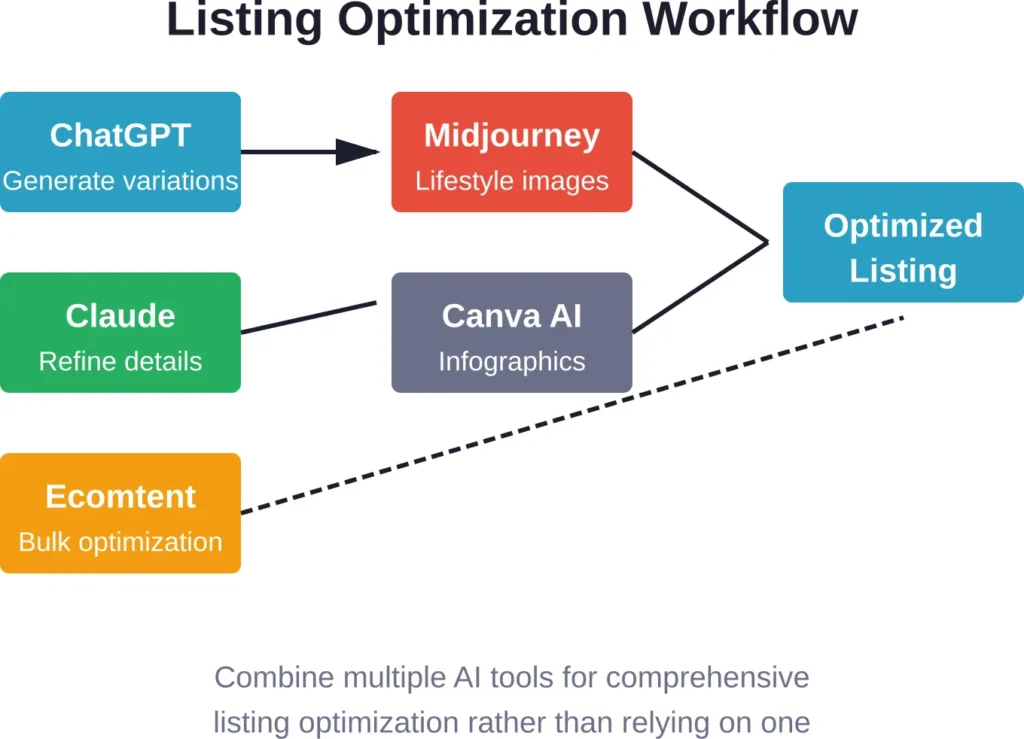
ChatGPT isn’t Amazon-specific, but sellers have adapted it remarkably well for listing optimization. The key is prompt engineering—providing the AI with sufficient context about your product, target customer, and competitive positioning.
Effective sellers use ChatGPT to generate multiple title variations, then A/B test them. Same approach for bullet points and descriptions. The AI produces options quickly enough that testing becomes practical rather than prohibitively time-consuming.
Data analysis represents another powerful use case. Export your Business Reports from Seller Central, feed them to ChatGPT, and ask specific questions about trends, seasonality, or performance anomalies. The AI identifies patterns humans might overlook in raw data.
Claude for Detail-Oriented Optimization

Claude excels at understanding nuanced instructions and maintaining consistency across long-form content. For Amazon sellers, that translates to better A+ Content and brand story sections.
The AI handles complex formatting requirements naturally. Tell Claude you need five bullet points under 250 characters each, with the primary keyword in the first two bullets, and it delivers exactly that specification consistently.
Claude also performs well at competitive analysis. Provide top-ranking competitor listings, and the AI identifies common elements, keyword patterns, and positioning strategies worth incorporating into your approach.
Midjourney for Lifestyle Imagery

Product photography represents a significant expense for Amazon sellers, particularly for lifestyle shots showing products in use. Midjourney has changed that equation dramatically.
The AI generates unique, high-quality images from detailed text prompts. Sellers describe the scene they want—product placement, lighting, setting, mood—and Midjourney creates it. No photographer, no props, no location rental.
Seasonal promotional images demonstrate the tool’s practical value. Create summer-themed visuals in December, test holiday imagery in July, refresh your entire listing aesthetic quarterly—all without coordinating photoshoots or managing image assets.
That said, Midjourney works best for supplementary lifestyle images rather than primary product shots. Customers still need accurate photos of the actual product, but AI-generated context images enhance the overall presentation effectively.
Ecomtent

Ecomtent focuses exclusively on e-commerce content generation, making it more specialized than general-purpose AI tools. The platform creates product descriptions, titles, and bullet points optimized specifically for Amazon’s algorithm and conversion patterns.
The AI understands Amazon’s category-specific requirements. Electronics listings need technical specifications formatted differently than beauty products. Kitchen items emphasize different features than sports equipment. Ecomtent adjusts its output based on product category automatically.
Bulk processing capabilities matter for sellers with large catalogs. Upload a CSV with product attributes, and Ecomtent generates optimized listings for hundreds of products in one batch. That scalability is impractical with manual copywriting.
Pricing and Inventory Management
Pricing directly impacts both sales velocity and profitability, but manually adjusting prices across multiple SKUs becomes impractical quickly. AI-powered repricing tools monitor competitors and market conditions constantly, adjusting prices within parameters sellers define.
Dynamic Pricing Tools
AI repricing engines track competitor prices in real-time and adjust listings to maintain competitive positioning. The sophistication varies—basic tools simply undercut competitors by a fixed amount, while advanced systems optimize for profit rather than just sales volume.
The better algorithms factor in inventory levels, sales velocity, and seasonality. If stock is running low and can’t be replenished quickly, the AI might raise prices to slow sales and prevent stockouts. Conversely, aging inventory approaching storage-limit thresholds might trigger aggressive pricing to move units.
Profasee represents one example of this category, using AI to balance competitive positioning with profit optimization. The system learns which price points maximize margin for specific products rather than applying blanket strategies.
Inventory Forecasting
Stockouts kill momentum and tank search rankings. Excess inventory ties up capital and incurs storage fees. AI-powered inventory management splits the difference, forecasting demand based on historical sales patterns, seasonal trends, and external factors.
These systems alert sellers when reorder points approach, calculate optimal order quantities, and even suggest gradual inventory reduction for declining products. The goal is maintaining stock availability without over-committing capital or storage space.
Integration with supplier data enhances forecasting accuracy. When the AI knows lead times and minimum order quantities from your suppliers, it can recommend reorder timing that accounts for production and shipping delays.
Sourcing and Supplier Management
Finding reliable suppliers at competitive prices determines profitability before a single unit sells. AI tools now automate the tedious research that used to require hours of manual comparison.
Accio

Accio specializes in global supplier discovery, using AI to match product specifications with manufacturers across multiple platforms and databases. Instead of separately searching Alibaba, 1688, and other supplier networks, sellers get consolidated results ranked by relevance and reliability indicators.
The platform analyzes supplier profiles, transaction history, and verification status to assess risk. Not all suppliers with low prices deliver quality or reliability—the AI flags potential red flags that manual research might miss.
Communication assistance represents an underappreciated feature. Accio helps draft supplier inquiries, negotiate terms, and clarify specifications, reducing miscommunication that leads to incorrect orders or quality issues.
Supplier Comparison and MOQ Optimization
Minimum order quantities trap new sellers who lack capital for large purchases. AI tools identify suppliers with lower MOQs that still meet quality standards, or suggest product bundles that reach MOQ thresholds efficiently.
Cost-of-goods filters automatically exclude suppliers above defined price ceilings. Sellers set maximum per-unit costs, and the AI removes options that would make the product unprofitable even before FBA fees and advertising.
Customer Service and Communication
Amazon penalizes slow response times to customer inquiries. AI-powered customer service tools maintain responsiveness without requiring sellers to monitor messages constantly.
AI Response Systems
These platforms analyze incoming customer messages, categorize them by type, and either generate appropriate responses automatically or draft replies for seller approval. Common questions about shipping, returns, or product specifications get handled instantly.
The AI learns from approved responses, improving accuracy over time. Sellers review and edit suggested replies initially, but the system requires less supervision as it builds a knowledge base of acceptable responses for different scenarios.
Sentiment analysis flags frustrated or angry customers for priority human attention. While AI handles routine inquiries efficiently, upset customers benefit from personalized responses—the system recognizes the difference.
Review Management
AI tools monitor product reviews for emerging issues, competitive intelligence, and improvement opportunities. Sudden spikes in negative reviews trigger alerts, allowing sellers to investigate quality problems or listing inaccuracies before damage spreads.
Review analysis identifies common praise points and complaints across hundreds of reviews. That aggregated feedback informs product improvements, listing adjustments, and marketing messaging more effectively than reading reviews individually.
Compliance and Risk Management
Amazon’s terms of service and FTC regulations around AI claims have gotten stricter. In September 2024, the FTC announced Operation AI Comply, targeting deceptive AI claims and schemes. The crackdown included action against FBA Machine and Bratislav Rozenfeld, who allegedly misled consumers in a business opportunity scheme involving AI-powered software, with consumers defrauded of significant sums.
FTC actions against similar deceptive AI business opportunity schemes have resulted in permanent bans from marketing such opportunities. The message is clear—AI tools must deliver on their claims, and sellers using AI-powered services should verify capabilities rather than accepting marketing promises.
AI compliance tools now monitor listings for prohibited claims, restricted keywords, and category-specific requirements. Amazon’s rules vary by category, and violations trigger suppression or account warnings. Automated compliance checking prevents accidental violations.
Visual Content and Video Creation
Video content converts significantly better than static images on Amazon listings, but video production traditionally required equipment, expertise, and budget. AI video tools have lowered those barriers substantially.
HeyGen

HeyGen creates AI-powered user-generated content and influencer-style videos without filming anything. Sellers provide product images and talking points, and the platform generates videos with realistic AI avatars demonstrating or discussing the product.
The videos aren’t perfect—close inspection reveals they’re AI-generated. But for supplementary listing content, social proof elements, or A+ Content video sections, they’re remarkably effective and cost a fraction of traditional video production.
Canva for E-commerce

Canva integrated AI features specifically useful for Amazon sellers. The Magic Design tool generates infographic layouts from product specifications automatically. Text-to-image features create background elements or lifestyle scenes for product composites.
Template libraries accelerate creation of consistent branded content across multiple listings. Sellers maintain visual cohesion without starting from scratch for each product or variation.
Market Research and Trend Analysis
Understanding market trends before they become obvious gives sellers first-mover advantage. AI research tools scan broader data sources than Amazon alone, identifying emerging opportunities early.
Perplexity AI

Perplexity functions as an AI-powered research assistant with internet access. Sellers use it to investigate market trends, consumer preferences, and competitive landscapes across multiple sources simultaneously.
The cited-source approach provides verification. Unlike ChatGPT’s training-data responses, Perplexity links to current web sources, allowing sellers to verify claims and dig deeper into relevant data.
Queries like “trending kitchen products 2026” or “emerging sustainability preferences in beauty products” surface insights from industry publications, trend reports, and consumer discussions that inform product selection and positioning decisions.
GummySearch for Niche Discovery

GummySearch specializes in mining Reddit for product pain points, unmet needs, and niche community insights. The AI scans relevant subreddits, identifies common complaints or requests, and surfaces potential product opportunities.
Community discussions reveal problems people actually experience—not hypothetical pain points marketers imagine. A thousand Reddit users complaining about the same product flaw represents validated demand for a solution.
The tool tracks trending topics over time, showing which problems are gaining attention versus fading. That temporal context helps sellers distinguish durable opportunities from temporary fads.
Building Your AI Tool Stack
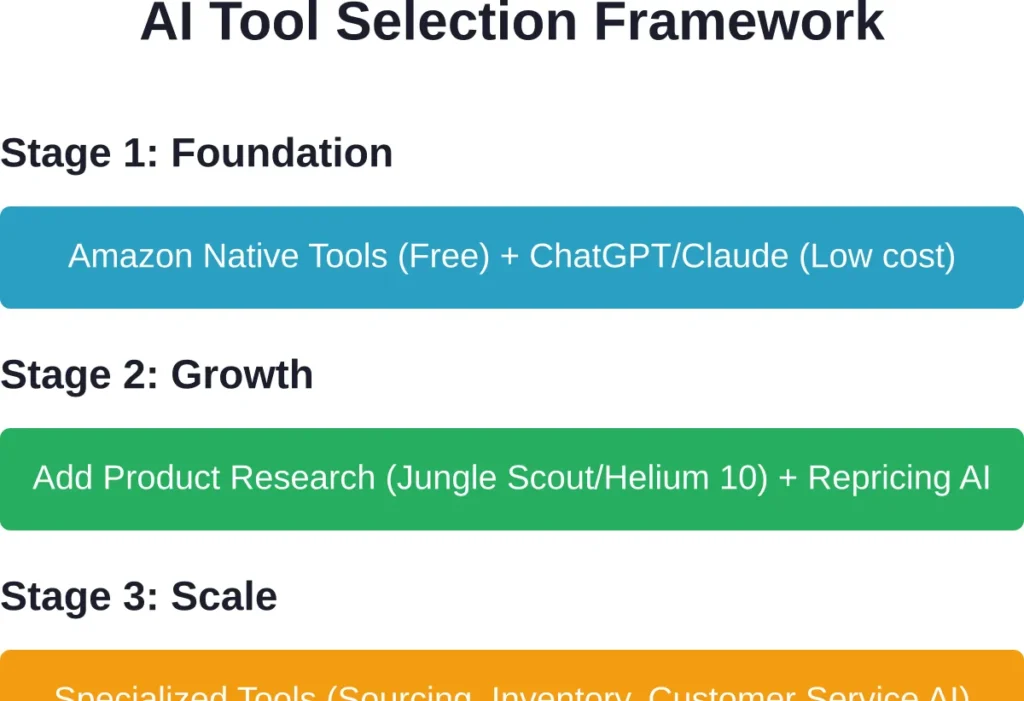
The tools covered above represent capabilities, not requirements. Most sellers don’t need every category immediately. Start with foundational tools and add specialized solutions as specific bottlenecks emerge.
New sellers should begin with Amazon’s free native AI tools and low-cost general-purpose options like ChatGPT. Those provide immediate value without significant financial commitment or learning curve.
As monthly revenue grows, invest in dedicated product research tools. The data quality and time savings justify subscription costs once product launches become regular rather than occasional.
High-volume sellers benefit most from automation in pricing, inventory, and customer service. The efficiency gains scale with transaction volume, making these tools ROI-positive for established businesses but potentially premature for beginners.
Integration matters more than feature count. Tools that sync with Seller Central, share data, or automate handoffs between functions multiply their individual value. Disconnected tools create data silos and manual transfer work.
Looking Ahead: AI Trends for Amazon Sellers
Amazon continues expanding its AI capabilities aggressively. CEO Andy Jassy emphasized that Amazon’s partnership with independent sellers represents “the most substantial collaboration in the history of retail”—signaling continued investment in seller-facing AI tools.
Agentic AI systems like Project Amelia represent the direction. Future iterations will likely handle more autonomous decision-making—automatically adjusting prices, reordering inventory, or optimizing ad campaigns within guardrails sellers define.
Multimodal AI that processes images, video, and text simultaneously will improve listing creation. Sellers might simply upload product samples, and AI generates complete listings with optimized copy, professional images, and video content automatically.
Voice and conversational interfaces will make complex analytics accessible to non-technical sellers. Instead of learning dashboard navigation, sellers ask questions and receive actionable insights in natural language.
The competitive advantage of AI tools will shift from availability to implementation quality. Everyone has access to similar capabilities now—the differentiator becomes how effectively sellers integrate these tools into coherent workflows.
Frequently Asked Questions
Amazon’s native AI tools for listing creation and Project Amelia provide substantial value at zero cost and should be every seller’s starting point. Free tiers of ChatGPT and Claude handle many content generation tasks adequately. However, specialized paid tools for product research, repricing, and inventory management typically justify their cost once revenue reaches consistent four-figure monthly levels. The ROI calculation depends on whether the tool saves time, prevents costly mistakes, or identifies opportunities that offset subscription fees.
AI-generated content itself doesn’t violate Amazon’s terms of service, but content that includes false claims, prohibited keywords, or category violations certainly can—regardless of whether AI or humans created it. Sellers remain responsible for reviewing AI outputs before publishing. The FTC has also cracked down on deceptive AI claims in business opportunity schemes, as evidenced by the $15 million FBA Machine case. Use AI tools from reputable providers, verify compliance with Amazon’s policies, and review generated content rather than publishing blindly.
Product research tools deliver the highest impact for new sellers because launching the wrong product wastes capital and time regardless of how well everything else executes. Jungle Scout and Helium 10 both offer proven track records for validating product opportunities before committing to inventory. After product selection, Amazon’s free generative AI listing tools provide quality optimization without additional investment. Resist the temptation to subscribe to multiple tools simultaneously—master one category before adding complexity.
Time savings vary dramatically by task type. Listing creation that previously took 30-45 minutes per product now happens in 5-10 minutes with AI assistance—roughly 70-80 percent reduction. Product research accelerates similarly, with AI filtering thousands of options down to shortlists in minutes versus hours of manual spreadsheet work. Repricing represents the most dramatic savings since AI monitors and adjusts continuously while manual repricing requires scheduled dedicated time blocks. Conservatively, sellers implementing AI tools across research, listings, and pricing report reclaiming 10-15 hours weekly.
Customer acceptance depends heavily on quality and context. AI-generated lifestyle images showing products in use settings generally perform well as supplementary content alongside genuine product photos. Primary hero images should still show the actual product accurately—AI generation works better for contextual and atmospheric content. Video content from tools like HeyGen functions effectively for explanatory or testimonial-style content but shouldn’t replace demonstrations of actual product functionality. The key principle is transparency in representation—AI content should enhance understanding, not deceive about product characteristics.
Amazon’s native AI capabilities continue expanding and will likely absorb some functions currently handled by third-party tools, particularly in listing optimization and basic analytics. However, specialized tools serving specific seller types or solving niche problems will remain relevant. Third-party providers can iterate faster, serve multi-platform sellers, and focus deeply on particular pain points in ways Amazon’s broadly-applicable tools cannot. The relationship is more complementary than competitive—native tools provide baseline capabilities while specialized solutions address advanced needs.
Legitimate AI tools offer free trials or freemium tiers allowing hands-on testing before financial commitment. Evaluate based on specific, measurable outcomes—does the product research tool’s sales estimates match actual data for products in categories where sales are known? Do generated listings perform comparably to manually-created ones in A/B tests? Check for case studies with verifiable results and user reviews on independent platforms rather than just vendor testimonials. The FTC’s Operation AI Comply crackdown targeted tools making unfounded guarantees, so be skeptical of “guaranteed income” or “automated wealth” claims that characterize opportunities rather than tools.
Conclusion
AI tools have fundamentally changed what’s possible for Amazon sellers in 2026. Capabilities that required teams or agencies a few years ago now run automatically or semi-automatically through accessible software.
The sellers winning in this environment aren’t necessarily those with the most tools—they’re the ones who’ve identified their specific bottlenecks and deployed AI solutions strategically to address them. Start with Amazon’s native capabilities, add general-purpose AI for content creation, then invest in specialized tools as clear needs emerge.
But here’s what matters most: AI tools amplify good strategy and accelerate execution, but they don’t replace fundamental business judgment. Product selection, customer understanding, and competitive positioning still require human insight. The AI handles the execution, data processing, and optimization—you provide the direction.
Test, measure, and iterate. Not every tool will deliver equal value for your specific business model, category, or stage. The Amazon marketplace evolves constantly, and so do the tools serving it. The competitive advantage comes not from adopting every new capability but from thoughtfully integrating the right ones into cohesive workflows that compound over time.