

Quick Summary: Automated tools for Amazon sellers streamline product research, inventory management, pricing, and advertising—freeing up time to focus on growth. Industry reports suggest successful sellers combine multiple specialized tools rather than relying on one all-in-one platform, with typical monthly costs ranging from basic platforms under $50 to several hundred for advanced analytics.
Selling on Amazon isn’t what it used to be. The marketplace has matured, and so has the competition. Manual spreadsheets and gut-feel decisions don’t cut it anymore—not when competitors are running automated systems that adjust prices every hour, optimize keywords in real time, and predict inventory needs weeks in advance.
Here’s the thing though—automation doesn’t mean handing over control. The best Amazon seller tools work as force multipliers, handling repetitive tasks while surfacing insights that manual analysis would miss.
Amazon holds over 30% market share in global e-commerce, and sellers who leverage the right automation stack are the ones capturing disproportionate returns. But with hundreds of tools flooding the market, building the right combination requires understanding what each category actually delivers.
Why Amazon Sellers Need Automation in 2026
The Amazon selling environment has shifted dramatically. Competition intensifies daily, margins compress, and Amazon’s own algorithm changes force constant adaptation. Community discussions reveal that sellers spending less than $200k annually struggle most with time management—they’re caught between operational tasks and strategic growth.
Automation solves three critical problems. First, it reclaims time. Tasks like repricing, review requests, and inventory alerts run on autopilot. Second, it eliminates human error. Stockouts, pricing mistakes, and missed advertising optimizations cost real money. Third, it surfaces hidden opportunities—keyword gaps, profitable niches, and competitor weaknesses that manual research overlooks.
Real talk: sellers who resist automation don’t lose overnight. They lose gradually, squeezed by competitors who ship faster, price smarter, and convert better.
PPC and Advertising Automation
Amazon PPC is one of the most powerful ways to gain initial visibility for new products and maintain steady sales for mature listings. However, manual campaign management — constantly adjusting bids, adding negative keywords, analyzing search term reports, and shifting budgets — takes many hours every week. PPC automation tools handle these tasks in real time, reacting to performance data faster and more accurately than any human could.
WisePPC

WisePPC is a powerful, user-friendly Amazon PPC automation tool designed specifically for sellers who need efficient management of large-scale advertising campaigns. The platform excels at bulk operations, allowing users to edit thousands of keywords, bids, and campaigns simultaneously with advanced filtering and gradient highlighting that make it easy to spot underperforming elements quickly.
It provides real-time analytics combined with long-term historical data storage (far beyond Amazon’s 60–90 day limit), on-spot editing, placement analysis, and multi-metric charting. Sellers can set up automated bid optimization rules while maintaining full manual control when needed.
As an official Amazon Ads Verified Partner, WisePPC ensures secure integration and full compliance with Amazon’s policies. The tool is continuously evolving, with upcoming features including AI-powered campaign adjustments, dynamic repricing, and inventory forecasting.
WisePPC is an excellent choice for both mid-sized and large Amazon sellers looking for a clean, fast, and highly functional PPC management solution without unnecessary complexity.
Contact Information:
- Website: wiseppc.com
- Facebook: www.facebook.com/people/Wise-PPC/61573154427547
- LinkedIn: www.linkedin.com/company/wiseppc
- Instagram: www.instagram.com/wiseppc
Perpetua

Perpetua is a leading AI-powered PPC management platform for Amazon sellers. It uses machine learning to optimize campaigns across Sponsored Products, Sponsored Brands, and Sponsored Display. Sellers set their target ACoS or ROAS, and the system automatically adjusts bids, budgets, and targeting to hit those goals. Beyond automation, Perpetua provides strategic insights, campaign audits, and forecasting tools that help shape the overall advertising strategy.
Helium 10 Adtomic

Adtomic by Helium 10 seamlessly combines keyword research with campaign automation. It allows sellers to launch new campaigns already pre-loaded with high-converting keywords discovered through Helium 10’s other tools (like Cerebro). The platform automates bid management, negative keyword harvesting, and budget allocation while offering deep performance analytics. This tight integration makes it especially convenient for sellers already using the Helium 10 suite.
Teikametrics

Teikametrics stands out by integrating advertising performance with broader business intelligence. It doesn’t just optimize ACoS — it shows how PPC spend affects overall profitability, including inventory carrying costs, FBA fees, and net margins. This holistic view helps sellers avoid the common mistake of driving low ACoS at the expense of actual profit. The platform is ideal for mid-to-large sellers who want advertising decisions aligned with total business health.
Product Research and Validation Tools
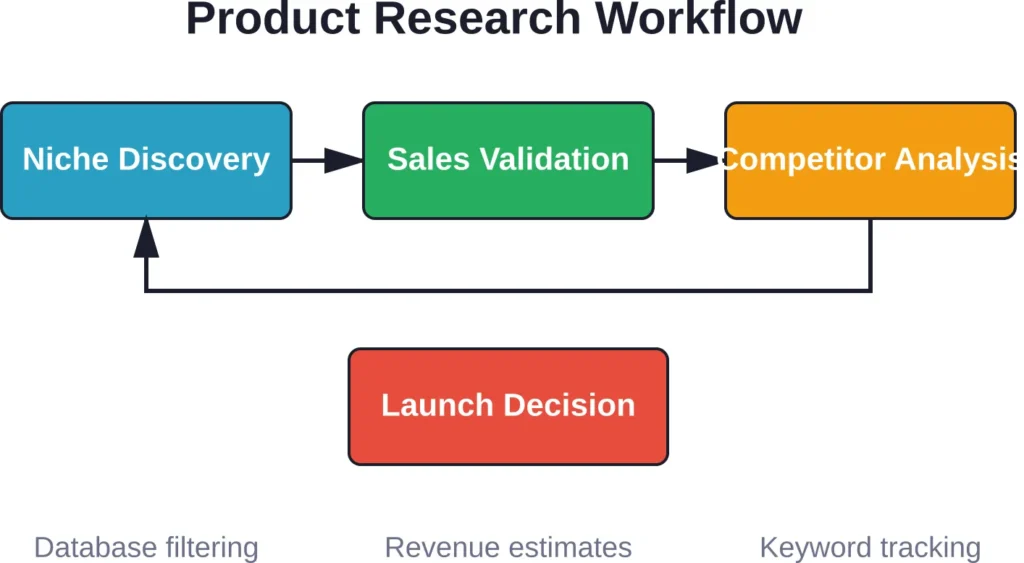
Finding profitable products separates successful Amazon sellers from everyone else. Product research tools automate the most time-consuming parts of the process — scraping realistic sales estimates, tracking historical trends, analyzing competition, and validating real demand before you invest a single dollar in inventory.
Jungle Scout

Jungle Scout remains one of the most established and trusted tools in the industry. It features a powerful Product Database that lets sellers filter millions of Amazon listings by monthly sales volume, review count, competition level, BSR, pricing, and profit potential. Additional tools like Opportunity Finder, Product Tracker, and Competitive Intelligence provide deep insights into market trends, competitor performance, and hidden niches with strong demand and lower saturation.
Data Dive

Data Dive is a newer, AI-powered tool that stands out for deep-dive competitor analysis. It excels at pulling detailed keyword rankings, advertising strategies, listing optimization scores, and organic rank tracking. This helps sellers understand exactly how top-performing competitors dominate their categories and identify specific gaps they can exploit in product listings and PPC.
SellerAmp

SellerAmp (SAS) specializes in online arbitrage and retail arbitrage. It scans thousands of retail websites in real time, highlights price discrepancies, and instantly calculates true profitability — factoring in Amazon fees, FBA costs, storage fees, returns, and shipping. With its Chrome extension and mobile app, you can analyze potential deals on the go and make fast, confident sourcing decisions.
ZonGuru

ZonGuru is particularly popular among private label sellers. Its Niche Finder and Chrome Extension help discover low-competition product opportunities with high demand potential. The platform offers strong filters for seasonality, supplier availability, and listing quality, along with tools that support the full product validation process from idea generation to launch readiness.
Keyword Research and Listing Optimization
Keywords are the foundation of Amazon visibility. The A9 algorithm heavily rewards products with strong keyword relevance, high search volume, and solid conversion rates. Modern automation tools go far beyond manual research — they reverse-engineer competitor strategies, uncover hidden long-tail keywords, track ranking performance over time, and help optimize listings at scale.
Keyword Tool Dominator

Keyword Tool Dominator specializes in pulling real Amazon autocomplete suggestions directly from the search bar. These are the exact phrases real customers type every day. The tool quickly generates hundreds of long-tail keyword ideas with search volume data, helping sellers find low-competition, high-intent phrases that are often overlooked by broader tools.
SellerSprite

SellerSprite excels at ongoing keyword tracking and ranking analysis. It monitors how your keywords perform over time, showing daily and weekly fluctuations, seasonal trends, and ranking drops. This continuous monitoring is essential because keyword performance is never static — search volumes change, new competitors appear, and rankings naturally decay without active optimization.
Automated Listing Enhancements
Creating high-converting Amazon listings requires strong keyword optimization, persuasive copy, and professional visuals. Manual creation is slow and expensive, which is why many sellers now use specialized automation tools that combine AI writing, design automation, and image generation to produce complete, SEO-friendly product pages much faster.
Ecomtent

Ecomtent is a specialized AI tool designed exclusively for Amazon listings. It can generate complete, SEO-optimized product pages including titles, bullet points, descriptions, and A+ Content. The platform focuses on conversion rate optimization, ensuring the copy not only ranks well but also persuades shoppers to buy.
Canva

Canva has become a go-to automation tool for Amazon creatives. With its drag-and-drop interface and smart templates, sellers can quickly create professional infographics, comparison charts, lifestyle images, and brand storytelling visuals. The built-in Magic Studio features (AI-powered) further speed up design work, eliminating the need to hire expensive graphic designers.
Midjourney

Midjourney is widely used by Amazon sellers to generate high-quality lifestyle and lifestyle product images from simple text prompts. Instead of expensive photoshoots, sellers describe the desired scene (e.g., “modern kitchen with family using stainless steel blender”), and the AI produces photorealistic images. This has significantly cut costs and time, especially for seasonal promotions and multiple lifestyle variations.
Inventory Management and Forecasting
Stockouts kill sales momentum and damage your ranking, while overstock ties up capital and triggers expensive long-term storage fees. Smart inventory management tools solve this by automatically forecasting demand, tracking real-time levels, and optimizing reorder timing based on sales velocity, seasonality, trends, and supplier lead times.
Ordoro

Ordoro is a robust multi-channel inventory management platform ideal for sellers operating beyond Amazon. It syncs inventory across Amazon, Shopify, eBay, Walmart, and other marketplaces in real time, preventing overselling and stock discrepancies. The tool provides centralized order management, automated purchase order creation, and detailed reporting, making it especially valuable for sellers with complex supply chains or multiple sales channels.
RestockPro

RestockPro specializes in intelligent reorder automation. It calculates optimal reorder points and quantities by analyzing your historical sales data, current inventory levels, supplier lead times, and safety stock requirements. The platform generates ready-to-send purchase orders automatically when stock hits predefined thresholds, removing emotional guesswork and helping sellers maintain healthy inventory levels without constant manual monitoring.
SoStocked

SoStocked is purpose-built for Amazon FBA sellers. It delivers accurate demand forecasting by combining your sales velocity with seasonal patterns and market trends, while taking into account Amazon’s storage limits and fee structures. The tool sends proactive alerts about potential long-term storage fees, suggests inventory rebalancing between warehouses, and helps optimize shipment planning to minimize costs and avoid stockouts during peak seasons.
| Tool Category | Primary Function | Best For |
|---|---|---|
| Multi-channel sync | Unified inventory across platforms | Sellers on Amazon + Shopify/eBay |
| Reorder automation | Purchase order generation | Private label with predictable lead times |
| FBA planning | Storage fee avoidance | High-volume FBA sellers |
| Demand forecasting | Seasonal trend prediction | Products with cyclical demand |
Repricing and Dynamic Pricing Tools
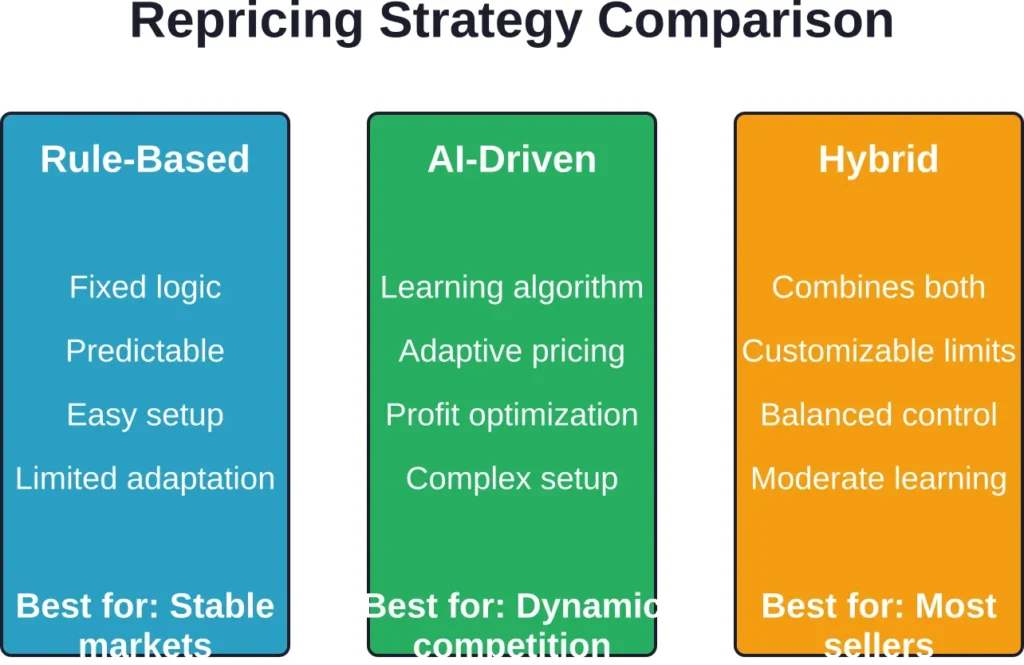
The Buy Box is where most Amazon sales happen. It rotates based on price, fulfillment method, seller performance, and stock availability. Staying competitive requires constant price monitoring and adjustments across hundreds of SKUs — a task that is practically impossible to manage manually. Repricing tools solve this by tracking competitors in real time and automatically adjusting your prices according to custom rules or AI logic.
BQool

BQool is one of the most popular and established repricing tools for Amazon sellers. Its powerful engine supports both rule-based strategies and advanced AI-driven algorithms. Sellers can set rules like “stay 3–5% below the lowest FBA price” or “maintain minimum profit margin while being competitive.” Over time, the AI learns from market behavior and suggests optimal pricing patterns, helping sellers win the Buy Box more consistently while protecting margins.
Profasee

Profasee takes dynamic pricing to the next level by focusing on profit maximization rather than just Buy Box ownership. The tool analyzes demand elasticity, competitor behavior, time of day, seasonality, and historical conversion data to adjust prices intelligently. Instead of simply undercutting competitors, it finds the sweet spot that maximizes total revenue and profit per product. It’s especially effective for sellers with large catalogs or those selling in competitive, high-velocity categories.
RepricerExpress

RepricerExpress stands out for its speed and reliability. Some pricing plans allow price updates every few minutes, which is critical in highly competitive niches where multiple sellers fight for the Buy Box. The platform offers easy-to-use rule creation, detailed performance reports, and strong integration with Amazon. It also includes features like repricing based on inventory levels, competitor count, and even time-based strategies (e.g., aggressive pricing during peak hours).
Feedback and Review Management
Reviews and seller feedback heavily influence conversion rates and Amazon’s internal ranking signals. Manually tracking orders, sending review requests, and following up simply doesn’t scale. Review automation tools handle this process professionally while staying fully compliant with Amazon’s policies.
FeedbackWhiz

FeedbackWhiz is one of the most established review request tools for Amazon sellers. It automatically sends polite, timed review requests via email after delivery, based on optimal windows that maximize response rates. The platform tracks review velocity, monitors feedback scores, and sends instant alerts for negative reviews or feedback. It also includes templates, A/B testing for request messages, and detailed reporting.
HighFive

HighFive is a modern review and feedback automation tool designed for high-volume sellers. It automates personalized review requests at the perfect post-delivery timing and helps boost both product reviews and seller feedback. The tool includes sentiment analysis to identify recurring customer complaints and provides dashboards to track review trends over time. This data helps sellers make informed improvements to products and listings.
Analytics and Profit Tracking
Amazon’s native reports show sales and revenue, but they hide the real picture of profitability. PPC ad spend, referral fees, FBA storage and fulfillment costs, returns, promotions, and cost of goods sold can quietly destroy margins. Profit analytics tools bring all these numbers together into one clear dashboard, giving sellers an accurate, real-time view of their actual profit (or loss) per product and across the entire business.
SellerBoard

SellerBoard is a popular, user-friendly profit tracking tool that calculates true net profit in real time. It automatically pulls all Amazon fees, advertising costs, refunds, and your COGS, then displays clean dashboards with profit by product, category, and time period. Its strength lies in simplicity and visual reports that help sellers quickly spot unprofitable SKUs and make better decisions.
HelloProfit

HelloProfit is one of the most detailed profit analytics platforms for Amazon sellers. It tracks every single cost factor — including storage fees, long-term storage charges, PPC spend, returns, and even Amazon’s reimbursement opportunities. The tool provides deep breakdowns, customizable reports, and trend analysis so sellers can see exactly where money is being made or lost. It’s especially valued by sellers who want maximum accuracy and granular data.
Nova Analytics

Nova Analytics goes beyond basic profit tracking by adding powerful benchmarking and predictive features. It compares your performance against category averages, shows how you rank against competitors, and forecasts the impact of changes in pricing, advertising, or inventory on your bottom line. This predictive analysis helps sellers make proactive decisions instead of reacting after margins have already dropped.
Integrating Multiple Tools into Your Stack
Here’s the reality—no all-in-one platform dominates every category. Helium 10 and Jungle Scout offer broad feature sets, but specialized tools often outperform in specific functions. Building a tool stack means combining best-in-class solutions that integrate smoothly.
Look for tools with API connections or native integrations. Data silos waste time and create discrepancies. When a repricing tool talks to a profit tracker, which connects to an inventory system, automation compounds.
Based on available guidance, a strong setup might include a product research database, keyword tracker, repricing engine, PPC automation platform, and profit analytics tool. Total monthly cost varies widely—basic selling platforms can run under $50 monthly according to government data, scaling to several hundred for sellers managing substantial catalogs.
| Business Size | Recommended Stack | Estimated Monthly Cost |
|---|---|---|
| Launching (0-10 SKUs) | Product research + keyword tool + basic analytics | Check current pricing on official sites |
| Growing (10-50 SKUs) | Add repricing + review automation + inventory alerts | Varies by selection—verify current rates |
| Scaling (50+ SKUs) | Full stack with PPC automation + profit tracking + multi-channel sync | See provider websites for up-to-date plans |
Amazon’s Official Selling Partner Appstore
Amazon’s Selling Partner Appstore is the official marketplace for third-party tools that are vetted and approved by Amazon. All apps in the store integrate directly via Amazon’s Selling Partner API, ensuring high data security, reliability, and full compliance with Amazon’s policies. This makes them a safer and often easier-to-set-up option compared to standalone tools.
Amazon Currency Converter

Amazon Currency Converter is an official tool that automatically handles currency conversion for international sellers. It simplifies global payouts, reduces currency fluctuation risks, and provides clear visibility into disbursements across different marketplaces, making cross-border selling significantly smoother.
Project Amelia

Project Amelia is Amazon’s AI-powered seller assistant currently available in beta. It acts as an intelligent virtual helper inside Seller Central, answering questions, surfacing personalized performance insights, identifying optimization opportunities, and guiding sellers on best practices. As Amazon continues to develop it, Project Amelia is expected to become a central AI command center for many sellers.
Emerging AI Tools Reshaping Seller Operations
Artificial intelligence has evolved from experimental hype into practical, everyday tools that save Amazon sellers significant time and improve decision-making. These AI solutions now handle everything from data analysis to content creation and sourcing.
ChatGPT

ChatGPT has become a daily workhorse for many Amazon sellers. Beyond basic writing, it can analyze uploaded sales reports and spreadsheets, identify trends, suggest pricing adjustments, summarize search term reports, and generate bulk listing variations. Sellers simply upload data and ask natural-language questions to get instant, actionable insights.
Claude

Claude (by Anthropic) excels at high-quality listing optimization. It produces SEO-rich titles, bullet points, descriptions, and A+ Content while preserving your brand voice and tone. Many sellers prefer Claude over other models for its superior reasoning, longer context window, and more natural, persuasive copywriting abilities.
HeyGen

HeyGen allows sellers to create professional AI-generated videos without hiring videographers or actors. It can produce product demonstration videos, influencer-style reviews, explainer content, and UGC (user-generated content) videos using realistic AI avatars. This dramatically lowers the cost of creating promotional assets for Amazon listings, social media, and advertising.
GummySearch

GummySearch is a specialized AI tool that scans Reddit and other forums to uncover real customer conversations. It reveals unmet needs, pain points, and product opportunities that traditional keyword tools often miss. This makes it extremely valuable for product research and validating new private-label ideas directly from actual user discussions.
Perplexity AI

Perplexity AI functions as an intelligent market research assistant. It searches and synthesizes information from across the web in real time, providing well-sourced answers to complex questions such as competitor analysis, market size estimation, trend forecasting, and supplier evaluation.
Accio

Accio is an AI-powered sourcing platform that automates supplier discovery and negotiation workflows. It helps sellers find reliable manufacturers (primarily in Asia), request quotes, compare offers, and manage communication — significantly speeding up the sourcing process for private label and wholesale products.
Compliance and Best Practices
Automation requires responsibility. Amazon’s Terms of Service prohibit certain automated activities—fake reviews, manipulated rankings, unauthorized data scraping. Legitimate tools operate within these boundaries, but sellers must verify compliance.
The INFORM Consumers Act requires certain transparency from third-party sellers. Online advertising must meet Federal Trade Commission truth-in-advertising standards—claims must be truthful, non-deceptive, and evidence-based.
When evaluating tools, check reviews on trusted forums and seller communities. Software that promises “guaranteed Buy Box wins” or “instant ranking” likely violates Amazon policies. Sustainable automation supports legitimate optimization, not platform manipulation.
Frequently Asked Questions
Popular choices include Jungle Scout or Helium 10 for product research, specialized repricing tools for dynamic pricing, and profit trackers like SellerBoard. Most sellers combine multiple specialized tools rather than relying on one all-in-one platform, creating a stack that addresses their specific operational needs.
Costs vary significantly based on features and business size. Basic selling platforms can run under $50 monthly according to government data, while comprehensive analytics tools tracking thousands of SKUs across multiple channels may cost several hundred dollars monthly. Check official provider websites for current pricing, as subscription tiers and features change frequently.
No tool guarantees sales increases. Automation improves efficiency, surfaces opportunities, and optimizes existing operations—but success still requires quality products, competitive positioning, and sound strategy. Tools amplify good decisions and prevent costly mistakes, but they don’t replace fundamental business judgment.
For sellers doing less than $200k annually, targeted automation may deliver returns. Some sellers discuss starting with one or two tools addressing the biggest time drains—often repricing and review requests—then expanding the stack as revenue grows and operational complexity increases.
Modern seller tools require no coding knowledge. Most offer visual interfaces, pre-built templates, and guided setup workflows. Advanced users can leverage API integrations for custom automation, but basic functionality is accessible to anyone comfortable with spreadsheets and web applications.
Use only approved tools from Amazon’s Selling Partner Appstore or verified third-party providers with established reputations. Avoid any software promising to manipulate reviews, artificially inflate rankings, or engage in deceptive practices. When in doubt, consult Amazon’s Terms of Service and Seller Central policy documentation.
Many tools support multi-marketplace management, allowing sellers to operate across Amazon.com, Amazon.co.uk, Amazon.de, and other regions from one dashboard. Amazon Currency Converter specifically helps sellers manage global disbursements automatically when selling across international marketplaces.
Conclusion
Automation separates sellers who scale from those who plateau. The tools exist—product research platforms that reveal profitable niches, repricing engines that win the Buy Box consistently, inventory systems that prevent costly stockouts, PPC automation that maximizes advertising ROI, and analytics dashboards that expose true profitability.
But tools alone don’t build businesses. Strategic thinking determines which tools to deploy and how to configure them. Start with the operational bottlenecks consuming the most time or causing the biggest headaches. Automate those first, measure the impact, then expand the stack systematically.
The e-commerce sector continues to show strong growth, with Amazon accounting for over 30% of global e-commerce market share. Sellers equipped with the right automated tools capture disproportionate share of that market. Don’t overcomplicate it. Pick tools that solve real problems, integrate them properly, and let automation handle the repetitive work while focusing human effort on strategy, product selection, and customer experience. That’s how sustainable Amazon businesses scale in 2026.