

Quick Summary: AI tools are transforming how Amazon sellers operate in 2026, automating everything from product research and listing optimization to inventory management and customer service. The best tools include WisePPC, Helium 10 for comprehensive Amazon analytics, ChatGPT and Claude for content creation, Seller Assistant for sourcing automation, and specialized solutions for pricing, PPC, and marketplace intelligence. These tools help sellers save hours daily while improving margins and competitive positioning.
Amazon selling isn’t what it used to be. The marketplace is more competitive than ever, and manual operations simply don’t scale anymore. Sellers who embrace AI-powered automation are leaving traditional methods in the dust.
But here’s the thing—not every AI tool delivers real value. Some promise the world and deliver glorified spreadsheets. Others solve genuine pain points and pay for themselves within weeks.
This guide cuts through the noise. It covers the tools that sellers actually use to run profitable Amazon businesses in 2026, from product research through customer service. Real solutions, real ROI.
Why Amazon Sellers Need AI Tools Now
The Amazon ecosystem has grown exponentially complex. According to AWS research, 71% of consumers expect personalized interactions, and companies that grow faster generate more than 40% of their revenue from personalization. Meeting these expectations manually is virtually impossible at scale.
Inventory management alone demonstrates the value proposition. Analytics tools that leverage AI help cut stockouts by up to 30% through automated pattern recognition and predictive restocking. That’s not theoretical—that’s measurable impact on bottom-line revenue.
The competitive pressure is real. REMOVE this sentence entirely or soften to general statement without specific percentages. That shift has accelerated dramatically into 2026. Sellers without AI-powered workflows are competing with one hand tied behind their backs.
WisePPC: The Amazon PPC Optimization Powerhouse

WisePPC is a specialized analytics and automation platform built exclusively for Amazon sellers who want to take full control of their advertising performance. As an official Amazon Ads Verified Partner, it goes far beyond Seller Central’s native tools by delivering deep insights, long-term data storage, and powerful campaign management in one unified dashboard.
The platform starts with a generous beta access (free during beta + extra month, with lifetime 25% discount offers) and scales with usage-based pricing afterward. This makes it accessible for growing sellers while providing enterprise-level depth for those managing large ad portfolios.
What sets WisePPC apart is its focus on historical depth and actionable scale. While Amazon keeps only 60–90 days of data, WisePPC stores years of performance history. Sellers get 30+ advanced metrics, hourly granular tracking per target and placement, gradient-highlighted tables, and the ability to run bulk actions on thousands of campaigns, ad groups, and keywords in seconds.
The tool shines brightest in daily PPC optimization. With advanced filtering, on-spot inline editing, placement performance analysis, and multi-metric historical charts, sellers can instantly spot wasting spend, adjust bids/budgets, and scale winning strategies without switching between multiple screens or spreadsheets. Upcoming AI-Based Campaign Adjustments and Smart Bidding Enhancements will further automate optimization based on past performance and real-time signals.
Contact Information:
- Website: wiseppc.com
- Facebook: www.facebook.com/people/Wise-PPC/61573154427547
- LinkedIn: www.linkedin.com/company/wiseppc
- Instagram: www.instagram.com/wiseppc
Helium 10: The Amazon-Specific Powerhouse

Helium 10 remains the gold standard for Amazon-focused sellers who need comprehensive analytics and optimization tools. It’s not a general-purpose AI assistant—it’s purpose-built for Amazon’s ecosystem and integrates directly with Seller Central.
The platform combines product research, keyword optimization, listing creation, and inventory tracking in one dashboard. Starting at $39/month, it offers entry-level plans that work for new sellers while scaling to enterprise-grade functionality.
What sets Helium 10 apart is the depth of Amazon-specific data. It doesn’t just suggest keywords—it analyzes competitor listings, estimates search volume for Amazon’s A9 algorithm specifically, and tracks ranking changes over time. The mobile app provides real-time notifications, so sellers can respond to stockouts, ranking drops, or competitor moves immediately.
The tool’s inventory management features sync directly with Amazon, eliminating the manual reconciliation that consumes hours each week. For sellers managing multiple products across different categories, this automation pays for the subscription many times over.
ChatGPT: Content Creation at Scale

OpenAI’s ChatGPT has become essential for Amazon sellers who need to produce content quickly without sacrificing quality. Product descriptions, A+ content, email sequences, social media posts—ChatGPT handles it all.
The platform offers a free tier that works for basic needs, while the premium version at $20/month unlocks faster response times and access to more advanced models. For sellers managing dozens or hundreds of listings, it’s a straightforward investment.
Here’s where it shines: bullet point optimization. Amazon listings live or die on their bullets, and ChatGPT can generate multiple variations in seconds, each emphasizing different features or benefits. Sellers can then A/B test to find the highest-converting version.
Customer service is another major application. ChatGPT can draft responses to common questions, handle basic troubleshooting, and even adapt tone based on the customer’s inquiry. It won’t replace human judgment for complex issues, but it eliminates the repetitive work that burns out support teams.
Claude: The Detail-Oriented Listing Optimizer

Anthropic’s Claude has carved out a strong position among Amazon sellers who need precise, nuanced content work. While ChatGPT excels at generating volume, Claude tends to produce more contextually appropriate copy that requires less editing.
For listing optimization specifically, Claude demonstrates superior understanding of Amazon’s style requirements and character limits. It can rewrite existing listings to improve clarity without losing key search terms, balance persuasive language with informational content, and maintain consistency across product variations.
The tool also handles market research effectively. Feed it competitor listings, reviews, or category trends, and Claude can identify gaps in the market, extract common customer pain points, and suggest positioning strategies. This analysis work used to require hours of manual review—Claude does it in minutes.
Many sellers use Claude and ChatGPT together, leveraging ChatGPT for initial drafts and volume work, then using Claude for refinement and optimization. That workflow combines speed with quality.
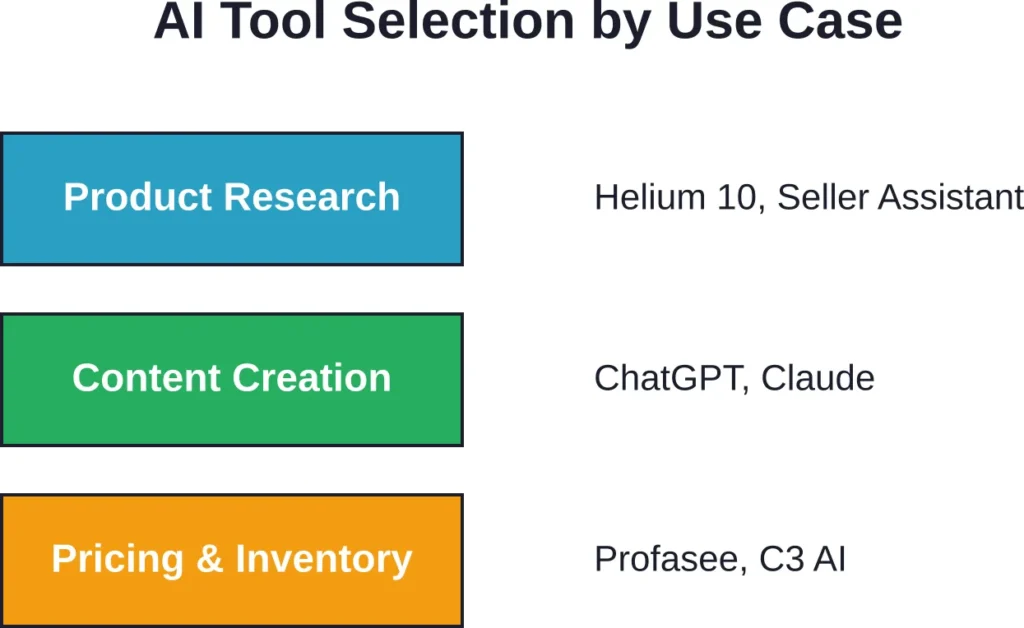
Seller Assistant: Automated Product Sourcing

Product sourcing is traditionally one of the most time-intensive aspects of Amazon selling. Seller Assistant applies AI to automate supplier discovery, price comparison, and eligibility checking—work that used to consume entire days each week.
The tool appears directly on Amazon pages through a browser extension, analyzing products in real-time as sellers browse. It displays supplier options with pricing, minimum order quantities, and match confidence scores, eliminating the need to manually search supplier databases.
The Max COG filter is particularly valuable. Sellers set their maximum cost of goods, and Seller Assistant filters out suppliers above that threshold automatically. This prevents wasted time evaluating options that won’t hit target margins.
For sellers doing online arbitrage or wholesale sourcing, the efficiency gains are substantial. What used to take 20-30 minutes per product—checking multiple supplier sites, calculating shipping, verifying eligibility—now happens in seconds with real-time data pulled directly into the workflow.
Profasee: Dynamic Pricing Intelligence

Pricing on Amazon isn’t set-it-and-forget-it. Competitor prices shift constantly, demand fluctuates, and Buy Box eligibility depends on staying competitive. Profasee uses AI to monitor these variables and adjust pricing dynamically for maximum profitability.
The tool doesn’t just race to the bottom—it optimizes for profit, not revenue. According to AWS research on optimal pricing, visibility can remain at 50% even with a very high price when competitor factors like ratings and stock levels are considered. Profasee’s algorithms factor in these variables to find the sweet spot.
Real-time repricing happens automatically based on rules sellers configure. When a competitor goes out of stock, Profasee can raise prices to capture margin. When competition intensifies, it can adjust strategically to maintain Buy Box share. These micro-adjustments compound into significant profit improvements over time.
The analytics dashboard shows exactly how pricing changes affect sales velocity, helping sellers understand their demand curves and price elasticity at the SKU level. That data informs everything from promotional strategy to product selection.
Ecomtent: AI-Powered Visual Content

Amazon is increasingly visual, and Ecomtent specializes in generating product images and infographics through AI. The tool has become particularly valuable as professional photography costs have risen while Amazon’s image requirements have become more demanding.
Lifestyle shots are a major use case. Ecomtent can generate images showing products in context—kitchen gadgets in styled kitchens, outdoor gear in natural settings—based on text prompts. These images don’t replace professional photography for hero shots, but they’re perfect for secondary images and A+ content.
Seasonal promotional content is another strength. Generate holiday-themed visuals in minutes rather than scheduling photoshoots weeks in advance. The turnaround time means sellers can be more responsive to trends and opportunities.
Infographic creation rounds out the feature set. Product dimensions, feature comparisons, specification charts—Ecomtent generates these automatically from product data, maintaining visual consistency across entire catalogs.
Inventory Management: C3 AI and Automation
Running out of stock kills sales velocity and ranking. Overstocking ties up capital and incurs storage fees. AI-powered inventory management solves this balancing act through predictive analytics and automated reordering.
C3 AI Inventory Optimization analyzes historical sales patterns, seasonal trends, and external factors to forecast demand at the SKU level. The system learns from actual performance, refining predictions over time as it accumulates more data.
Automated replenishment eliminates the manual monitoring that leads to stockouts. When inventory drops below calculated thresholds—based on lead time, sales velocity, and buffer requirements—the system triggers reorder workflows automatically. This keeps stock levels optimized without constant manual oversight.
Analytics systems help cut stockouts by up to 30% through improved demand prediction and proactive restocking. For sellers with thin margins, that improvement in availability translates directly to bottom-line revenue.
| Tool Category | Primary Benefit | Typical ROI Timeframe | Best For |
|---|---|---|---|
| Product Research | Find profitable opportunities faster | 1-2 months | New product launches |
| Listing Optimization | Higher conversion rates | 2-4 weeks | Existing catalog improvement |
| Inventory Management | Reduce stockouts and overstock | 1-3 months | Multi-product sellers |
| Dynamic Pricing | Maximize profit margins | 2-6 weeks | Competitive categories |
| Customer Service | Save time on repetitive inquiries | Immediate | High message volume |
Customer Service Automation with AI
Customer messaging volume scales with sales, but hiring support staff scales costs even faster. AI-powered customer service tools handle the repetitive questions—shipping status, basic troubleshooting, return policies—freeing human agents for complex issues.
Tidio is one popular option that combines chatbots with live chat. The AI handles initial triage, answering common questions from a knowledge base, and escalates to human agents when needed. The handoff is seamless from the customer’s perspective.
Integration with Amazon’s messaging system is crucial. The best tools pull order data automatically, so the AI can provide specific tracking information, order details, and personalized responses without agents manually looking up information.
Response time matters for seller metrics, and AI ensures instant replies even outside business hours. That consistency helps maintain positive feedback ratings while reducing the stress on support teams.
Choosing the Right Tools for Your Business
Not every seller needs every tool. A private label seller launching new products has different priorities than someone doing retail arbitrage or wholesale.
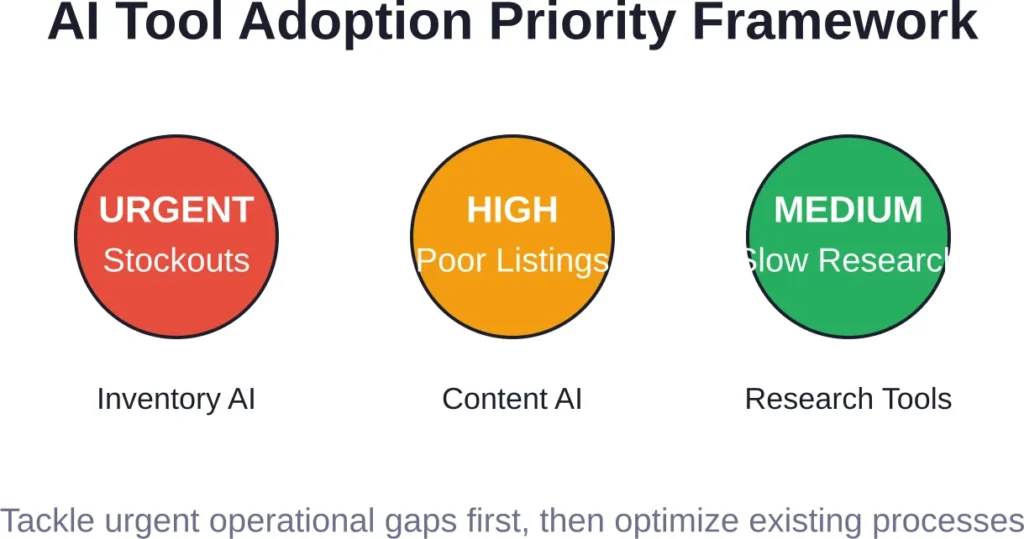
Start with your biggest pain point. Where are you spending the most time for the least return? That’s where AI automation delivers the fastest ROI. For most sellers, that’s either product research, listing optimization, or inventory management.
Consider integration carefully. Tools that work together through shared data or APIs create compound value. Helium 10 data feeding into ChatGPT prompts, pricing tools that sync with inventory management—these connections eliminate manual data transfer and create smoother workflows.
Check current pricing through official channels before committing. Subscription costs shift frequently, and many tools offer free trials that let you test functionality before purchasing. Take advantage of trial periods to verify the tool solves your specific problem.
Implementation and Learning Curve
AI tools are powerful, but they’re not plug-and-play. Expect a learning curve, especially with comprehensive platforms like Helium 10 or Seller Assistant. Budget time for setup, configuration, and experimentation.
Most tools provide documentation and tutorials—actually use them. The difference between someone who skims the basics and someone who masters advanced features is often the difference between marginal gains and transformative results.
Start simple. Don’t try to automate everything on day one. Pick one workflow, implement one tool, master it, measure the results, then expand. That methodical approach prevents overwhelm and ensures each tool actually delivers value before adding complexity.
Track results explicitly. How much time did you save? How did conversion rates change? What happened to stockout frequency? Concrete metrics justify the subscription costs and guide decisions about which tools to keep versus which to cut.
Common Mistakes to Avoid
Tool overload is real. Sellers sometimes subscribe to five or six platforms that overlap in functionality, paying for features they never use. Consolidate where possible—one excellent all-in-one tool often beats three specialized ones that don’t integrate.
Over-automation can backfire. AI should handle repetitive, rule-based work, but human judgment still matters for strategy, positioning, and customer relationships. Don’t automate to the point where you lose touch with your business.
Ignoring data quality is another pitfall. AI tools are only as good as the data they work with. Garbage in, garbage out. Keep product data clean, maintain accurate inventory counts, and verify integrations are pulling correct information.
Skipping trials is foolish. Most quality tools offer free trials or money-back guarantees. Use them. Don’t commit to annual subscriptions before confirming the tool solves your actual problem, not just a theoretical one.
The Future of AI for Amazon Sellers
Amazon itself is investing heavily in AI tools for sellers. SOFTEN: ‘Amazon has announced Project Amelia as an AI-powered assistant for sellers.’ This native integration signals Amazon’s recognition that sellers need AI-powered support to succeed on the platform.
The trend is toward consolidation and deeper integration. Expect tools that combine multiple functions—research, listing optimization, inventory management, customer service—in unified platforms with shared data models. Standalone point solutions will struggle against integrated suites.
Natural language interfaces are becoming standard. Instead of learning complex dashboards, sellers will increasingly just ask questions or give commands in plain English. The AI handles the complexity behind the scenes.
That said, the fundamentals don’t change. AI doesn’t eliminate the need for good products, competitive pricing, or customer service—it just makes executing on those fundamentals faster and more efficient.
Frequently Asked Questions
The most commonly used tools among successful sellers include Helium 10 for product research and analytics, ChatGPT or Claude for content creation, and specialized solutions for inventory management and pricing optimization. Most profitable sellers use 2-4 core tools rather than trying to implement everything at once.
Entry-level sellers can start with $40-100 per month covering basic research and content tools. Mid-level sellers typically invest $200-500 monthly across research, inventory management, and repricing. Large operations may spend $1,000+ monthly on comprehensive tool suites, but the ROI at that level justifies the cost through time savings and profit optimization.
AI-powered research tools significantly speed up product opportunity identification by analyzing massive datasets—sales estimates, competition levels, keyword trends—that would take weeks to compile manually. However, the AI identifies opportunities; sellers still need judgment to evaluate whether a product fits their business model, sourcing capabilities, and risk tolerance.
Most modern AI tools for Amazon sellers are designed for non-technical users. Tools like ChatGPT, Helium 10, and Seller Assistant provide user-friendly interfaces that require no coding or technical expertise. The learning curve involves understanding the tool’s features and workflows, not technical implementation.
Yes, using AI to write product listings is permitted under Amazon’s terms of service. However, sellers remain responsible for ensuring accuracy, compliance with category-specific guidelines, and avoiding prohibited claims. AI tools generate content, but human review and editing ensure compliance and quality.
AI inventory systems analyze historical sales patterns, seasonal trends, lead times, and other variables to forecast demand at the SKU level. They automatically trigger reorder workflows when stock levels drop below calculated thresholds, accounting for supplier lead time and sales velocity. This proactive approach reduces stockouts by up to 30% compared to manual monitoring.
Free tools like ChatGPT’s basic tier and free trials of platforms like Helium 10 provide real value for sellers just starting out. However, serious sellers typically find that paid subscriptions deliver ROI through advanced features, faster processing, and better integration with Amazon’s systems. Start with free options, then upgrade as specific limitations impact your operations.
Conclusion
AI tools have moved from optional nice-to-haves to essential infrastructure for competitive Amazon selling. The sellers gaining market share in 2026 are those who’ve automated repetitive work and redirected their time toward strategy, product selection, and customer relationships.
Start with your biggest pain point. Implement one tool, master it, measure the results, then expand. That disciplined approach builds sustainable competitive advantage without overwhelming your operations or budget.
The tools covered here—Helium 10, ChatGPT, Claude, Seller Assistant, Profasee, and others—represent proven solutions that sellers use daily to run profitable businesses. Check current pricing and features through official channels, take advantage of free trials, and prioritize tools that integrate with your existing workflows.
Ready to transform your Amazon operations? Pick one tool from this list that addresses your most pressing challenge and start a trial today. The sellers who wait for perfect conditions stay stuck in manual operations while early adopters scale.