

Quick Summary: Sellics was discontinued in 2021 when Perpetua acquired it and sunset most of its standalone seller tools. Former Sellics users now rely on alternatives like WisePPC, Helium 10, Jungle Scout, SmartScout, and ZonGuru for Amazon product research, keyword tracking, PPC automation, and listing optimization. This guide reviews the best replacements in 2026, comparing features, pricing, and which tool fits different seller needs.
Sellics used to be the go-to Amazon seller suite for thousands of FBA businesses. Perpetua acquired Sellics in 2021 and migrated its advertising platform into its own ecosystem, discontinuing other standalone seller tools.
If you’re still searching for Sellics alternatives in 2026, you’re either a legacy user hunting for a replacement or someone who stumbled onto an outdated recommendation. Either way, the good news is the market filled that gap quickly.
The following sections cover the best Sellics replacements available right now—what they do well, where they fall short, and how to pick the right one without overpaying for features nobody uses.
What Happened to Sellics?
Sellics ceased operations as a standalone Amazon seller platform in 2021. Perpetua, an Amazon advertising specialist, acquired the company and migrated its advertising platform into its own ecosystem.
The product research, keyword tracking, profit dashboards, and review management features that made Sellics popular? Gone. Perpetua kept the ad tech and discontinued other standalone seller tools.
Former Sellics users migrated to competitors like Helium 10, Jungle Scout, and SmartScout. Some held onto Sonar—Sellics’ free keyword tool—until Perpetua officially retired it too. The Sonar landing page now redirects visitors to Perpetua’s paid platform.
So if anyone’s still recommending Sonar or Sellics as active tools in 2026, they’re working from outdated data.
What Makes a Good Sellics Replacement in 2026?
Sellics wasn’t just one tool. It bundled product research, keyword tracking, PPC management, profit analytics, and inventory alerts into a single dashboard. That’s a lot to replace.
Here’s what matters when evaluating alternatives:
- Product and keyword research: Can the tool surface profitable niches, estimate sales volume, and suggest high-converting keywords?
- PPC automation: Does it optimize bids, structure campaigns, or at least offer decent reporting?
- Listing optimization: Does it analyze competitor listings, suggest improvements, or track ranking changes?
- Profit tracking: Can it calculate true net profit after fees, PPC spend, and cost of goods?
- Pricing: Is it affordable for sellers doing $50K–$500K annually, or does it only make sense for seven-figure brands?
Most tools excel at one or two of these. Very few nail all five. The best Sellics alternative for a wholesale reseller looks different from the best choice for a private label brand launching new products every quarter.
Top Sellics Alternatives for Amazon Sellers in 2026
Here’s the honest breakdown of the tools that replaced Sellics—what they do, what they cost, and who should use them.
1. WisePPC: The PPC-Focused Analytics Powerhouse for Data-Driven Sellers

WisePPC is a specialized Amazon PPC optimization and analytics platform (with Shopify support) that stands out for sellers who want deep advertising insights and bulk control without the bloat of full all-in-one suites. Many former Sellics users who prioritized PPC automation and long-term data turn to tools like this when they need more granular visibility than Amazon’s native console provides.
What it does well:
- Bulk Actions & Inline Editing — Apply changes (pause, adjust bids/budgets, status) to thousands of campaigns, ad groups, and targets in one go using powerful filters.
- 30+ Advanced Metrics with Granular Tracking — Hourly insights on placements, keywords, and targets; track up to 6 metrics simultaneously in customizable charts (ACoS, ROAS, TACoS, CTR, etc.).
- Long-Term Historical Data — Stores years of performance data (vs. Amazon’s 60-90 days), enabling trend analysis, seasonality insights, and better strategic decisions.
- Advanced Filtering & Visualization — Gradient-based highlighting to spot anomalies fast, critical data segmentation (by campaign type, match type, bid strategy), and placement-level performance breakdowns.
- Real-Time & Unified Dashboard — Combines ad performance with sales data for clear ad impact visibility; Amazon Ads Verified Partner with official integration.
The platform excels at scaling campaign management for mid-to-large accounts through automation-friendly tools and deep analytics.
Where it falls short:
WisePPC is still relatively young (in beta/growing phase in 2026) and remains heavily PPC- and analytics-focused. It lacks the broad product research, keyword discovery, or listing optimization tools found in Helium 10 or Jungle Scout. AI-powered auto-bidding and inventory forecasting are upcoming but not fully mature yet. Pricing details are often “contact vendor” or usage-based (starting around $126+/month in some listings), which can feel opaque for smaller sellers.
Best for: Amazon and multi-channel sellers with significant ad spend ($5K–$50K+/month) who need superior PPC analytics, bulk management, and long-term historical data. Ideal as a dedicated PPC companion or Sellics PPC replacement rather than a full all-in-one suite.
Contact Information:
- Website: wiseppc.com
- Facebook: www.facebook.com/people/Wise-PPC/61573154427547
- LinkedIn: www.linkedin.com/company/wiseppc
- Instagram: www.instagram.com/wiseppc
2. Helium 10: The Comprehensive Suite for Scaling Sellers

Helium 10 consistently ranks as the most feature-rich Amazon seller platform. It’s what most former Sellics users migrated to, especially those running private label brands.
What it does well:
- Black Box finds product opportunities by filtering sales, price, review count, and competition.
- Cerebro reverse-engineers competitor keyword strategies—paste an ASIN, get thousands of ranking keywords.
- Magnet generates keyword ideas with search volume and competition scores.
- Frankenstein and Scribbles help build optimized listings without keyword stuffing.
- Adtomic automates PPC with rule-based bidding, dayparting, and AI-powered optimization.
- Profits dashboard tracks true net profit across multiple marketplaces.
The platform covers nearly every function Sellics offered, plus deeper tools for listing optimization and competitor analysis. Helium 10’s Chrome extension overlays data directly on Amazon search results and product pages, making research faster.
Where it falls short:
Helium 10 pricing tiers exist with varying feature access. The entry-level plans lock essential features, and the full suite requires a Diamond plan. For beginners or sellers doing under $5,000 monthly revenue, the cost outweighs the ROI.
The interface also suffers from feature bloat. New users spend days figuring out which of the 30+ tools they actually need.
Best for: Private label sellers scaling past $10K/month who need deep keyword research, listing optimization, and PPC automation in one platform.
3. Jungle Scout: The All-in-One Solution for Product Research

Jungle Scout built its reputation on product research. Its database estimates sales, revenue, and competition for millions of Amazon products, and the accuracy holds up better than most competitors.
What it does well:
- Product Database filters by category, sales velocity, price, and review count to surface opportunities.
- Keyword Scout provides search volume and PPC cost estimates for Amazon keywords.
- Listing Builder suggests optimized titles, bullets, and backend keywords.
- Sales Analytics tracks daily sales, traffic, and conversion rates for any ASIN.
- Supplier Database connects sellers with manufacturers, vetted by Jungle Scout’s team.
Jungle Scout offers repricing tools starting at $99/month for sellers with up to $5,000 in monthly revenue, expanding to $250/month for higher-volume accounts. The repricing tool supports 20 marketplaces, including Amazon US, Canada, UK, Mexico, Brazil, Germany, France, Italy, Spain, Netherlands, Japan, Australia, UAE, Sweden, Poland, Belgium, South Africa, Turkey, Saudi Arabia, and Singapore, plus Walmart.
Jungle Scout also runs a 14-day free trial—no credit card required—making it easier to test before committing.
Where it falls short:
Jungle Scout’s PPC tools lag behind Helium 10 and Perpetua. The ad automation exists, but it’s basic. Sellers serious about PPC often pair Jungle Scout with a dedicated ad platform.
The profit dashboard exists but doesn’t integrate as cleanly as Helium 10’s. Some users report sync delays with Amazon’s API.
Best for: Sellers hunting for new products to launch, especially those who value accurate sales estimates and supplier sourcing over advanced PPC features.
4. SmartScout: Deep Market Intelligence for Strategic Sellers

SmartScout takes a different angle. Instead of focusing on individual products or keywords, it maps entire categories, brands, and market share.
What it does well:
- Traffic Graph visualizes which brands dominate a category and where white space exists.
- Brand and seller database shows revenue estimates, top ASINs, and sales trends for competitors.
- Subcategory analysis reveals overlooked niches with lower competition.
- FBA fee calculator and profit estimator help evaluate product viability.
SmartScout’s Chrome extension overlays data on Amazon pages, and the mobile app brings the same insights to smartphones. The tool excels at brand research—if you’re evaluating acquisition targets, potential wholesale partnerships, or competitive positioning, SmartScout surfaces data other tools miss.
Pricing starts at $25/month when paid annually, making it one of the most affordable Amazon research platforms. New users can apply SmartScout coupon codes to receive additional discounts.
Where it falls short:
SmartScout doesn’t offer PPC automation, listing optimization, or keyword tracking at the depth Helium 10 or Jungle Scout provide. It’s a research and intelligence layer, not an operational suite.
Sellers who need daily workflow tools—keyword rank tracking, automated repricing, split-test dashboards—will need to supplement SmartScout with other platforms.
Best for: Strategic sellers, agencies, and aggregators who prioritize market intelligence, brand research, and category mapping over day-to-day operational tools.
5. ZonGuru: Listing Optimization and SEO for Amazon

ZonGuru carved out a niche in listing optimization and SEO. The platform focuses less on product discovery and more on maximizing the performance of products already in your catalog.
What it does well:
- Listify analyzes competitor listings and suggests title, bullet, and description improvements.
- Keywords on Fire tracks keyword rankings daily and alerts sellers to drops.
- Business Dashboard consolidates sales, profit, and inventory metrics in one view.
- Photo Enhancer and Love-Hate review analysis help refine creative and messaging.
ZonGuru’s interface feels less cluttered than Helium 10. The learning curve is gentler, and the support team responds faster based on community discussions.
Pricing sits in the middle tier—not as cheap as SmartScout, not as expensive as Helium 10’s premium plans. The platform offers monthly and annual billing, with discounts for longer commitments.
Where it falls short:
Product research tools are weaker. ZonGuru’s Niche Finder works, but the database doesn’t match Jungle Scout’s depth or Helium 10’s filtering options.
PPC tools exist but remain basic. Sellers running complex campaigns often pair ZonGuru with Perpetua or Helium 10’s Adtomic.
Best for: Sellers with established product catalogs who want to improve rankings, optimize listings, and track keyword performance without paying for bloated all-in-one suites.
6. AMZScout: Budget-Friendly Research for New Sellers

AMZScout targets beginners and budget-conscious sellers. The platform offers product research, keyword tools, and a Chrome extension at a lower price point than Helium 10 or Jungle Scout.
What it does well:
- Product Database estimates sales and revenue for millions of ASINs.
- Niche Score rates product opportunities on a 1–10 scale based on demand, competition, and profitability.
- Keyword Explorer suggests keywords with search volume and trend data.
- Quick View Chrome extension overlays sales estimates and profitability metrics on Amazon search pages.
AMZScout’s simplified interface makes it approachable for sellers who find Helium 10 overwhelming. The tool doesn’t try to do everything—it focuses on helping users find products worth selling.
Where it falls short:
Data accuracy lags behind Jungle Scout and Helium 10. Sales estimates skew higher, especially in competitive categories. Smart sellers cross-reference AMZScout data with at least one other tool before making inventory decisions.
PPC, listing optimization, and profit tracking are either missing or underdeveloped. AMZScout works as a research layer, not a full operational suite.
Best for: New sellers testing the Amazon FBA model who want affordable product research without committing to premium platforms.
7. SellerApp: Keyword Suggestions and Listing Audit

SellerApp focuses on keyword research and listing quality scores. The platform analyzes competitor keywords, suggests optimizations, and audits listing health.
What it does well:
- Reverse ASIN lookup reveals competitor keyword strategies.
- Listing Quality Score evaluates titles, bullets, descriptions, and images against best practices.
- Keyword tracking monitors daily rank changes.
- Product Intelligence Dashboard consolidates sales, traffic, and conversion metrics.
SellerApp’s interface feels cleaner than Helium 10. The keyword suggestion engine pulls data from Amazon autocomplete, competitor listings, and search trends, surfacing long-tail phrases other tools miss.
Pricing starts at $99/month for the basic plan, positioning SellerApp in the mid-tier range.
Where it falls short:
Product research tools are weaker. SellerApp works better for optimizing existing listings than discovering new products to launch.
PPC automation exists but doesn’t compete with Perpetua or Helium 10’s Adtomic. Sellers running large ad budgets typically use dedicated platforms.
Best for: Sellers who prioritize keyword research and listing optimization over product discovery or advanced PPC.
8. Perpetua: PPC Automation for Ad-Heavy Sellers
Perpetua acquired Sellics and kept the PPC engine. If advertising was the main reason someone used Sellics, Perpetua is the direct successor.
What it does well:
- AI-powered bid optimization adjusts bids hourly based on performance goals.
- Goal-based campaigns align ad spend with targets like ACoS, total sales, or profit margin.
- Dayparting schedules bids to increase during high-conversion hours and decrease overnight.
- Cross-platform support extends beyond Amazon to Walmart, Instacart, and Target.
Perpetua’s ad engine is legitimately sophisticated. The platform uses machine learning to identify trends humans miss and adjusts bids faster than manual management allows.
Perpetua pricing starts at $695/month plus a percentage of ad spend. That’s steep for small sellers, but agencies and brands spending $20K+/month on ads often see positive ROI within 60 days.
Where it falls short:
Perpetua does PPC. That’s it. No product research, no keyword tracking outside ad campaigns, no listing builder, no profit dashboard. Sellers need to pair it with Helium 10, Jungle Scout, or SmartScout to cover the rest.
Best for: Brands and agencies spending $10K+/month on Amazon ads who need sophisticated automation and are willing to pay for it.
Free and Supplementary Tools Worth Trying
Not every seller needs an all-in-one suite. Some gaps can be filled with free or low-cost tools that do one thing well.
Thunderbit: Bulk Data Extraction for Amazon

Thunderbit is a Chrome extension that scrapes Amazon product data at scale. Point it at a search results page, and it exports ASINs, titles, prices, ratings, and review counts into a spreadsheet.
It’s useful for building target lists, tracking competitor catalogs, or pulling data for custom analysis. The free tier allows basic scraping; paid plans unlock faster extraction and more fields.
Thunderbit doesn’t estimate sales or provide keyword research. It’s a data extraction layer, not a research platform. Pair it with Jungle Scout or Helium 10 for deeper insights.
Amazon’s Native Tools

Amazon provides free tools through Seller Central that many sellers overlook:
- Brand Analytics: Shows top search terms, click share, and conversion share for brand-registered sellers.
- Search Query Performance: Reveals which keywords drive impressions, clicks, and sales for your ASINs.
- Manage Your Experiments: A/B tests titles, images, and A+ content.
These tools don’t replace third-party platforms, but they supplement them with Amazon’s own data. Smart sellers cross-reference Helium 10 keyword estimates with Amazon’s Brand Analytics to validate assumptions.
How to Pick the Right Sellics Alternative
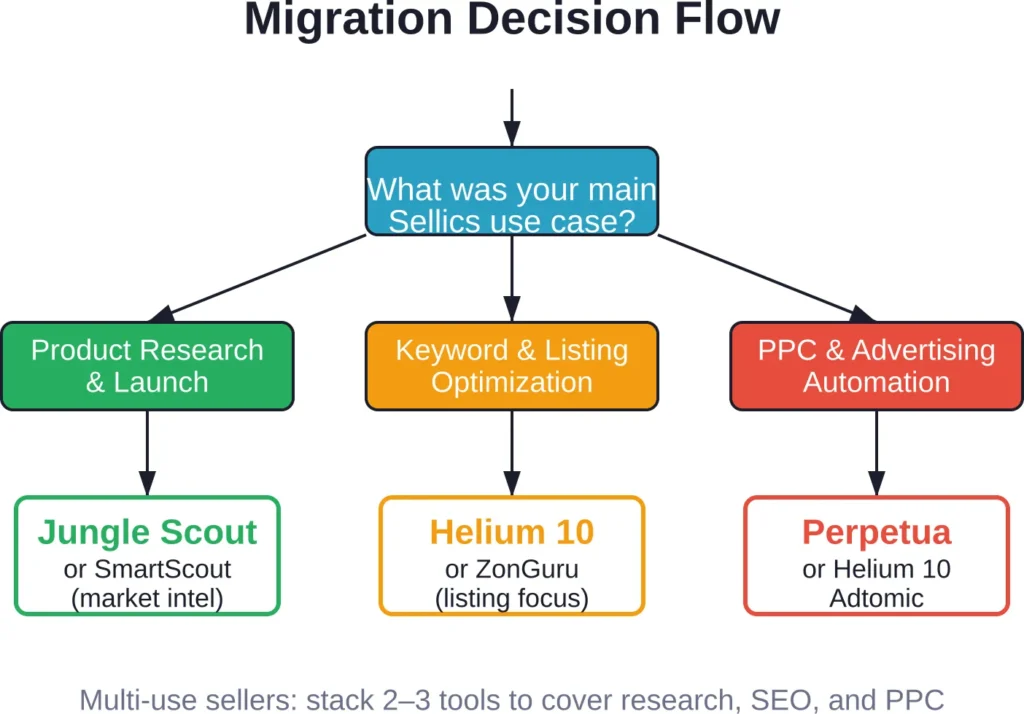
Choosing a replacement depends on what you’re trying to accomplish. Here’s a decision framework:
| If your priority is… | Best tool | Why |
|---|---|---|
| Finding new products to launch | Jungle Scout | Best sales estimation accuracy and supplier database |
| Deep keyword research and listing SEO | Helium 10 or ZonGuru | Helium 10 for breadth, ZonGuru for simplicity |
| Brand and category intelligence | SmartScout | Maps market share and competitive positioning |
| Advanced PPC automation | Perpetua | AI-driven bidding and goal-based campaign management |
| Budget-friendly research | AMZScout or SmartScout | AMZScout for product discovery, SmartScout for category mapping |
| All-in-one suite for scaling sellers | Helium 10 | Covers product research, keywords, PPC, and profit tracking |
Most sellers eventually stack two or three tools. A common combo is Jungle Scout for product research, Helium 10 for keywords and listings, and Perpetua for PPC. That’s not cheap, but it avoids relying on one platform’s weak points.
Another popular stack: SmartScout for market intelligence, Amazon’s native Brand Analytics for keyword validation, and ZonGuru for listing optimization. Total cost stays under $150/month.
Common Mistakes When Switching from Sellics
Former Sellics users often make the same errors when migrating to a new platform. Here’s what to avoid:
Paying for Features You Don’t Use
Helium 10’s Diamond plan costs hundreds per month and unlocks 30+ tools. Most sellers use five of them. Before upgrading, audit which features you actually open weekly. If you’re not running PPC campaigns, don’t pay for Adtomic. If you’re not launching new products, skip the product research modules.
Many platforms offer modular pricing or quarterly commitments. Start small, then scale as needs evolve.
Trusting One Data Source
Every Amazon tool estimates sales using incomplete data. Jungle Scout might show 500 monthly sales for an ASIN; Helium 10 might show 700. Neither is definitively correct—Amazon doesn’t publish exact figures.
Smart sellers triangulate. Check two or three tools, look at review velocity, and validate with Amazon’s own Brand Analytics if available. Don’t bet inventory dollars on one platform’s estimate.
Ignoring Free Trials
Jungle Scout offers a 14-day free trial with no credit card required. Helium 10 and ZonGuru run similar programs. Test before committing.
Use the trial period to run real research—pull keyword data for top products, analyze competitor listings, and test the PPC automation if available. Kick the tires hard. If the interface feels clunky or the data looks off, move on.
Overlooking Integration Gaps
Sellics synced directly with Amazon’s API for real-time profit tracking and inventory alerts. Not every alternative replicates that integration quality.
Before switching, confirm the new platform connects to your Amazon account, pulls accurate fee data, and updates daily. Some tools lag 24–48 hours behind Amazon’s API, which creates blind spots for fast-moving inventory.
Pricing Considerations: What’s Worth Paying For?
Amazon seller tools range from free Chrome extensions to enterprise platforms costing thousands per month. Here’s what different price tiers typically deliver:
Under $50/Month
At this tier, tools focus on one or two functions—usually product research or keyword tracking. SmartScout at $25/month offers solid category intelligence. AMZScout’s basic plan falls here too.
Expect limitations: fewer keywords, slower data refresh rates, and basic reporting. These plans work for part-time sellers or those validating ideas before scaling.
$50–$150/Month
This range unlocks most core features. Jungle Scout and ZonGuru sit here, offering product research, keyword tools, and listing optimization.
Helium 10’s mid-tier plans land in this bracket too, though they lock some advanced features. Sellers doing $10K–$50K monthly revenue often find the best ROI in this tier.
$150–$500/Month
Premium plans from Helium 10, plus add-ons like repricing or advanced PPC automation. Jungle Scout offers repricing tools with pricing scaled by account volume.
At this level, tools should deliver measurable profit increases—better ad performance, faster product launches, or improved Buy Box win rates. If the tool isn’t paying for itself within 60 days, reconsider the spend.
$500+/Month
Enterprise territory. Perpetua pricing starts at $695/month plus a percentage of ad spend. Jungle Scout Cobalt and similar market intelligence platforms target brands, agencies, and financial services firms analyzing Amazon at scale.
These tools make sense for seven-figure sellers, aggregators, or agencies managing multiple brands. Small sellers rarely see ROI here.
Real-World Use Cases: Which Tool Fits Your Situation?
Let’s walk through a few scenarios to clarify which Sellics alternative makes sense.
Scenario 1: New Seller Hunting for First Product
Budget: $50–$100/month. Priority: finding a profitable product without wasting money on bad data.
Recommendation: Jungle Scout’s basic plan. The product database is accurate, the niche score simplifies decision-making, and the 14-day free trial lets sellers validate a few ideas before paying.
Pair it with Amazon’s free Brand Analytics once brand-registered. Skip PPC automation for now—manual campaigns work fine when spend is low.
Scenario 2: Established Seller Optimizing Listings
Budget: $100–$200/month. Priority: improving keyword rankings and conversion rates for existing catalog.
Recommendation: ZonGuru or Helium 10’s mid-tier plan. ZonGuru’s Listify and Keywords on Fire tools directly address listing SEO. Helium 10’s Cerebro and Frankenstein offer deeper keyword research if needed.
Add Amazon’s Manage Your Experiments to A/B test changes. Don’t pay for product research tools—those aren’t needed without new product launches.
Scenario 3: Brand Scaling PPC Spend
Budget: $500+/month. Priority: automating ad management to maintain 20% ACoS while scaling spend from $10K to $30K monthly.
Recommendation: Perpetua. The AI bidding engine handles complexity manual management can’t match. Goal-based campaigns align spend with profit targets, and dayparting squeezes efficiency from every hour.
Pair it with Helium 10 or Jungle Scout for keyword research and listing optimization—Perpetua doesn’t cover those.
Scenario 4: Agency Managing Multiple Brands
Budget: $300–$1,000/month per client. Priority: category intelligence, competitive benchmarking, and scalable workflows.
Recommendation: SmartScout for market mapping, Helium 10 for operational tools, and Perpetua for PPC. SmartScout reveals market share and brand positioning—critical for pitch decks and quarterly reviews.
Helium 10’s user management supports multiple team members. Perpetua’s cross-platform support extends to Walmart and Instacart if clients sell beyond Amazon.
Final Thoughts: The Sellics Gap is Filled
Sellics is gone, but the market didn’t slow down. Helium 10, Jungle Scout, SmartScout, ZonGuru, and Perpetua each grabbed pieces of what Sellics used to offer—and in most cases, improved on it.
The challenge now isn’t finding a replacement. It’s avoiding the temptation to pay for everything when most sellers only need two or three focused tools.
Start with one platform that addresses your biggest bottleneck. New product launches? Jungle Scout. Keyword rankings? ZonGuru. PPC scaling? Perpetua. Test it for 30–60 days, measure the ROI, then layer on additional tools if gaps remain.
The best Sellics alternative isn’t the one with the most features. It’s the one that solves your specific problem without burning budget on tools that sit unused.
Frequently Asked Questions
No. Sellics ceased operations as a standalone Amazon seller platform in 2021 after Perpetua acquired it. Perpetua absorbed the PPC tools but discontinued product research, keyword tracking, profit dashboards, and other seller features. Former Sellics users have migrated to alternatives like Helium 10, Jungle Scout, and SmartScout.
Sonar was retired after Perpetua acquired Sellics. The Sonar website now redirects to Perpetua’s paid platform. Sellers looking for free keyword research can use Amazon’s Brand Analytics (for brand-registered accounts) or tools like Helium 10’s free tier, which offers limited keyword searches.
Jungle Scout is the most beginner-friendly option. The interface is clean, the product database is accurate, and the 14-day free trial requires no credit card. AMZScout is another budget option, though data accuracy lags behind Jungle Scout. Avoid Helium 10 initially—the feature bloat overwhelms new sellers.
Partially. Amazon’s Brand Analytics, Search Query Performance, and Manage Your Experiments cover keyword validation, traffic insights, and A/B testing at no cost. Free Chrome extensions like Thunderbit extract product data. But sales estimation, competitive analysis, and PPC automation require paid platforms. A realistic free-only approach limits research depth significantly.
SmartScout starts at $25/month. Jungle Scout and ZonGuru range from $49–$149/month depending on the plan. Helium 10 starts around $79/month but requires higher tiers for full features. SellerApp begins at $99/month. Perpetua starts at $695/month plus a percentage of ad spend. Jungle Scout offers repricing tools starting at $99/month for accounts under $5,000 monthly revenue and $250/month for larger volumes.
Most sellers eventually stack two or three specialized tools. A common setup: Jungle Scout for product research, Helium 10 or ZonGuru for keywords and listing optimization, and Perpetua for PPC. Trying to find one tool that does everything usually means settling for mediocre performance across the board. Budget $150–$300/month for a solid two-tool stack.
Jungle Scout consistently ranks highest for sales estimation accuracy, based on community testing and cross-referencing with Amazon’s own Brand Analytics data. Helium 10 is close behind. AMZScout tends to overestimate, especially in high-competition categories. No tool is perfect—Amazon doesn’t publish exact sales figures—so smart sellers triangulate data across two platforms before making inventory decisions.
Conclusion
Sellics left a gap, but the alternatives filled it fast—and in most cases, improved on what Sellics offered. Helium 10 delivers the most comprehensive suite for scaling sellers. Jungle Scout excels at product research and sales estimation. SmartScout maps market intelligence at an unbeatable price. ZonGuru simplifies listing optimization. Perpetua automates PPC for brands spending serious ad budgets.
The right choice depends on where your business is today and where you’re trying to go. Test the free trials, measure the ROI, and avoid paying for features you’ll never use.
Most sellers don’t need the biggest platform. They need the right tool for the problem in front of them. Pick one, master it, and scale from there.