

Quick Summary: Intentwise is a powerful Amazon advertising platform, but several alternatives offer compelling features for different use cases. This guide reviews the top Intentwise competitors in 2026, including WisePPC, Perpetua, Pacvue, Quartile, and Teikametrics, comparing their AI capabilities, pricing structures, and best-fit scenarios to help you choose the right Amazon PPC software for your brand’s specific needs and budget.
Intentwise has built a solid reputation in the Amazon advertising space, particularly with its recent focus on Commerce Observability—unifying marketplace signals into one intelligence architecture. But here’s the thing: it’s not the only game in town.
Brands spending $10,000 or more monthly on Amazon ads face a critical decision. Many brands report improvements in advertising performance through software optimization. The wrong platform? That’s wasted budget and missed opportunities.
This guide cuts through the noise. We’ve analyzed the top alternatives to Intentwise based on verified capabilities, pricing transparency, and real-world performance data from agencies managing complex accounts. Whether Intentwise’s pricing doesn’t fit your budget, its feature set doesn’t match your workflow, or you’re simply exploring options before committing, these alternatives deserve serious consideration.
Why Consider Intentwise Alternatives?
Intentwise excels at certain things. Its AI-driven SQL generation in Amazon Marketing Cloud (AMC) has reached 80-90% accuracy, a substantial leap from the 40-60% accuracy at launch 6-7 months prior, according to Intentwise’s official website and Up Next event materials. The platform’s push toward Commerce Observability represents a genuine innovation in how brands unify fragmented marketplace signals.
But that doesn’t mean it’s the right fit for every operation.
Some brands need simpler rule-based systems with transparent logic. Others require deeper integrations with Walmart, TikTok, or Google—channels where Intentwise may not offer the same depth. Pricing structure matters too. Platforms that work for agencies managing dozens of brands might be overkill for a single seller doing $50K monthly.
And then there’s the strategic question: do you want a platform that optimizes purely for ACoS, or one that thinks in terms of total profitability (TACoS) and organic rank impact? Different tools prioritize different outcomes.
What Makes a Strong Intentwise Alternative?
Before jumping into specific platforms, let’s establish what actually matters when evaluating Amazon PPC software.
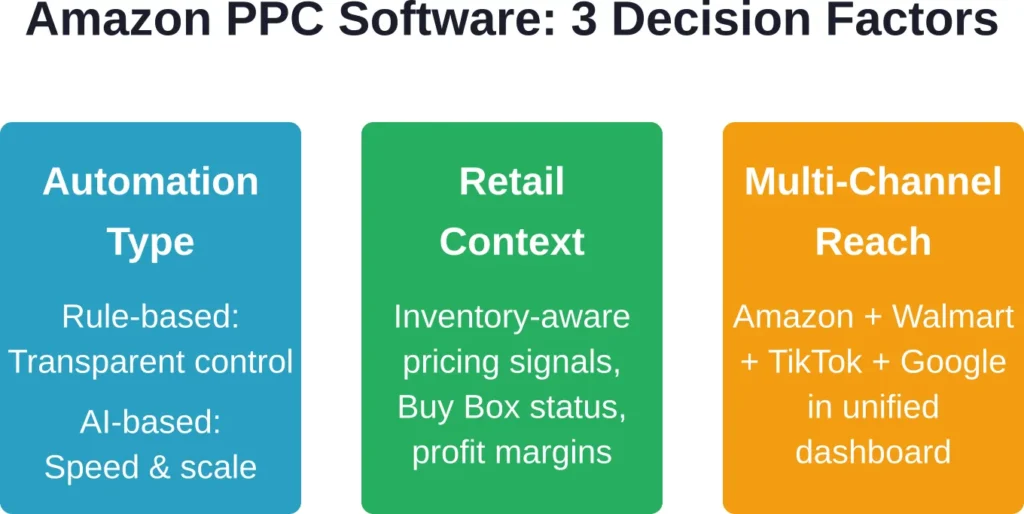
Automation Philosophy
Amazon PPC tools fall into three camps: rule-based, AI-based, or hybrid approaches combining both.
Rule-based systems operate on “If-This-Then-That” logic. Set a rule like “If a keyword has 20 clicks and zero sales, decrease the bid by 20%” and the system executes exactly that. High transparency, but these tools are often static—they don’t adapt to market changes unless you manually update the rules.
AI-based tools use machine learning algorithms to optimize thousands of keywords simultaneously. They react to market shifts faster than humans can, but the decision-making process can feel like a black box.
The best platforms in 2026 combine both: AI for pattern recognition and speed, with rule overrides for strategic control.
Retail-Aware Optimization
Here’s where most tools fall short. They optimize bids based on ad performance alone, ignoring the retail context.
Retail-aware platforms factor in inventory levels, competitor pricing, organic rank changes, and profit margins before making bid decisions. If you’re out of stock or your Buy Box ownership drops, the system automatically adjusts ad spend rather than burning budget on non-converting clicks.
For brands where gaining a 1-2% edge in share-of-voice can translate into meaningful revenue, this contextual intelligence is non-negotiable.
Multi-Channel Capabilities
Amazon isn’t the only battlefield anymore. Walmart Connect, TikTok Shop, and Google Shopping demand attention from serious sellers.
Some platforms started Amazon-only and bolted on other channels later. Others were built multi-channel from the ground up. The difference shows in how seamlessly data flows across platforms and whether you’re managing campaigns in one dashboard or juggling multiple interfaces.
Pricing Transparency
Many platforms hide pricing behind “contact sales” walls. That’s frustrating when you’re trying to budget.
The best alternatives publish clear starting tiers. Even if you’ll eventually negotiate custom enterprise pricing, knowing the baseline helps you compare options rationally.
Top 11 Intentwise Alternatives for 2026
Now, let’s get into the platforms themselves. These alternatives were selected based on verified capabilities, technology depth, and proven performance with brands managing significant ad spend.
1. WisePPC

WisePPC is a powerful analytics-first platform built for Amazon and Shopify sellers who need deeper visibility, faster campaign management, and long-term data insights. It stands out as a practical, efficient alternative for those who want strong control and visualization without enterprise-level complexity.
What sets it apart: WisePPC excels in bulk actions and advanced filtering, letting users edit thousands of campaigns, bids, and budgets in seconds with inline editing. Its gradient-based highlighting and multi-metric charts (up to 6 metrics simultaneously) make it easy to spot anomalies and trends quickly. The platform’s biggest advantage is long-term historical data storage — it keeps years of performance data while Amazon only retains 60–90 days. It also offers placement-level breakdowns, critical data segmentation (by campaign type, bid strategy, match type, etc.), and strong visual analytics.
Multi-channel support: Currently focused on Amazon with solid Shopify integration for unified sales and ad analytics. Additional marketplace connections are in development.
Pricing structure: Currently in open beta with generous entry: free access during beta + extra free month after launch, plus a 25% lifetime discount for early users. Post-beta pricing is expected to be competitive and transparent (flat monthly tiers), significantly more accessible than heavy enterprise tools.
Best for: Mid-market sellers, growing brands, and agencies that manage dozens to hundreds of SKUs and want powerful analytics, bulk optimization, and long-term historical insights without paying enterprise premiums. Ideal for those frustrated with Amazon’s limited data retention and slow manual workflows who need a fast, visual, and scalable solution.
Contact Information:
- Website: wiseppc.com
- Facebook: www.facebook.com/people/Wise-PPC/61573154427547
- LinkedIn: www.linkedin.com/company/wiseppc
- Instagram: www.instagram.com/wiseppc
2. Perpetua
Perpetua positions itself as an enterprise-grade solution for brands serious about Amazon advertising. The platform combines AI-powered optimization with granular control—a balance that appeals to brands transitioning from manual management or outgrowing simpler tools.
What sets it apart: Perpetua’s goal-based optimization lets you set business objectives (maximize sales, hit a target ACoS, prioritize profitability) and the AI adjusts bids accordingly across thousands of keywords. The platform’s reporting goes deep into attribution, showing how Sponsored Product ads influence Sponsored Brand performance and vice versa.
Multi-channel support: Beyond Amazon, Perpetua handles Walmart, Instacart, and Criteo. If you’re expanding to other retail media networks, the unified reporting saves considerable time.
Pricing structure: Starts at higher tiers than beginner tools, typically justified for brands spending $10,000 or more monthly on ads. The platform uses a percentage-of-ad-spend model at scale.
Best for: Mid-to-large brands and agencies that need sophisticated automation without sacrificing strategic control. Works particularly well for operations managing 20+ SKUs with complex campaign architectures.
3. Pacvue
Pacvue takes a commerce-first approach, integrating advertising with broader e-commerce operations. The platform was purpose-built for brands managing large catalogs across multiple retail media networks.
What sets it apart: Pacvue’s retail media orchestration goes beyond bid management. The platform unifies search, display, and video campaigns across Amazon, Walmart, Instacart, Target, and Kroger. The workflow automation handles bulk operations that would take hours manually—especially valuable for brands with hundreds or thousands of SKUs.
Enterprise features: Advanced role-based permissions, API access for custom integrations, and white-label reporting for agencies. The platform handles complex organizational structures better than most competitors.
Pricing structure: Enterprise pricing with custom quotes. Typically starts higher than mid-market tools but includes dedicated support and onboarding.
Best for: Large brands and agencies managing extensive product catalogs and significant ad spend (typically $10,000 or more monthly). The platform justifies its cost when operational efficiency at scale matters more than incremental feature savings.
4. Teikametrics (Flywheel 2.0)
Teikametrics built its reputation on algorithmic optimization—using machine learning to adjust bids multiple times daily based on performance patterns the human eye would miss.
What sets it apart: Flywheel 2.0’s profit-based optimization sets target margins rather than just ACoS. The system factors in product costs, Amazon fees, and shipping to optimize for actual profit, not vanity metrics. For brands where different products have wildly different margin profiles, this approach prevents the common mistake of spending too much on low-margin items.
Advertising-to-operations bridge: The platform connects advertising decisions to inventory forecasting. If you’re running low on stock, Flywheel automatically scales back ad spend to avoid stockouts—a feature that’s saved many brands from the nightmare of paying for clicks when they can’t fulfill orders.
Pricing structure: Percentage of ad spend model with different tiers based on monthly spend volume. More transparent than many enterprise platforms.
Best for: Brands that think in terms of profit, not just revenue. Particularly strong for operations with complex fulfillment (FBA + FBM hybrid models) or seasonal inventory constraints.
5. Quartile

Quartile markets itself as a fully autonomous advertising platform—set your goals, connect your account, and let the AI run. This hands-off approach appeals to brands that don’t want to become Amazon advertising experts.
What sets it apart: Quartile’s differentiation lies in its proprietary machine learning models trained on billions in ad spend across its customer base. The platform learns from patterns across similar products and applies those insights to your campaigns. If a keyword performs well for comparable brands, Quartile tests it in your account automatically.
Cross-platform intelligence: Covers Amazon, Walmart, Instacart, and Criteo with unified budget allocation. The system can shift spend between platforms based on where it’s seeing better performance day-to-day.
Pricing structure: Percentage of ad spend with a minimum monthly commitment. The platform targets brands spending at least $10,000 monthly.
Best for: Brands that prefer autonomous operation over manual control. Works well for time-strapped teams that trust algorithmic decision-making and don’t need to micromanage every bid adjustment.
6. Skai (formerly Kenshoo)
Skai comes from the paid search world (Google, Bing) and brought that enterprise DNA to retail media. The platform handles Amazon as one piece of a much larger omnichannel advertising operation.
What sets it apart: Skai’s strength is cross-channel orchestration at scale. If you’re running coordinated campaigns across Amazon, Google Shopping, Facebook, TikTok, and Walmart, Skai provides a single interface for budget allocation, performance reporting, and strategic planning. The platform’s predictive budgeting uses historical data to forecast how budget shifts impact outcomes across all channels simultaneously.
Enterprise-grade infrastructure: Advanced user permissions, comprehensive API, white-label client portals, and integration with major analytics platforms. Built for agencies managing hundreds of clients or brands with complex organizational hierarchies.
Pricing structure: Enterprise only, with custom pricing based on total managed spend across all channels. Not transparent about entry-level costs.
Best for: Large agencies and enterprise brands running sophisticated omnichannel campaigns where Amazon is one part of a coordinated strategy. Overkill for Amazon-only operations.
7. Helium 10 Adtomic

Helium 10 is known for its all-in-one Amazon seller toolkit (product research, keyword tracking, listing optimization). Adtomic is their advertising module, tightly integrated with the broader platform.
What sets it apart: The integration with Helium 10’s other tools creates powerful workflows. Cerebro identifies high-opportunity keywords from competitor research, then Adtomic automatically tests them in your campaigns. The listing optimization tools and advertising layer share data, so you can see how changes to your content affect ad performance.
Simplicity focus: Adtomic prioritizes ease of use over advanced features. The interface is more straightforward than enterprise platforms—ideal for sellers who find tools like Pacvue overwhelming.
Pricing structure: Included in Helium 10’s higher subscription tiers (Platinum and Diamond plans). No additional percentage-of-ad-spend fees. This flat-rate pricing works well for smaller operations where percentage fees would exceed the monthly subscription.
Best for: Sellers already using Helium 10 for product research and listing optimization. Makes sense for operations where one person handles both organic and paid strategy and wants everything in a unified platform.
8. BidX
BidX focuses squarely on algorithmic bid optimization. The platform doesn’t try to be an all-in-one solution—it does one thing (automated bidding) and does it well.
What sets it apart: BidX’s algorithms adjust bids multiple times per day based on performance data, day-parting patterns, and conversion rate trends. The platform supports both ACoS-based and TACoS-based optimization strategies, making it suitable for brands that think about total advertising cost of sale rather than just ad-attributed revenue.
Dayparting sophistication: BidX identifies the hours when your products convert best and automatically increases bids during those windows while scaling back during low-conversion periods. This temporal optimization can improve efficiency without cutting overall spend.
Pricing structure: Percentage of ad spend with tiered rates. Relatively transparent compared to enterprise platforms.
Best for: Brands that want strong automation but don’t need multi-channel support or advanced retail analytics. Works well as a focused tool that integrates into a broader stack.
9. Sellozo
Sellozo positions itself as the middle ground between basic automation and enterprise complexity. The platform targets growing brands that have outgrown manual management but don’t need (or can’t afford) top-tier enterprise tools.
What sets it apart: Sellozo’s machine learning adjusts bids based on the likelihood of conversion, not just past performance. The platform predicts which keywords are trending toward better or worse performance and adjusts proactively. The keyword harvesting automation identifies high-performing search terms from auto campaigns and promotes them to manual campaigns automatically.
Managed service hybrid: Beyond the software, Sellozo offers a hybrid model where their team provides strategic guidance on campaign structure and keyword strategy. This bridges the gap between pure software and full-service agency management.
Pricing structure: Software-only and managed service tiers available. Pricing based on ad spend with clear published rates.
Best for: Brands spending $5,000-$50,000 monthly that want more sophistication than basic tools but aren’t ready for enterprise pricing. The managed service option works well for teams without deep Amazon advertising expertise.
10. m19
m19 was acquired by Skai but continues to operate as a focused Amazon advertising platform. The tool emphasizes machine learning-driven optimization with a particularly strong focus on new product launches.
What sets it apart: m19’s launch optimization algorithms are tuned specifically for products with limited sales history. The platform uses data from similar products in its network to make smarter early-stage bidding decisions—valuable when you don’t have months of performance data to train algorithms.
Anomaly detection: The platform monitors for unusual performance patterns (sudden ROAS drops, conversion rate changes, unexpected CPC spikes) and alerts users immediately. This early warning system helps brands catch issues before they burn significant budget.
Pricing structure: Percentage of ad spend model. Pricing details available through direct contact.
Best for: Brands launching new products frequently or managing portfolios where different items are at different lifecycle stages. The launch-focused features justify the cost for operations where effective new product introduction drives growth.
11. Zon.Tools

Zon.Tools takes a rule-based approach with AI enhancements—a hybrid that appeals to sellers who want automation but need to understand exactly why the system makes each decision.
What sets it apart: Zon.Tools’ transparent rule system lets you see precisely which rules triggered which bid changes. The AI layer suggests new rules based on performance patterns it detects, but you approve or reject each suggestion. This collaborative approach works well for sellers who’ve been burned by black-box algorithms making incomprehensible decisions.
Negative keyword automation: The platform automatically adds underperforming search terms to negative keyword lists based on your thresholds. This defensive optimization prevents wasted spend without requiring constant manual review.
Pricing structure: Flat monthly fee based on the number of campaigns managed, not percentage of ad spend. This pricing model benefits brands with high ad spend but simpler campaign structures.
Best for: Sellers who want to maintain strategic control and understand the logic behind optimizations. Works particularly well for operations transitioning from manual management and not yet comfortable with fully autonomous systems.
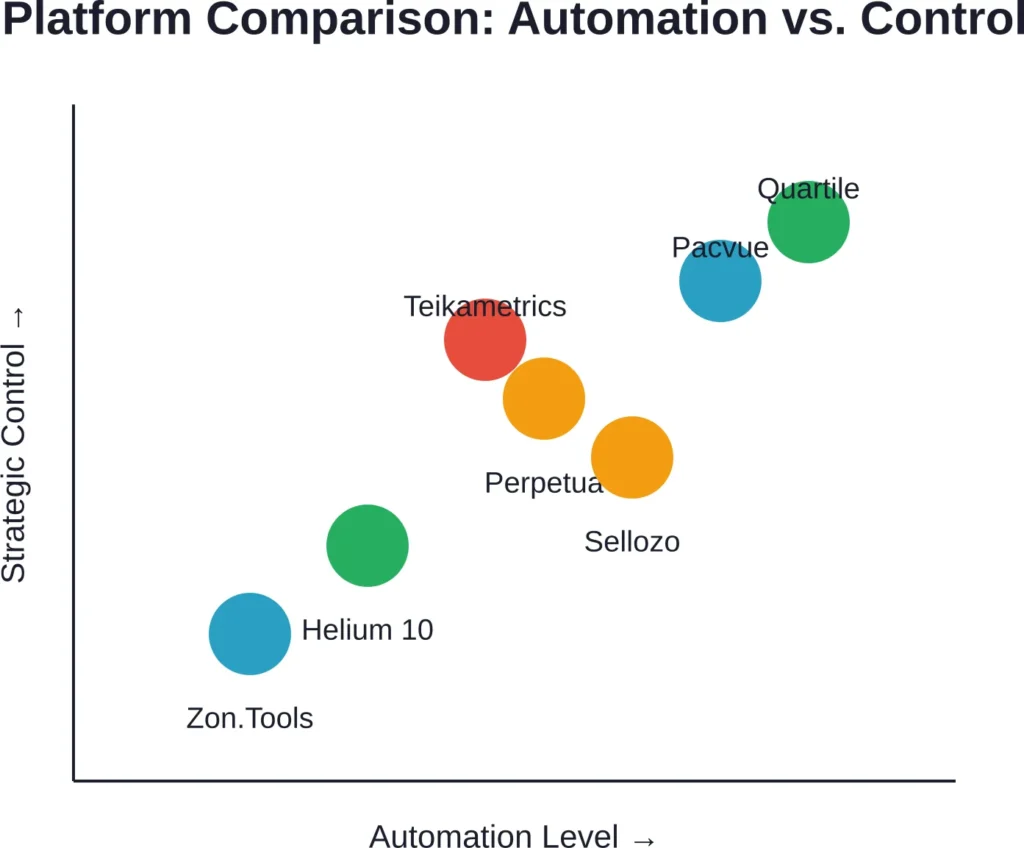
Platform Comparison: Key Features Matrix
Now, here’s how these alternatives stack up across the dimensions that matter most:
| Platform | Automation Type | Multi-Channel | Retail-Aware | Starting Price | Best For |
|---|---|---|---|---|---|
| Perpetua | AI + Rules | Amazon, Walmart, Instacart | Yes | $250/mo+ | Mid-to-large brands |
| Pacvue | AI + Workflow | Amazon, Walmart, Target, Kroger | Yes | Enterprise custom | Large catalogs, agencies |
| Teikametrics | Profit-focused AI | Amazon, Walmart | Yes | % of ad spend | Profit-focused brands |
| Quartile | Autonomous AI | Amazon, Walmart, Instacart | Partial | % of ad spend | Hands-off operators |
| Skai | Omnichannel AI | All major platforms | Yes | Enterprise custom | Omnichannel agencies |
| Helium 10 Adtomic | Rules + Basic AI | Amazon only | No | Included in H10 plans | All-in-one sellers |
| BidX | AI bidding focus | Amazon, Walmart | Partial | % of ad spend | Bid optimization focus |
| Sellozo | Predictive AI | Amazon only | No | % of ad spend | Growing brands |
| m19 | Launch-optimized AI | Amazon focus | Partial | % of ad spend | Frequent product launches |
| Zon.Tools | Transparent rules | Amazon only | No | Flat monthly fee | Control-focused sellers |
Choosing the Right Alternative: Decision Framework
So which alternative actually fits your operation? Here’s how to think through the decision systematically.
Start with Monthly Ad Spend
Your budget determines which platforms are even realistic options.
Under $5,000 monthly: Focus on Helium 10 Adtomic or Zon.Tools. Percentage-based pricing from enterprise platforms would exceed the value they deliver at this scale. Flat-rate or included-in-subscription models make more economic sense.
$5,000-$20,000 monthly: Sellozo, BidX, or Perpetua’s entry tier become viable. You’re at the threshold where sophisticated automation starts delivering measurable ROI, but you don’t need enterprise features.
$20,000-$100,000 monthly: Perpetua, Teikametrics, Quartile, or Pacvue (lower tiers) all work. At this level, focus shifts from “can I afford this?” to “which strategic approach fits my goals?”
Above $100,000 monthly: Pacvue, Skai, or Quartile with dedicated account teams. You need enterprise infrastructure, and the percentage-based pricing becomes competitive with hiring internal specialists.
Automation Philosophy Match
Be honest about your operational style. Do you trust algorithms or need to understand every decision?
If you’re migrating from manual management and want to maintain control: Zon.Tools, Perpetua, or Helium 10 Adtomic offer transparency and rule customization.
If you want to set goals and let AI handle execution: Quartile or Teikametrics. Just understand you’re trading control for time savings.
If you need both (common for agencies managing diverse clients): Perpetua or Pacvue provide flexibility to operate in autonomous mode for some accounts and manual mode for others.
Channel Strategy
Amazon-only operations have different needs than omnichannel brands.
Amazon-focused: Helium 10 Adtomic, Zon.Tools, Sellozo, or BidX. Don’t pay for multi-channel features you won’t use.
Amazon + Walmart: Perpetua, Teikametrics, Quartile, or BidX. These platforms treat both channels as first-class citizens rather than bolted-on afterthoughts.
Full omnichannel (Amazon, Walmart, TikTok, Google): Pacvue or Skai. The operational efficiency of unified reporting justifies the higher cost when managing four or more advertising platforms.
Team Expertise Level
Your internal capabilities matter more than most brands admit.
If your team includes experienced Amazon advertising specialists: platforms with deep customization (Perpetua, Pacvue, Zon.Tools) let them exercise that expertise.
If you’re building expertise and need the platform to guide decisions: Quartile, Sellozo (with managed service), or Helium 10 Adtomic provide more guardrails and education.
If you want to outsource strategic thinking entirely: consider whether you actually need software or should hire a full-service agency instead.
Implementation Strategy: Getting the Transition Right
Switching Amazon PPC platforms isn’t as simple as flipping a switch. Here’s how to manage the transition without tanking performance.
Run Parallel Campaigns First
Don’t hand over your entire account to a new platform on day one. That’s how brands burn thousands in ad spend learning what doesn’t work.
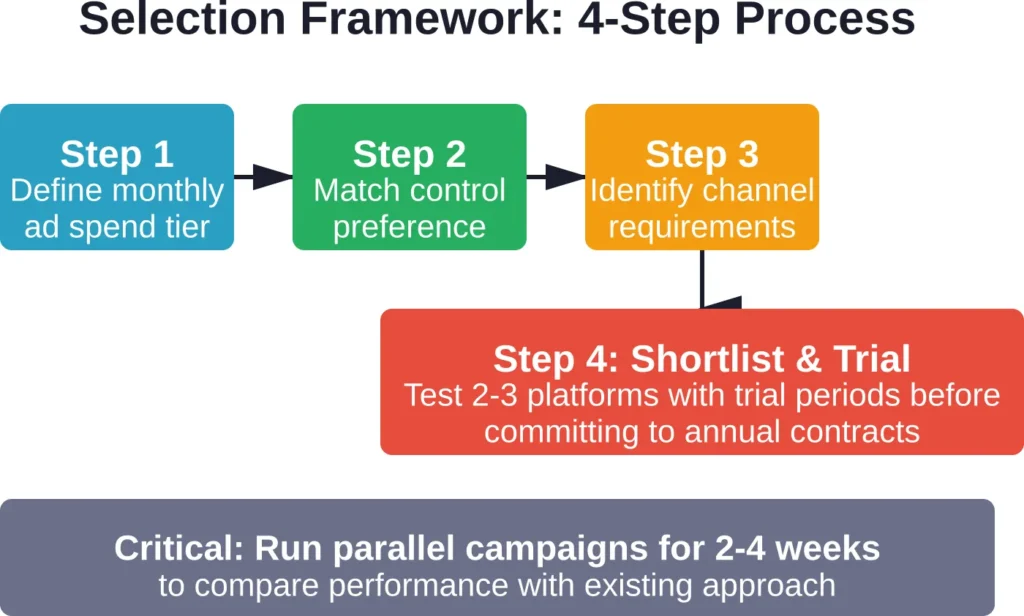
Instead, create duplicate campaigns for 5-10 representative products. Let the new platform manage those while your existing system handles the rest. Run both for 2-4 weeks and compare results: ACoS, TACoS, conversion rate, organic rank impact.
This controlled test reveals whether the platform’s optimization actually delivers in your specific category and competitive environment—not just in case studies featuring someone else’s products.
Baseline Your Current Performance
Before changing anything, document where you are. Pull reports for the last 90 days covering ACoS, TACoS, conversion rate by campaign type, organic rank for top keywords, and inventory turnover rate.
Without this baseline, you can’t objectively measure whether the new platform improved performance or just coincided with seasonal trends, market shifts, or changes you made elsewhere.
Negotiate Trial Periods
Most platforms offer 30-day trials or discounted onboarding periods. Use them. But understand that one month isn’t enough to see the full impact of optimization changes—it takes 4-6 weeks for algorithmic platforms to fully train on your data.
If possible, negotiate a 60-90 day trial at reduced fees. Position it as de-risking the decision for both parties: you get confidence the platform works, they get a committed customer rather than a quick cancellation.
Plan for the Learning Curve
Even the most intuitive platforms require onboarding time. Budget 10-15 hours in the first month for training, setup, and workflow adjustment.
Most performance issues with new platforms stem from poor initial configuration, not platform limitations. Take the onboarding process seriously. Actually watch the training videos. Join the implementation calls. Configure settings correctly from the start rather than troubleshooting issues for three months.
Common Migration Mistakes to Avoid
Real talk: here’s where brands typically screw up the transition.
Expecting Immediate Results
Algorithmic platforms need data to optimize. If you switch on Monday and expect performance improvements by Friday, you’re setting yourself up for disappointment.
Most AI-driven tools show early signals within 7-10 days but don’t hit their stride until 30-45 days. Plan accordingly. Don’t panic and revert to manual management in week two because you haven’t seen the magical transformation yet.
Ignoring Campaign Architecture
Some platforms work best with specific campaign structures. Teikametrics, for example, performs optimally when campaigns are organized by product margin profile. Perpetua’s goal-based optimization requires campaigns grouped by business objective.
If your current structure doesn’t match the platform’s preferred architecture, you’ll need to rebuild campaigns. That’s not a flaw—it’s how the system was designed to work. Fighting it by forcing your existing structure into an incompatible platform just limits performance.
Over-Constraining the Algorithm
This is the flip side of wanting too much control. You adopt an AI platform but then set dozens of rules that prevent it from actually optimizing.
If you’re going to micromanage every decision, you don’t need sophisticated software—you need a spreadsheet. Trust the optimization logic you’re paying for, or choose a platform designed for manual control instead.
Neglecting the Retail Side
Advertising software can’t fix broken product listings, bad images, or pricing that’s 30% above Buy Box. Before obsessing over which platform delivers 2% better ACoS, make sure your retail fundamentals are solid.
The best platforms amplify what’s already working. They can’t manufacture success for products that customers don’t want at the price you’re asking.
Pricing Comparison: What to Actually Expect
Platform pricing for Amazon PPC software is notoriously opaque. Here’s what to expect when the sales rep finally sends numbers.
| Pricing Model | Typical Range | Who Uses It | Watch Out For |
|---|---|---|---|
| Flat Monthly Fee | $99-$500/month | Zon.Tools, Helium 10 | Campaign count limits, feature restrictions in lower tiers |
| Percentage of Ad Spend | 3-10% of spend | Most AI platforms | Minimum monthly fees, annual commitments, tiered percentage rates |
| Hybrid (Base + Percentage) | $250-$1,000 base + 2-5% | Perpetua, mid-tier platforms | How the base and percentage interact at different spend levels |
| Enterprise Custom | Negotiated | Pacvue, Skai | Minimum spend requirements, multi-year lock-in, implementation fees |
Pricing negotiation tips: Most platforms discount 10-20% for annual prepayment. Multi-brand operators can often negotiate volume pricing. If you’re migrating from a competitor, mention that—retention offers beat published rates. And always ask about implementation fees separately from ongoing costs.
When to Stick with Intentwise
Look, not every brand needs an alternative. Intentwise does certain things exceptionally well.
If Commerce Observability—unifying fragmented marketplace signals into one architecture—matches your strategic priorities, that’s Intentwise’s core differentiator. The platform’s recent focus on AI integration (their SQL generation reaching 80-90% accuracy demonstrates genuine innovation) shows commitment to staying at the cutting edge.
For brands heavily invested in Amazon Marketing Cloud (AMC) analysis, Intentwise’s deep integration there provides capabilities most alternatives don’t match. If you’re running sophisticated attribution studies across channels and need to tie everything back to AMC insights, alternatives may feel like a step backward.
And if you’ve already invested significant time training your team on Intentwise workflows and building custom reports, the switching cost might outweigh the marginal benefit of moving to a competitor with slightly different features.
The decision to change platforms should be strategic, not impulsive. “The grass is greener” thinking leads to platform-hopping that wastes time and money without improving results.
Future-Proofing Your Platform Choice
Here’s something most comparison articles skip: the Amazon advertising landscape is changing fast.
According to data from Intentwise’s Up Next event, ChatGPT usage jumped from 20% of attendees one year prior to 100% currently. That’s a signal. AI isn’t a future consideration—it’s the present operating environment.
When evaluating platforms, look at their AI roadmap, not just current features. How quickly are they integrating new Amazon Ads API capabilities? Are they building proprietary data models or just wrapping third-party AI?
Multi-channel capabilities matter even if you’re Amazon-only today. Retail media is fragmenting. Walmart, TikTok, Instacart, and regional players are growing fast. The platform you choose now should support expansion when (not if) you add channels.
API flexibility separates platforms that’ll scale with your business from those you’ll outgrow. Can you export data easily? Integrate with your business intelligence tools? Connect to inventory management systems? These technical capabilities determine whether the platform becomes the backbone of your operation or a siloed tool that doesn’t talk to anything else.
Frequently Asked Questions
Intentwise differentiates primarily through its Commerce Observability framework—unifying fragmented marketplace signals into a single intelligence architecture. Competitors like Perpetua emphasize goal-based optimization, Teikametrics focuses on profit-based bidding, and Quartile offers fully autonomous operation. The main differences come down to optimization philosophy (how decisions get made), multi-channel depth (which platforms beyond Amazon receive first-class support), and pricing structure (flat-rate versus percentage-of-ad-spend models).
Technically yes, but it’s usually a bad idea. Running multiple optimization platforms on the same campaigns creates conflicts—one tool raises a bid while another lowers it, leading to erratic performance. The better approach is running parallel campaigns (separate products managed by different tools for comparison) during evaluation, then consolidating to one primary platform. Some brands use one tool for automation and another for analytics/reporting, which works if they’re not both trying to control bids.
Early signals typically appear within 7-10 days, but meaningful performance data requires 30-45 days. AI-driven platforms need this time to collect sufficient data and train their models on conversion patterns, seasonality, and competitive dynamics specific to your products. Rule-based tools show impact faster (1-2 weeks) since they execute pre-defined logic immediately. Budget 60 days before making a final judgment on whether the new platform delivers better results than your previous approach.
Pricing varies dramatically by model. Flat-rate tools like Helium 10 Adtomic run $99-$400 monthly as part of broader subscriptions. Percentage-based platforms charge 3-10% of ad spend—so a brand spending $10,000 monthly might pay $300-$1,000 for software. Hybrid models combine a base fee ($250-$1,000) plus a smaller percentage (2-5%). Enterprise platforms negotiate custom pricing starting around $2,000-$5,000 monthly for dedicated support and advanced features. Most brands find value when software costs less than the performance improvement it delivers.
It depends on the platform. Tools like Quartile and Teikametrics are designed for minimal technical involvement—set your goals and let the AI handle execution. Platforms like Perpetua and Pacvue offer more control but require understanding Amazon advertising fundamentals (campaign types, match types, attribution windows). Zon.Tools and Helium 10 Adtomic fall in the middle—accessible to non-experts but with advanced features for specialists. Most platforms provide onboarding support and training resources. The bigger question is strategic expertise: understanding what good performance looks like and how advertising fits into your broader business goals.
Several platforms handle both: Perpetua, Teikametrics, Quartile, BidX, and Pacvue all support Walmart Connect alongside Amazon. However, implementation depth varies. Some platforms built Amazon-first and added Walmart later, resulting in fewer features or less sophisticated optimization for Walmart campaigns. Pacvue and Perpetua treat both channels more equally. If Walmart represents a significant portion of your advertising budget, verify that the platform’s Walmart capabilities match what it offers for Amazon before committing.
Software makes sense when you have internal expertise to set strategy and interpret results—the tools handle execution and scale. Agencies make sense when you lack that expertise or want to fully outsource the function. Cost-wise, software runs 3-10% of ad spend while agencies charge 10-20% or more. A hybrid approach works for many brands: use software for automation and efficiency while working with an agency for strategic guidance, campaign architecture, and quarterly planning. This combines cost efficiency of software with strategic expertise of agencies.
Conclusion: Making the Final Decision
Intentwise is a strong platform. But so are its competitors. The “best” choice depends entirely on your specific situation—ad spend level, channel strategy, team capabilities, and automation philosophy.
Here’s the bottom line: start with the decision framework above. Define your monthly ad spend tier, clarify how much control versus automation you want, identify your channel requirements, and assess your team’s expertise honestly.
That narrows the field to 2-3 realistic options. Then—and this is critical—actually test them. Not just demos where a sales rep shows carefully curated examples. Real tests with your products, your competition, your categories.
Run parallel campaigns for 30-60 days. Measure ACoS, TACoS, conversion rates, and organic rank impact. Let the data decide, not the sales pitch.
Amazon advertising software represents a significant investment. Many Amazon sellers report improvements in advertising performance when using advanced marketing software. But that only happens when the platform matches your operational reality.
Do the evaluation work up front. Test rigorously. Negotiate pricing. Then commit fully to one platform and give it time to deliver results. Platform-hopping every quarter wastes more money than choosing the second-best option and sticking with it.
Ready to explore alternatives to Intentwise? Start with the 2-3 platforms from this list that match your decision criteria. Schedule demos, request trial access, and run those parallel campaign tests. The right platform is out there—you just need to do the work to identify which one actually fits your operation.