

Quick Summary: The right Amazon keyword tool makes the difference between invisible listings and products that rank on page one. Free tools like WisePPC, Helium 10’s limited version and Sonar provide solid starter research, while paid platforms such as Helium 10 Premium, Jungle Scout, and AMZScout deliver advanced analytics, historical trends, and competitive intelligence. Sellers should match tool selection to their stage—bootstrapping beginners benefit from free options, while established brands need comprehensive suites with reverse-ASIN lookup, backend keyword optimization, and PPC bid suggestions.
Keywords are the bridge connecting customer searches to product listings. Without strategic keyword research, even the best products sit buried on page five while competitors capture sales. But here’s the thing—Amazon’s A9 algorithm doesn’t reward guesswork.
Sellers face a crowded marketplace where half of all traffic comes from mobile shoppers hunting for quick answers. That reality makes keyword precision critical. The wrong terms burn ad spend, while the right ones unlock organic visibility and sustained revenue.
This guide breaks down the most effective Amazon keyword research tools available in 2026, from no-cost options perfect for testing waters to enterprise-grade platforms built for seven-figure brands. Each tool serves different needs—some excel at ASIN reverse-engineering, others dominate backend keyword optimization or PPC campaign planning.
Why Amazon Keyword Research Tools Matter
Amazon operates differently than Google. Shoppers arrive with purchase intent, not just curiosity. They’re comparing products, reading reviews, and often ready to buy within minutes. That compressed decision window means listings must surface for the exact terms buyers type.
Manual keyword guessing fails for three reasons. First, Amazon’s autocomplete shows popular searches but hides search volume data. Second, competitor analysis requires reverse-engineering what’s driving their rankings. Third, seasonal trends shift demand—what worked in Q4 might tank in Q2.
Dedicated tools solve these problems by pulling data directly from Amazon’s ecosystem. They reveal monthly search volumes, competitive density, and related phrases sellers might miss. Some connect to Amazon’s advertising API for real-time bid recommendations.
The best tools also track keyword performance over time. Historical trends expose rising opportunities before markets saturate. For instance, a keyword climbing 40% month-over-month signals early-mover advantage—if caught quickly.
Top Paid Amazon Keyword Tools
Premium tools justify their cost through depth and accuracy. They aggregate data from multiple sources, run continuous scans, and offer features impossible in free versions.
WisePPC

WisePPC is a specialized Amazon PPC optimization tool and an official Amazon Ads Verified Partner. While Helium 10 and Jungle Scout focus heavily on keyword discovery and product research, WisePPC stands out in deep performance analysis and large-scale management of live advertising campaigns.
The platform delivers powerful keyword-level insights, displaying real performance metrics such as sales, ACoS, ROAS, CTR, conversion rates, and more for every target. Its strongest advantage is access to long-term historical data spanning multiple years, far beyond Amazon’s standard 60–90 day limit. Sellers can apply advanced filters, segment thousands of keywords simultaneously, and perform bulk actions like pausing, activating, or adjusting bids directly in the interface.
WisePPC automatically highlights underperforming and overperforming keywords, identifies wasted spend, and provides detailed graphs broken down by campaigns, ad groups, and placements. It is especially effective after the initial keyword research phase, helping sellers scale winning terms and eliminate unprofitable ones quickly.
Although still a younger platform with growing Ahrefs metrics, WisePPC has earned strong recognition among mid-to-large Amazon sellers and agencies who manage substantial ad budgets.
Contact Information:
- Website: wiseppc.com
- Facebook: www.facebook.com/people/Wise-PPC/61573154427547
- LinkedIn: www.linkedin.com/company/wiseppc
- Instagram: www.instagram.com/wiseppc
Helium 10

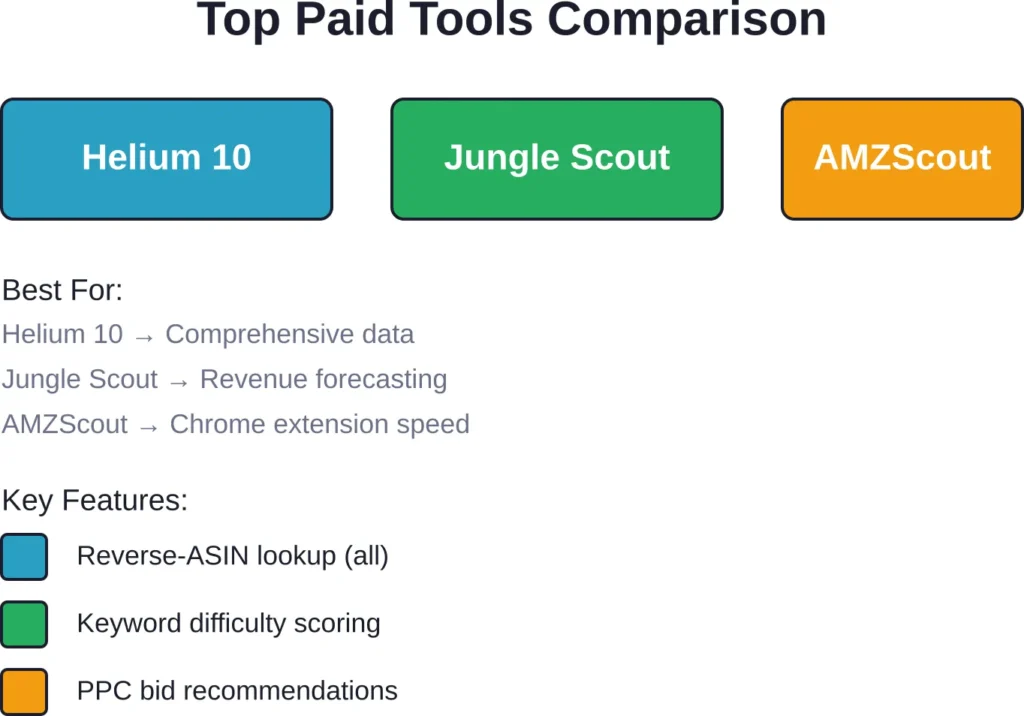
Helium 10 dominates the Amazon seller tool space with a comprehensive suite covering product research, listing optimization, and keyword tracking. The platform’s Magnet tool generates thousands of related keywords from a single seed term or ASIN.
Magnet displays search volume, keyword difficulty scores, and cost-per-click estimates in one dashboard. Users can filter by relevance, phrase match, or broad match to narrow results. The tool also flags competitor keywords, showing which terms drive traffic to rival listings.
Cerebro, another Helium 10 module, performs reverse-ASIN lookups. Enter up to ten competitor ASINs and Cerebro reveals their shared keywords, ranking positions, and estimated search volumes. This competitive intelligence helps sellers identify gaps in their own targeting.
According to Ahrefs data, Helium 10 attracts significant US search traffic with a domain rating of 76—evidence of strong domestic seller adoption.
Pricing remains a consideration. While Helium 10 offers a limited free tier, serious sellers typically need paid plans. The platform hasn’t published universal pricing, so checking the official site for current subscription costs is essential before committing.
Jungle Scout

Jungle Scout built its reputation on product research but delivers robust keyword tools as part of its ecosystem. The Keyword Scout feature analyzes billions of Amazon searches to surface high-opportunity terms.
What sets Jungle Scout apart is its accuracy scoring. The platform uses historical sales data and ranking patterns to estimate how many units competitors move for specific keywords. This connects keyword selection directly to revenue forecasting.
The Rank Tracker monitors keyword positions daily, alerting sellers when rankings drop or competitors overtake them. Automated tracking saves hours of manual checking and lets teams respond quickly to algorithm shifts.
Jungle Scout also integrates with Amazon PPC campaigns. The tool suggests bid amounts based on keyword competitiveness and conversion likelihood, helping sellers allocate ad budgets more effectively.
Ahrefs reports Jungle Scout with traffic value of 245.1K, domain rating of 76, and 637 indexed pages—metrics indicating strong authority and content depth in the Amazon seller education space.
AMZScout

AMZScout targets sellers wanting streamlined workflows without sacrificing data quality. The platform’s keyword research tool combines database searches with Chrome extension features for on-the-fly analysis.
The extension overlays keyword data directly on Amazon search results pages. Sellers can browse categories, spot trending products, and extract their keywords without switching tabs. This real-time context helps validate ideas faster.
AMZScout’s PRO Extension shows estimated sales, revenue, and review counts for any product listing. Pairing this with keyword data reveals which terms correlate with high-performing products versus low-converting ones.
The platform also offers a web-based keyword tracker that monitors rankings across multiple marketplaces—US, UK, Germany, and others. Multi-region sellers appreciate centralized reporting instead of juggling separate tools per country.
For current AMZScout pricing, consult the official site as subscription structures change regularly.
SellerApp

SellerApp positions itself as an all-in-one analytics platform with particularly strong keyword and PPC modules. The Keyword Research tool generates suggestions based on seed keywords, ASINs, or competitor domains.
One standout feature is keyword quality scoring. SellerApp rates each term on a scale considering search volume, competition, and relevance. High-scoring keywords indicate sweet spots—decent traffic without overwhelming competition.
The PPC Analyzer connects keyword data to advertising performance. Sellers can identify which keywords drive clicks but fail to convert, then shift budgets toward better performers. This closed-loop feedback improves ROI over time.
SellerApp also provides listing quality audits. The tool scans product pages for missing keywords, weak bullet points, and underoptimized backend terms, then scores overall SEO health. Recommendations are actionable and prioritized by impact.
A seven-day free trial lets sellers test the platform before subscribing. For current pricing, consult the official SellerApp website.
MerchantWords

MerchantWords specializes in Amazon search volume data, claiming one of the largest keyword databases in the industry. The platform tracks billions of customer searches and updates metrics regularly.
The core value proposition is accuracy. While many tools estimate search volume, MerchantWords sources data closer to Amazon’s actual query logs. Industry reports suggest accuracy can still vary by 30-40% compared to Amazon’s internal numbers, but MerchantWords generally performs better than generic SEO tools repurposed for Amazon.
The Classic Search function returns search volume, seasonality trends, and related keywords for any term. Seasonal graphs help sellers time product launches and adjust ad spend during peak demand windows.
MerchantWords also offers a Digital Shelf tool that monitors brand presence across Amazon search results. Brands can track which keywords competitors own and identify gaps where their products should rank but don’t.
Pricing tiers include a three-search free option and paid plans. For current MerchantWords pricing, consult the official website.
Best Free Amazon Keyword Tools
Free tools serve three audiences well: new sellers testing the Amazon waters, bootstrapped brands minimizing fixed costs, and experienced sellers supplementing premium subscriptions with additional data sources.
Helium 10 Free Version
Helium 10’s free tier grants limited access to Magnet and Cerebro. Users can perform a set number of searches per day—enough for light research or validating specific product ideas.
The free version displays search volume and basic keyword suggestions but locks advanced filters and bulk exports behind paid plans. Still, it’s a legitimate way to explore keyword opportunities without financial commitment.
Sellers wanting deeper data-driven analysis eventually hit the free tier’s walls, but the trial period offers genuine insights, especially when combined with other free tools.
Sonar by Sellics

Sonar provides free Amazon keyword research with no registration required. Enter a seed keyword and Sonar returns related terms pulled from Amazon’s database, along with estimated search volumes.
The tool supports multiple Amazon marketplaces—US, UK, Germany, France, Italy, Spain, and more. Multi-country sellers can research regional keyword variations without switching platforms.
Sonar also offers reverse-ASIN lookups in the free version. Paste a competitor’s ASIN and discover which keywords they rank for. This competitive intelligence typically requires paid tools elsewhere.
The interface is clean and fast. Results load quickly, and users can export keyword lists as CSV files for further analysis or campaign uploads.
Keyword Tool Dominator

Keyword Tool Dominator scrapes Amazon’s autocomplete suggestions to generate keyword ideas. The tool simulates what shoppers see when typing into Amazon’s search bar, capturing real user intent.
The free version allows three searches per day. Enter a base keyword and the tool returns dozens of autocomplete variations, organized alphabetically or by suffix.
Paid plans unlock unlimited searches and additional data layers. For current Keyword Tool Dominator pricing, consult the official website., though official rates should be confirmed.
Keyword Tool Dominator also covers other platforms—eBay, Etsy, Google, YouTube—making it useful for multi-channel sellers researching keywords across marketplaces.
SellerApp Free Extension
SellerApp’s Chrome extension offers on-the-spot keyword insights while browsing Amazon. The free version displays basic metrics like search volume estimates and keyword difficulty.
The extension integrates seamlessly into Amazon product pages. Sellers can analyze any listing’s keyword strategy without leaving the browser, comparing their own optimization against top performers.
SellerApp’s free tier includes a seven-day trial of premium features, providing a window to test advanced capabilities like PPC analysis and listing audits before subscribing.
Analyzer.Tools

Analyzer.Tools targets data-driven sellers who want profit analysis tied to keyword research. The platform’s free features include bulk keyword analysis and profit margin calculations integrated with FBA and FBM cost structures.
What distinguishes Analyzer.Tools is its focus on profitability, not just traffic. The tool connects keyword search volumes to estimated sales, then factors in Amazon fees, shipping costs, and product costs to project net margins.
According to available data, sellers wanting deeper analytics appreciate the trial period for testing profit calculations before committing to a subscription. While the platform isn’t entirely free long-term, the trial offers legitimate insights into data-driven decision-making.
| Tool | Free Tier Limits | Best Feature | Ideal User |
|---|---|---|---|
| Helium 10 Free | Limited daily searches | Magnet keyword generation | New sellers testing ideas |
| Sonar by Sellics | Unlimited, no login | Multi-marketplace support | International sellers |
| Keyword Tool Dominator | 3 searches/day | Autocomplete scraping | Multi-channel sellers |
| SellerApp Extension | 7-day trial | Browser integration | On-the-fly researchers |
| Analyzer.Tools | Trial period | Profit-linked keywords | Data-driven optimizers |
How to Choose the Right Keyword Tool
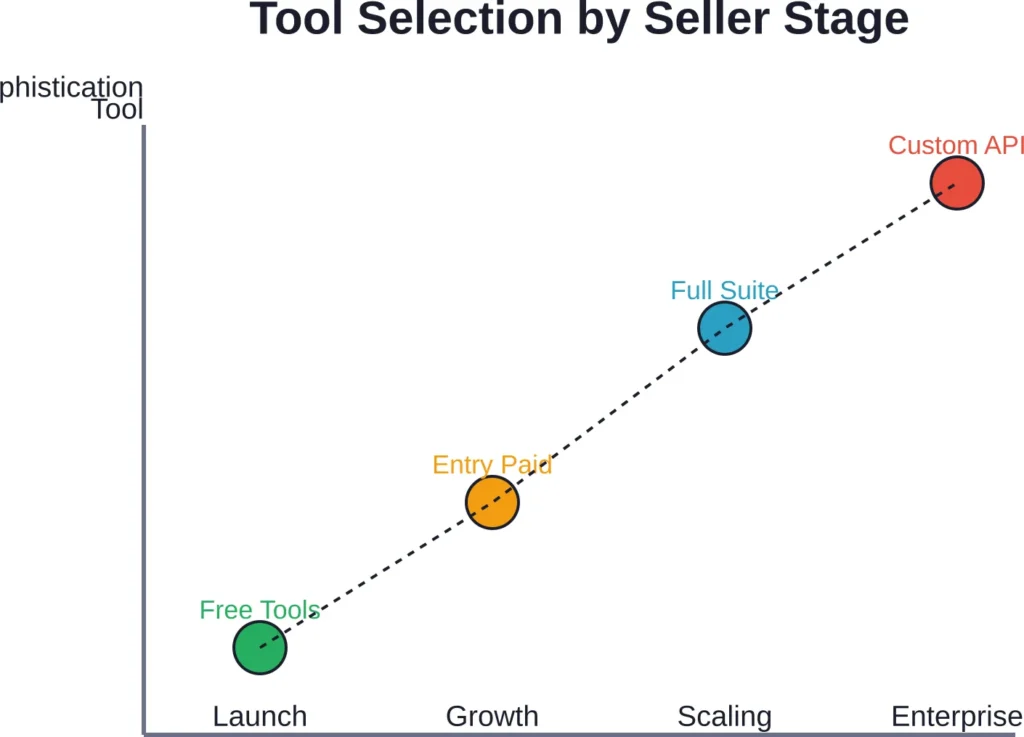
Tool selection depends on budget, business stage, and workflow preferences. A seller launching their first product has different needs than a brand managing 50 SKUs across five countries.
Start by defining must-have features. If reverse-ASIN lookup is critical for competitive analysis, tools like Helium 10, Jungle Scout, and Sonar move to the top. If PPC optimization drives strategy, platforms with bid management and campaign analytics become priorities.
Budget constraints narrow options quickly. Bootstrapped sellers benefit from stacking free tools—Sonar for keyword discovery, Keyword Tool Dominator for autocomplete insights, and Amazon’s own Search Terms report for performance feedback.
Established brands usually need paid platforms for scale. Managing hundreds of keywords manually becomes impractical. Automated rank tracking, historical trend analysis, and API integrations save time and improve accuracy.
Consider data freshness. Amazon’s marketplace shifts rapidly. Tools that update daily or connect to live APIs provide more reliable intel than those refreshing weekly or monthly.
Integration matters too. Sellers using specific workflows—like exporting keyword lists to PPC platforms or connecting to inventory management systems—should verify compatibility before subscribing.
Beginners: Start Free, Upgrade Strategically
New sellers should resist paying for premium tools until they validate product-market fit. Free options provide enough data to research niches, analyze competitors, and optimize initial listings.
Once a product generates consistent sales, upgrading makes sense. Paid tools accelerate growth by revealing optimization opportunities free versions miss—like seasonal trends, backend keyword gaps, or emerging competitor threats.
Scaling Brands: Invest in Comprehensive Suites
Brands managing multiple products or expanding internationally need platforms that centralize data. Juggling separate tools for keyword research, rank tracking, and PPC management creates inefficiency.
Comprehensive suites like Helium 10 or Jungle Scout bundle features into unified dashboards. Teams can monitor keyword performance, adjust campaigns, and audit listings from one interface.
Multi-user access becomes important at scale. Larger teams need role-based permissions so VAs can run reports while account managers control strategy.
Essential Features in Amazon Keyword Tools
Not all keyword tools offer the same capabilities. Understanding which features matter most helps avoid paying for bells and whistles that don’t drive results.
Search Volume Data
Accurate search volume estimates are foundational. Knowing whether a keyword gets 100 searches monthly or 10,000 informs targeting strategy and effort allocation.
Tools source volume data differently. Some estimate based on autocomplete patterns, others license data from Amazon’s advertising platform, and a few aggregate historical sales and ranking correlations.
Precision varies. As mentioned, even specialized tools like MerchantWords can be off by 30-40% versus Amazon’s internal numbers. Still, relative comparisons work—if Tool X shows Keyword A has 5× the volume of Keyword B, that ratio likely holds even if absolute numbers aren’t perfect.
Keyword Difficulty Scores
Search volume alone misleads. A keyword with 50,000 monthly searches sounds attractive until you discover the top ten results are dominated by established brands with thousands of reviews.
Keyword difficulty metrics estimate how hard ranking will be. Tools calculate this by analyzing competitor strength—review counts, seller authority, listing quality, and sponsored ad saturation.
High difficulty doesn’t mean avoid the keyword, but it signals that ranking organically will require time, reviews, and possibly aggressive PPC. Lower difficulty keywords offer faster wins.
Reverse-ASIN Lookup
Reverse-ASIN lookup is competitive intelligence gold. Enter a competitor’s product identifier and the tool reveals which keywords drive their traffic.
This feature answers critical questions: What terms are competitors ranking for that I’m not? Which keywords overlap between top sellers in my niche? Are there low-competition keywords they’re missing?
The best reverse-ASIN tools let users compare multiple ASINs simultaneously. Analyzing five competitors at once exposes common keyword themes and gaps.
Backend Keyword Optimization
Amazon allows sellers to add backend search terms invisible to shoppers but indexed by the A9 algorithm. These hidden keywords expand reach without cluttering product titles or bullet points.
Some tools specifically audit backend keywords, flagging redundancies, spelling errors, or wasted characters. Amazon limits backend fields to 249 bytes, so efficiency matters—every wasted character is a lost opportunity.
Tools like Helium 10’s Frankenstein and Scribbles help sellers build optimized backend strings by removing duplicates, filtering stop words, and prioritizing high-value terms.
Rank Tracking
Keyword rankings fluctuate daily. Manual tracking across dozens or hundreds of keywords becomes impossible at scale.
Automated rank trackers monitor positions and alert sellers to significant changes. If a primary keyword drops from page one to page three overnight, quick investigation might reveal a competitor launched a promotion or Amazon adjusted the algorithm.
Historical rank data also validates optimization efforts. Did adding a keyword to the title improve rankings? Did a backend update boost visibility? Tracking proves causation.
PPC Integration
Keyword research and advertising strategy intertwine. Tools that bridge organic and paid data help sellers allocate budgets efficiently.
PPC-integrated tools suggest bid amounts based on keyword difficulty and conversion probability. They also identify keywords performing well organically that don’t need paid support, freeing budget for tougher terms.
Some platforms auto-generate campaign structures from keyword research—grouping related terms into ad groups and suggesting match types (broad, phrase, exact).
| Feature | Why It Matters | Tools Offering It |
|---|---|---|
| Search Volume | Prioritize high-traffic opportunities | All major tools |
| Keyword Difficulty | Estimate ranking effort required | Helium 10, Jungle Scout, SellerApp |
| Reverse-ASIN | Steal competitor keyword strategies | Helium 10, Sonar, AMZScout |
| Backend Audits | Maximize hidden keyword efficiency | Helium 10, SellerApp |
| Rank Tracking | Monitor position changes daily | Jungle Scout, SellerApp, AMZScout |
| PPC Bid Suggestions | Optimize ad spend ROI | Helium 10, SellerApp |
Strategies for Effective Amazon Keyword Research
Tools provide data, but strategy transforms data into sales. Here’s how top sellers approach keyword research systematically.
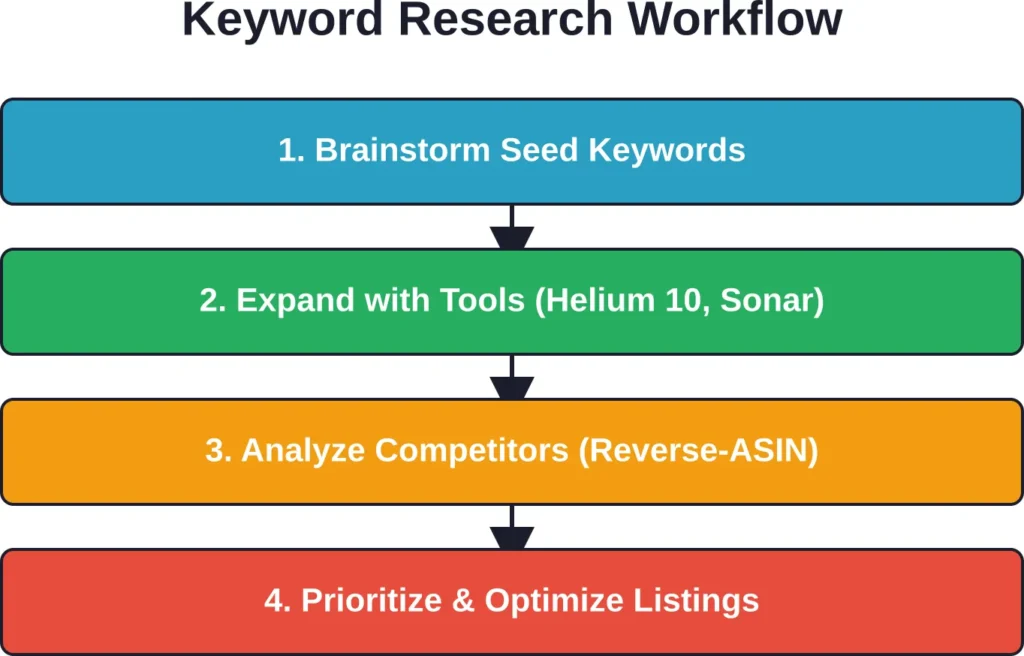
Start with Seed Keywords, Expand with Tools
Begin research with obvious seed terms—the words describing what the product actually is. For a yoga mat, seeds include “yoga mat,” “exercise mat,” “fitness mat.”
Feed those seeds into keyword tools to uncover variations and related terms. Tools reveal phrases like “extra thick yoga mat,” “non-slip exercise mat,” “eco-friendly yoga mat”—terms shoppers use but sellers might not think of.
Expanding from seeds to long-tail variations captures specific customer intent and often faces less competition.
Analyze Competitor Keywords
Reverse-ASIN lookup identifies what’s already working in the niche. If the top five sellers all rank for “portable yoga mat,” that keyword clearly drives conversions.
Look for patterns across competitors. Shared keywords indicate must-target terms. Unique keywords one competitor owns might represent untapped opportunities—especially if that listing is newer or has fewer reviews.
Prioritize by Search Volume and Difficulty Balance
The sweet spot combines decent search volume with manageable difficulty. A keyword with 5,000 monthly searches and low competition beats one with 50,000 searches where the top results are category giants.
Create a prioritization matrix: high volume + low difficulty = immediate focus; high volume + high difficulty = long-term target with PPC support; low volume + low difficulty = quick wins for new products.
Optimize for Customer Intent
Not all keywords with volume convert equally. Informational searches like “how to clean yoga mat” generate traffic but rarely sales. Transactional terms like “buy yoga mat” signal purchase intent.
Prioritize keywords indicating readiness to buy: product type + modifier (e.g., “thick yoga mat”), brand comparisons (e.g., “Manduka vs Jade yoga mat”), and problem-solution phrases (e.g., “yoga mat for sweaty hands”).
Refresh Research Regularly
Keyword performance isn’t static. Seasonal demand shifts, new competitors enter, and Amazon’s algorithm evolves. Research conducted six months ago might miss current opportunities.
Schedule quarterly keyword audits. Review which terms are gaining or losing search volume, check for new competitor keywords, and test emerging phrases flagged by tools.
Leverage Amazon’s Own Data
Amazon provides sellers with the Search Terms report in Seller Central. This shows actual customer search queries that led to impressions, clicks, and purchases for a product.
The Search Terms report is authoritative—it’s Amazon’s own data. Sellers can reference Amazon’s Search Terms report to validate keyword performance data from tools.
Common Mistakes to Avoid
Even experienced sellers fall into keyword research traps that tank performance.
Keyword Stuffing
Amazon’s A9 algorithm penalizes unnatural keyword density. Stuffing titles with repetitive phrases hurts readability and can trigger suppression.
Instead of “Yoga Mat Extra Thick Yoga Mat Non-Slip Yoga Mat Exercise Mat,” write naturally: “Extra Thick Non-Slip Yoga Mat for Exercise and Fitness.” The latter includes key terms without spammy repetition.
Ignoring Backend Keywords
Some sellers optimize titles and bullet points but leave backend fields empty. That wastes Amazon’s hidden keyword allowance.
Backend terms should include synonyms, alternate spellings, and related phrases that don’t fit naturally in visible content. For a yoga mat, backend might include “pilates mat,” “stretching mat,” “workout mat.”
Chasing Volume Over Relevance
High search volume tempts sellers to target loosely related keywords. A yoga mat seller might chase “home gym equipment” because it has massive volume, but the keyword’s too broad—most searchers want dumbbells or treadmills, not mats.
Relevance drives conversion. Better to rank well for a moderate-volume, highly relevant keyword than poorly for a high-volume, tangential one.
Set-and-Forget Approach
Launching a product with optimized keywords is step one, not the finish line. Markets evolve, competitors adjust, and algorithms shift.
Sellers must monitor keyword performance and refresh strategies. Quarterly audits catch declining keywords early and surface new opportunities before they saturate.
Relying on One Tool Exclusively
No single tool has perfect data. Cross-referencing multiple sources improves accuracy and reveals blind spots.
Combine a primary tool (Helium 10 or Jungle Scout) with free alternatives (Sonar, Keyword Tool Dominator) and Amazon’s own Search Terms report for comprehensive intelligence.
FAQ
Sonar by Sellics stands out as the best free option. It requires no registration, supports multiple Amazon marketplaces, and includes reverse-ASIN lookup—a feature typically locked behind paywalls. Keyword Tool Dominator also offers value with its autocomplete scraping, though the free tier limits users to three searches daily.
Search volume accuracy varies by tool and can differ by 30-40% from Amazon’s internal data, according to industry analyses. Tools that license data from Amazon’s advertising API or aggregate historical sales patterns tend to be more reliable than those estimating from autocomplete behavior. Relative accuracy matters more than absolute precision—tools reliably show which keywords have higher or lower volume compared to each other.
No. New sellers can conduct effective keyword research using free tools like Sonar, Helium 10’s free tier, and Amazon’s own Search Terms report. Paid tools become worthwhile once products generate consistent sales and scaling requires advanced features like automated rank tracking, PPC integration, and multi-marketplace analysis.
Helium 10 excels in keyword breadth and reverse-ASIN depth—Cerebro can analyze up to ten competitor ASINs simultaneously. Jungle Scout emphasizes revenue forecasting, connecting keyword data to estimated sales and units moved. Helium 10 suits sellers prioritizing comprehensive keyword discovery, while Jungle Scout appeals to those focusing on profit-driven keyword selection.
Quarterly audits work well for most sellers. Review keyword rankings, search volume trends, and competitor changes every three months. Products in highly seasonal niches may need monthly reviews to capture shifting demand. Always update keywords immediately if a major competitor enters the niche or Amazon introduces algorithm changes.
Yes. Tools like Helium 10, SellerApp, and Jungle Scout integrate keyword research with PPC features. They suggest bid amounts based on keyword difficulty, identify high-converting terms from organic data, and auto-generate campaign structures. This integration helps sellers allocate ad budgets efficiently and avoid bidding on keywords that don’t convert.
Backend keywords are hidden search terms sellers add in Amazon Seller Central that shoppers never see but Amazon’s algorithm indexes. They let sellers include synonyms, alternate spellings, and related phrases without cluttering visible content. Amazon limits backend fields to 249 bytes, so optimizing this space with non-duplicate, relevant terms expands discoverability without hurting listing readability.
Moving Forward with Keyword Research
Keyword research isn’t a one-time checklist item. It’s an ongoing competitive advantage for sellers who treat it as a core business process rather than a launch task.
The right tools make research faster and more accurate, but tools alone don’t win. Strategy matters—understanding customer intent, balancing volume with difficulty, and refreshing data regularly separate page-one sellers from everyone else.
Start simple. New sellers should begin with free tools, validate product ideas, and optimize initial listings. As revenue grows, invest in paid platforms that scale with the business—automated tracking, deeper analytics, and cross-marketplace insights.
Established brands benefit from comprehensive suites that centralize keyword research, rank tracking, and PPC management. The time saved and opportunities uncovered typically justify subscription costs within weeks.
Amazon’s marketplace continues growing, but so does competition. Sellers who master keyword research gain visibility, attract ready-to-buy customers, and build sustainable competitive moats. The tools exist—choosing and using them strategically makes all the difference.