

Quick Summary: Free Amazon seller tools like WisePPC, Seller Central’s native features, Keepa price trackers, ASIN converters, and Google Trends help new sellers launch without upfront costs. Pairing these with affordable options like SellerSprite or Jungle Scout trials builds a cost-effective research workflow. Most successful sellers combine 3-4 free tools to cover product research, keyword tracking, and profitability checks before scaling to paid platforms.
Starting an Amazon FBA business in 2026 doesn’t require thousands of dollars in software subscriptions. Smart sellers layer free tools with strategic paid trials to validate products before committing capital.
The landscape has shifted. Five years ago, premium platforms held all the data. Now Amazon itself publishes more metrics through Seller Central, and open-source communities have built powerful free alternatives.
Here’s the thing though—not all free tools deliver real value. Some are outdated, others are feature-locked demos designed to frustrate users into upgrading. This guide focuses exclusively on tools that experienced sellers actually use in their daily workflows.
Why Free Tools Matter for New Sellers
Launching an Amazon business involves inventory risk, shipping costs, and storage fees. Software expenses can easily add $200-$500 monthly before making the first sale. That cash crunch kills promising businesses before they start.
Free tools let sellers test hypotheses without financial commitment. Research ten product ideas, validate market demand, check competition levels—all before spending a dollar on inventory. Once a product proves viable, upgrading to paid analytics makes sense.
But there’s a skill ceiling. Free tools often lack automation, bulk processing, or advanced forecasting. Some sellers report using free tools for 3-6 months before upgrading to paid platforms as revenue scales.
Wiseppc: Amazon PPC Management & Optimization

Wiseppc is a powerful, modern Amazon PPC tool built specifically for sellers who want to scale their advertising profitably. It connects directly to your Amazon Ads account and gives you deep visibility, bulk editing, and smart automation that native Amazon Ads Console simply doesn’t offer.
Most sellers burn money on PPC because they manually manage campaigns or rely on basic rules. Wiseppc turns chaotic advertising into a controllable, data-driven system. It pulls long-term historical data (Amazon only keeps 60–90 days), shows real performance trends, and lets you edit thousands of keywords, bids, and campaigns in seconds.
Real talk: If you spend more than $1,000–$2,000 per month on Sponsored Products, Sponsored Brands, or Sponsored Display, Wiseppc quickly pays for itself through better ACoS and saved time. Beginners can start with the free trial and still get huge value by cleaning up existing campaigns.
Wiseppc shines with its bulk operations, advanced analytics (ACoS, TACoS, ROAS, CTR over long periods), smart automation rules, inline editing, and clear visual reports. It also supports multiple marketplaces (US, UK, EU, CA, etc.) and makes search term harvesting fast and effective.
It’s especially strong for mid-to-large sellers who have outgrown basic tools and need serious PPC firepower without hiring a full agency.
Contact Information:
- Website: wiseppc.com
- Facebook: www.facebook.com/people/Wise-PPC/61573154427547
- LinkedIn: www.linkedin.com/company/wiseppc
- Instagram: www.instagram.com/wiseppc
Amazon Seller Central: The Foundation
Amazon’s native platform is the most underutilized free resource. Seller Central provides business reports, customer metrics, inventory tracking, and advertising dashboards—everything needed to run day-to-day operations.
The Business Reports section tracks traffic, conversion rates, and sales by ASIN. These metrics reveal which products resonate with buyers and which listings need optimization. The Request a Review button automates follow-up emails to boost review counts without violating Amazon’s terms.
Real talk: most beginners ignore these built-in analytics while chasing third-party tools. Master Seller Central first. It’s free, fully compliant with Amazon policies, and provides data competitors pay for elsewhere.
The Brand Registry program unlocks A+ Content, enhanced brand analytics, and protection against counterfeiters. Enrollment requires a registered trademark but costs nothing beyond the trademark filing fee. Brand Registry members can upload product documents like installation manuals and compatibility guides directly to detail pages.
Key Seller Central Features Worth Mastering

- Manage Inventory: Track FBA stock levels, create removal orders, monitor stranded inventory
- Advertising Console: Launch Sponsored Products campaigns with minimal spend to test keywords
- Customer Feedback: Monitor seller rating, respond to negative reviews, track buyer messages
- Payments Dashboard: View settlement details, refund activity, fee breakdowns by transaction
Keepa: Price History and Sales Rank Tracking

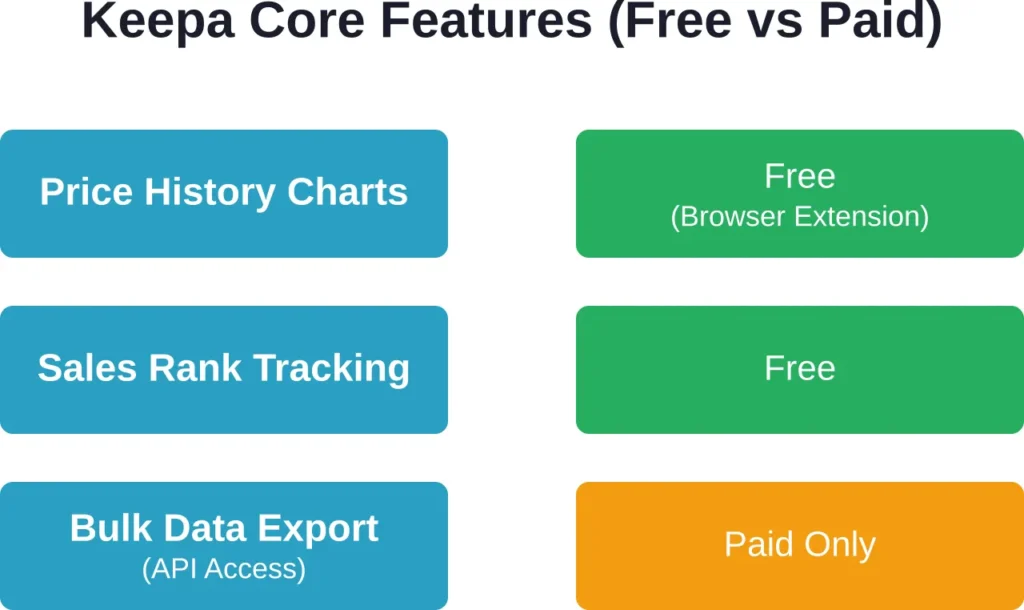
Keepa dominates the price tracking space for good reason. The free browser extension graphs historical prices, sales rank fluctuations, and Buy Box ownership across every Amazon marketplace. Install it once and every product page displays embedded charts.
Sales rank patterns reveal demand consistency. A product bouncing between 5,000 and 50,000 BSR shows stable interest. Wild swings from 200 to 200,000 indicate seasonality or promotional spikes—risky for new sellers relying on steady cash flow.
Price history exposes competitor behavior. If three sellers dropped prices 40% during Q4 2025, expect the same pattern in 2026. That intel shapes inventory decisions and pricing strategy months in advance.
The free tier limits some data access, but the core features—price drops, rank tracking, availability alerts—remain fully functional. Power users eventually upgrade to Keepa’s paid API for bulk data extraction, but beginners get tremendous value from the extension alone.
Google Trends: Seasonality and Market Validation

Before ordering 500 units of a product, check Google Trends. This free tool maps search interest over time, revealing seasonal patterns and long-term trajectory.
Search for the product category—”yoga mats,” “camping lanterns,” “pet grooming kits.” If interest spikes December-January then crashes in March, plan inventory accordingly. If the trend line climbs steadily over three years, the market is expanding.
Compare related keywords to identify the strongest search terms. “Resistance bands” might show 3x more interest than “exercise bands,” guiding listing optimization and PPC campaigns.
Google Trends doesn’t provide Amazon-specific data, but consumer search behavior correlates strongly with marketplace demand. It’s a quick sanity check that prevents costly mistakes.
Free ASIN and UPC Conversion Tools
Amazon uses ASINs (Amazon Standard Identification Numbers) while suppliers and inventory systems rely on UPCs (Universal Product Codes). Converting between formats is a daily task for active sellers.
Several free converters handle bulk transformations. Seller Assistant offers free ASIN-to-UPC lookup without registration. Paste an ASIN, get the corresponding UPC instantly. The tool also reverses the process—UPC to ASIN—useful when sourcing products from wholesale catalogs.
These converters save hours of manual lookup work. Instead of searching Amazon for each product code, batch-convert entire spreadsheets in seconds.
Jungle Scout’s Free Sales Estimator

Jungle Scout built its reputation on accurate sales estimates. The company offers a limited free version of its sales estimator that predicts monthly units sold based on Best Seller Rank.
Enter a product’s BSR and category, and the tool outputs estimated monthly sales. A rank of 10,000 in Home & Kitchen might translate to 450 units monthly, while the same rank in Toys & Games indicates 200 units.
The free estimator lacks the precision of paid tools—it won’t account for seasonal adjustments or marketplace variations. But for quick viability checks during initial research, it’s sufficient.
Sellers may benefit from cross-referencing Jungle Scout estimates with Keepa’s rank history for better accuracy. If Keepa shows stable rank around 8,000-12,000 and Jungle Scout estimates 400 units monthly, the product likely moves consistent volume.
Amazon’s FBA Revenue Calculator
Profitability determines success. Amazon’s official FBA Revenue Calculator projects fees, storage costs, and net margins before committing to a product.
Input the ASIN, product dimensions, weight, and cost of goods. The calculator displays FBA fulfillment fees, referral fees, storage fees, and estimated profit per unit. It also compares FBA costs to FBM (Fulfilled by Merchant) scenarios.
This tool is 100% accurate for fee structures—it pulls directly from Amazon’s pricing tables. No third-party tool can match that reliability.
The calculator doesn’t include advertising spend, return rates, or inventory holding costs. Sellers must factor those separately, but the baseline fee data is indispensable.
Sonar by Sellics: Free Keyword Research

Sonar provides Amazon-specific keyword data without subscription fees. Enter a seed keyword and receive hundreds of related search terms shoppers actually use on Amazon.
Unlike Google Keyword Planner—which reflects search engine queries—Sonar focuses exclusively on Amazon’s internal search behavior. That distinction matters. Shoppers searching “best wireless earbuds” on Google want reviews; those typing it on Amazon want to buy.
The free version doesn’t show search volume numbers, but the keyword suggestions remain valuable for listing optimization and PPC campaigns. Export the list, filter for relevance, and incorporate high-value terms into titles, bullet points, and backend search terms.
SellerSprite: Comprehensive Free Features

SellerSprite entered the market offering unusually generous free tiers. According to recent comparisons, the platform provides keyword research, product tracking, and market analysis without charging for basic access.
The keyword research module surfaces long-tail phrases with lower competition—ideal for new sellers who can’t outbid established brands on broad terms. Product tracking monitors competitors’ pricing, reviews, and rank changes daily.
SellerSprite supports multiple marketplaces: US, UK, EU, Japan, and Australia. That global reach helps sellers testing international expansion without multiplying software costs.
The free plan limits daily searches and historical data depth, but for sellers researching 5-10 products weekly, those restrictions rarely bind. Paid plans start around $29-$39 monthly for sellers needing unlimited access.
When to Upgrade to Paid Tools
Free tools carry sellers through product validation and initial launches. But scaling to $10,000+ monthly revenue typically requires automation, bulk processing, and advanced forecasting.
Signs it’s time to invest in paid software:
- Managing 10+ active SKUs where manual tracking becomes unmanageable
- Launching PPC campaigns that need keyword bid optimization and split testing
- Expanding to international marketplaces requiring multi-country data
- Competing in saturated niches where small inefficiencies erode margins
Popular paid options include Helium 10, Jungle Scout, and SellerSprite’s premium tiers. These platforms cost $39-$187 monthly depending on feature sets and data limits.
The inflection point usually hits around $5,000 in monthly sales. At that volume, paid tools often pay for themselves through improved efficiency and better decision-making.
Building a Hybrid Tool Stack
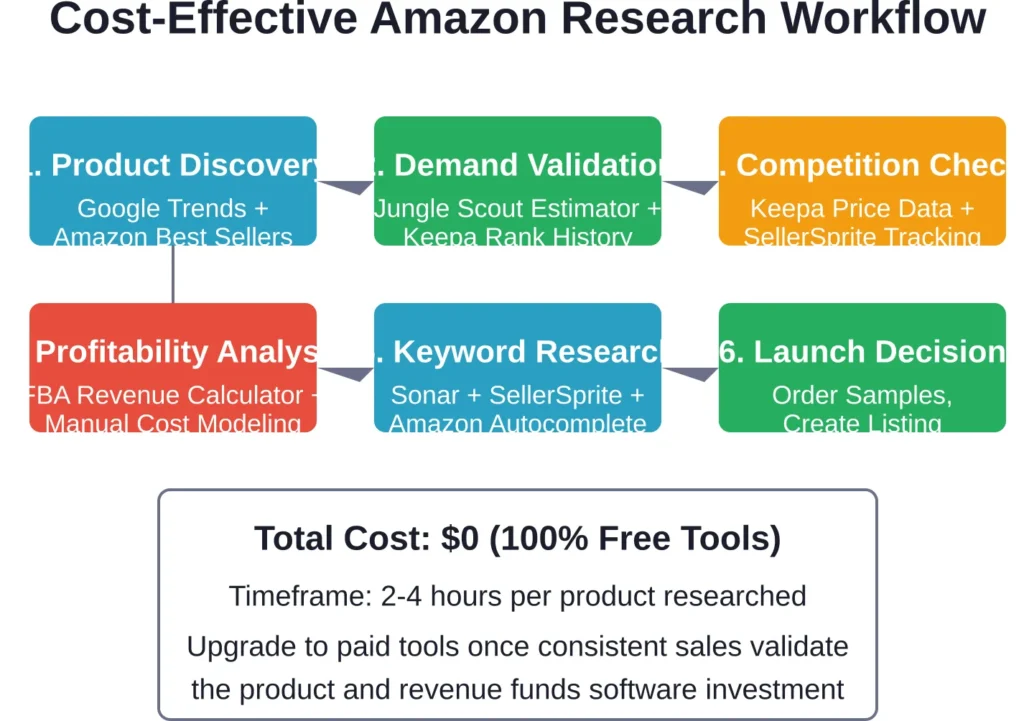
Smart sellers mix free and paid tools based on task frequency. Use Seller Central for daily operations, Keepa for ongoing price monitoring, and a paid platform for intensive product research sessions.
One effective hybrid model: free tools for 80% of tasks, one paid subscription ($39-$69 monthly) for specialized needs. That approach keeps costs under $100 monthly while covering all critical functions.
| Task Category | Free Solution | Paid Alternative | When to Upgrade |
|---|---|---|---|
| Price Tracking | Keepa (extension) | Keepa API | Tracking 50+ competitors |
| Keyword Research | Sonar + SellerSprite | Helium 10 Cerebro | Managing 5+ campaigns |
| Sales Estimates | Jungle Scout free tool | Jungle Scout Chrome extension | Researching 20+ products monthly |
| Profitability Calc | Amazon FBA Calculator | Seller Assistant App | Analyzing margins for 10+ SKUs |
| Inventory Management | Seller Central reports | RestockPro | Multi-warehouse FBA operations |
Avoiding Common Free Tool Pitfalls
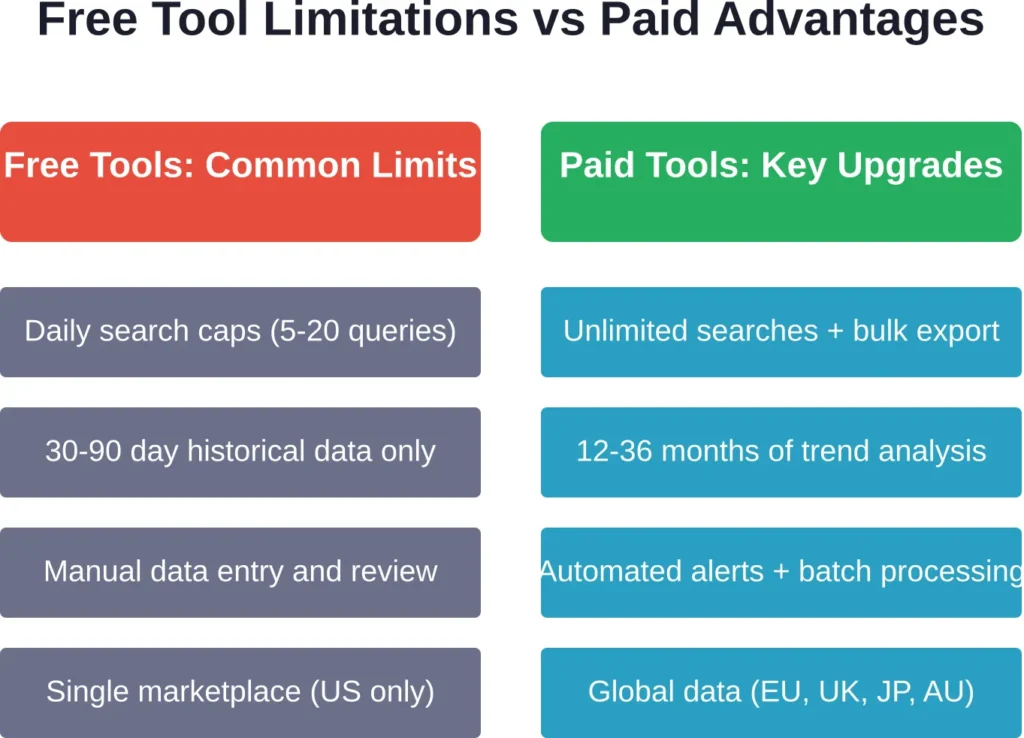
Free tools come with limitations that catch beginners off guard. Search caps restrict daily queries. Historical data might only go back 30-90 days. Customer support is often non-existent.
The biggest mistake: relying on a single free tool for critical decisions. Cross-reference data across multiple sources. If Keepa shows declining rank, Jungle Scout estimates dropping sales, and Google Trends confirms falling interest, the signal is clear. One tool alone might mislead.
Some free tools monetize through affiliate links or sponsored results. A “free keyword tool” might push paid products in search results. Stay aware of these incentives and verify recommendations independently.
Free vs Paid: Feature Comparison
Understanding what features justify paid subscriptions helps sellers allocate budgets wisely. Here’s what typically separates free from premium tiers:
Features That Justify Paid Subscriptions
- Historical trend data: 2-3 years of price and rank history reveals true seasonality patterns
- Bulk analysis: Compare 50-100 products simultaneously instead of one-by-one
- Automated tracking: Set alerts for price changes, rank drops, review surges across competitor ASINs
- PPC optimization: Bid management, negative keyword automation, campaign performance analytics
- Multi-marketplace support: Research UK, Germany, Japan markets without switching platforms
Compliance and Safety Considerations
Amazon’s Terms of Service prohibit certain data scraping activities. Free tools that violate these policies risk account suspension for users.
Seller Central’s built-in features are always safe—they’re Amazon’s official tools. Established platforms like Keepa, Jungle Scout, and Helium 10 maintain partnerships or approved API access. Newer free tools without clear documentation pose higher risk.
Consumers trust online reviews as personal recommendations. Tools that manipulate reviews or violate Amazon’s review policies invite permanent bans. Stick to compliant review request features like Seller Central’s Request a Review button.
When evaluating a new free tool, check whether it requires Seller Central login credentials. Legitimate tools use Amazon’s official SP-API (Selling Partner API) for data access. Tools requesting direct login credentials might violate security policies.
Mobile Apps and Extensions
Most free Amazon tools started as desktop software but now offer mobile apps or browser extensions. Keepa’s Chrome extension is the gold standard—install it once and every product page displays price history.
SellerSprite, Helium 10, and Jungle Scout all offer mobile apps for on-the-go research. Scanning products at retail stores with a phone while checking Amazon prices and sales rank helps identify arbitrage opportunities.
Browser extensions work best for desktop research sessions. Mobile apps excel at quick lookups and field work. Combining both covers all scenarios sellers face.
Community Resources and Free Training
Free tools extend beyond software into educational resources. Seller forums, YouTube channels, and Facebook groups provide strategies that cost thousands from consultants.
Amazon’s Seller University offers free video courses covering FBA inventory requirements, listing optimization, and advertising basics. Brand Registry members have access to enhanced brand analytics and training resources.
Reddit’s r/FulfillmentByAmazon hosts daily discussions where experienced sellers share tactics. The collective wisdom in community discussions often surpasses paid courses. Sort by top posts annually to find the highest-value content.
Frequently Asked Questions
For new sellers validating their first 3-5 products, free tools provide sufficient data. They cover product research, keyword discovery, and profitability analysis without subscription costs. However, sellers managing 10+ SKUs or running complex PPC campaigns eventually need paid tools for automation and bulk processing. The typical transition happens around $5,000-$10,000 in monthly sales.
Keepa’s price history extension ranks as the single most valuable free tool. It installs in seconds, works on every Amazon product page, and reveals demand patterns through sales rank fluctuations. Pair Keepa with Amazon’s FBA Revenue Calculator for profitability checks, and new sellers have enough data to validate product ideas before investing in inventory.
Established free tools like Keepa, Jungle Scout’s sales estimator, and Amazon’s native Seller Central features are completely safe. They either use official APIs or publicly available data. Newer tools requesting Seller Central login credentials warrant caution—verify they use Amazon’s approved SP-API before granting access. Avoid tools that promise to manipulate reviews or bypass Amazon policies.
Free tools typically monetize through freemium models—offering basic features free while charging for premium tiers. Others display affiliate links to products or services within results. Some aggregate anonymized seller data for market research sold to brands. Understanding the business model helps assess whether a tool’s recommendations might be biased.
An effective free stack combines Google Trends for seasonality checks, Keepa for price history and rank tracking, Jungle Scout’s free estimator for sales volume, Amazon’s FBA Calculator for profitability, and Sonar for keyword research. This five-tool workflow covers demand validation, competition analysis, and financial modeling—everything needed to launch confidently.
Upgrade when time spent on manual research exceeds the cost of automation. If analyzing 20 products weekly takes 10 hours with free tools but paid software reduces that to 2 hours, the $50-$100 monthly subscription pays for itself. Other triggers include launching in multiple marketplaces, managing advertising campaigns across 5+ SKUs, or needing historical data beyond 90 days.
Tool coverage varies by platform. Keepa supports all major Amazon marketplaces (US, UK, Germany, France, Italy, Spain, Canada, Japan, Australia) in its free extension. SellerSprite’s free tier covers US, UK, EU, Japan, and Australia. Amazon’s Seller Central features work across all regions where a seller maintains accounts. Google Trends provides global data. Most free tools now support at least 2-3 international markets.
Conclusion: Building Your Free Tool Stack
Launching an Amazon business in 2026 doesn’t require premium software subscriptions. Strategic use of free tools—Seller Central’s analytics, Keepa’s price tracking, Google Trends validation, and ASIN converters—provides everything needed to validate products and launch successfully.
Start with the foundation: master Amazon Seller Central’s built-in reports and tools. Layer on Keepa for market intelligence and Jungle Scout’s free estimator for demand validation. Add Sonar for keywords and the FBA Calculator for profitability checks. That five-tool stack costs nothing and covers product research end-to-end.
As revenue grows past $5,000 monthly, consider upgrading one tool at a time based on specific bottlenecks. Need better keyword research? Upgrade to Helium 10’s paid tier. Struggling with inventory forecasting? Add a dedicated inventory management platform.
The key is avoiding premature optimization. Free tools carry new sellers through validation and initial launches. Once products prove profitable, reinvesting 2-3% of revenue into better software accelerates growth.
Ready to launch your Amazon business? Start with Seller Central today—it’s free, comprehensive, and the foundation every successful seller builds on. Master the built-in tools before adding external platforms.