

Quick Summary: Amazon listing tools help sellers optimize product pages, manage inventory, automate pricing, and boost sales through data-driven insights. The top tools for 2026 include Jungle Scout for product research ($49–$129/month), Helium 10 for comprehensive optimization (starting at $29/month), and SellerSprite for traffic analysis. Specialized tools like Keywords.am ($49–$299/month) and Soona (free to $35/month) address specific needs from keyword research to visual content creation.
Running an Amazon business without the right tools means making decisions blindfolded. The data exists—search volume, competitor sales estimates, supplier pricing benchmarks, PPC bid landscapes, keyword ranking positions—but without software to surface and interpret it, sellers compete against opponents armed with hard numbers.
Amazon FBA software has matured significantly in 2026. Tool categories have consolidated around product research, listing optimization, inventory management, PPC automation, and profit analytics. The gap between accurate data and poor estimates can mean the difference between a profitable launch and $15,000 of inventory that won’t sell at margin, according to industry analyses.
Here’s what matters: choosing tools that solve specific bottlenecks rather than accumulating subscriptions. Some sellers need deep keyword research. Others need repricing automation or A+ Content generation. The toolkit depends on business stage, product category, and whether the operation focuses on wholesale, private label, or arbitrage.
Managing Amazon Campaigns Efficiently Using WisePPC

Managing multiple campaigns and analyzing performance data often consumes significant time that could be better spent on growth strategy. WisePPC offers a centralized platform designed to streamline operations for Amazon sellers by providing granular insights and efficient bulk management tools.
Key features include:
- Long-Term Data Retention: Maintains historical performance data beyond the standard 60–90 day window offered by Amazon, enabling comprehensive trend analysis and seasonality tracking.
- Advanced Analytics and Segmentation: Allows for simultaneous tracking of up to six metrics, with granular data segmentation by campaign type, match type, and bid strategy.
- Efficient Bulk Operations: Enables users to edit thousands of campaigns, ad groups, or targets in a few clicks, significantly reducing time spent on manual adjustments.
- Performance Visualization: Uses gradient-based highlighting in tables and flexible charts to quickly identify underperforming keywords or profitable placement opportunities.
To begin optimizing your campaigns with real-time data and advanced automation, sign up for an account with WisePPC.
Why Amazon Listing Tools Matter for Sellers
Amazon’s algorithm rewards listings that convert. But conversion optimization requires testing headlines, refining bullet points, analyzing competitor keyword strategies, and tracking how changes impact rankings. Manual execution of these tasks consumes hours that could drive revenue elsewhere.
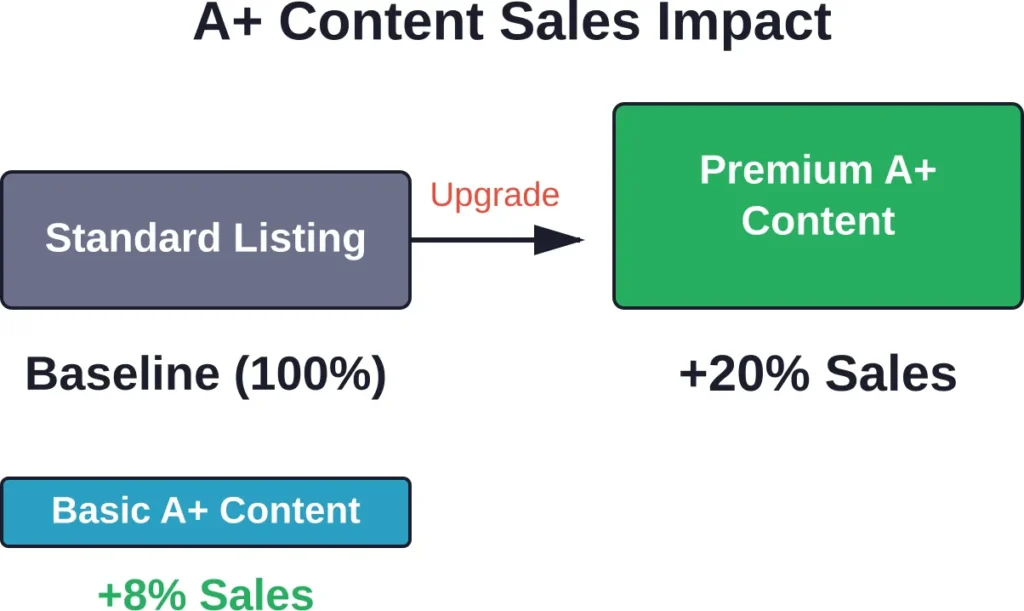
The data shows real impact. Basic A+ Content increases sales by up to 8%, while Premium A+ Content drives up to 20% higher sales, according to official Amazon statistics from November 2025. Tools that streamline A+ Content creation, keyword insertion, and mobile optimization directly affect conversion rates.
Inventory miscalculations create cash flow problems. Tools that forecast demand based on sales velocity, seasonality patterns, and lead times prevent stockouts during peak traffic periods. Veeqo, Amazon’s free multichannel shipping software, lets sellers earn up to 5% back on eligible shipments while managing inventory across platforms.
But here’s the thing—not all tools deliver accurate data. Search volume estimates vary wildly between platforms. Tools that underestimate keyword search volume lead to missed optimization opportunities. Sellers need to verify tool accuracy against known benchmarks before trusting recommendations for $10,000+ inventory decisions.
Categories of Amazon Listing Tools
Amazon seller tools fall into distinct categories, each addressing different operational needs. Understanding these categories helps sellers build a lean toolkit without redundant subscriptions.
Product Research and Market Analysis
Product research tools estimate sales volume, revenue potential, and competition intensity for specific ASINs or niches. These platforms analyze historical sales data, review counts, pricing trends, and seller metrics to score product opportunities.
Jungle Scout pioneered this category and remains a top choice, with pricing from $49 to $129 per month as of February 2026. The platform provides bulk product analysis, Amazon store analysis, product identification by category or brand, and sales estimators.
SellerSprite offers product research, market analysis, keyword discovery, and competitor monitoring with traffic insights. The tool tracks traffic insights for both organic and paid channels, helping sellers understand where competitor sales originate.
Analyzer Tools provides profit calculation and bulk analysis functionality with various pricing tiers.
Listing Optimization and Keyword Research
Listing optimization tools focus on keyword discovery, title construction, bullet point refinement, and backend search term selection. These platforms analyze top-ranking competitors to reverse-engineer successful keyword strategies.
Keywords.am specializes in listing optimization with AI-powered title and description generation. Monthly plans range from $49 to $299, positioned below the $99 to $279 pricing of all-in-one suites. The tool handles technical requirements like byte counting for Japan and Germany marketplaces.
Helium 10 combines listing optimization with product research, keyword tracking, and index checking. Starting at $29 per month, the platform offers a comprehensive suite that includes the Listing Builder tool and Cerebro reverse ASIN lookup.
Amazon’s native AI tools now include a free Listing Generator available to all sellers. While AI-generated listings show quality improvements versus pre-AI methods, specialized tools still outperform for competitive keywords because they ground recommendations in real search data rather than general language patterns.
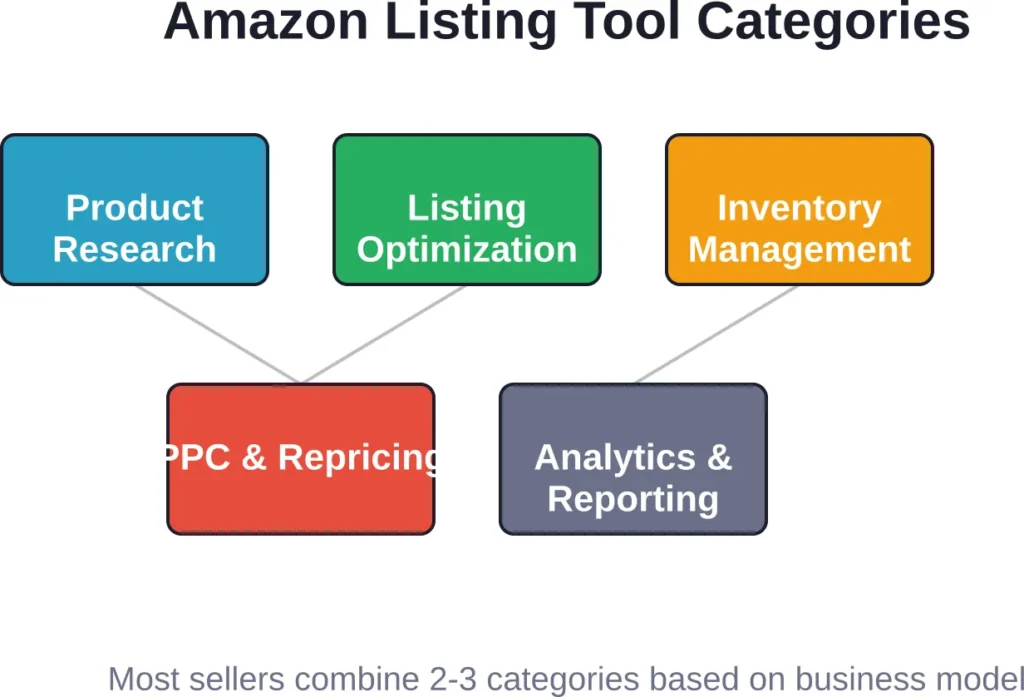
Inventory and Shipping Management
Inventory tools track stock levels across warehouses, forecast reorder timing, and integrate with shipping carriers for label generation and tracking. These platforms prevent costly stockouts and reduce storage fees from overstocking.
Veeqo stands out as Amazon’s free multichannel shipping software. The platform handles picking, packing, and shipping with the lowest shipping rates, smart automations, and powerful inventory tools. Sellers earn up to 5% back on eligible shipments, turning a cost center into a profit contributor.
InventoryLab connects to Amazon Professional seller accounts ($39.99 per month subscription) to manage inventory, calculate landed costs, and generate shipment plans. The tool simplifies reconciling expenses against revenue for accurate profit tracking.
PPC Automation and Repricing
Advertising and pricing tools automate bid adjustments, campaign creation, and competitive price positioning. These platforms monitor competitor pricing changes and adjust listings within seller-defined parameters to win the Buy Box.
Perpetua and Adtomic lead PPC automation, using machine learning to optimize bids based on ACoS targets and conversion data. Campaign management that previously required daily manual adjustments now runs on autopilot with performance guardrails.
Repricing tools monitor Buy Box prices and competitor positions, automatically adjusting prices to maintain competitiveness while protecting margins. During major sales events like Prime Day, Black Friday, and Cyber Monday, sellers typically pay flat premium fees for promotional placements, making automated pricing important for managing costs during peak traffic.
Analytics and Profit Tracking
Analytics platforms aggregate data from Amazon Seller Central, advertising consoles, and external sources to calculate true profitability after fees, PPC spend, returns, and operational costs. These tools answer whether a product line actually generates profit or just revenue.
Business Reports within Seller Central provide basic traffic and conversion metrics, but third-party analytics platforms add deeper segmentation, cohort analysis, and multi-channel attribution that native tools lack.
Top Amazon Listing Tools for 2026
The following tools represent the most effective options across categories, based on feature sets, pricing, and real-world application for different seller types.
Jungle Scout: Product Research and Validation

Jungle Scout remains the benchmark for product research, offering sales estimates, competition analysis, and supplier discovery in one platform. The tool’s Opportunity Score ranks products based on demand, competition, and listing quality gaps.
Pricing ranges from $49 to $129 per month as documented in February 2026 sources. The platform includes bulk product analysis, Amazon store analysis, product identification by category and brand, keyword tracking, and a sales estimator.
Best for sellers in the product selection phase or expanding into new categories. The tool compresses research that would take weeks of manual spreadsheet work into hours of filtered, scored opportunities.
Helium 10: Comprehensive Optimization Suite

Helium 10 provides end-to-end tools from product research through listing optimization, keyword tracking, and operations management. Starting at $29 per month, the platform offers better value than paying separately for specialized point solutions.
Key features include Cerebro for reverse ASIN lookup, Magnet for keyword research, Listing Builder for optimization, Index Checker to verify keyword indexing, and Refund Genie to recover lost inventory reimbursements from Amazon.
The Diamond plan at $279 per month unlocks advanced features like multi-user access, higher usage limits, and priority support. Best for established sellers managing 10+ ASINs who need daily access to multiple tool types.
SellerSprite: Market Intelligence and Traffic Analysis

SellerSprite focuses on market analysis, keyword discovery, and competitor monitoring with detailed traffic insights for organic and paid channels. The platform reveals where competitor sales originate, allowing sellers to replicate successful traffic strategies.
The tool tracks keyword rankings over time, monitors competitor advertising activity, and estimates sales velocity for specific ASINs. Product research features include bulk analysis and niche scoring similar to Jungle Scout.
Best for sellers focused on competitive intelligence and ranking strategies in crowded categories where understanding competitor tactics provides an edge.
Keywords.am: Specialized Listing Optimization
Keywords.am specializes in AI-powered listing optimization with keyword research grounded in real search data rather than generic language models. Monthly plans range from $49 to $299, cheaper than all-in-one suites while delivering superior listing quality.
The platform handles technical requirements like byte counting for international marketplaces (Japan, Germany), ensuring listings meet character limits without manual calculation. AI now compresses a 4-hour listing build into 30 to 45 minutes, but only if the tool uses real search data as a foundation.
Best for sellers who already have product research tools and need specialized optimization for competitive keywords where generic AI listings underperform.
Soona: Visual Content and Image Optimization

Soona provides product photography, image optimization, and visual content creation specifically for ecommerce listings. Pricing ranges from free to $35 per month according to source data.
High-quality images drive conversion rates. The tool offers listing insights, helping sellers understand which visual elements resonate with customers through rapid feedback on image variations.
Best for sellers launching new products or refreshing visual content on underperforming listings. Visual optimization particularly impacts mobile conversion, where 50% of Amazon traffic originates according to Shopify data.
Analyzer Tools: Profit Calculation and Bulk Analysis
Analyzer Tools focuses on profit calculation and bulk product analysis for wholesale and arbitrage sellers. The web app starts at $49 per month, with a Pro tier at $69 per month and short-term access options at $15 for 2 days or $25 for 5 days.
The platform calculates landed costs including shipping, tariffs, Amazon fees, and PPC spend to reveal true unit economics. Bulk analysis features let sellers evaluate hundreds of ASINs simultaneously for restocking or expansion decisions.
Best for wholesale sellers managing large catalogs who need rapid profitability screening across many SKUs rather than deep research on individual products.
| Tool | Primary Use | Pricing (Monthly) | Best For |
|---|---|---|---|
| Jungle Scout | Product research & validation | $49–$129 | New product launches |
| Helium 10 | Comprehensive optimization suite | $29–$279 | Established sellers (10+ ASINs) |
| SellerSprite | Competitor intelligence & traffic | Varies | Competitive categories |
| Keywords.am | Listing optimization & keywords | $49–$299 | Competitive keyword targeting |
| Soona | Visual content & images | Free–$35 | Product photography needs |
| Analyzer Tools | Profit calculation & bulk analysis | $49–$69 (or $15–$25 short-term) | Wholesale & arbitrage |
Amazon’s Native Tools Every Seller Should Use
Amazon provides powerful built-in tools at no additional cost beyond the Professional seller plan ($39.99 per month). Many sellers overlook these native features while paying for third-party alternatives that deliver similar functionality.
A+ Content for Conversion Optimization
A+ Content enhances product detail pages with rich images, comparison charts, and brand storytelling. Basic A+ Content increases sales by up to 8%, while Premium A+ Content drives up to 20% higher sales according to official Amazon data from November 2025.
Basic A+ Content requires a Professional selling account, Brand Registry enrollment, and Brand Representative status. Premium A+ Content additionally requires an active Brand Story applied to all ASINs and 5 approved A+ Content projects within the past 12 months.
January 2026 guidance from Amazon recommends refreshing A+ Content at the start of the year before first quarter traffic peaks. Updated images, comparison charts, and video modules boost conversion rates as customer traffic increases. Start by replacing seasonal or dated images with evergreen lifestyle shots optimized for mobile viewing.
Review product comparison modules to ensure they show current data and position products accurately. If video modules aren’t already in use, consider adding brief product demos or how-to guides. Update brand story modules to reflect current positioning and any new product lines launching in 2026.
Amazon AI Listing Generator
Amazon’s free AI Listing Generator creates basic listing drafts from product information. While AI-generated listings show a 40% lift in listing quality scores versus pre-AI methods, the tool works best for straightforward products in less competitive categories.
For competitive keywords, specialized tools like Keywords.am outperform because they ground recommendations in actual search data rather than generic language patterns. Amazon’s Gen-AI algorithm now influences product exposure, making optimization around real search behavior more critical.
Business Reports for Performance Tracking
Business Reports within Seller Central provide traffic, conversion, and sales data for all ASINs. The reports break down sessions, page views, buy box percentage, units ordered, and sales by date range.
Community discussions identify Business Reports as a secret weapon for understanding which products drive profitability versus just revenue. The data reveals underperforming listings that need optimization or should be discontinued to free up capital.
Inventory Management Dashboard
The Inventory Management Dashboard tracks stock levels, forecasts restock timing, and alerts sellers to stranded inventory or suppressed listings. The tool prevents stockouts during peak periods and identifies slow-moving inventory accumulating storage fees.
Sellers in community forums consistently cite inventory management features as time-savers that prevent costly mistakes. Automated alerts catch issues before they impact sales or trigger long-term storage fees.
Advertising Console for Campaign Management
The Advertising Console manages Sponsored Products, Sponsored Brands, and Sponsored Display campaigns. The interface provides bid recommendations, keyword suggestions, and performance reporting by campaign, ad group, and keyword.
While third-party PPC tools add automation and cross-campaign optimization, the native console handles basic campaign creation and adjustment without additional subscriptions. Sellers just starting with advertising should master the native tools before layering on automation platforms.
Choosing the Right Tools for Different Business Models
Tool selection depends on business model, product category, sales volume, and growth stage. The right toolkit for a private label seller differs completely from what an arbitrage operation needs.
Private Label Sellers
Private label sellers need deep product research, keyword optimization, and differentiation from competitors selling similar items. The focus shifts to conversion optimization and ranking for primary keywords.
Recommended stack: Jungle Scout for product validation, Helium 10 or Keywords.am for listing optimization, Veeqo for inventory and shipping, and a PPC automation tool once advertising spend exceeds $2,000 monthly.
A+ Content becomes critical for private label because it’s the primary differentiation tool when products physically resemble competitors. Premium A+ Content justifies higher price points through brand storytelling and detailed feature comparisons.
Wholesale Sellers
Wholesale sellers manage large catalogs with thinner margins. Speed matters more than deep optimization per ASIN. Tools need to handle bulk operations and rapid profitability screening.
Recommended stack: Analyzer Tools for bulk profit calculation, repricing software to maintain Buy Box competitiveness, and Veeqo for multichannel inventory management. Product research tools provide less value since wholesale sellers work with established brands rather than discovering new opportunities.
Arbitrage Sellers
Retail and online arbitrage require fast sourcing decisions and inventory turnover tracking. Tools must quickly assess whether a clearance item will sell profitably on Amazon after fees and shipping.
Recommended stack: Mobile apps with barcode scanning for in-store sourcing decisions, Analyzer Tools for profit calculation, and inventory management to track aging stock before it hits long-term storage fees.
Arbitrage sellers typically skip expensive all-in-one suites in favor of lean toolkits focused on speed and profitability screening rather than ranking optimization.
Dropshipping Operations
Amazon dropshipping focuses on identifying products that suppliers can fulfill directly without carrying inventory. Tools need to evaluate market demand and supplier reliability.
Recommended stack: Product research tools to identify high-demand, low-competition opportunities, repricing to stay competitive without manual monitoring, and order management systems that integrate with supplier APIs for automated fulfillment.
Advertising becomes less critical for dropshipping since margins rarely support aggressive PPC spend. Organic ranking through listing optimization provides better ROI.
Common Mistakes When Choosing Amazon Tools
Sellers waste thousands annually on redundant subscriptions or tools that don’t match their business model. Here are the most common missteps and how to avoid them.
Buying All-in-One Suites for Narrow Needs
All-in-one platforms like Helium 10 Diamond at $279 per month provide tremendous value—if the seller uses most features. But paying $279 monthly to access only keyword research wastes money when specialized tools like Keywords.am deliver better results at $49–$299.
Audit actual usage quarterly. If 70% of a platform’s features sit unused, downgrade or switch to specialized tools for the specific functions needed.
Ignoring Free Native Tools
Amazon includes powerful tools with the Professional seller plan. Sellers paying third parties for features already available in Seller Central—like basic reporting, inventory alerts, or A+ Content—throw away margin.
Start with native tools. Only add paid alternatives when hitting specific limitations that block growth. For example, Business Reports provide sufficient data until managing 50+ ASINs, at which point third-party analytics add value through better segmentation.
Chasing the Latest AI Hype
AI listing generators proliferated in 2025–2026, but generic AI tools underperform in competitive categories. Tools that just wrap GPT around a simple prompt produce listings that blend into the crowd rather than rank.
AI works when grounded in real search data. Amazon’s Gen-AI algorithm now influences product exposure, but sellers still need to optimize around actual buyer search behavior. Choose AI tools that incorporate keyword research data rather than pure language generation.
Not Testing Data Accuracy
Search volume estimates and sales predictions vary dramatically between platforms. Betting inventory dollars on inaccurate estimates leads to overstocking slow-moving SKUs.
Cross-reference estimates between tools for high-stakes decisions. If Jungle Scout estimates 3,000 monthly searches but Helium 10 shows 8,000 for the same keyword, investigate the discrepancy before ordering 1,000 units.
Subscribing to Redundant Tools
Many sellers accumulate tools that overlap significantly. Paying for Jungle Scout, Helium 10, and SellerSprite simultaneously makes sense only if actively using unique features from each platform daily.
Map tool features against actual workflow needs. Most sellers achieve 90% of required functionality with 2–3 well-chosen tools rather than 6+ subscriptions with massive feature overlap.
How Tool Selection Changes with Business Growth
Toolkit needs evolve as operations scale from single-product launches to multi-channel brands. What works at $10,000 monthly revenue creates bottlenecks at $100,000.
Launch Phase (Pre-Revenue to $10k/Month)
Early-stage sellers need product validation and basic listing optimization. Budget constraints favor free tools and lean subscriptions.
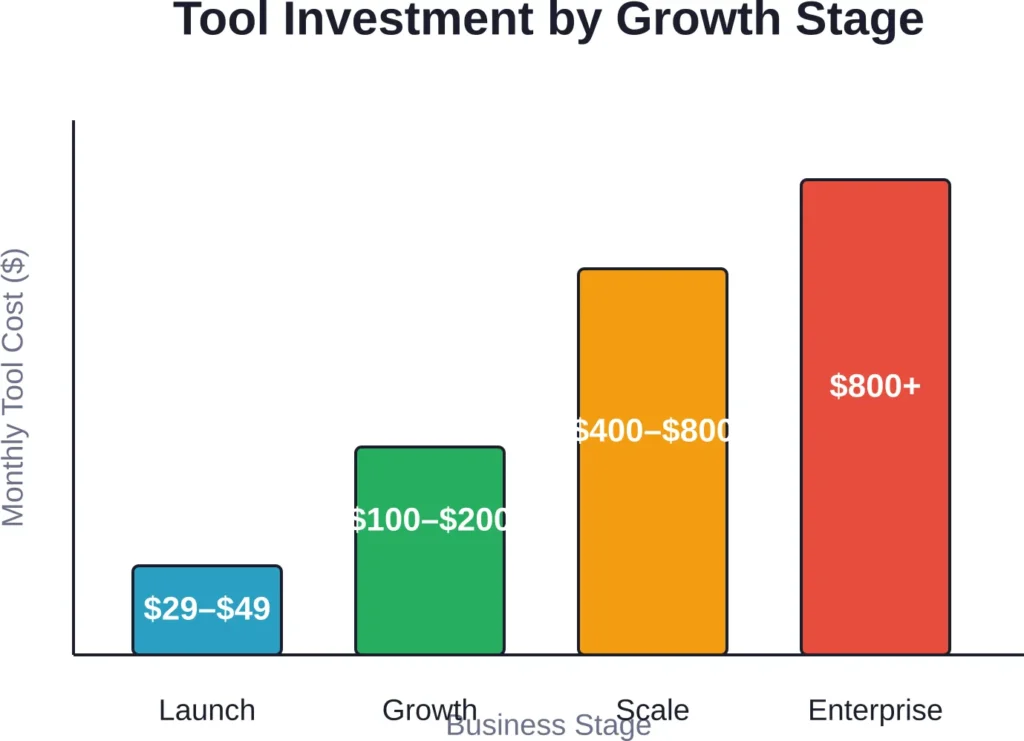
Recommended approach: Use Amazon’s free AI Listing Generator, Business Reports for basic analytics, and one product research tool (Jungle Scout or Helium 10 Starter). Total monthly tool cost: $29–$49.
Avoid premium tiers until proving product-market fit. The incremental features rarely justify 3–5× cost increases for sellers managing 1–5 ASINs.
Growth Phase ($10k–$50k/Month)
Growing sellers need better keyword optimization, PPC management, and inventory forecasting. Operational complexity increases as product count expands to 10–25 ASINs.
Recommended approach: Upgrade to mid-tier plans (Helium 10 Platinum or equivalent), add Veeqo for inventory, and consider entry-level PPC automation if managing 5+ campaigns. Total monthly tool cost: $100–$200.
This phase justifies A+ Content investment. Premium A+ Content’s 20% sales lift generates meaningful revenue impact at this scale, potentially adding $2,000–$10,000 monthly.
Scale Phase ($50k–$250k/Month)
Established sellers manage 25–100+ ASINs across multiple product lines. Tools need to handle catalog-wide operations, team collaboration, and channel expansion beyond Amazon.
Recommended approach: Premium all-in-one suite (Helium 10 Diamond), multichannel inventory platform, advanced PPC automation, and profit analytics. Total monthly tool cost: $400–$800.
Team features become important. Multi-user access, role-based permissions, and API integrations with ERPs or 3PLs justify premium pricing at this scale.
Enterprise Phase ($250k+/Month)
Enterprise operations require custom integrations, white-glove support, and tools that handle international expansion. Off-the-shelf solutions hit limits around managing hundreds of ASINs or coordinating cross-functional teams.
Recommended approach: Enterprise tool agreements, custom API integrations, dedicated account management, and potentially in-house tool development for proprietary workflows. Tool costs scale as a percentage of revenue rather than fixed subscriptions.
Emerging Trends in Amazon Seller Tools for 2026
The seller tool landscape continues evolving. Several trends are reshaping how tools deliver value and which capabilities matter most.
AI Moving from Hype to Utility
2025 saw explosive growth in AI-powered Amazon tools, but 2026 separates genuine utility from repackaged GPT wrappers. Tools that integrate AI with proprietary data—search volumes, competitor tracking, conversion benchmarks—deliver measurable improvements.
Amazon’s Gen-AI algorithm changes how products get exposure. Sellers need to optimize around AI-driven discovery patterns, not just traditional keyword placement. Tools that decode how Amazon’s AI interprets listings will command premium pricing.
Mobile-First Optimization
A significant portion of Amazon traffic comes from mobile devices. Tools now prioritize mobile preview modes, character limits for mobile display, and image optimization for smaller screens.
Site speed impacts mobile conversion rates significantly. Image file size optimization and mobile load testing features are becoming table stakes for listing tools.
Cross-Channel Inventory Management
Sellers expand beyond Amazon to Shopify, Walmart, Target+, and international marketplaces. Tools need unified inventory tracking, synchronized pricing, and channel-specific listing optimization.
Veeqo represents this trend—free multichannel shipping and inventory management that prevents stockouts on Amazon while dropshipping from Shopify or wholesale to Target. The future favors platforms that manage Amazon as one channel within a broader ecommerce operation.
Profit Analytics Over Vanity Metrics
Sellers increasingly demand true profitability tracking that accounts for all costs—COGS, Amazon fees, PPC, returns, refunds, promos, storage fees, and labor. Tools that surface unit economics rather than just sales velocity help identify which products actually generate profit.
Community discussions emphasize this shift. Sellers want to know ROI and cash conversion cycles, not just sales rank movements.
Sustainability and Compliance Features
Regulatory requirements around product safety, packaging, and environmental claims tighten globally. Tools that automate compliance checking, certification tracking, and documentation for international sales reduce legal risk.
As Amazon expands Climate Pledge Friendly and other sustainability badges, tools that help sellers qualify for these programs provide competitive advantages in search results and customer trust.
Maximizing ROI from Amazon Seller Tools
Subscribing to tools doesn’t automatically improve performance. Maximizing ROI requires systematic implementation, team training, and regular audits.
Start with Clear Goals
Define specific objectives before subscribing. “Improve listings” is vague. “Increase organic conversion rate from 12% to 15% on top 5 ASINs” provides a measurable target that determines whether the tool delivers value.
Match tools to goals. If the objective is reducing ad spend by 20%, focus on PPC automation tools with ACoS optimization. If the goal is launching 3 new products quarterly, prioritize product research platforms.
Block Time for Implementation
Tools require learning curves. Allocate dedicated time to watch tutorials, complete platform onboarding, and set up integrations. Partial implementation wastes subscription costs.
Schedule recurring sessions—weekly for the first month, then biweekly—to review reports and adjust strategies based on tool insights. Tools provide data, but sellers must act on it.
Track Metrics Before and After
Establish baseline metrics before subscribing. Track conversion rates, PPC ACoS, organic rank for target keywords, and units sold for 30 days pre-tool.
Compare the same metrics 60 and 90 days post-implementation. If metrics don’t improve, diagnose whether the issue is tool quality, incomplete implementation, or misalignment between tool capabilities and actual bottlenecks.
Audit Subscriptions Quarterly
Set calendar reminders to review all tool subscriptions quarterly. Ask: Did this tool generate more profit than its cost this quarter? What specific actions did we take based on this tool’s data?
Cancel tools that sit unused or deliver redundant data available elsewhere. Redirect those dollars to tools with proven ROI or test new platforms addressing current bottlenecks.
Combine Tools with Manual Expertise
Tools provide data and automation, but human judgment still matters. Algorithmic repricing can trigger race-to-the-bottom pricing wars. AI-generated listings miss nuances that resonate with specific customer segments.
Use tools to handle scale and repetitive tasks, but apply manual review to high-stakes decisions: pricing strategy for hero products, messaging for new launches, supplier relationships for top inventory.
FAQ: Amazon Listing Tools
Amazon listing tools are software platforms that help sellers optimize product pages, research profitable products, manage inventory, automate pricing, and track performance metrics. Sellers need these tools because manual execution of research, optimization, and monitoring tasks consumes hours daily. Tools compress weeks of spreadsheet work into minutes of filtered insights, allowing sellers to make data-driven decisions about which products to sell, how to price them, and how to rank competitively. The right tools can mean the difference between a profitable launch and $15,000 of unsellable inventory according to industry analyses.
Tool budgets scale with business stage. Launch-phase sellers spending under $10,000 monthly need $29–$49 for basic product research and listing tools. Growth-stage operations ($10k–$50k monthly) should allocate $100–$200 for mid-tier platforms, PPC tools, and inventory management. Established sellers ($50k–$250k monthly) typically invest $400–$800 in comprehensive suites, automation, and analytics. Enterprise operations over $250k monthly may spend $800+ or negotiate custom enterprise agreements. As a general rule, tool costs should remain under 2% of monthly revenue.
Basic A+ Content allows Brand Registered sellers to add enhanced images, comparison charts, and formatted text to product descriptions, increasing sales by up to 8% according to Amazon. Premium A+ Content adds interactive modules like carousels, hotspot images, and videos, driving up to 20% higher sales. Basic A+ requires only Brand Registry enrollment and Professional seller status. Premium A+ additionally requires an active Brand Story on all ASINs and 5 approved A+ projects in the past 12 months. Premium justifies the extra requirements through significantly higher conversion lifts.
All-in-one suites like Helium 10 ($29–$279 monthly) provide better value for sellers managing 10+ ASINs who need daily access to multiple functions—product research, keyword tracking, listing optimization, and analytics. Specialized platforms like Keywords.am ($49–$299 monthly) outperform for sellers with narrow needs, delivering superior results in one area without paying for unused features. Lean operations and arbitrage sellers often benefit from specialized tools plus free native Amazon features. The decision hinges on actual daily workflow: if using 5+ tool categories regularly, all-in-one saves money; if focused on 1–2 functions, specialized tools perform better.
Sales estimate accuracy varies significantly between platforms and product categories. Industry analyses note that poor data accuracy in product research can mean the difference between a profitable launch and $15,000 of unsellable inventory. Tools that underestimate keyword search volume cause missed optimization opportunities. Cross-reference estimates between multiple tools for high-stakes inventory decisions. If Jungle Scout shows 3,000 monthly searches but Helium 10 estimates 8,000 for the same keyword, investigate the discrepancy before committing capital. Tools perform best for established products with consistent sales history and worse for seasonal items or new categories with limited data.
Sellers can build viable businesses using primarily free tools—Amazon’s AI Listing Generator, A+ Content, Business Reports, Inventory Dashboard, and Advertising Console—plus Veeqo’s free shipping software. This approach works for straightforward products in less competitive categories or wholesale operations where brand recognition drives sales more than ranking optimization. However, sellers in competitive categories or launching private label products typically need paid tools for deep keyword research, competitor intelligence, and listing optimization. Start with free tools and add paid subscriptions only when hitting specific limitations that block growth.
Amazon’s free AI Listing Generator creates basic drafts suitable for straightforward products in less competitive niches. AI-generated listings show a 40% quality score lift versus pre-AI methods according to Shopify data. But Amazon’s Gen-AI algorithm now influences product exposure, requiring optimization around real buyer search behavior. Third-party AI tools like Keywords.am outperform in competitive categories because they ground recommendations in actual keyword search data rather than pure language patterns. Generic AI that just wraps GPT around a prompt produces listings that blend in rather than rank. Choose AI tools that incorporate proprietary search data for best results.
Building a Sustainable Tool Strategy
The Amazon seller tool ecosystem will continue evolving as AI capabilities expand, Amazon introduces new features, and competitive pressures intensify. Sustainable success requires viewing tools as infrastructure investments that compound over time rather than magic bullets that instantly fix underperformance.
Start lean. Use free native tools and one carefully chosen paid platform addressing the biggest current bottleneck. Master that tool completely before adding subscriptions. Track ROI monthly. Cancel ruthlessly when tools don’t deliver measurable improvements.
Invest in tools that build proprietary advantages. Competitor intelligence platforms that reveal gaps in rival listings create opportunities for differentiation. Profit analytics that surface true unit economics help sellers double down on winners and exit losers faster than competitors flying blind.
But remember—tools amplify strategy, they don’t replace it. The best keyword research platform won’t save a product with no market demand. The most advanced PPC automation can’t overcome a listing that doesn’t convert. Focus first on fundamentals: product-market fit, compelling value propositions, high-quality images, and clear copy. Tools then optimize and scale what already works.
As Amazon’s algorithm incorporates more Gen-AI, as mobile traffic dominates, and as sellers expand beyond Amazon to multichannel operations, tools that provide unified data, automated compliance, and true profitability tracking will separate growing businesses from stagnant ones.
The sellers who build systematic tool evaluation frameworks, audit subscriptions quarterly, and reallocate budgets toward platforms with proven ROI will extract maximum value from every software dollar. Start with one or two tools aligned to immediate needs, measure results rigorously, and scale investment as revenue grows.