

Quick Summary: Amazon sellers in 2026 need strategic tools that address rising ad costs, evolving AI-driven competition, and tighter profit margins. Essential categories include product research platforms for validation, keyword and listing optimization tools for visibility, analytics software for profitability tracking, and inventory management systems to prevent stockouts that cost up to 65% in lost revenue. The right stack balances depth in critical areas with budget constraints — most successful sellers rely on 2-4 specialized tools rather than bloated all-in-one suites.
The Amazon marketplace has fundamentally shifted. What worked eighteen months ago — manual product hunting, gut-feel pricing, spreadsheet PPC tracking — leaves sellers hemorrhaging margin in 2026.
Ad costs keep climbing. AI-powered competitors move faster. And Amazon’s fee structure changes quarterly, making profitability a moving target.
The gap between sellers who rely on guesswork and those who use the right software stack has never been wider. According to industry analyses cited in competitor content, sellers waste an average of 12+ hours per week cobbling together disconnected tools and spreadsheets. According to industry sources, nearly 42% of sellers report that poor software decisions cost them profitable opportunities in their first year.
Here’s the thing though — not every tool delivers value. Many platforms bundle features sellers never touch, inflating costs without improving outcomes.
This guide breaks down the essential Amazon business tools every seller actually needs in 2026, organized by the core challenges they solve. Each category includes verified features, transparent pricing context, and clear indicators for when a tool matches specific selling models.
Product Research Tools: Validation Before Investment
Product research remains the foundation of profitable Amazon selling. Launch a dud, and no amount of optimization rescues margin.
Modern product research platforms filter millions of ASINs by revenue estimates, review velocity, sales trends, and competition saturation. The best tools surface opportunities competitors miss while flagging saturated niches before capital gets committed.
WisePPC: Amazon PPC Optimization Powerhouse

WisePPC anchors the workflow of serious Amazon sellers who want deep control and long-term visibility specifically in advertising — without the bloat of full research suites.
The platform includes bulk actions for 10K+ campaign edits, gradient-based metric highlighting, placement performance analysis, multi-metric charts (up to 6 at once), and on-spot inline editing. It stores years of historical data (far beyond Amazon’s 60–90 days limit) with 250K+ granular hourly insights across 30+ metrics.
According to competitor comparisons, WisePPC stands out as a focused PPC and analytics tool with strong bulk operations and long-term data retention, making it ideal for mid-to-large sellers and agencies who already have research tools and need a dedicated advertising command center (supports Amazon + Shopify).
The platform is currently in beta with generous early-access offers (free access + lifetime perks for beta users). After release, expect subscription-based pricing — contact vendor for current details, as plans are usage-oriented and may vary. Check WisePPC’s official pricing page for the latest tiers and feature availability.
WisePPC excels when sellers need surgical PPC management, bulk speed, and historical depth under one clean interface. That sharp focus delivers clarity and efficiency but may feel narrow if you’re looking for an all-in-one suite with heavy product research capabilities.
Contact Information:
- Website: wiseppc.com
- Facebook: www.facebook.com/people/Wise-PPC/61573154427547
- LinkedIn: www.linkedin.com/company/wiseppc
- Instagram: www.instagram.com/wiseppc
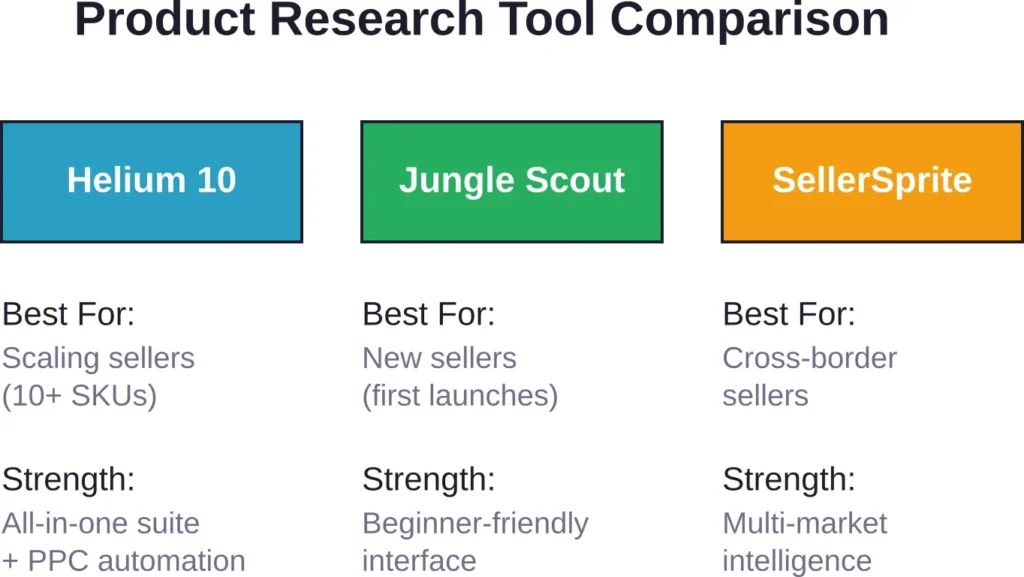
Helium 10: Comprehensive Research Suite

Helium 10 anchors many serious sellers’ workflows for one reason — depth across the entire research-to-launch pipeline.
The platform includes Black Box for database filtering, Xray for Chrome-based ASIN analysis, and Trendster for historical demand tracking. According to competitor analysis, Helium 10 includes powerful research tools and an integrated PPC platform called Helium 10 Ads, making it suitable for sellers from beginners to large agencies.
The platform offers a free version and entry pricing starting around $39/month for basic tiers, though prices may vary and scaling sellers typically need higher plans. Check Helium 10’s official pricing page for current tier details and feature availability.
Helium 10 excels when sellers need all-in-one coverage — product research, keyword tracking, listing optimization, and PPC management under one roof. That breadth creates simplicity but can overwhelm new sellers who need focus over features.
Jungle Scout: Beginner-Friendly Validation

Jungle Scout built its reputation on accessibility. The interface strips away complexity, making product validation faster for sellers launching their first 5-10 SKUs.
Core features include the Product Database for niche discovery, Opportunity Finder for low-competition keywords with demand, and the Supplier Database connecting sellers to manufacturers. The Chrome extension delivers instant sales estimates and competition metrics on any Amazon page.
Jungle Scout pricing typically starts lower than Helium 10 for entry tiers, though feature access scales with plan level. For current subscription costs and trial availability, consult Jungle Scout’s official site.
The tool shines for new sellers prioritizing ease of use and clear next-step guidance. Experienced sellers managing 50+ SKUs often need deeper analytics than Jungle Scout provides at accessible price points.
SellerSprite: Cross-Border Intelligence

SellerSprite stands out for international sellers managing multiple Amazon marketplaces or sourcing from China.
The platform combines traditional product research with market intelligence features tailored to cross-border operations — supplier verification, regional demand comparison, and multi-marketplace keyword mining. SellerSprite also tracks competitor keyword strategies and monitors listing changes across markets.
Pricing structures vary by feature bundle and marketplace coverage. Verify current plans on SellerSprite’s official website before committing.
SellerSprite fits sellers expanding beyond the US marketplace or those sourcing directly from overseas manufacturers who need integrated supplier and product data.
Keyword Research and Listing Optimization Tools
Product research identifies what to sell. Keyword tools determine whether anyone finds it.
Amazon’s A10 algorithm prioritizes relevance and conversion history. Listings optimized for high-volume, low-competition keywords gain visibility faster and sustain organic rank longer than those built on guesswork.
Modern keyword platforms track rank position, search volume trends, and competitor keyword strategies. They also audit listing health — flagging suppressed content, incomplete backend fields, and policy violations before they tank visibility.
What Keyword Tools Must Deliver
Effective keyword research tools provide several non-negotiable features. Search volume estimates paired with competition scores identify winnable terms. Historical trend data prevents optimization around seasonal spikes that collapse outside peak windows.
Rank tracking monitors keyword position daily or weekly, alerting sellers when organic placement drops. Reverse ASIN lookup reveals which keywords competitors rank for, surfacing gaps in current optimization.
Backend keyword suggestions maximize the 250-byte limit without violating Amazon’s indexing rules. Listing health monitoring flags suppressed content, missing attributes, or policy violations in real time.
Integrated vs. Standalone Keyword Platforms
Many all-in-one suites like Helium 10 and Jungle Scout bundle robust keyword tools. Helium 10’s Cerebro performs reverse ASIN analysis, Magnet generates keyword lists, and Frankenstein cleans and deduplicates terms for backend optimization.
Jungle Scout offers Keyword Scout for search volume and competition metrics, plus Listing Builder to embed keywords into copy while maintaining readability.
Standalone tools like Sonar by Sellics focus exclusively on keyword intelligence, often at lower price points for sellers who don’t need full research suites. Pricing and feature tiers vary — consult each platform’s official site for current details.
The choice depends on workflow. Sellers already using Helium 10 or Jungle Scout for product research rarely need separate keyword tools. Those working with specialized analytics platforms may prefer standalone keyword software to avoid redundant subscriptions.
Amazon Analytics Tools: Profitability Over Vanity Metrics
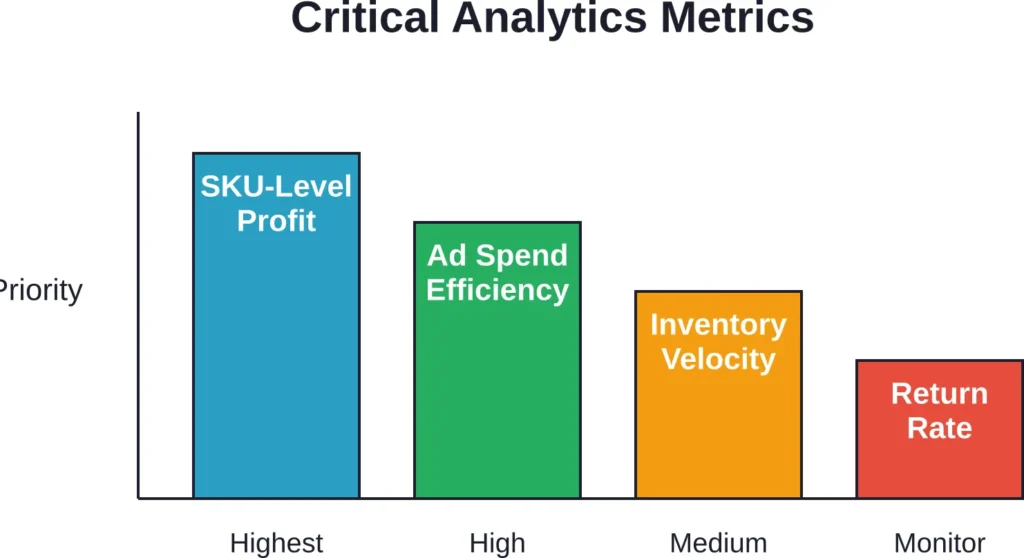
Revenue looks great until fees, returns, and wasted ad spend erase margin. Analytics tools surface the numbers that actually matter — profit per SKU, true advertising cost of sale, and inventory velocity.
The best analytics platforms in 2026 connect Amazon Seller Central data, advertising reports, and external costs into unified dashboards. They answer critical questions spreadsheets can’t handle at scale: Which SKUs drain cash? Which campaigns destroy ACOS? Where does inventory sit too long?
What Analytics Software Must Track
Profitability tracking at the SKU level accounts for all costs — COGS, FBA fees, referral fees, storage, advertising, returns, and promotions. Platforms that skip any variable produce misleading profit figures.
Advertising analytics should break down spend, sales, and ACOS by campaign, ad group, keyword, and ASIN. Real-time alerts flag runaway spend before budget gets torched.
Inventory metrics track sell-through rate, days of stock remaining, and stockout risk. According to GTMOffice analysis, AI-powered inventory forecasting can reduce stockouts by up to 65%, though implementation typically takes 4 to 8 weeks to deliver value.
Multi-marketplace reporting consolidates performance across US, UK, EU, and other regions for international sellers. Comparative dashboards reveal which markets deliver the best margin.
Leading Analytics Platforms
Conjura focuses on profitability and ad performance, providing SKU-level margin tracking and automated PPC optimization. The platform integrates Amazon Seller Central and Advertising data to surface actionable insights sellers can act on immediately.
According to available data, Conjura users report significant revenue increases, though specific percentages vary by business model. Check Conjura’s official site for current pricing and trial availability.
Data Dive emphasizes inventory intelligence and reorder automation, helping sellers prevent stockouts that kill rank and overstocks that inflate storage fees. The platform uses sales velocity and trend analysis to recommend optimal reorder quantities and timing.
SellerLabs offers Scope for keyword rank tracking and Ignite for PPC automation, alongside profit analytics. The platform appeals to sellers who want keyword, advertising, and margin tools under one subscription.
Pricing structures across analytics platforms vary widely based on sales volume, marketplace count, and feature access. Always verify current costs and contract terms before committing.
Inventory Management and Forecasting Tools
Stockouts kill organic rank. Overstocks inflate storage fees and tie up capital.
Inventory management tools bridge the gap between sales velocity and reorder lead times, ensuring stock levels match demand without excess. Advanced platforms incorporate seasonality, promotional spikes, and marketplace trends into forecasting models.
Why Manual Inventory Tracking Fails
Spreadsheets can’t react to real-time sales velocity shifts. A sudden rank boost from viral attention doubles sell-through overnight, and by the time manual tracking catches the trend, inventory’s gone.
Amazon’s FBA storage fees punish slow movers, especially during Q4 when rates spike. Tools that flag aging inventory early enable proactive liquidation before fees compound.
Lead time variability from suppliers adds uncertainty. Forecasting software accounts for supplier delays, shipping transit windows, and Amazon’s receiving timelines to recommend reorder points that prevent stockouts without over-committing capital.
Inventory Platforms Worth Considering
RestockPro automates reorder recommendations based on sales velocity, lead times, and desired days of stock coverage. The platform integrates with Seller Central to pull real-time inventory levels and sales data.
SoStocked focuses on multi-channel inventory for sellers managing FBA alongside Shopify, Walmart, or other platforms. Unified dashboards prevent overselling and optimize stock allocation across channels.
Data Dive, mentioned earlier for analytics, also provides robust inventory forecasting and reorder automation. The dual focus on profitability and inventory makes it appealing for sellers who want integrated tools.
Pricing models typically scale with SKU count and sales volume. Verify current subscription tiers on each platform’s official website before signing up.
AI-Powered Tools: Automation and Personalization
AI has moved beyond buzzword status in 2026. Sellers now deploy machine learning for customer support, dynamic pricing, personalized recommendations, and automated ad buying.
The measurable impact varies by implementation quality and data hygiene. According to GTMOffice analysis, AI-driven personalization can deliver revenue lifts ranging from 8% to 25%, though results depend heavily on existing conversion rates and traffic volume.
AI Customer Support
AI chatbots and automated messaging handle common inquiries — order status, shipping timelines, return instructions — deflecting tickets from human support teams.
Platforms report 30% to 40% ticket deflection rates for sellers with well-trained AI models, freeing support staff to handle complex issues. Implementation timelines range from 1 to 3 weeks depending on existing message volume and FAQ depth.
Tools like Helium 10’s AI-powered customer messaging and third-party platforms such as eDesk integrate with Seller Central to automate responses while maintaining Amazon’s communication policies.
Dynamic Pricing
Dynamic pricing adjusts listing prices in real time based on competitor activity, demand signals, and inventory levels. The goal: maximize margin without sacrificing Buy Box share.
According to practitioner reports, dynamic pricing implementations report margin improvements ranging from 5% to 15%, though implementation takes 4 to 10 weeks to calibrate properly. Poorly configured repricing tools race to the bottom, destroying profitability faster than manual pricing.
RepricerExpress, Feedvisor, and Seller Snap offer rule-based and AI-driven repricing strategies. Always test cautiously and monitor impact on margin, not just sales velocity.
AI-Powered Ad Automation
Manual PPC management can’t react fast enough to bid fluctuations, keyword performance shifts, or budget pacing issues. AI ad platforms adjust bids continuously to maximize ACOS efficiency.
Quartile, Perpetua, and Helium 10 Ads use machine learning to optimize bids, pause underperforming keywords, and reallocate budget to high-converting campaigns. Time to value typically ranges from 2 to 4 weeks as algorithms learn account-specific patterns.
These platforms work best for sellers spending $5,000+ monthly on ads. Below that threshold, manual optimization often delivers comparable results without subscription costs.
Compliance and Legal Tools for Amazon Sellers
Amazon’s policies evolve constantly. Fee structures shift quarterly. Legal requirements like the INFORM Consumers Act impose new transparency obligations on high-volume sellers.
Compliance tools monitor account health, flag policy violations, and ensure sellers meet regulatory requirements before suspensions occur.
INFORM Consumers Act Compliance
The INFORM Consumers Act, effective June 27, 2023, requires online marketplaces to collect and verify information from high-volume third party sellers. According to the FTC’s INFORM Consumers Act guidance, a high-volume seller is defined as one completing 200 or more separate transactions and earning $5,000 or more in gross revenues in a 12-month period.
Sellers meeting these thresholds must provide verified contact information, tax identification, and bank account details to marketplaces. Sellers earning $20,000 or more in gross revenue annually must have verified seller information displayed on product listings.
Amazon handles most compliance steps internally, but sellers should verify their account information remains current and accurate. Failure to respond to certification requests within 10 days can trigger listing suppression.
CAN-SPAM and Communication Compliance
Sellers using email marketing to drive external traffic or build customer lists must comply with the CAN-SPAM Act. According to the FTC’s CAN-SPAM compliance guide, violations carry penalties of up to $53,088 per separate email that violates the law.
Key requirements include accurate header information, clear subject lines, visible unsubscribe mechanisms, and honoring opt-out requests within 10 business days. Sellers using third-party email platforms should verify the provider handles compliance automatically.
Account Health Monitoring
Amazon Seller Central’s Account Health dashboard tracks order defect rate, late shipment rate, and policy violations. Tools like Helium 10’s Alerts and SellerLabs’ automated monitoring send real-time notifications when metrics approach suspension thresholds.
Proactive monitoring prevents small issues from escalating into account-level suspensions that halt revenue for weeks during appeals.
Supply Chain and Procurement Tools
For sellers managing private label products or complex supplier relationships, supply chain visibility determines whether stock arrives on time or customers wait weeks for restocks.
Procurement tools centralize supplier communication, purchase orders, quality control, and shipment tracking. They reduce the manual coordination that consumes hours weekly and introduces errors.
What Supply Chain Tools Should Provide
According to practitioner reports, only 55% of procurement teams report using AI for scenario planning despite widespread concern about supplier cost increases and geopolitical disruption. Tools that model risk and provide alternative sourcing options help teams prepare for supply shocks.
Visibility across the entire supply chain — from manufacturer to Amazon warehouse — prevents surprises. Real-time shipment tracking, customs clearance status, and receiving timelines ensure sellers know exactly when inventory becomes available for sale.
Centralized purchase order management eliminates email chains and spreadsheet chaos. Platforms like Sourcify, Alibaba’s integrated tools, and specialized software such as Anvyl consolidate supplier communication and documentation.
Quality control checklists and inspection workflows catch defects before shipments leave factories, reducing returns and negative reviews caused by manufacturing issues.
When Supply Chain Tools Matter Most
Sellers ordering from domestic suppliers with short lead times often manage procurement manually without major friction. The complexity that justifies dedicated tools emerges when dealing with overseas manufacturers, multi-container shipments, or 10+ SKU catalogs.
International sellers juggling multiple Amazon marketplaces benefit most from unified supply chain platforms that track inventory in transit to US, EU, and UK fulfillment centers simultaneously.
How to Choose the Right Amazon Seller Tools
Sellers drown in options. Every platform promises growth, efficiency, and competitive advantage. Most deliver value for specific use cases but become expensive distractions when mismatched to actual needs.
Start With Your Biggest Bottleneck
What kills the most time or bleeds the most margin right now? New sellers launching their first products need validation tools before analytics platforms. Established sellers managing 50+ SKUs need profitability tracking before advanced PPC automation.
The best tool solves the constraint preventing growth today, not the feature set that sounds impressive.
Prioritize Integration Over Features
Disconnected tools create data silos and workflow friction. Platforms that integrate with Seller Central, Advertising Console, and third-party software reduce manual data entry and improve accuracy.
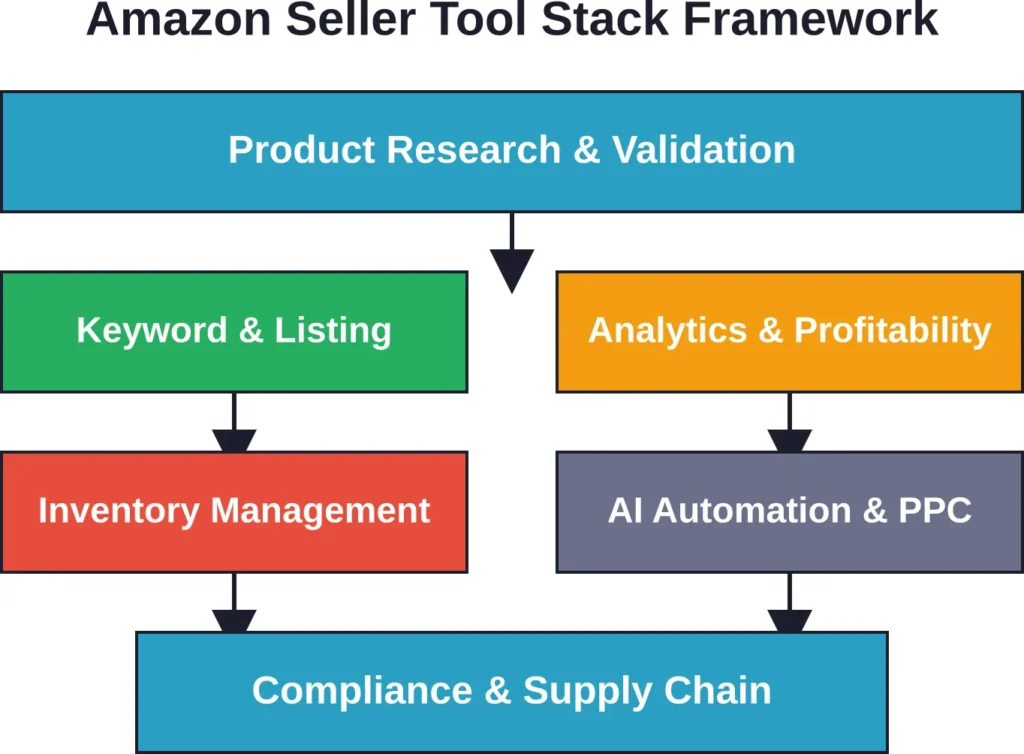
Many sellers succeed with 2-4 well-integrated tools rather than 8-10 standalone platforms requiring constant context switching.
Test Before Committing
Most reputable platforms offer free trials or money-back guarantees. Testing with live data reveals whether features match marketing claims and whether the interface fits existing workflows.
Avoid annual contracts until quarterly usage confirms the platform delivers measurable ROI. The cheapest annual plan costs more than a monthly subscription canceled after three months when the tool doesn’t fit.
Watch for Pricing Traps
Entry-tier pricing often excludes critical features. Platforms advertise $29 or $39 starting costs, then gate essential tools behind $99 or $199 tiers.
Always verify which features live in which pricing tier before signing up. Check for hidden costs — per-user fees, marketplace add-ons, API access charges, or overage penalties for exceeding SKU limits.
Consider Free and Native Tools First
Amazon Seller Central includes free tools many sellers overlook: Brand Analytics for keyword search volume, Opportunity Explorer for niche discovery, and Account Health monitoring. These native tools cost nothing and integrate perfectly because Amazon built them.
Third-party tools add value when they surface insights or automate workflows Seller Central can’t handle. But paying for features Amazon provides free wastes budget.
Common Mistakes Sellers Make With Tools
Even the best software delivers poor results when implemented incorrectly. These mistakes appear repeatedly across seller accounts.
Buying Tools Before Defining Goals
“Everyone uses Helium 10” isn’t a strategy. Tools should support specific, measurable goals — increase organic rank for 5 target keywords, reduce ACOS below 20%, or cut stockout frequency by half.
Without clear objectives, sellers pay for features they don’t use and ignore metrics that matter.
Trusting Automation Blindly
AI and automation improve efficiency but can’t replace strategic thinking. Automated repricing tools that ignore margin targets destroy profitability. PPC automation that doesn’t align with product lifecycle stage wastes budget launching dying SKUs.
Review automated decisions weekly. Algorithms optimize for the metrics they’re told to prioritize, which may not match business reality.
Ignoring Data Quality
Garbage in, garbage out. Analytics platforms produce misleading insights when COGS data is outdated, shipping costs are estimated, or return rates aren’t tracked accurately.
Invest time upfront ensuring cost data is complete and current. Accurate inputs produce actionable outputs.
Tool Hopping Without Evaluation
Switching tools every quarter prevents mastery and wastes onboarding time. Most platforms require 4-8 weeks of consistent use before results stabilize and patterns emerge.
Evaluate performance after 60-90 days of full implementation, not 2 weeks of casual experimentation.
Frequently Asked Questions
New sellers need product research validation and basic keyword optimization. Jungle Scout or Helium 10’s entry tier provides both. Add Amazon’s free Brand Analytics for search volume data. That covers launch essentials without overspending. Analytics and inventory tools become critical once 5-10 SKUs are live and profitability needs tracking.
All-in-one suites like Helium 10 simplify workflows by consolidating research, keywords, analytics, and PPC under one subscription. They work well for sellers who need broad coverage and value integration over best-in-class depth. Specialized tools often provide deeper functionality in narrow areas but require managing multiple subscriptions and data exports. The right choice depends on complexity — sellers managing 3-5 SKUs benefit from all-in-one simplicity, while those running 50+ SKUs across multiple marketplaces may need specialized analytics and inventory platforms all-in-one suites can’t match.
Entry-level sellers launching their first products can operate on $40-$100 monthly covering product research and keyword tools. Scaling sellers with 10-30 SKUs typically invest $150-$400 monthly adding analytics, inventory management, and PPC automation. Large operations managing 50+ SKUs across multiple marketplaces may spend $500-$1,500 monthly on comprehensive tool stacks. Budget should scale with revenue — tools that improve margin by 3-5% pay for themselves quickly, while underutilized subscriptions drain profit.
Amazon’s native tools — Brand Analytics, Opportunity Explorer, Account Health — offer substantial value at no cost. Sellers can launch and grow using free resources, though growth speed and optimization depth suffer compared to paid platforms. Free tools work best for part-time sellers testing viability before committing capital. Full-time sellers aiming for significant revenue typically reach a point where paid tools’ time savings and insight depth justify the investment. The transition usually happens around $10,000-$20,000 monthly revenue when manual processes become unsustainable.
The INFORM Consumers Act requires marketplaces to verify high-volume sellers — those completing 200 or more transactions or earning $5,000 or more in gross revenues within 12 months. Amazon handles verification internally by requesting updated contact, tax, and bank information. Sellers must respond to certification requests within 10 days to avoid listing suppression. Those earning $20,000 or more annually must have verified seller information displayed on product listings. Keeping Seller Central account information current and responding promptly to Amazon’s verification requests ensures compliance.
AI-powered PPC platforms like Quartile, Perpetua, and Helium 10 Ads automate bid adjustments, keyword testing, and budget allocation based on performance data. They excel at repetitive optimization tasks and react faster than manual management to bid fluctuations. However, AI can’t replace strategic decisions — which products to promote, when to launch campaigns, or how to balance short-term ACOS against long-term rank building. Best results come from combining AI automation for execution with human oversight for strategy. Sellers spending $5,000+ monthly on ads typically see the clearest ROI from AI tools, while smaller budgets often perform comparably with careful manual management.
Buying tools before identifying specific problems creates expensive clutter. Sellers see competitors using Helium 10 or Jungle Scout and subscribe without defining what they need to improve. The biggest mistake is prioritizing features over outcomes. Effective tool selection starts with measurable goals — reduce stockouts by 50%, improve organic rank for 10 keywords, or cut wasted ad spend by 20%. Then choose platforms designed to solve those specific problems. Tools purchased to solve vague goals like “be more competitive” or “automate everything” rarely deliver value proportional to their cost.
Conclusion: Build Your Stack Strategically
The Amazon seller tools landscape in 2026 offers unprecedented depth. Platforms exist for every workflow bottleneck, every data gap, every optimization opportunity.
But more tools don’t equal better results. The most successful sellers build focused stacks aligned to current growth constraints. They start with essentials — product validation and keyword optimization — then layer in analytics, inventory management, and automation as revenue scales and complexity increases.
The right tools amplify strategy. They surface insights faster, automate repetitive tasks, and prevent costly mistakes like stockouts or runaway ad spend. Wrong tools — overly complex, mismatched to business model, or redundant with existing workflows — drain budget and attention without moving metrics.
Start small. Test rigorously. Scale what works. And remember: no tool fixes bad product selection, weak differentiation, or poor unit economics. Software accelerates good strategy. It can’t create one.
Ready to optimize your Amazon business? Audit your current stack, identify the biggest constraint preventing growth, and invest in one tool that directly addresses it. Master that platform. Measure impact. Then expand strategically.