

Quick Summary: Amazon marketing tools help sellers automate advertising, optimize PPC campaigns, track performance, and scale operations efficiently. Top solutions include Amazon’s native Sponsored Products and Sponsored Brands, third-party automation platforms like WisePPC, Helium 10 and Quartile, and specialized analytics software that delivers profit-based optimization. Essential tools span campaign management, keyword research, competitor tracking, and customer engagement.
Competition on Amazon has never been tighter. With ad costs rising and profit margins shrinking, sellers can’t afford manual campaign management anymore. The right marketing tools separate profitable brands from those bleeding cash on inefficient ads.
The landscape shifted dramatically over the past two years. Amazon’s ad revenue surged over 20% YoY in Q4 2025, with Meta and Amazon posting standout results according to eMarketer analysis. That growth reflects both opportunity and challenge—more sellers fighting for the same customers means you need smarter automation, not just bigger budgets.
This guide covers the tools that actually move the needle: native Amazon advertising platforms, third-party automation software, and analytics solutions that help sellers make decisions based on profit, not vanity metrics.
Why Amazon Marketing Tools Matter in 2026
Manual campaign management doesn’t scale. Sellers running dozens of products across multiple ad types can’t monitor performance hourly, adjust bids by keyword profitability, or identify which search terms drain budgets.
Amazon’s marketplace grew more competitive. The platform now hosts over 480 million products. Standing out requires precise targeting, continuous optimization, and data-driven decisions that happen faster than any human can execute.
Marketing tools solve three core problems:
- Automation eliminates repetitive tasks like bid adjustments and budget pacing
- Analytics reveal which keywords, products, and campaigns actually generate profit
- Optimization algorithms test thousands of variations to find winning combinations
With AI tools now used by 34% of Amazon sellers, the gap between automated and manual sellers widens every quarter.
Amazon’s Native Advertising Platforms
Start with what Amazon provides directly. These tools integrate seamlessly with Seller Central and require no third-party connections.
Sponsored Products
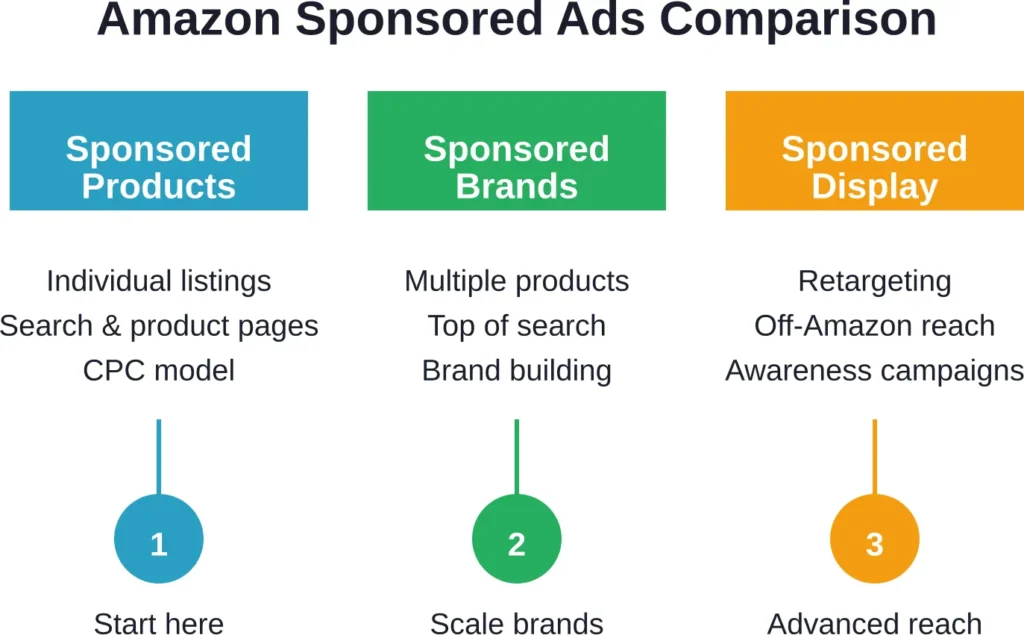
Sponsored Products remain the workhorse of Amazon advertising. These cost-per-click ads promote individual listings in search results and product pages. Setup takes minutes—choose products, select keywords (or let Amazon’s systems target automatically), and set budgets.
The platform offers both image and video formats now. Long-form interactive video ads drive engagement beyond static images, though they require more production effort.
Amazon’s advertising platforms require minimum daily budgets to run campaigns, with amounts varying by market. These low minimums make Sponsored Products accessible even for new sellers testing products.
Small businesses using Amazon Ads attributed 30% of their sales to our ads, demonstrating measurable impact beyond organic rankings.
Sponsored Brands and Sponsored Display
Sponsored Brands put your logo, custom headline, and multiple products in prominent placements. These ads build brand awareness while driving traffic to your storefront or product portfolio.
Sponsored Display extends reach beyond Amazon’s marketplace to premium apps and websites. Retargeting capabilities bring back shoppers who viewed your products but didn’t purchase.
All three sponsored ad types share simple setup workflows, cost control through bid and budget caps, and performance measurement directly in Campaign Manager.
Third-Party PPC Automation Platforms
Native tools lack sophisticated automation. Third-party platforms fill that gap with algorithmic bid management, profit-based optimization, and 24/7 campaign monitoring.
WisePPC

WisePPC built its reputation as a deep-dive Amazon PPC analytics tool with long-term data storage, later expanding into full campaign management and bulk optimization.
The platform focuses on extreme granularity and visual intelligence, allowing sellers to see and act on performance patterns that Amazon’s native tools hide.
Instead of switching between reports and making slow manual changes, WisePPC gives instant visibility across years of data and lets users apply mass edits in seconds.
Key features include long-term historical data (years instead of 60–90 days), powerful bulk editing of thousands of campaigns/keywords/bids, gradient metric highlighting, placement-level and hourly analysis, and inline real-time adjustments.
Contact Information:
- Website: wiseppc.com
- Facebook: www.facebook.com/people/Wise-PPC/61573154427547
- LinkedIn: www.linkedin.com/company/wiseppc
- Instagram: www.instagram.com/wiseppc
Helium 10 Ads

Helium 10 built a reputation on product research tools, then expanded into PPC management. Their Ads platform uses AI to maximize ROI through advanced optimization and automation capabilities.
The system adjusts bids continuously based on performance data. Instead of checking campaigns daily and making manual changes, Helium 10 runs optimization cycles every few hours.
Key features include automated keyword harvesting from search terms, negative keyword discovery to stop wasted spend, and dayparting to adjust bids by hour based on conversion patterns.
Quartile

Quartile takes a different approach—fully managed AI that runs campaigns with minimal seller input. The platform shifts ad spend toward profitable keywords automatically, eliminating the need to monitor every campaign.
With AI tools now used by 34% of Amazon sellers, Quartile’s hands-off model appeals to sellers who lack time for daily campaign management but still want optimization beyond Amazon’s basic automation.
The platform adjusts bids based on real-time performance, moves budgets between campaigns as opportunities shift, and identifies new keyword opportunities without manual research.
Rule-Based vs. AI Automation
Different tools use different automation philosophies. Rule-based systems execute simple logic: “If ACOS exceeds 30%, lower bid by 10%.” AI systems learn patterns across thousands of campaigns and make nuanced decisions that simple rules can’t capture.
For sellers managing 10-50 products, rule-based automation often suffices. Clear profit targets, straightforward bid adjustments, and basic budget pacing solve most problems.
Larger catalogs benefit from AI that spots patterns humans miss—seasonal trends, cross-product cannibalization, or keyword performance shifts that require coordinated bid changes across dozens of campaigns.
Analytics and Performance Tracking Tools
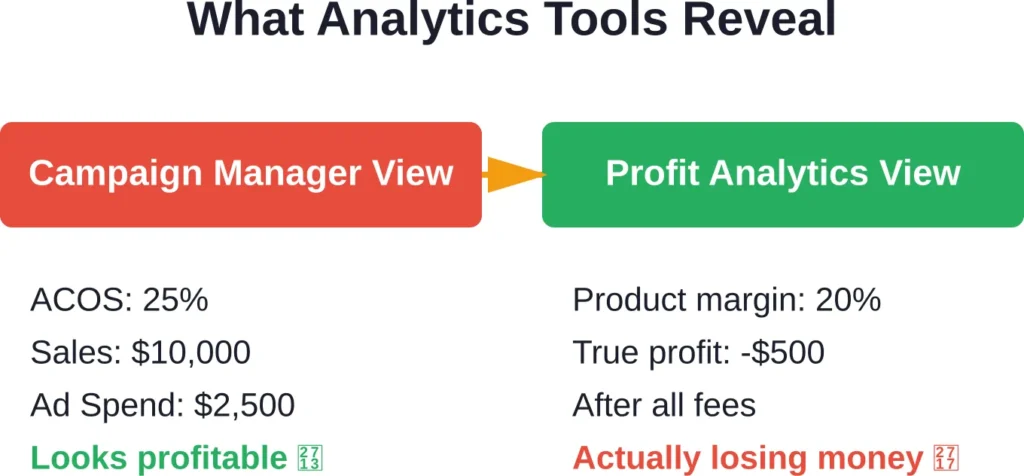
Campaign Manager shows basic metrics: impressions, clicks, spend, sales. But it doesn’t connect ad performance to actual profit after Amazon fees, shipping costs, and product expenses.
Profit-Based Optimization
The best tools calculate true profitability. They import cost data (supplier costs, FBA fees, referral fees, storage charges), then show which campaigns generate positive margin versus those that lose money despite appearing “profitable” in Campaign Manager.
This matters because a 25% ACOS campaign might seem efficient—until profit analysis reveals that your actual margin is only 20%, meaning every sale loses money.
Tools that prioritize profit optimization shift spending away from negative-margin keywords even if they convert well, and toward lower-volume keywords that generate higher per-unit profit.
Custom Analytics in Seller Central
Amazon rolled out Custom Analytics, letting sellers build reports with specific ASIN metrics previously unavailable without downloading multiple spreadsheets and manually combining data.
Community discussions highlight how this tool eliminated hours of manual reporting. Sellers can now pull cohesive views of sales velocity, conversion rates, and ad performance by ASIN without brutal one-by-one searches.
The limitation? Custom Analytics still doesn’t integrate third-party cost data or provide profit calculations—it shows Amazon’s view of performance, which omits critical profitability context.
Specialized Tools for Sellers
Beyond advertising, sellers need tools for product research, competitor monitoring, review management, and inventory planning.
Product Research and Keyword Tools
Finding profitable products requires data on search volume, competition levels, and pricing trends. Tools like Helium 10 include keyword research modules that estimate monthly searches and suggest low-competition opportunities.
These platforms scrape Amazon data to show which keywords competitors rank for, what their estimated revenue looks like, and where gaps exist in the market.
Review and Feedback Management
Customer reviews drive conversions. Tools that monitor reviews, alert sellers to negative feedback, and facilitate customer communication help maintain high ratings.
AI-assisted customer support tools can route issues efficiently, improving response times and boosting agent productivity by up to 50%.
Inventory and Fulfillment Tools
Running out of stock kills momentum. Inventory management tools forecast demand, suggest reorder quantities, and track shipments to prevent stockouts.
Amazon’s own Subscribe & Save dashboard helps sellers optimize recurring purchases, while third-party tools provide more sophisticated demand planning and multi-channel inventory sync.
How to Choose the Right Tools
The best tool depends on business size, budget, and specific pain points. A new seller with three products needs different capabilities than an established brand managing 500 SKUs.
Match Tools to Business Stage
New sellers should start with Amazon’s native advertising tools. The learning curve is gentle, costs are controllable with low minimum daily budgets, and the platform handles all technical integration.
Once monthly ad spend exceeds $5,000, automation tools pay for themselves through time savings and improved efficiency. Manual campaign management becomes impractical at scale.
Sellers with thin margins need profit analytics immediately. Without accurate cost tracking, it’s easy to scale losing campaigns that appear profitable in Campaign Manager.
Essential Features to Prioritize
| Feature | Why It Matters | Who Needs It |
|---|---|---|
| Automated bidding | Adjusts bids 24/7 without manual monitoring | Sellers with 10+ active campaigns |
| Profit tracking | Shows true margin after all costs | Products with margins under 30% |
| Keyword harvesting | Finds converting search terms automatically | Brands expanding product lines |
| Negative keyword automation | Stops wasted spend on irrelevant clicks | Broad match campaigns |
| Dayparting | Adjusts bids by time of day | Products with clear peak hours |
| Portfolio management | Coordinates bids across related products | Catalogs with complementary items |
Budget Considerations
Tool costs range from free (Amazon’s native platforms) to several hundred dollars monthly for advanced automation. The math is simple: if a tool saves 10 hours weekly and improves ACOS by 5%, it pays for itself quickly for most established sellers.
Amazon offers new seller incentives including advertising credits, though community discussions note that claiming these credits can require navigating support channels when automated systems fail to apply them correctly.
Emerging Trends in Amazon Marketing
The marketing landscape keeps evolving. Several trends are reshaping how sellers approach advertising in 2026.
AI and Agentic Advertising
Amazon recently introduced an MCP server that expands AI-driven advertising capabilities. This infrastructure turns experimentation into production-ready automation, prioritizing controlled systems over raw API access.
The shift toward agentic advertising—where AI agents make strategic decisions autonomously—changes the seller’s role from campaign manager to strategist who sets goals and constraints while algorithms handle execution.
Retail Media Growth
US retail media ad spending is expected to have a compound annual growth rate (CAGR) of 17.2% from 2024 through 2028, down from earlier projections of 24.1%. More than $10 billion in incremental ad spending flows into US retail media, according to early 2025 eMarketer analysis as brands shift budgets from traditional channels.
According to a January 2026 Skai and Stratably report based on surveys conducted in October-November 2025, brand and agency marketers report focusing on improving ROI and efficiency of existing Amazon spend. The focus shifted from growth-at-any-cost to profitable, efficient scaling.
Video and Interactive Formats
Sponsored Products now support long-form interactive video. These ads generate higher engagement than static images but require more production investment.
As shoppers become desensitized to standard product photos, video content offers differentiation—though only for sellers who can produce quality content cost-effectively.
Common Mistakes to Avoid
Even with good tools, strategic errors sink campaigns.
Ignoring profitability is the biggest mistake. Optimizing for low ACOS without understanding margin means scaling unprofitable products. Always connect ad performance to actual profit after all fees and costs.
Setting and forgetting campaigns wastes money. Markets shift, competitors adjust, and seasonal patterns change. Even with automation, quarterly strategy reviews keep campaigns aligned with business goals.
Spreading budgets too thin dilutes impact. Better to fully fund three high-performing campaigns than partially fund ten mediocre ones. Concentrate spending where data shows consistent returns.
Neglecting negative keywords bleeds budgets. Broad match campaigns attract irrelevant searches. Regular negative keyword audits—ideally automated—prevent wasted clicks.
Frequently Asked Questions
Amazon marketing tools are software platforms and services that help sellers manage advertising campaigns, optimize product listings, track analytics, and automate repetitive tasks. They range from Amazon’s native Sponsored Products and Sponsored Brands to third-party solutions for PPC automation, profit analytics, keyword research, and inventory management.
Amazon’s native advertising platforms (Sponsored Products, Sponsored Brands, Sponsored Display) have no monthly fees—sellers only pay per click with minimum daily budgets starting at $10 in most markets. Third-party automation and analytics tools typically charge monthly subscriptions ranging from $50 to $500+ depending on features, catalog size, and support level. Some offer free trials or tiered pricing based on ad spend volume.
New sellers with limited products and budgets under $2,000 monthly can often manage campaigns effectively using Campaign Manager alone. Once ad spend exceeds $5,000 monthly or catalog size grows beyond 20 products, third-party tools typically pay for themselves through time savings and optimization improvements. Tools that track true profitability (factoring in all costs) are essential regardless of size if margins are thin.
Rule-based automation executes simple conditional logic that sellers define explicitly (example: “If ACOS exceeds 30%, reduce bid by 10%”). AI automation uses machine learning to identify patterns across large datasets and make nuanced decisions without explicit rules. Rule-based systems work well for straightforward optimization goals, while AI excels at managing complex catalogs where human-defined rules can’t capture all relevant patterns.
Calculate total landed cost per unit (product cost, shipping to Amazon, FBA fees, referral fees, storage charges, and ad spend). Subtract this from selling price to get true profit per sale. Most advanced analytics tools automate this by importing cost data and displaying profit metrics alongside standard Campaign Manager metrics. Without profit tracking, campaigns can appear successful based on ACOS while actually losing money on every sale.
Absolutely. Start with Amazon’s native tools and their built-in automatic targeting, which requires no software fees. Focus advertising spend on 3-5 best-performing products rather than spreading budgets thin. As revenue grows, reinvest a percentage into automation tools that free up time for product sourcing and business development—tasks that drive more value than manual bid adjustments.
Profit per order and total profit matter most—revenue and ACOS can mislead if they don’t account for product costs and fees. Secondary metrics include conversion rate (shows listing quality), click-through rate (indicates relevance of keywords and images), and customer lifetime value (especially for consumable or repeat-purchase products). Track these in context of your business model and margin structure, not in isolation.
Moving Forward with Amazon Marketing Tools
The right tools amplify effort. They don’t replace strategy, but they execute strategy faster and more consistently than manual management allows.
Start with clear goals. Know your profit margins, understand which products deserve advertising investment, and define success metrics beyond vanity numbers like impressions or clicks.
Build your stack incrementally. Begin with Amazon’s native advertising platforms to learn the fundamentals. Add automation when manual management becomes a bottleneck. Layer in analytics when you need deeper insight into profitability and performance drivers.
Test methodically. Most tools offer trials or low-cost entry tiers. Run campaigns in parallel—automated versus manual, or Tool A versus Tool B—to measure actual impact on your specific products before committing large budgets.
The sellers winning in 2026 aren’t those with the biggest budgets. They’re the ones who combine smart tool selection with disciplined strategy, letting automation handle execution while they focus on product selection, pricing, and long-term positioning.
Ready to upgrade your Amazon marketing approach? Start by auditing your current campaigns for profitability—not just ACOS—and identify which manual tasks consume the most time. That’s where the right tools deliver immediate ROI.