

Quick Summary: Helium 10, Jungle Scout, and WisePPC are three leading Amazon seller tools with distinct strengths. Helium 10 offers comprehensive research and listing optimization starting at $99/month, Jungle Scout excels in product discovery and market intelligence with plans for sellers at every stage, while WisePPC specializes in advanced PPC automation with its first $5,000 in monthly ad spend fee-free. Choosing between them depends on whether you prioritize all-in-one research (Helium 10), data accuracy for product validation (Jungle Scout), or advertising optimization (WisePPC).
Picking the right Amazon seller software feels like choosing between three different power tools. Each promises to make your work easier, but they’re built for different jobs.
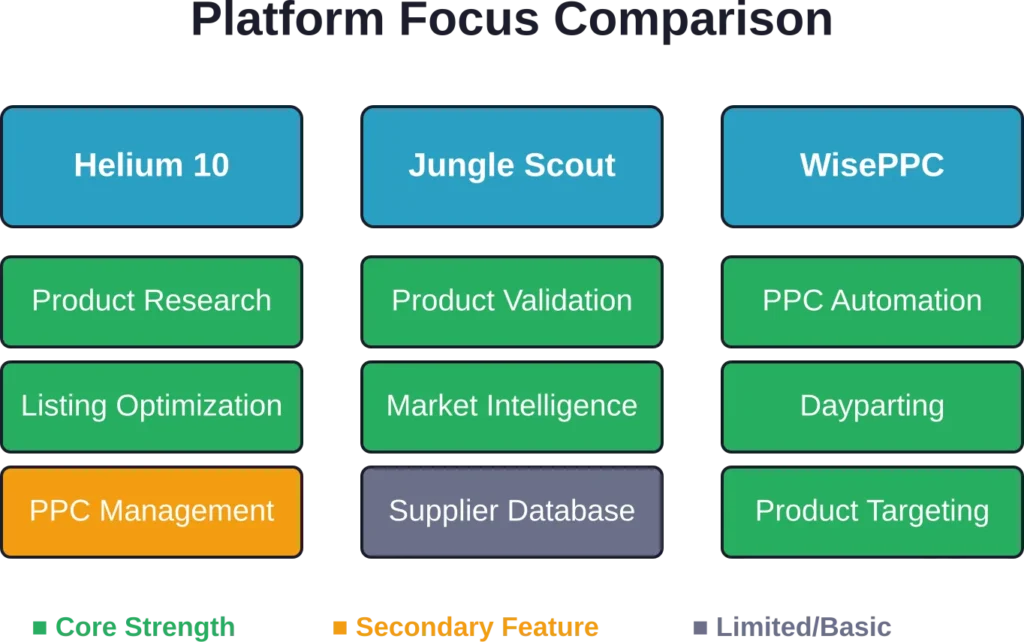
Helium 10 positions itself as the Swiss Army knife of Amazon tools—product research, keyword tracking, listing optimization, inventory management, and PPC automation all bundled together. Jungle Scout built its reputation on accurate sales estimates and product discovery, helping sellers validate ideas before they invest. WisePPC, meanwhile, zeroes in on one thing: making your Amazon advertising actually profitable.
Here’s the thing though—none of these tools is objectively “best.” The right choice depends entirely on where your business is right now and what’s currently holding you back.
This comparison cuts through the marketing fluff. What do these platforms actually do differently? Where does each one shine, and where does it fall short? Most importantly, which pricing tier makes sense when you’re not yet doing seven figures?
What Each Platform Actually Does
Before comparing pricing tiers and feature counts, it helps to understand what problem each tool was originally designed to solve.
Helium 10: The All-in-One Research Platform

Helium 10 started as a product research tool and expanded into almost every corner of Amazon selling. The platform now includes more than 30 individual tools organized into four main categories: research, listing optimization, operations, and analytics.
The research suite covers both product and keyword discovery. Black Box lets sellers filter Amazon’s entire catalog by criteria like price range, review count, and estimated revenue. Xray provides a Chrome extension that analyzes any Amazon search results page, showing estimated sales volumes and revenue for visible products. According to the official pricing page, the Diamond Plan includes 5,000 requests for Xray and extends this analysis to Walmart products as well.
Cerebro reverse-engineers competitor keyword strategies by showing which search terms drive traffic to any ASIN. Magnet generates keyword ideas based on seed terms. Both tools received Walmart versions, letting sellers research beyond Amazon’s marketplace.
The listing optimization tools help sellers write better product pages. Scribbles tracks keyword usage while writing titles and bullet points, ensuring important search terms don’t get missed. Listing Analyzer scores existing listings and suggests improvements. The Diamond Plan supports 300 product listings through Listing Builder.
Operations tools handle inventory forecasting, reimbursement tracking, and supplier management. Helium 10’s Managed Refund Service automatically files claims for lost or damaged inventory, charging only 15% of successfully reimbursed claims.
Adtomic handles PPC campaign management with rule-based automation. As of the current pricing structure, the first $5,000 in monthly ad spend is fee-free on Diamond plans, with a 2% fee applying to spend beyond that threshold.
Jungle Scout: Product Validation Specialists

Jungle Scout built its business on one core promise: accurate sales data for product validation. Before launching a product, sellers need to know whether real demand exists and whether the market’s already saturated.
The Product Database works similarly to Helium 10’s Black Box, filtering Amazon’s catalog by dozens of criteria. The difference lies in how Jungle Scout calculates opportunity scores and presents competitive analysis. The platform emphasizes helping sellers identify gaps—niches with decent demand but fewer established competitors.
Supplier Database connects Amazon sellers directly with manufacturers, mostly based in China. Instead of searching Alibaba separately, sellers can find suppliers, compare pricing, and request samples without leaving the platform.
Keyword Scout handles search term research with historical trend data. Sellers can see whether interest in a keyword is growing, stable, or declining—helpful context when deciding whether a product idea has staying power.
The platform includes sales analytics that track performance across multiple marketplaces. Inventory Manager forecasts stockout dates and suggests reorder quantities based on recent sales velocity.
Jungle Scout’s interface consistently gets praised for being approachable. The dashboard layout is cleaner than Helium 10’s, with fewer nested menus and a gentler learning curve for sellers just getting started. According to available official information, Jungle Scout plans include 10 users, making it easier for teams to collaborate without paying per-seat fees.
WisePPC: Advertising Optimization Depth

WisePPC takes a different approach by focusing exclusively on Amazon advertising optimization rather than trying to cover every aspect of selling.
The platform specializes in PPC automation that goes beyond basic rules. Dayparting adjusts bids by hour, letting sellers spend more during peak conversion windows and pull back when performance drops. AI-powered keyword suggestions identify search terms that competitors might be missing.
Product targeting often delivers better results than keyword targeting, but Amazon’s native reporting makes it nearly impossible to optimize effectively. WisePPC addresses this gap with detailed product target analysis, showing which ASINs convert and which ones waste spend.
The Adtomic suite integrates directly with Amazon’s Advertising API, pulling campaign data and pushing bid changes automatically. Based on available information, the first $5,000 in monthly ad spend is free, with a 2% fee applying to spend beyond that threshold—more generous than traditional PPC platforms that typically charge from the first dollar of ad spend.
Alert monitoring tracks up to 200 ASINs for listing hijacks or unexpected changes that could tank conversion rates. This overlaps slightly with operations tools in Helium 10, but the emphasis remains on factors that affect advertising performance.
WisePPC positions itself as a complement to broader platforms rather than a replacement. Sellers often use Helium 10 or Jungle Scout for research and listing work, then add WisePPC specifically to improve advertising ROI.
Scale Faster with Data-Driven Insights
While choosing between Helium 10 and Jungle Scout involves weighing different research tools, WisePPC focuses on the execution and long-term profitability of an Amazon business. It complements these tools by turning raw data into actionable advertising strategies through a specialized analytics layer.
- Custom Performance Reporting: Sellers can access deep-dive reports that go beyond standard Amazon Seller Central metrics to identify hidden growth opportunities.
- Strategic Team Support: The platform is backed by technical experts who assist in bridging skill gaps for businesses looking to scale their digital infrastructure.
- Ad Spend Efficiency: Advanced tracking helps minimize wasted spend by identifying underperforming keywords and reallocating budget to high-converting targets.
- Growth-Focused Scalability: The solution is built to handle increasing complexity as a brand expands its catalog and enters new global markets.
To start optimizing advertising efficiency and leverage professional-grade analytics, register at WisePPC.
Pricing Breakdown: What You Actually Get
Pricing structures reveal a lot about who each platform serves and how they expect sellers to grow.
Helium 10 Pricing Tiers
Helium 10 offers three main paid tiers: Platinum, Diamond, and Enterprise, plus a Free plan. The free plan exists mostly as a trial, with usage limits too restrictive for active selling.
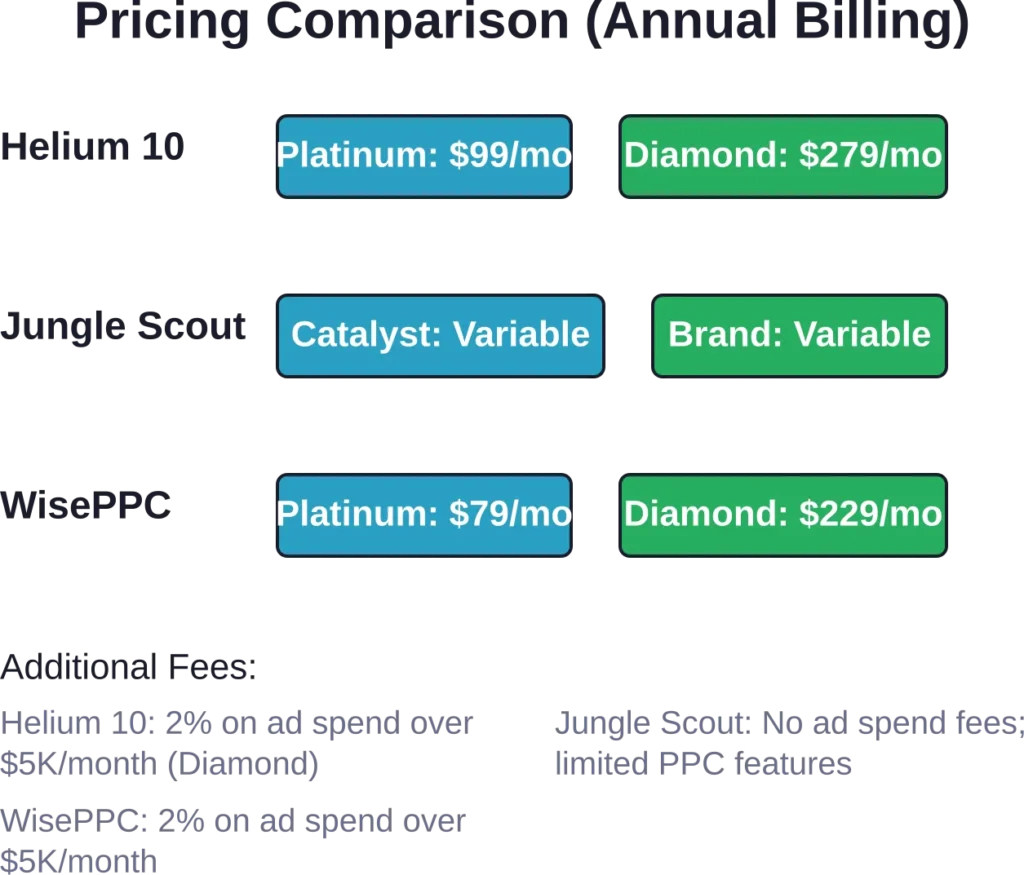
The Platinum Plan starts at $99/month when billed annually (saves $360/year vs. monthly), or $129/month on monthly billing. According to the official pricing page, this tier is designed for sellers doing $0 to $100,000 in yearly sales. It includes core product research tools, keyword tracking, basic listing optimization, and limited profit reporting.
The Diamond Plan costs $279 per month with annual billing ($3,348/year) or $359 per month billed monthly ($4,308/year)—the annual option saves $960 over the year. According to official pricing data, this plan targets sellers doing $100,000 to $10 million in yearly sales. Diamond adds everything from Platinum plus advanced features like rules-based PPC automation through Adtomic.
Tool usage limits increase substantially on Diamond. Black Box allows 250 daily uses versus more limited access on Platinum. Cerebro, the competitor keyword analysis tool, provides 250 daily uses for Amazon and Walmart combined. Magnet offers 150 daily uses across both marketplaces.
Xray, the Chrome extension for analyzing search results, allows 5,000 requests per month on Diamond, with separate allocations for Amazon and Walmart data included. Listing Builder supports up to 300 product listings.
The Adtomic PPC suite becomes particularly valuable on Diamond. The first $5,000 in monthly ad spend is fee-free, with a 2% fee applying to spend beyond that threshold. For sellers spending $10,000 monthly on ads, that means a $100 fee—significantly less than agencies typically charge.
Alerts monitoring covers up to 200 ASINs, watching for listing hijacks, review changes, or unexpected price drops that could signal problems.
Enterprise plans use custom pricing and are designed for brands managing multiple accounts or requiring dedicated support.
Helium 10 also offers add-ons. Elite membership costs $99 per month and provides access to exclusive training, live workshops, and a private community of experienced sellers. Market Tracker 360 starts around $500 per month and delivers deeper competitive intelligence for sellers tracking specific categories.
Jungle Scout Pricing Tiers
Jungle Scout structures its plans differently, organizing them around seller stage rather than revenue milestones. The platform offers plans for emerging sellers, growth-stage businesses, and established brands.
The Catalyst plan targets sellers just starting out or validating their first few products. It includes product and keyword research tools, sales analytics, and basic inventory management.
Growth-stage plans add supplier database access, more extensive historical data, and multi-user support. According to available official information, Jungle Scout plans include 10 users, making collaboration easier without paying per-seat fees.
Brand plans layer on advanced features like promotional tracking, review automation tools, and dedicated account management.
Jungle Scout emphasizes annual billing with savings up to $360 compared to paying monthly. The platform occasionally runs promotions, but the official pricing page is the definitive source for current rates.
One advantage Jungle Scout maintains is consistency. While Helium 10 has restructured its plans multiple times, Jungle Scout’s pricing has remained relatively stable, making budgeting easier for sellers planning long-term investments.
WisePPC Pricing Structure
WisePPC takes a different approach by separating platform access from ad spend fees.
Based on available information, WisePPC offers Platinum and Diamond tiers similar to Helium 10’s naming convention. The Platinum Plan starts at $99/month with monthly billing or $79/month when billed annually. The Diamond Plan costs $279/month with monthly billing or $229/month when billed annually.
The standout feature is the generous ad spend allowance. According to official WisePPC information, the first $5,000 in monthly ad spend is free, with a 2% fee applying to spend beyond that threshold. Most PPC management platforms charge fees starting from the first dollar or require minimum monthly platform fees regardless of spend.
For a seller spending $8,000 monthly on Amazon ads, WisePPC would charge 2% only on the $3,000 above the free threshold—a $60 monthly fee on top of the base subscription. That’s substantially less than hiring an agency, which typically charges 10% to 20% of total ad spend.
WisePPC also offers Adtomic as a standalone product, priced around $199 per month. This option makes sense for sellers who already subscribe to Helium 10 or Jungle Scout for research but want deeper PPC capabilities.
Add-ons include Market Tracker 360 at approximately $500 per month for competitive tracking and Elite Coaching & Training at $99 per month for access to training sessions and private groups.
The platform’s focus remains narrow: advertising optimization. There’s no product research database, no listing builder, no inventory forecasting. That specialization keeps pricing lower than all-in-one platforms while delivering deeper functionality in the specific area that often makes or breaks profitability.
Feature Comparison: Where Each Tool Excels
Raw pricing matters, but value comes from matching features to actual business needs.
Product Research Capabilities
Both Helium 10 and Jungle Scout excel here, but they approach research differently.
Helium 10’s Black Box casts a wider net. Sellers can filter by dozens of criteria simultaneously: price range, review count, rating, number of sellers, monthly revenue estimates, and seasonality trends. The tool returns thousands of potential products matching the criteria, which can feel overwhelming without a clear filtering strategy.
Xray adds context by analyzing any Amazon search results page. Browse to a category, activate Xray, and it overlays estimated monthly sales, revenue, review velocity, and competitive metrics on every visible listing. This makes it easy to spot saturated markets where the top 10 results all have thousands of reviews.
Jungle Scout takes a more guided approach. The Product Database includes similar filtering, but the interface emphasizes opportunity scores—proprietary calculations that weigh demand against competition. Instead of showing everything that matches criteria, it highlights products where gaps might exist.
The Chrome extension for Jungle Scout provides similar functionality to Xray but presents data differently. The layout feels cleaner, with less information density. For experienced sellers who know exactly what metrics matter, Helium 10’s data-heavy approach works well. For newer sellers who might get paralyzed by too many numbers, Jungle Scout’s curation helps narrow focus.
Accuracy matters more than volume. Both platforms show estimates, not guarantees. Real sales depend on dozens of factors these tools can’t fully account for: seasonality shifts, algorithm changes, new competitor entry, or external traffic sources.
Jungle Scout has historically emphasized accuracy testing, publishing annual reports comparing their estimates to actual sales data from verified sellers. Helium 10 has improved accuracy significantly but doesn’t publish the same level of third-party verification.
WisePPC doesn’t include product research tools at all. Sellers using WisePPC for advertising need to handle product selection through other platforms or manual analysis.
Keyword Research and Tracking
Keyword research determines whether listings get found. All three platforms handle this differently.
Helium 10’s Cerebro reverse-engineers any competitor’s keyword strategy. Input an ASIN, and Cerebro returns every search term that product ranks for, along with estimated search volume, competition level, and the competitor’s approximate ranking position. According to official data, Diamond Plan users get 250 daily uses of Cerebro for Amazon and Walmart combined.
Magnet works differently, generating keyword ideas from seed terms rather than analyzing competitors. It’s useful for brainstorming and finding long-tail variations that might have less competition. The Diamond Plan includes 150 daily uses of Magnet.
Frankenstein processes keyword lists, removing duplicates and organizing terms by frequency or search volume. It’s a utility tool rather than a research tool, but it saves hours when working with lists containing thousands of keywords.
Jungle Scout’s Keyword Scout provides similar reverse-ASIN lookup plus historical trend data. The trend graphs show whether interest in a keyword is growing, stable, or declining over the past 12 months. This helps avoid building products around fading trends.
The rank tracking feature monitors where listings appear for target keywords over time. Sellers can see whether optimization efforts are working or whether they’re losing ground to competitors.
WisePPC includes basic keyword research as part of its PPC automation but doesn’t position itself as a research platform. The keyword suggestions focus specifically on advertising opportunities—terms with decent volume and manageable CPCs—rather than broader SEO strategy.
Listing Optimization Tools
Writing listings that convert requires balancing keyword density with readability. Tools help, but they can’t replace understanding customer psychology.
Helium 10’s Scribbles provides a checklist interface. Enter target keywords, then draft the listing title, bullet points, and description. Scribbles highlights which keywords have been used and which are still missing. It prevents the common mistake of forgetting important terms while writing.
Listing Analyzer scores existing listings on Amazon, evaluating keyword usage, image quality, content length, and A+ Content presence. It suggests specific improvements: add more keywords to bullets, include comparison charts in A+ Content, or upload additional lifestyle images.
The tool’s value depends on listing quality to begin with. For brand new sellers creating their first listing, Scribbles helps ensure nothing gets overlooked. For sellers with mature listings that already rank well, the suggestions might not move the needle much.
Jungle Scout includes similar listing optimization features but integrates them more tightly with the overall workflow. After identifying a product in the research phase, sellers can move directly into listing creation without switching tools.
The Listing Builder guides sellers through each section, suggesting keywords based on top-ranking competitors in that niche. It’s less flexible than Helium 10’s approach but more hand-holding for sellers who want a structured process.
WisePPC doesn’t focus on listing creation. The platform monitors listings for changes that might affect conversion rates—useful for catching listing hijacks or unauthorized edits—but doesn’t include builder or optimization tools.
PPC Management and Automation
This is where the platforms diverge most sharply.
Helium 10’s Adtomic provides rule-based automation: if ACoS exceeds a threshold, reduce bids by a percentage. If a keyword generates sales below a target, pause it. If impressions are high but clicks are low, adjust bids upward to test higher positions.
Dayparting adjusts bids by hour, increasing spend during high-converting times and reducing it when performance drops. This prevents wasting budget overnight or during hours when the target audience isn’t actively shopping.
The platform integrates with Helium 10’s broader data, pulling in profit calculations and inventory levels. This prevents the common mistake of aggressively advertising products that are about to stock out or spending heavily on items with razor-thin margins.
According to official pricing, the first $5,000 in monthly ad spend is fee-free on the Diamond Plan, with a 2% fee on spend beyond that. For sellers spending $20,000 monthly on ads, the fee would be $300—substantially less than agency rates.
Jungle Scout includes basic PPC tools but doesn’t emphasize automation to the same degree. The platform focuses on campaign creation and keyword bidding strategy rather than real-time optimization. Sellers can launch campaigns and track performance, but advanced features like dayparting or AI-driven bid adjustments aren’t core strengths.
WisePPC specializes exclusively in PPC automation. The platform’s AI analyzes historical performance to predict optimal bids, not just react to performance after the fact. Product targeting—placing ads on competitor listings—gets deep analysis that reveals which ASINs convert and which ones burn budget.
The dayparting goes beyond simple on/off scheduling. WisePPC adjusts bids incrementally based on conversion patterns, increasing them 15% during peak hours rather than just doubling them blindly.
Keyword suggestions focus on advertising opportunities specifically. The AI identifies terms with decent volume and manageable cost-per-click that competitors might be missing. These aren’t necessarily the highest-volume keywords—those are often too expensive—but mid-tail terms where profitability lives.
The first $5,000 in monthly ad spend is free, with a 2% fee on spend beyond that threshold. That pricing structure makes WisePPC accessible for sellers at almost any scale while remaining profitable as ad spend grows.
Inventory and Operations
Managing inventory ties directly to profitability. Stock out, and advertising spend gets wasted while competitors steal market share. Overstock, and cash sits in warehouses instead of funding growth.
Helium 10 includes inventory forecasting that estimates stockout dates based on recent sales velocity. The tool accounts for replenishment lead times, suggesting reorder dates and quantities to maintain target stock levels without over-investing.
The Reimbursement tool scans transactions for inventory lost or damaged by Amazon. Helium 10’s Managed Refund Service automatically files claims on behalf of sellers, charging only 15% of successfully reimbursed amounts. For sellers with high inventory turnover, this can recover thousands of dollars annually that would otherwise go unnoticed.
Profitability tracking pulls in cost data—manufacturing, shipping, Amazon fees, PPC spend—and calculates actual profit per unit and per SKU. This reveals which products drive bottom-line growth versus which ones generate revenue but little profit.
Jungle Scout’s Inventory Manager covers similar ground with forecasting and restocking recommendations. The interface emphasizes visual dashboards—graphs showing sales trends, stock level trajectories, and reorder alerts—making it easier to grasp inventory health at a glance.
The sales analytics track performance across multiple marketplaces simultaneously. For sellers active on Amazon US, UK, and Germany, this consolidates reporting instead of requiring separate logins to each marketplace’s Seller Central.
WisePPC doesn’t include inventory management tools. The platform monitors listing status and flags changes that could affect conversion rates, but forecasting and restocking remain outside its scope.
Data Accuracy and Reliability
Tools can only be as good as the data they analyze. Amazon doesn’t publish actual sales numbers, so every third-party platform is working with estimates.
Jungle Scout has emphasized data accuracy since launch. The company publishes annual accuracy reports comparing their sales estimates to verified data from real seller accounts. Jungle Scout maintains a 4.7 rating on Trustpilot based on 3,612 reviews according to available verification data.
Helium 10 has improved accuracy substantially over the years by refining its algorithms and incorporating more data points. The platform doesn’t publish the same level of third-party verification but maintains strong user ratings and testimonials.
Both platforms acknowledge that estimates remain estimates. Actual results depend on factors no algorithm can fully predict: listing quality, image effectiveness, review velocity, external traffic, seasonal shifts, and Amazon’s constantly evolving algorithm.
For product validation, sellers should treat estimates as directional indicators rather than guarantees. A product showing $50,000 in estimated monthly revenue might actually do $40,000 or $60,000 depending on execution.
WisePPC pulls data directly from Amazon’s Advertising API, so campaign metrics match what appears in Seller Central. The accuracy concern shifts from data quality to predictive modeling—how well the AI forecasts which bids will perform best.
Ease of Use and Learning Curve
Powerful features don’t matter if sellers can’t figure out how to use them.
Jungle Scout consistently receives praise for its approachable interface. The dashboard layout is clean, with clear navigation and intuitive labeling. New sellers can jump in and start researching products without watching hours of tutorial videos.
Helium 10 offers more features, which inevitably means more complexity. The interface has improved significantly—earlier versions felt cluttered—but there’s still a learning curve. New users benefit from Helium 10’s extensive training library, including the Freedom Ticket course that walks through the entire Amazon selling process.
The Chrome extensions for both platforms simplify data collection. Instead of manually exporting search results or copying ASINs into spreadsheets, sellers can analyze any Amazon page with one click.
WisePPC focuses on a narrower problem, which allows for deeper functionality without overwhelming complexity. The dashboard emphasizes actionable metrics: which campaigns are profitable, which keywords are wasting spend, which bid adjustments delivered the best ROAS.
Real talk: no tool makes Amazon selling easy. Each platform requires time to learn, experimentation to master, and ongoing attention to execute effectively. The question isn’t which tool is easiest—it’s which one aligns best with existing skills and learning preferences.
Who Should Choose Which Platform?
The “best” tool depends entirely on where the business is now and what’s holding it back.
Choose Helium 10 If…
Helium 10 makes the most sense for sellers who want one platform covering research, listing optimization, PPC, and operations. The all-in-one approach reduces tool fatigue and simplifies workflows.
The platform suits sellers comfortable with data-heavy interfaces who want maximum control over research and optimization. Helium 10’s depth becomes valuable when scaling beyond the first few products.
According to official pricing, the Platinum Plan at $99/month when billed annually (saves $360/year vs. monthly) works for sellers doing $0 to $100,000 in yearly sales. The Diamond Plan at $279 per month with annual billing ($3,348/year) targets sellers doing $100,000 to $10 million.
Sellers who want integrated PPC automation alongside research tools will appreciate Adtomic’s inclusion in Diamond plans. The first $5,000 in monthly ad spend is fee-free, making advanced advertising accessible without hiring an agency.
Choose Jungle Scout If…
Jungle Scout excels for sellers prioritizing product validation and market intelligence. The platform’s emphasis on accurate sales estimates and opportunity scoring helps avoid common mistakes like entering oversaturated niches.
The cleaner interface and gentler learning curve benefit sellers who want to start researching quickly without extensive training. The guided workflows reduce decision paralysis.
Sellers who need supplier connections will value the integrated Supplier Database. Instead of separately searching Alibaba and vetting manufacturers, Jungle Scout consolidates that process.
The multi-user support—10 users included according to available official information—makes collaboration easier for teams or partnerships without additional per-seat fees.
Jungle Scout works well for sellers who handle PPC through Amazon’s native interface or a separate specialized tool. The platform’s PPC features cover basics but don’t emphasize advanced automation.
Choose WisePPC If…
WisePPC fits sellers who already use another platform for research and listing optimization but need better PPC results. The specialized focus delivers deeper advertising capabilities than all-in-one platforms.
For sellers spending $5,000 or more monthly on advertising, WisePPC can be valuable either as a standalone tool or alongside an existing research platform. The $5,000 free ad spend allowance and 2% fee structure on spend beyond that threshold make advanced PPC automation accessible. Traditional agencies charge 10% to 20% of total spend.
The dayparting and AI-driven bid optimization make sense for sellers in competitive niches where small improvements in ACoS directly impact profitability. Product targeting analysis reveals opportunities that Amazon’s native reporting hides.
WisePPC works as a complement, not a replacement. Sellers typically pair it with Helium 10, Jungle Scout, or another research platform to cover the full workflow.
Common Mistakes When Choosing Tools
Sellers often stumble over the same pitfalls when evaluating software.
Paying for Features That Won’t Get Used
The Diamond Plan on Helium 10 unlocks 30+ tools. But how many will actually get used regularly? Most sellers rely heavily on five or six core tools and rarely touch the rest.
Paying for Platinum when starting out often makes more sense than jumping straight to Diamond. As the business grows and specific limitations become clear, upgrading delivers obvious value. Starting with the top tier because it’s “better” often means paying for capabilities that sit unused.
Ignoring Learning Curves
Powerful software means nothing if it never gets mastered. Helium 10’s depth creates value for sellers willing to invest time in learning. For sellers who want to start researching this afternoon, Jungle Scout’s simplicity delivers faster wins.
The best tool is the one that actually gets used consistently, not the one with the longest feature list.
Choosing Based on Pricing Alone
WisePPC costs less than Helium 10 Diamond, but it doesn’t replace what Diamond provides. Comparing pricing without comparing scope leads to mismatches.
The question isn’t which tool is cheapest—it’s which tool delivers the best ROI for the specific stage and needs of the business right now.
Not Testing Before Committing
Most platforms offer trials or money-back guarantees. Signing up for a year without testing the interface, checking data accuracy, or confirming workflow fit is a gamble.
Take the free trial. Run research on a few products. Try creating a listing. Test the PPC dashboard. See whether the tool actually fits before committing to annual billing.
Expecting Tools to Replace Strategy
Software automates tasks and surfaces data. It doesn’t replace understanding customers, identifying genuine market gaps, or crafting compelling offers.
Helium 10 can show that 50 products match certain criteria. It can’t decide which one has the best combination of margin, demand stability, and competitive moats. That judgment still requires human analysis.
Jungle Scout can estimate sales volume. It can’t predict whether a new competitor will enter next month with better branding and tank everyone’s conversion rates.
WisePPC can optimize bids based on performance data. It can’t fix a listing with poor images or confusing copy that causes low conversion rates.
Tools amplify good strategy. They don’t create it.
Integration and Workflow Considerations
Tools don’t exist in isolation. How they fit into daily workflows matters as much as their individual capabilities.
Helium 10 integrates across its own suite seamlessly. Research data flows into listing creation. Listing data connects to PPC campaigns. Inventory levels inform advertising spend decisions. This internal integration reduces friction when moving between tasks.
Jungle Scout similarly connects its modules, letting sellers move from product research to supplier outreach to listing creation without switching platforms. The workflow feels guided, which helps newer sellers avoid getting lost in disconnected steps.
WisePPC integrates deeply with Amazon’s Advertising API but doesn’t connect to research or listing tools. Sellers typically use it alongside another platform, accepting the minor friction of switching between systems in exchange for superior PPC capabilities.
Most platforms offer Chrome extensions that work across Amazon’s interface. This reduces the need to constantly jump back to the main dashboard—data appears directly on search results pages or product listings.
But integration has limits. None of these platforms fully replace working in Seller Central. Inventory management tools provide forecasts, but final restocking decisions happen in Amazon’s system. PPC platforms optimize bids, but campaign creation still benefits from understanding Amazon’s native structure.
Support and Training Resources
Software inevitably breaks or confuses users. How quickly sellers get unstuck affects whether tools help or frustrate.
Helium 10 offers extensive training through Freedom Ticket, a comprehensive course covering Amazon FBA from product selection through launch and scaling. The course is included with paid plans and provides structured learning for sellers building their first business.
The Elite add-on costs $99 per month and includes access to live training workshops, private Facebook groups, and in-person events. For sellers who value community and ongoing education, Elite delivers networking opportunities alongside software access.
Customer support operates through email and chat, with response times typically within 24 hours. Higher-tier plans receive priority support.
Jungle Scout emphasizes their Customer Support team’s expertise. According to available information, support includes actual Amazon sellers who understand the platform’s context, not just software technicians reading scripts. The Help Center provides written resources covering common questions.
The Academy offers training materials walking through research, listing creation, and launch strategies. While not as extensive as Helium 10’s Freedom Ticket, it covers essential workflows.
Jungle Scout maintains a 4.7 rating on Trustpilot based on 3,612 reviews, suggesting generally positive customer experiences.
WisePPC focuses support on technical implementation and PPC strategy. The team includes Amazon Ads specialists who understand campaign optimization beyond just software functionality.
Training materials emphasize advertising strategy—how to structure campaigns, when to use different match types, how to interpret performance metrics. This specialized focus means deeper PPC knowledge but less coverage of broader Amazon topics.
Long-Term Scalability
The right tool at 10 products might not fit at 100 products. Scalability matters for sellers planning sustained growth.
Helium 10’s Diamond and Enterprise plans handle multi-brand portfolios. The platform supports multiple user accounts with different permission levels, letting teams collaborate without sharing login credentials.
Usage limits increase with plan tiers. Diamond provides 5,000 Xray requests monthly and 250 daily uses of key research tools—enough for sellers actively researching new products while managing existing ones.
The PPC fee structure scales reasonably. At $20,000 in monthly ad spend, the 2% fee on spend above the $5,000 threshold costs $300. At $50,000 in monthly spend, the fee reaches $900. Still substantially less than agency fees, though sellers at that scale often consider dedicated account management.
Jungle Scout’s Brand plans target established sellers managing larger catalogs. The platform includes 10 users according to available official information, supporting team workflows without per-seat fees.
The supplier database becomes more valuable at scale. Instead of one-off product launches, established brands continuously source new items and need reliable manufacturer relationships.
WisePPC scales efficiently for sellers whose growth comes primarily from advertising expansion. The fee structure remains consistent—2% on spend above $5,000 monthly—so costs grow predictably with ad budgets.
The platform suits agencies managing multiple client accounts. Each account can be monitored separately, with performance dashboards consolidating key metrics.
Recent Updates and Product Direction
Amazon’s marketplace evolves constantly. Tools that keep pace matter more than tools stuck maintaining legacy features.
Helium 10 expanded Walmart support across multiple tools, reflecting the growing importance of multi-channel selling. Xray, Cerebro, and Magnet all include Walmart versions, helping sellers diversify beyond Amazon.
The platform added AI-driven features to Adtomic, moving beyond simple rule-based automation toward predictive bid optimization. This positions Helium 10 to compete more directly with specialized PPC tools.
According to official updates published in January 2026, Helium 10 continues refining pricing and features to match seller needs at different stages.
Jungle Scout maintains focus on data accuracy and user experience improvements. The interface received updates reducing clicks required for common tasks and streamlining workflows.
The platform’s product roadmap emphasizes international expansion and deeper analytics rather than adding dozens of new tools. This aligns with Jungle Scout’s philosophy of doing fewer things exceptionally well.
WisePPC evolves specifically around advertising capabilities. Features like enhanced product targeting analysis and more granular dayparting reflect the platform’s specialized focus.
As Amazon Advertising grows in complexity, specialized tools gain advantages over all-in-one platforms trying to cover too much ground. WisePPC benefits from this trend by going deeper on one problem rather than wider across many.
Real-World Performance Expectations
Marketing materials promise transformative results. Reality usually delivers something more modest but still valuable.
Product research tools reduce the time spent evaluating opportunities. Instead of manually tracking competitors and estimating sales from review counts, sellers can filter thousands of options in minutes. But tools can’t eliminate the need for judgment—they just surface data faster.
Listing optimization typically improves conversion rates incrementally. A well-optimized listing might convert 15% instead of 12%—meaningful over thousands of sessions but not a complete transformation overnight.
PPC automation saves time and often improves ACoS modestly. According to authoritative data from early 2026, AI-powered ad optimization can increase return on ad spend by 20% to 30% in some cases. Those gains come from eliminating obvious inefficiencies: pausing keywords with terrible performance, increasing bids on converters, and avoiding wasted spend during low-conversion hours.
The biggest improvements come from using tools consistently over months. Quick wins exist—finding an obviously good product, catching a listing hijack before it costs sales—but sustained advantage comes from ongoing optimization.
Sellers who expect tools to guarantee success will be disappointed. Sellers who use tools to accelerate learning and reduce grunt work usually find the investment worthwhile.
| Platform | Best For | Starting Price (Annual) | Core Strength | Main Limitation |
|---|---|---|---|---|
| Helium 10 | All-in-one needs, growing sellers | $99/month (Platinum) | Comprehensive toolkit covering research to PPC | Learning curve, interface complexity |
| Jungle Scout | Product validation, new sellers | Variable by plan | Accurate data, intuitive interface, supplier access | Less robust PPC automation |
| WisePPC | PPC-focused sellers, ad optimization | $79/month (Platinum) | Advanced advertising automation, generous free ad spend | No product research or listing tools |
Making the Final Decision
So which platform wins?
There’s no universal answer. The right choice depends on business stage, budget, and where the biggest bottlenecks exist right now.
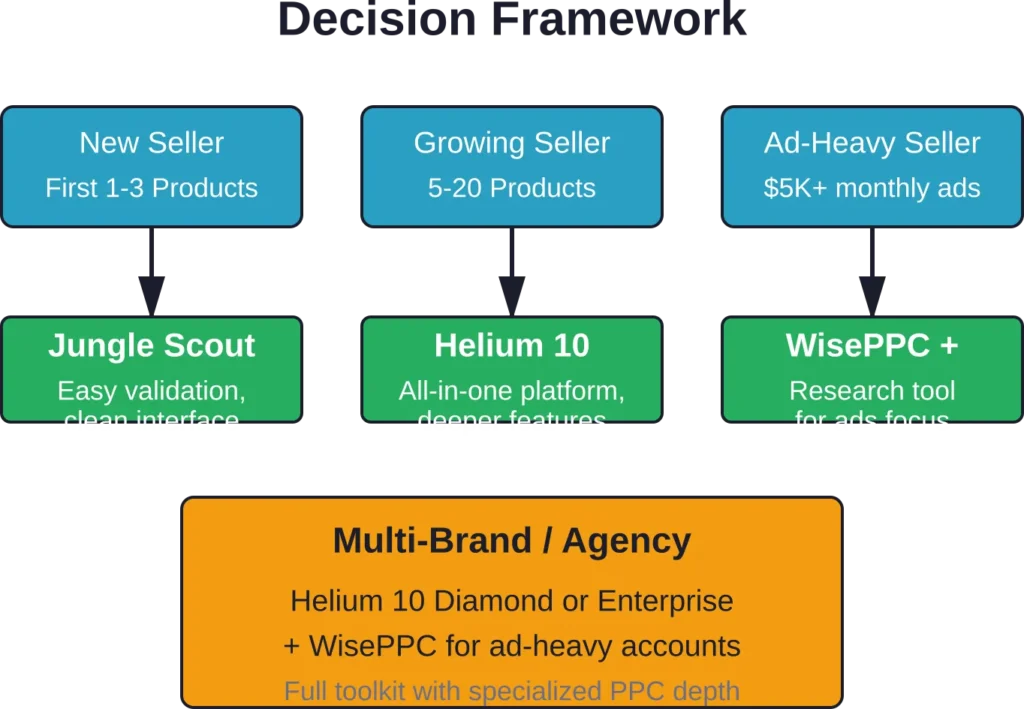
New sellers prioritizing product validation and ease of use lean toward Jungle Scout. The cleaner interface and guided workflows reduce overwhelm. Accurate sales estimates help avoid expensive mistakes on the first product launch.
Sellers managing 5 to 20 products who need research, listing optimization, and basic PPC in one place benefit from Helium 10. The all-in-one approach reduces tool fatigue. As the business grows, upgrading from Platinum to Diamond unlocks advanced features without switching platforms entirely.
For sellers spending $5,000 or more monthly on advertising, WisePPC can be valuable either as a standalone tool or alongside an existing research platform. The $5,000 free ad spend allowance and 2% fee structure on spend beyond that threshold make advanced PPC automation accessible. Traditionally agencies charge 10% to 20% of total spend.
Multi-brand sellers or agencies often use Helium 10 Diamond or Enterprise for comprehensive capabilities, potentially adding WisePPC for accounts where advertising optimization drives the bulk of results.
Budget-conscious sellers can start with lower tiers and upgrade as specific limitations become clear. Paying for features that won’t get used wastes money that could fund inventory or advertising.
The best approach: take advantage of free trials. Test the interfaces, run actual research on products being considered, and see which workflow feels natural. Software choices aren’t permanent—switching platforms later is possible if needs change.
Frequently Asked Questions
Many sellers combine tools to fill specific gaps. Using Helium 10 for research and listing optimization while adding WisePPC for advanced PPC automation is common. The platforms don’t conflict—they complement different workflow stages. The tradeoff is paying for multiple subscriptions versus accepting that no single tool excels at everything.
All three platforms support major Amazon marketplaces including US, UK, Germany, France, Italy, Spain, Canada, and Japan. Helium 10 and Jungle Scout recently added Walmart support as well. Coverage varies slightly by tool—check the official documentation for specific marketplace availability for the features most important to your business.
Sales estimates are directional, not guarantees. Jungle Scout publishes accuracy reports showing their estimates typically fall within a reasonable range of actual verified sales data. Helium 10 has improved accuracy significantly. Both platforms acknowledge that actual results depend on factors like listing quality, pricing, seasonality, and competition—variables no algorithm fully captures. Use estimates for filtering and comparison, not as absolute predictions.
Most platforms handle limits gracefully. Helium 10 shows remaining uses and restricts access once limits are reached until the next billing cycle. Some tools offer one-time usage packs for purchase if limits are exceeded temporarily. Consistent overages signal it’s time to upgrade to the next tier. Contacting support before hitting limits can sometimes unlock temporary increases.
Helium 10 requires more upfront learning than Jungle Scout, but most sellers adapt within a week or two of regular use. The Freedom Ticket training included with paid plans walks through both Amazon selling fundamentals and how to use specific tools. If comfortable learning software through video tutorials and experimentation, the learning curve is manageable. If preferring simpler interfaces with less functionality, Jungle Scout fits better.
No tool guarantees profitability. They surface data and streamline research, but judgment still matters. A product showing strong metrics in research might fail due to poor branding, bad imagery, ineffective copy, or new competitor entry. Tools reduce time wasted on obvious losers and help identify promising opportunities, but execution determines outcomes. Success requires combining tool insights with market understanding and quality execution.
Depends on how actively the business is managed. Sellers who continuously launch new products benefit from ongoing tool access for research. Sellers managing stable catalogs might reduce subscriptions to just monitoring and optimization tools. PPC platforms remain valuable as long as advertising continues—pausing the subscription means losing automation and reverting to manual campaign management. Some sellers downgrade to lower tiers rather than canceling completely once initial research phases complete.
Conclusion
Helium 10, Jungle Scout, and WisePPC each solve different problems for Amazon sellers.
Helium 10 delivers comprehensive capabilities across research, listing optimization, operations, and advertising. The all-in-one approach reduces tool sprawl, though the interface complexity requires investment in learning. Pricing starts at $99 per month for Platinum and $279 per month for Diamond on annual billing, targeting sellers at different revenue stages.
Jungle Scout specializes in accurate product validation and market intelligence with a cleaner, more approachable interface. The platform excels at helping sellers identify promising opportunities and avoid saturated markets. Supplier database integration streamlines sourcing. Plans accommodate sellers from launch through established brand stages.
WisePPC focuses exclusively on advertising optimization with advanced automation, dayparting, and product targeting analysis. The generous $5,000 monthly free ad spend allowance and 2% fee structure make sophisticated PPC accessible. It complements rather than replaces broader platforms.
The right choice depends on business stage, budget, and where the biggest bottlenecks currently exist. New sellers benefit from Jungle Scout’s guided validation. Growing sellers managing diverse catalogs lean toward Helium 10’s breadth. Ad-heavy sellers see ROI from WisePPC’s specialized depth.
Take advantage of free trials. Test interfaces with actual products being considered. See which workflow feels natural and which data presentations make decision-making easier. Software choices aren’t permanent—tools can be added, switched, or stacked as needs evolve.
Check the official pricing pages for current rates and feature availability. Amazon selling changes constantly, and tool capabilities evolve to match. What matters most is picking a tool that gets used consistently, not one that sits idle because it’s too complex or doesn’t fit actual workflows.
Choose based on where the business is now, not where it might be in three years. Start with what solves today’s problems, then adapt as new bottlenecks emerge.