

Quick Summary: Facebook ads targeting tools help advertisers identify and reach profitable audiences despite privacy changes and iOS updates. The best solutions in 2026 combine AI-powered audience discovery, lookalike modeling, interest research, and automated optimization to reduce wasted spend and improve ROAS across Meta campaigns.
Facebook ads targeting isn’t what it used to be. Privacy updates gutted traditional tracking. iOS changes killed most pixel data. Manual audience building? That’s a gamble now.
The platforms that win in 2026 lean heavily on AI and automation. They process historical data, detect hidden patterns, and surface audiences that manual research misses entirely. Some focus on interest discovery. Others optimize creative allocation. A few handle the entire funnel.
This guide covers the top Facebook ads targeting tools available right now. Each serves a specific need—whether you’re hunting hidden interests, automating campaign optimization, or trying to recover pre-iOS14 performance levels.
Why Facebook Targeting Tools Matter in 2026
Meta’s native targeting interface has gaps. Big ones.
The search function inside Ads Manager shows maybe 20% of available interests. Advertisers who rely solely on Meta’s autocomplete miss thousands of targetable segments. That’s where specialized tools come in—they surface hidden audience options and automate testing at scale.
But here’s the thing: not all tools solve the same problem. Some excel at interest research. Others predict creative performance before you spend a dollar. A handful manage budget allocation across dozens of campaigns simultaneously.
Privacy regulations continue tightening. According to academic research published in 2019, Facebook’s ad delivery algorithms can produce skewed outcomes even when advertisers don’t explicitly discriminate. Tools that apply AI to audience selection help navigate these constraints while maintaining performance.
Top Facebook Ads Targeting Tools
The following platforms represent the current state of Facebook targeting technology. Each brings specific strengths to different advertising scenarios.
1. Extuitive
Extuitive uses predictive AI to validate creative before launch. The platform analyzes historical campaign data to forecast which ads will perform, cutting waste on testing failures.
Best suited for brands with established historical data—think $3M+ revenue—to train the initial model. The system learns from past winners and losers, then scores new creative against those patterns.
The core value? Eliminating guesswork. Instead of launching ten variations and burning budget to discover eight duds, Extuitive flags likely winners upfront. That drastically increases creative throughput while cutting cost per acquisition.
Contact Information:
- Website: extuitive.com
- Email: [email protected]
- LinkedIn: www.linkedin.com/company/extuitive
- Twitter: x.com/Extuitive_Inc
- Instagram: www.instagram.com/extuitiveinc
2. AdStellar

AdStellar targets e-commerce brands with clear funnel stages. The platform uses AI to handle optimization while advertisers focus on creative strategy.
Pricing starts at $44/month for up to $1,000 in monthly ad spend. Pricing scales with ad budget, which keeps it accessible for smaller advertisers testing the waters.
The tool shines when managing multiple accounts. Media buyers running campaigns for several clients appreciate the centralized dashboard and automated audience rotation features.
3. Madgicx
Madgicx specializes in dynamic audience targeting. The platform continuously tests audience segments and reallocates budget toward top performers in real time.
The autonomous targeting feature monitors performance across demographics, interests, and behaviors. When a segment underperforms, Madgicx shifts spend automatically—no manual intervention required.
For brands running retargeting campaigns, Madgicx offers granular segmentation based on user behavior depth. Site visitors who viewed three products get different messaging than those who abandoned checkout.
4. Audience Builder
Audience Builder focuses exclusively on interest discovery. The tool reveals hidden Facebook interests that don’t appear in Ads Manager’s native search.
The interface is straightforward: enter a seed interest, and Audience Builder returns related segments your competitors probably aren’t targeting. That specificity often translates to lower CPMs and better engagement.
It’s 100% cloud-based, so there are no compatibility issues with any operating system or screen size. For advertisers whose primary bottleneck is finding fresh, untapped audiences, this tool delivers consistent value.
5. AdTargeting

AdTargeting provides detailed audience insights including demographics, interests, and behaviors. The platform aggregates data from multiple sources to build comprehensive audience profiles.
The tool excels at competitive research. Enter a competitor’s page, and AdTargeting shows which interests overlap with their audience. Use those insights to build lookalike segments or refine existing campaigns.
Pricing varies—check the official site for current plans—but the entry tier remains accessible for solo marketers and small agencies.
6. InterestExplorer

InterestExplorer helps advertisers dig deeper into Meta’s interest taxonomy. The platform surfaces niche interests and estimates audience size before you commit budget.
The size estimation feature matters more than it sounds. Targeting a 5,000-person interest won’t scale. InterestExplorer shows realistic reach numbers, so you can prioritize segments with growth potential.
The tool also highlights trending interests—segments experiencing rapid growth that may not yet show high competition.
7. WASK

WASK combines targeting recommendations with automated budget management. The platform analyzes campaign performance and adjusts daily budgets across ad sets to maximize overall ROAS.
For advertisers managing large portfolios—think 20+ campaigns running simultaneously—WASK reduces manual workload significantly. The automation engine handles routine optimization tasks, freeing time for strategic creative development.
The tool integrates directly with Meta’s API, so changes sync instantly without requiring manual uploads or approvals.
8. AdAmigo.ai

AdAmigo.ai applies machine learning to audience segmentation. The platform identifies high-value customer clusters within your existing data, then builds lookalike audiences based on those profiles.
The clustering algorithm goes beyond basic demographics. It considers behavioral patterns, purchase frequency, average order value, and lifetime value to segment customers into actionable groups.
Best for brands with robust customer databases. The more historical data AdAmigo.ai can analyze, the more precise its audience recommendations become.
9. LeadEnforce
LeadEnforce targets B2B advertisers running lead generation campaigns. The platform optimizes for lead quality, not just lead volume—a critical distinction in business marketing.
The tool scores leads in real time based on fit criteria you define. When a campaign generates low-quality leads, LeadEnforce adjusts targeting automatically to improve match quality.
Integration with CRM platforms lets the system learn which lead characteristics convert to closed deals, creating a feedback loop that continuously refines targeting over time.
10. InterestInsights

InterestInsights provides detailed analytics on interest performance across your campaigns. The platform tracks which interests drive conversions versus which generate empty clicks.
The reporting dashboard breaks down performance by interest segment, making it easy to identify winners and losers. Cut underperformers fast, then reallocate budget to top-performing interests.
For agencies reporting to clients, the visual dashboards simplify performance storytelling. Show exactly which audience segments delivered results and which didn’t pull their weight.
11. Vaizle Free Interest Finder

Vaizle offers a free tool for basic interest research. The platform won’t match paid solutions in depth, but it’s solid for quick audience brainstorming.
The free tier shows related interests and basic audience size estimates. For advertisers just starting with Facebook ads, Vaizle provides enough functionality to build initial test campaigns without upfront cost.
Once campaigns scale and targeting needs grow more complex, most advertisers graduate to paid platforms with deeper features.
Core Facebook Targeting Options
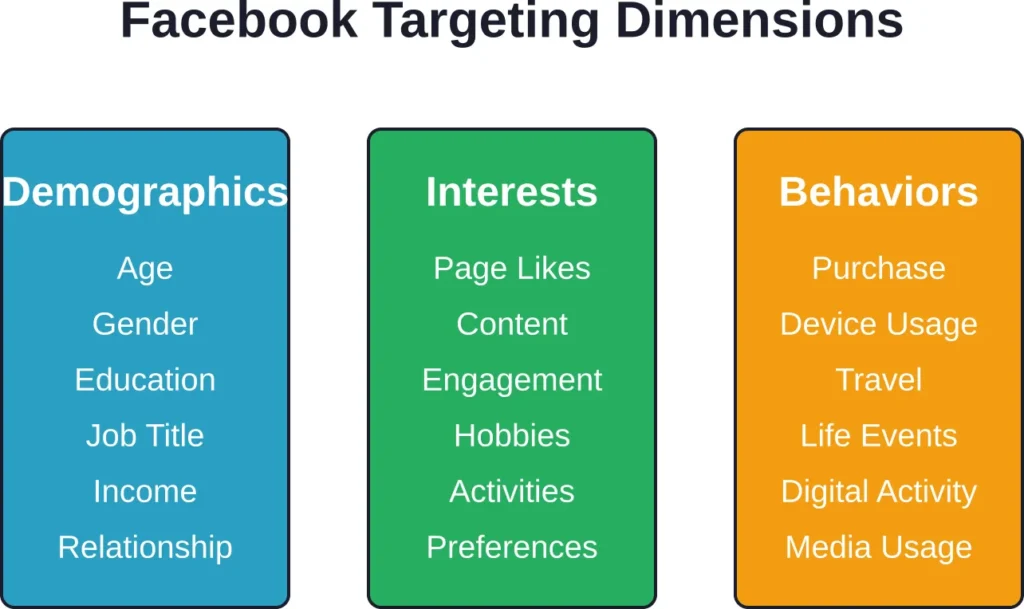
Before diving into third-party tools, understanding Meta’s native targeting capabilities matters. The platform offers three primary targeting dimensions.
Demographic Targeting
Demographics include age ranges, gender, education level, job titles, and relationship status. Income brackets are available in select markets, with ranges like $40,000–$49,999, $50,000–$74,999, and $75,000–$99,999 according to advertiser reports.
Education targeting goes granular. Target by degree type, field of study, or specific schools. For B2B campaigns promoting executive education or professional certifications, education targeting narrows audiences effectively.
Interest Targeting
Interests represent user behavior, page likes, and content engagement patterns. Facebook categorizes interests into broad themes—business, entertainment, fitness, technology—then breaks them into thousands of subcategories.
The challenge? Most interests don’t appear in Ads Manager’s search. Manually typing “fitness” might return 50 interests, but specialized tools surface 500+ related segments in the same category.
Behavior Targeting
Behaviors track purchase activity, device usage, travel patterns, and more. Target users who recently moved, purchased specific product categories, or use particular devices.
Behavior data comes from third-party data providers and Facebook’s tracking pixel network. Privacy restrictions have limited some behavior targeting options, but key segments remain available for advertisers.
Choosing the Right Targeting Tool
Not every tool fits every business model. The right choice depends on campaign goals, budget scale, and existing data infrastructure.
For Interest Discovery
If the primary challenge is finding fresh audiences, tools like Audience Builder and InterestExplorer deliver the most value. They surface hidden interests that manual research misses.
These platforms work well for advertisers who’ve exhausted obvious targeting options and need to expand reach without sacrificing relevance.
For Creative Optimization
Brands producing high volumes of creative need prediction tools like Extuitive. Testing every variation burns budget and time. Predictive AI scores creative upfront, so teams can focus resources on likely winners.
This approach works best with sufficient historical data. Algorithms need past performance patterns to generate accurate predictions.
For Campaign Automation
Advertisers managing multiple campaigns simultaneously benefit from automation platforms like Madgicx and WASK. These tools handle routine optimization tasks—budget allocation, audience rotation, bid adjustments—freeing time for strategic work.
Automation particularly helps agencies managing dozens of client accounts. Manual optimization at that scale becomes impossible.
For B2B Lead Generation
B2B marketers need tools that optimize for lead quality, not just volume. LeadEnforce specializes in this use case, scoring leads in real time and adjusting targeting to improve match quality.
Integration with CRM systems creates feedback loops that improve targeting as more leads convert through the sales pipeline.
| Tool Category | Best For | Key Feature | Typical User |
|---|---|---|---|
| Interest Discovery | Finding hidden audiences | Surfaces non-searchable interests | Solo marketers, small agencies |
| Creative Prediction | High creative volume | Scores ads before launch | E-commerce brands, DTC |
| Campaign Automation | Managing multiple accounts | Automated optimization | Agencies, large advertisers |
| B2B Lead Gen | Quality over volume | Real-time lead scoring | SaaS, professional services |
Common Targeting Mistakes to Avoid
Even with sophisticated tools, certain targeting errors kill campaign performance. Awareness helps avoid costly mistakes.
Audience Overlap
Running multiple campaigns that target the same users creates internal competition. Ad sets bid against each other, driving up costs and confusing Meta’s algorithm.
Most tools include overlap detection. Use it. Consolidate audiences when overlap exceeds 20-30%.
Audience Size Extremes
Audiences below 50,000 users limit algorithm learning. Audiences above 10 million dilute targeting precision. Both extremes hurt performance.
Tools that estimate audience size help identify segments within the optimal range—typically 500,000 to 3 million users for most campaigns.
Ignoring Placement Performance
Not all placements perform equally. Instagram Stories might crush for one audience while Facebook Feed dominates for another. Tools with placement-level reporting reveal these patterns.
Split test placements, then allocate budget accordingly. Don’t assume Automatic Placements always delivers optimal distribution.
Static Targeting
Audiences evolve. What worked last quarter may underperform now. Tools that continuously test new segments prevent stagnation.
Schedule regular audience audits—monthly for high-spend accounts, quarterly for smaller budgets. Rotate in fresh interests and retire consistent underperformers.
Privacy and Algorithmic Bias Considerations
Targeting tools operate within complex ethical and regulatory landscapes. Understanding these constraints matters for sustainable advertising.
Research published in April 2019 (arXiv:1904.02095) demonstrated that Facebook’s ad delivery algorithms can produce skewed outcomes even when advertisers don’t explicitly target protected characteristics. The platform’s optimization systems learn patterns that may perpetuate bias.
On July 24, 2019, the FTC imposed a $5 billion penalty on Facebook for privacy violations and instituted sweeping new restrictions. These regulations continue shaping how targeting tools access and process user data.
Community discussions highlight ongoing concerns about algorithmic transparency. Users report seeing ads that feel invasive despite opting out of data collection. Tools that document targeting rationale help advertisers maintain compliance and build trust.
The Markup reported on April 13, 2021 that ExxonMobil spent $7 million in ads labeled as “political” in the six months leading up to the November 2020 election, using Facebook’s targeting to show different messages to liberal versus conservative audiences. This capability raises questions about transparency in political and advocacy advertising.
Measuring Targeting Effectiveness
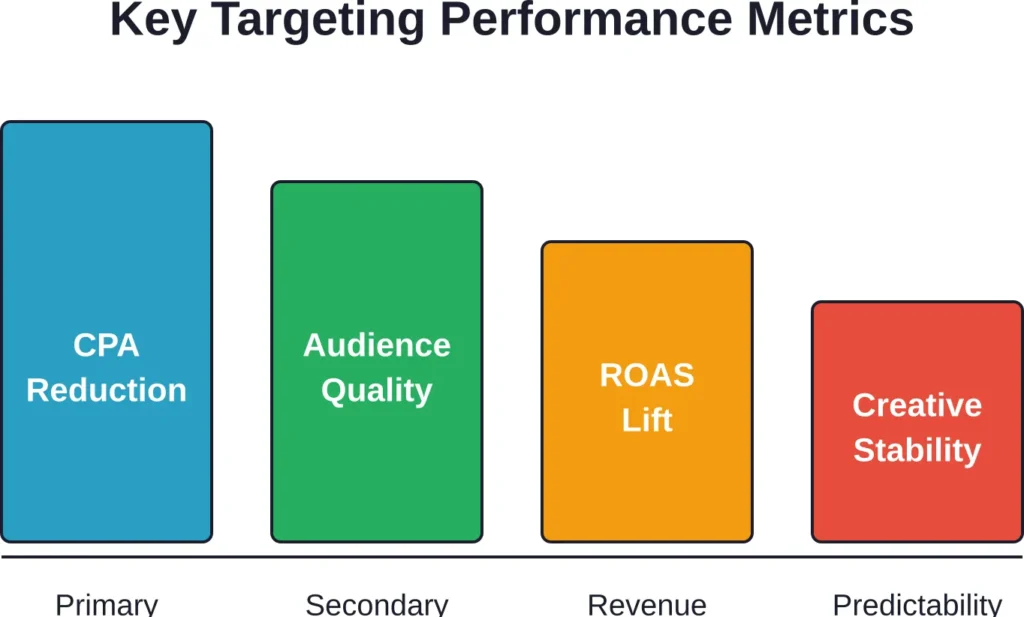
Tools are only valuable if they improve outcomes. Track specific metrics to evaluate targeting performance.
Cost Per Acquisition
CPA remains the clearest success metric. Does the tool reduce cost per customer acquisition? Track CPA before and after implementing new targeting approaches.
CPA improvements of 15-20% justify tool costs for most advertisers. Gains below 10% may not offset subscription fees and implementation time.
Audience Quality Scores
Some tools generate quality scores for discovered interests. High-quality audiences show strong engagement and conversion rates. Low-quality segments generate clicks but few conversions.
Prioritize quality over reach. A 100,000-person high-quality audience outperforms a 5-million-person low-quality segment every time.
Creative Performance Consistency
Strong targeting makes creative perform more consistently. If identical ads show wildly different results across audiences, targeting likely needs refinement.
Tools that reduce creative performance variance help budget forecasting and scaling decisions become more predictable.
Implementation Best Practices
Adopting new targeting tools requires strategic implementation. Random experimentation wastes budget.
Start With One Tool
Don’t stack five tools simultaneously. Choose one that addresses the biggest current bottleneck—whether that’s interest discovery, creative testing, or automation.
Master one platform before adding others. Layering complexity prematurely creates confusion and makes it impossible to isolate what’s working.
Maintain Control Groups
When testing new targeting approaches, maintain control campaigns using existing methods. Compare performance directly.
Control groups prevent attribution errors. If overall account performance improves, control groups reveal whether changes came from the new tool or external factors like seasonality.
Document Baseline Metrics
Record current performance before implementing tools. Track CPA, ROAS, CPM, CTR, and conversion rate for at least two weeks.
Without baseline data, evaluating tool effectiveness becomes guesswork. Documentation also helps troubleshoot if performance drops unexpectedly.
Integrate With Existing Stack
Most tools integrate with Meta’s API, Google Analytics, and major e-commerce platforms. Configure integrations upfront to enable automatic data sync.
Manual data transfer introduces errors and delays. Proper integration ensures tools access real-time performance data for accurate optimization.
Future of Facebook Targeting Tools
The targeting landscape continues evolving rapidly. Several trends will shape tool development through 2026 and beyond.
Increased AI Autonomy
Tools are moving from recommendation systems to fully autonomous optimization. Advertisers set goals and guardrails, then algorithms handle execution entirely.
This shift works well for performance campaigns with clear conversion metrics. Brand awareness and consideration campaigns still benefit from human oversight.
Cross-Platform Coordination
Leading tools now coordinate targeting across Meta, TikTok, Google, and other platforms simultaneously. Unified audience profiles prevent duplication and enable consistent messaging.
Cross-platform tools help advertisers understand customer journeys that span multiple channels, improving attribution accuracy and budget allocation.
Privacy-First Targeting
As regulations tighten, tools that deliver results without invasive tracking gain advantage. Contextual targeting and cohort-based approaches replace individual-level tracking.
Academic research published on November 27, 2024 explores how real-time algorithmic learning in digital search advertising can lead to apparent discrimination while algorithms optimize content delivery. Expect more tools adopting these techniques as default approaches.
Frequently Asked Questions
Ads Manager provides basic targeting through demographics, interests, and behaviors. Third-party tools surface hidden interests, automate optimization, predict creative performance, and provide advanced analytics that native features don’t offer. Most tools integrate directly with Meta’s API to access deeper targeting capabilities.
Yes, but differently. Tools now rely more heavily on first-party data, AI modeling, and interest-based targeting rather than pixel tracking. The best platforms adapted by building lookalike models from customer data and surfacing non-obvious interest combinations that compensate for lost tracking capabilities.
Entry-level tools start around $44 per month for basic features. Mid-tier platforms range from $100-$300 monthly. Enterprise solutions handling large-scale automation can exceed $1,000 per month. Pricing typically scales with ad spend volume. Check official websites for current plans, as pricing structures change frequently.
Absolutely. Tools like Audience Builder and Vaizle offer affordable options for discovering new audiences. Small businesses often see proportionally larger gains because they’re starting from basic manual targeting. Even modest improvements in CPA or ROAS justify tool costs when working with limited budgets.
Most platforms show initial improvements within 7-14 days as algorithms gather performance data. Significant gains typically appear after 30-45 days once tools accumulate enough learning data. Predictive tools using historical data can show immediate improvements since they leverage existing patterns.
Reputable tools comply with GDPR, CCPA, and other privacy frameworks. They work within Meta’s approved API structure and don’t access restricted user data. However, advertisers remain responsible for how they apply targeting. Avoid discriminatory practices even if tools technically allow them. Always review each platform’s privacy policy and compliance certifications.
No tool guarantees specific results—performance depends on creative quality, offer strength, market conditions, and existing campaign foundation. That said, quality targeting tools consistently improve ROAS by reducing wasted spend on poor-fit audiences. Typical improvements range from 15-40% for advertisers switching from manual targeting to AI-powered platforms.
Conclusion
Facebook ads targeting in 2026 demands more sophistication than manual Ads Manager setups provide. Privacy restrictions eliminated easy tracking. Algorithm changes killed predictable scaling. Competition pushed costs upward.
The tools covered here address those challenges through AI-powered audience discovery, predictive creative scoring, and automated campaign management. Each platform serves specific needs—from interest research to B2B lead scoring to cross-channel coordination.
Start by identifying the biggest bottleneck in current campaigns. Need fresh audiences? Focus on interest discovery tools. Drowning in campaign management? Prioritize automation platforms. Unsure which creative will work? Test predictive scoring.
Implementation matters as much as tool selection. Document baselines, maintain control groups, and give platforms sufficient time to learn before judging effectiveness. Most advertisers see meaningful improvements within 30-45 days of proper implementation.
The targeting landscape will continue evolving. Privacy regulations will tighten further. AI capabilities will expand. But the core principle remains constant: reaching the right people with relevant messages drives profitable advertising. Tools that make that process easier, faster, and more accurate will always deliver value.
Ready to improve Facebook targeting performance? Pick one tool that addresses the current biggest challenge. Test it properly. Measure results objectively. Then scale what works.