

Quick Summary: The best tools for Facebook dynamic ads management in 2026 include Extuitive for pre-launch ad prediction, Madgicx for AI-powered automation, Revealbot for rule-based optimization, ROI Hunter for catalog-heavy campaigns, and native Meta Ads Manager for basic dynamic product ads. Choose based on your catalog size, budget, and need for automation — according to recent studies, advertisers using dedicated management platforms see 23-41% improvement in ROAS compared to manual optimization alone.
Dynamic ads on Facebook sound simple on paper: connect a catalog, set rules, let the system do the work. In reality, once catalogs grow and campaigns multiply, things get messy fast.
Products go out of stock, creative variations underperform, and audience segments drift. Manual management through Meta Ads Manager becomes a bottleneck.
The platforms winning right now aren’t just campaign dashboards — they’re automation engines that handle catalog sync, audience segmentation, and real-time budget adjustments. The complexity of Meta’s ad platform has exploded with dynamic creative, advantage+ targeting, and multiple campaign objectives. Babysitting campaigns manually simply doesn’t scale anymore.
Here’s the thing though — not every tool fits every use case. Some excel at creative testing, others at catalog management, and a few at autonomous optimization. This guide breaks down the strongest options for Facebook dynamic ads management in 2026, scored on what actually matters: automation depth, catalog handling, reporting clarity, and whether the ROI justifies the cost.
Why Facebook Dynamic Ads Need Specialized Management Tools
Meta Ads Manager handles basic dynamic product ads just fine. But the moment catalog size crosses a few hundred SKUs, or when running cross-border campaigns with multiple currencies, the native interface shows its limits.
Dedicated management software brings three critical advantages: automated catalog synchronization that catches inventory changes before ad spend gets wasted on out-of-stock products, rule-based optimization that adjusts bids and budgets based on performance thresholds without manual intervention, and consolidated reporting across multiple ad accounts and catalogs.
According to recent studies, advertisers using dedicated management platforms see 23-41% improvement in ROAS compared to manual Meta Ads Manager optimization. That gap comes from speed — automated systems react to performance shifts in minutes, not hours or days.
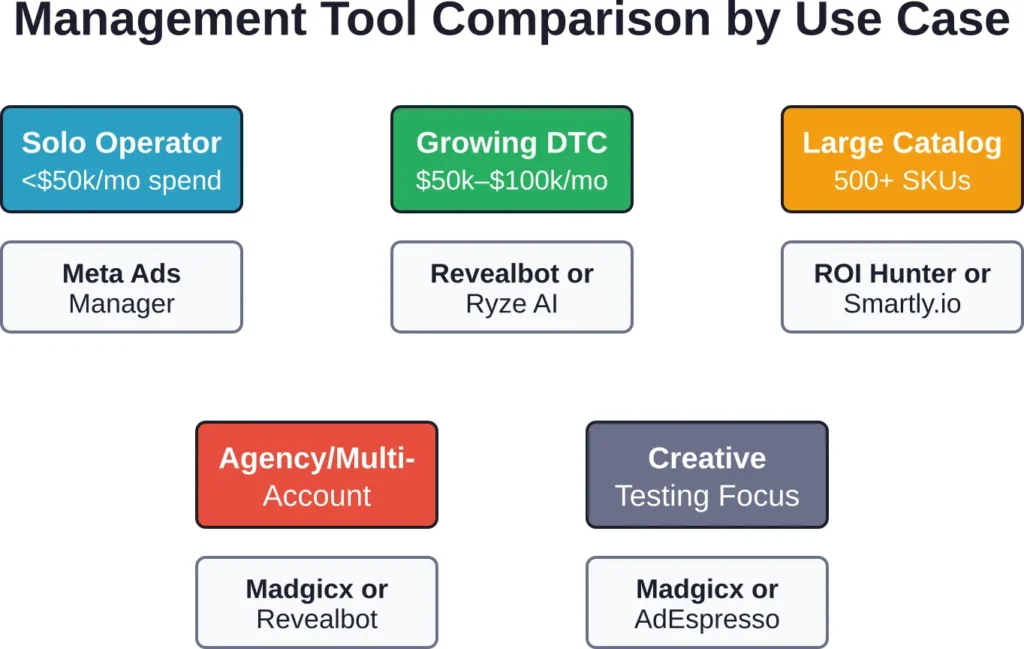
Real talk: the value threshold sits around catalog size and ad spend volume. Solo operators or DTC brands under $50k/month in ad spend often find Meta Ads Manager sufficient. Above that threshold, the efficiency gains from automation tools quickly justify the subscription cost.
Meta Ads Manager — The Native Baseline

Before jumping to third-party platforms, understanding what Meta’s native tools offer sets the comparison baseline. Meta Ads Manager handles dynamic product ads through catalog connections, advantage+ shopping campaigns, and basic rule-based automation.
The interface supports catalog sets, custom audiences from pixel events, and automated rules for budget adjustments. For straightforward dynamic retargeting or broad catalog promotions, it covers the essentials without additional subscription costs.
Where it falls short: creative testing workflows require manual duplication, cross-account reporting demands separate logins, and rule logic remains limited to simple if-then conditions. Bulk editing across hundreds of product sets becomes tedious fast.
Extuitive — AI-Powered Pre-Launch Ad Prediction & Validation
Extuitive is a predictive AI platform that allows e-commerce brands to test and validate Facebook Dynamic Ads creatives before spending a single dollar. Instead of launching campaigns and learning from real results, it forecasts performance using AI consumer agents trained on 150,000+ real buyer behavior patterns.
The platform connects directly to Shopify, pulls the full product catalog, and runs simulated audience tests on generated or uploaded creatives. It predicts CTR, ROAS, purchase intent, and engagement, then ranks variations and recommends the strongest ones for Advantage+ Catalog Ads, retargeting, and collection campaigns. Users can generate new copy, images, and video variations inside the platform and export only the validated winners straight to Meta Ads Manager.
Pricing starts at $1,000/month for the Starter plan (up to 500 ads scored per month) and scales to $2,500/month on Professional (2,500 ads). Enterprise pricing is custom. The cost is positioned for brands spending $10k–$100k+ monthly on Meta, where preventing wasted creative testing budget quickly covers the subscription.
Where Extuitive shines: true pre-launch prediction and creative validation specifically tailored for Dynamic Product Ads and large catalogs. It acts as a quality gatekeeper — brands launch fewer, but significantly stronger creatives, reducing the usual 30-50% waste common in traditional testing. Deep Shopify integration and catalog-aware AI make it one of the best additions for heavy product advertisers.
Drawbacks center on the higher starting price and narrower focus. It excels at pre-launch validation and generation but does not offer ongoing autonomous bid management, audience optimization, or full campaign rules like all-in-one platforms. The AI predictions, while strong, still require human judgment for brand voice and final decisions. It works best as a powerful front-end tool rather than a complete Meta Ads replacement.
Contact Information:
- Website: extuitive.com
- Email: [email protected]
- LinkedIn: www.linkedin.com/company/extuitive
- Twitter: x.com/Extuitive_Inc
- Instagram: www.instagram.com/extuitiveinc
Revealbot — Rule-Based Optimization Powerhouse

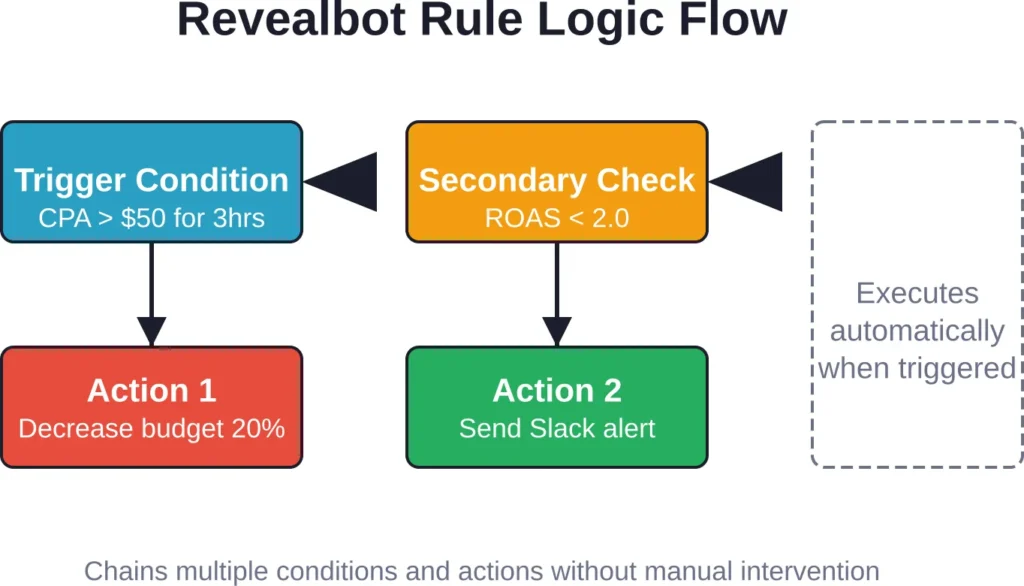
Revealbot excels at conditional automation. The platform allows creation of complex rule chains like “if CPA exceeds $50 for 3 hours and ROAS drops below 2.0, then decrease budget by 20% and send Slack notification.”
That level of granular control suits media buyers who want automated execution of their optimization strategy without handing full control to an AI black box. The bulk management interface handles edits across hundreds of ad sets simultaneously — changing bids, budgets, or targeting parameters in one action.
Pricing begins at $99/month, positioning it in the mid-range for dedicated tools. The platform integrates with Meta, Google, TikTok, and Snapchat, making it viable for multi-channel campaigns beyond just Facebook.
What stands out: the notification system. Rules can trigger alerts through Slack, email, or webhooks when performance thresholds are hit. For agencies managing client accounts, this prevents budget overruns before they spiral.
Limitations show up in creative operations and native reporting depth. Revealbot optimizes existing campaigns effectively but doesn’t streamline the initial creative testing or provide advanced attribution beyond Meta’s pixel data.
Madgicx — AI-Powered Audience and Creative Automation

Madgicx positions itself as an AI copilot for Meta advertising, emphasizing autonomous audience discovery and creative intelligence. The platform analyzes account performance data to suggest audience segments that conventional targeting might miss.
The audience targeting tools use credit card transaction data patterns to identify lookalike segments based on actual purchasing behavior, not just pixel events or engagement signals. For dynamic product ads, this translates to reaching buyers who’ve purchased similar products from competitors.
Creative automation handles variant testing at scale. Upload base assets, set testing parameters, and the system generates combinations while automatically pausing underperformers. The workflow saves hours compared to manual creative duplication in Meta Ads Manager.
Pricing sits in the $$ tier — typically $200–$600/month depending on ad spend volume and feature access. The cost makes sense for brands spending $20k–$100k monthly on Meta ads where attribution accuracy and time efficiency justify premium tooling.
Where Madgicx shines: the unified creative and audience layer. Many tools handle one or the other well, but few integrate both into cohesive workflows. The AI recommendations improve over time as the system learns account-specific performance patterns.
Drawbacks center on complexity and learning curve. New users face a steeper onboarding compared to simpler rule-based tools. The AI suggestions require trust — understanding why the system recommends certain actions isn’t always transparent.
ROI Hunter — Catalog-First Dynamic Ad Platform

ROI Hunter built its platform specifically for product catalog advertising, making it the strongest option for retailers managing 50+ products or complex catalog structures across multiple markets.
The catalog management interface handles product feed optimization, automatic updates when inventory changes, and dynamic creative templates that pull product attributes directly into ad variations. This eliminates the manual work of updating ads when prices change or products go out of stock.
Pricing starts at $149/month for catalogs with 50+ products, scaling with catalog size and ad spend. For brands with large inventories, the ROI comes from preventing wasted spend on unavailable products and ensuring price accuracy across thousands of SKUs.
The platform integrates with major e-commerce systems — Shopify, WooCommerce, Magento — syncing product data automatically. Custom catalog rules allow segmentation by margin, stock levels, or seasonality without manual product set creation.
Dynamic templates deserve attention. Instead of creating separate ads for each product, templates define the structure once, then auto-populate with product data. Change the template, and hundreds of active ads update simultaneously.
Limitations appear when moving beyond pure product catalog campaigns. ROI Hunter doesn’t handle lead generation, app installs, or video campaigns as comprehensively as general-purpose tools. It’s specialized by design.
Ryze AI — Autonomous Optimization Agent

Ryze AI takes a different approach — full autonomous management rather than assisted automation. The platform positions itself as an AI agent that runs campaigns end-to-end with minimal human intervention.
Setup takes under 10 minutes according to platform documentation. Connect the Meta ad account, define business objectives and budget limits, and the AI handles bid optimization, budget allocation across ad sets, and creative rotation based on real-time performance.
Pricing begins at $99/month and scales to $499/month depending on ad spend volume and account complexity. Time savings represent the primary value proposition — less than 10 minutes of weekly management time versus 2-3 hours for manual optimization or rule-based tools.
The platform is used by 2,000+ marketers across 23 countries managing over $500M in ad spend, indicating meaningful adoption beyond early testing. First-party data integration and server-side tracking support address attribution accuracy, a critical concern as cookie-based tracking becomes less reliable.
What makes it different: the autonomy level. Most tools execute predefined rules or require approval for optimization actions. Ryze AI makes adjustments automatically within the guardrails set during onboarding.
The tradeoff — less granular control. Media buyers who want hands-on management and detailed control over every bid adjustment won’t love the black-box approach. But for time-strapped operators or brands without dedicated media buying teams, the autonomous model works.
Smartly.io — Enterprise-Scale Campaign Automation

Smartly.io targets enterprise advertisers and agencies managing campaigns across dozens of brands or markets. The platform handles Meta, TikTok, Pinterest, Snapchat, and programmatic display from a unified interface.
Dynamic creative optimization sits at the core. Upload creative components — headlines, images, CTAs, product feeds — and Smartly generates thousands of combinations, testing systematically to identify winning variations. The scale makes sense for brands running localized campaigns across multiple geographies with different languages and currencies.
Catalog management supports multi-market operations with currency conversion, localized copy templates, and market-specific product availability rules. Campaigns can launch simultaneously across 20+ countries with appropriate creative and targeting for each.
Pricing operates on custom enterprise contracts rather than published tiers. Generally positions in the $$$ category — $600+ monthly or percentage-of-spend models. The investment makes sense above $100k monthly ad spend where coordination costs justify centralized automation.
The platform’s strength — consistency at scale. Brand guidelines, approval workflows, and creative templates ensure campaigns maintain quality standards even when dozens of team members create ads across multiple markets.
Drawbacks center on overhead and complexity. Smaller operations find the platform overkill. Setup and onboarding take weeks, not hours. The feature depth requires dedicated training for team members.
AdEspresso — Beginner-Friendly Testing and Management

AdEspresso simplifies Facebook ad creation and testing for marketers without deep technical expertise. The visual interface guides users through campaign setup with templates and best practice suggestions.
Split testing workflows make A/B testing accessible. Define variables to test — audience segments, creative variations, ad copy — and the platform handles distribution and statistical analysis. Results display clearly which combinations perform best.
Pricing starts from $49/month with a free 14-day trial, making it accessible for small businesses testing Facebook advertising or teams learning dynamic ads before moving to more advanced platforms.
The campaign creation wizard walks through targeting options, budget settings, and creative requirements step-by-step. For teams unfamiliar with Meta’s sometimes confusing interface, this reduces errors and speeds up launch.
Limitations become apparent at scale. The automation rules remain basic compared to Revealbot or Madgicx. Catalog management features exist but lack the depth of ROI Hunter or Smartly. AdEspresso works well as a first paid tool, less so for sophisticated operations.
Where it fits: marketing teams of 2-5 people managing $10k–$50k monthly ad budgets who need clearer reporting and simpler testing than Meta Ads Manager provides, but don’t require enterprise-grade automation.
Choosing the Right Tool for Your Catalog Size and Budget
Tool selection comes down to three primary factors: catalog complexity, monthly ad spend, and internal team capacity. These dimensions determine which platform capabilities actually matter versus which are nice-to-have.
Catalog size under 100 SKUs: Meta Ads Manager often suffices. Dynamic product ads work well through native catalog connections. Third-party tools add minimal value unless creative testing volume or cross-account management drives the need.
Catalog size 100-500 SKUs: Dedicated catalog tools start showing clear ROI. Automated inventory sync prevents wasted spend. Dynamic templates reduce creative production time significantly. ROI Hunter or similar platforms make sense here.
Catalog size 500+ SKUs or multi-market operations: Enterprise platforms become necessary. Managing thousands of products across different currencies, languages, and compliance requirements requires sophisticated automation. Smartly.io or similar enterprise solutions fit this tier.
| Monthly Ad Spend | Team Size | Recommended Tool Tier | Expected Monthly Cost |
|---|---|---|---|
| Under $20k | 1-2 people | Meta Ads Manager or AdEspresso | $0–$49 |
| $20k–$50k | 2-3 people | Revealbot or Ryze AI | $83–$149 |
| $50k–$100k | 3-5 people | Madgicx or ROI Hunter | $149–$499 |
| $100k+ | 5+ people or agency | Smartly.io or custom enterprise | $600+ or % of spend |
But wait. Budget alone doesn’t tell the full story. Time efficiency matters significantly. A platform costing $499/month that saves 20 hours of manual work monthly easily justifies the investment if internal hourly costs exceed $25.
Attribution accuracy represents another dimension. Platforms with first-party data integration and server-side tracking provide more accurate conversion data as third-party cookies phase out. This capability becomes critical for brands where Meta’s attribution window doesn’t capture the full customer journey.
Automation vs. Control — Finding the Right Balance
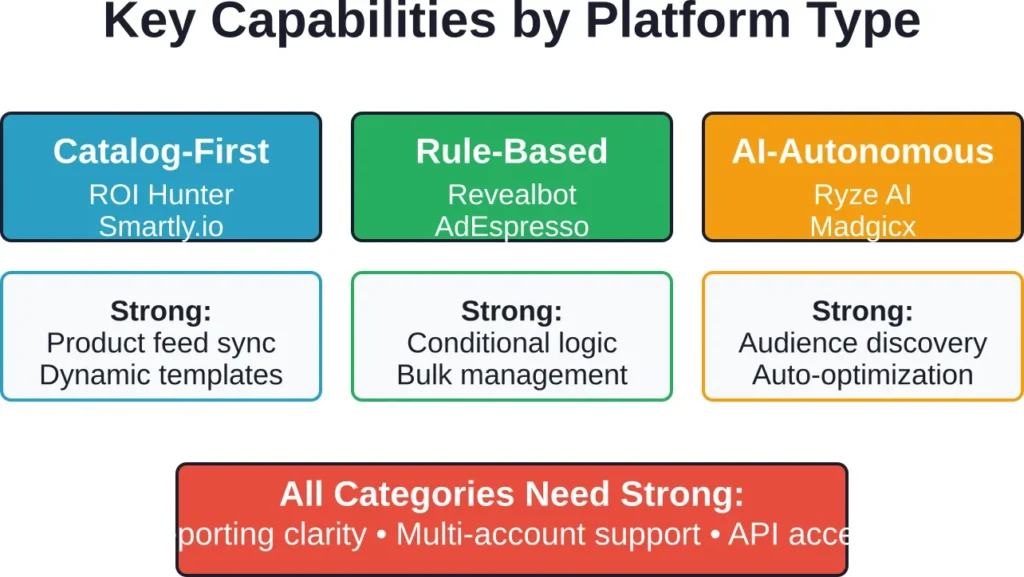
The fundamental tension in choosing Facebook ads management software: automation efficiency versus granular control. Fully autonomous platforms like Ryze AI optimize continuously but obscure decision logic. Rule-based tools like Revealbot give transparency but require constant refinement.
Experienced media buyers often prefer rule-based systems. They know exactly what optimization strategy works for their products and want automated execution of that strategy, not AI suggestions that might conflict with business priorities.
Teams without deep Meta advertising expertise lean toward AI-driven platforms. The system learns from broader data patterns and applies tactics the team might not know to implement manually.
Neither approach is universally better. The right choice depends on internal expertise level and time availability. A solo founder running a DTC brand while also handling product development doesn’t have time to build complex automation rules. Full AI autonomy makes sense. An agency media buyer managing 15 client accounts needs precise control and transparent decision logic. Rule-based automation fits better.
Many successful operations use hybrid approaches — AI-driven platforms for discovery and testing new audiences or creative variants, then rule-based tools to scale what works with controlled execution.
Integration Capabilities That Actually Matter
Marketing technology stacks in 2026 rarely consist of a single platform. Facebook ads management tools need to connect cleanly with analytics platforms, CRM systems, e-commerce backends, and reporting dashboards.
Essential integrations to verify before committing:
- E-commerce platform sync (Shopify, WooCommerce, BigCommerce) for automatic catalog updates and conversion tracking
- Analytics platforms (Google Analytics 4, Segment, Mixpanel) for attribution modeling beyond Meta’s pixel
- Business intelligence tools (Looker, Tableau, Google Data Studio) for custom reporting and cross-channel analysis
- Communication platforms (Slack, Teams, email) for alert notifications when campaigns need attention
- CRM systems (HubSpot, Salesforce) for audience building from customer data and lead management
API access matters for custom workflows. Some platforms provide full API documentation allowing developers to build proprietary integrations. Others lock functionality behind the user interface only.
The short answer? Check integration documentation during evaluation, not after purchase. Missing a critical integration creates workflow friction that erodes the efficiency gains automation promises.
Reporting and Attribution Challenges in 2026
Accurate performance measurement remains one of the hardest problems in Facebook advertising. iOS privacy changes, cookie restrictions, and attribution window limitations mean Meta’s reported conversions often undercount actual results.
Third-party management tools approach attribution differently. Some rely entirely on Meta’s pixel data and Conversions API, essentially reformatting native reporting with better visualizations. Others integrate first-party data sources to build independent attribution models.
Platforms with server-side tracking integration capture conversion data directly from e-commerce backends, matching orders to ad clicks without depending solely on browser pixels. This method provides more complete conversion counts but requires technical implementation.
For accurate ROAS measurement on dynamic product ads specifically, product-level attribution matters. Which SKUs drive profitable conversions versus which generate clicks but low-value purchases? Catalog-focused platforms like ROI Hunter provide this granularity. General automation tools often report campaign-level or ad-set-level metrics only.
When evaluating reporting capabilities, verify:
- Can the platform attribute conversions to specific product SKUs, not just campaigns?
- Does it support custom attribution windows beyond Meta’s default settings?
- Can reports segment by customer lifetime value or repeat purchase rate?
- Does it integrate offline conversion data for businesses with phone sales or in-store purchases?
- Are raw data exports available for custom analysis in BI tools?
Creative Operations — The Overlooked Workflow Bottleneck
Campaign optimization gets attention. Attribution gets attention. Creative production workflows rarely do, despite consuming massive time for brands running dynamic ads at scale.
Dynamic product ads require creative templates that work across thousands of SKU variations. Product images vary in aspect ratio, background color, and composition. Template designs need flexibility to handle this variability without manual adjustments per product.
Some platforms provide dynamic creative studios with drag-and-drop template builders. Upload product feed, design layout once, generate thousands of variations automatically. Others assume creative production happens externally and only handle deployment.
For brands with in-house design teams, flexible API access to push finished creatives matters more than built-in design tools. For brands without dedicated designers, template libraries and automation become essential.
Video creative introduces another complexity layer. Dynamic video templates that auto-populate with product clips, prices, and CTAs exist but remain limited compared to static image capabilities. Most tools still require manual video production per product or product category.
The creative operations gap explains why some advertisers use multiple platforms — one for catalog and campaign management, another specifically for creative production and testing. Madgicx offers strong creative intelligence. ROI Hunter excels at catalog management. Using both in tandem covers capabilities neither provides alone.
Common Implementation Mistakes to Avoid
Platform selection represents half the challenge. Implementation determines whether the tool actually delivers promised efficiency gains. Common mistakes derail value realization:
Mistake one: Migrating entire account structures immediately. Start with one campaign or product category. Learn the platform’s quirks and optimization behavior before committing the full budget. Gradual rollout limits downside risk.
Mistake two: Setting automation rules or AI guardrails too tight initially. Overly conservative CPA caps or ROAS minimums prevent the system from spending enough to gather learning data. Allow wider boundaries during the first two weeks, then tighten based on actual performance patterns.
Mistake three: Ignoring platform-recommended setup steps. Yes, some onboarding checklists feel tedious. But skipping catalog verification, pixel validation, or conversion event mapping causes attribution gaps that undermine all subsequent optimization.
Mistake four: Expecting immediate results. Most platforms require 7-14 days of learning before optimization algorithms perform meaningfully better than manual management. Judging performance after three days leads to premature abandonment of tools that would work given adequate data.
Mistake five: Failing to align internal teams. Marketing, e-commerce, and analytics teams need shared understanding of how the new platform works, what data it accesses, and who handles which tasks. Coordination breakdowns create duplicated work or worse, conflicting optimizations.
Multi-Platform Strategies for Advanced Operations
Sophisticated operations rarely rely on a single tool. The strongest setups combine specialized platforms, each handling what it does best.
One common stack: Meta Ads Manager for campaign structure and basic setup, Revealbot for rule-based optimization and bulk management, Supermetrics or Funnel.io for data aggregation into custom dashboards, and Triple Whale or Northbeam for attribution modeling.
This approach requires more coordination but provides best-in-class capabilities at each layer. Total cost runs higher — potentially $300–$800 monthly across subscriptions — but the efficiency gains justify investment above certain spend thresholds.
For agencies managing multiple client accounts, centralized platforms that support white-label reporting become critical. Clients need branded dashboards showing their specific campaigns, not generic interfaces showing all agency accounts. Smartly.io and similar enterprise tools provide this. Mid-tier platforms often don’t.
The platform landscape keeps evolving. Tools merge, new entrants launch, pricing models change. Annual evaluation cycles ensure the tech stack stays aligned with current needs rather than locked into legacy decisions.
Frequently Asked Questions
Industry analyses indicate the ROI threshold sits around $20k–$30k monthly ad spend. Below that, time savings and performance improvements typically don’t justify subscription costs of $100–$500/month. Exceptions exist for catalog-heavy businesses where inventory sync automation prevents significant wasted spend even at lower budgets. Solo operators under $50k/month often find Meta Ads Manager plus one basic tool like Revealbot sufficient.
Yes, most platforms handle all Meta campaign objectives — conversions, traffic, engagement, video views, lead generation. ROI Hunter specializes in catalog campaigns but supports others. Madgicx, Revealbot, and Smartly.io manage complete account structures across all objective types. The automation rules and AI optimization apply to any campaign, not just dynamic ads.
Platforms approach this through server-side tracking integration and first-party data modeling. Tools like Ryze AI and Madgicx implement Conversions API connections that capture backend transaction data independent of browser cookies. This provides more complete conversion counts than pixel-only tracking. Some platforms also model attributed conversions using statistical analysis of conversion patterns, though accuracy varies.
Several platforms manage both Meta and Google campaigns from unified dashboards. Revealbot supports Meta, Google, TikTok, and Snapchat. Smartly.io covers Meta, TikTok, Pinterest, and programmatic display. Using one tool for multiple channels simplifies reporting and reduces subscription costs, but check that cross-platform features match single-platform depth. Some tools add channels but with limited functionality compared to their primary platform.
Campaigns continue running normally in Meta Ads Manager — the tool doesn’t control campaign existence, only optimization and management. Automated rules stop executing, scheduled changes won’t trigger, and custom reporting dashboards become inaccessible. Campaign performance often degrades without ongoing optimization unless manual management resumes immediately. Always have a transition plan before canceling to avoid performance gaps.
Established platforms implement standard security practices — OAuth authentication, encrypted data transmission, SOC 2 compliance, and GDPR adherence. Read security documentation and verify certifications before granting account access. Avoid newer tools without documented security practices or compliance certifications. Use Meta’s Business Manager permission settings to limit tool access to only required functions rather than full account control.
For straightforward e-commerce campaigns with clear conversion metrics, AI-autonomous platforms like Ryze AI can handle ongoing optimization without dedicated staff. Complex situations — multi-touchpoint funnels, seasonal promotions, new product launches, brand awareness objectives — still benefit from experienced human judgment. Most successful operations use automation to handle repetitive optimization tasks, freeing media buyers for strategic decisions, creative direction, and testing hypotheses automation wouldn’t discover independently.
Conclusion — Matching Tool Capabilities to Business Reality
The best Facebook dynamic ads management tool isn’t the one with the most features or the fanciest AI. It’s the one that solves the specific bottleneck constraining campaign performance today.
Catalog sync eating hours weekly? ROI Hunter or Smartly.io address that directly. Budget optimization requiring constant manual adjustments? Revealbot or Ryze AI automate that work. Audience targeting underperforming despite testing? Madgicx brings AI-powered discovery.
Start with a clear diagnosis of current workflow pain points. Test one platform against those specific problems before committing annual contracts or migrating entire account structures. The 14-day free trials most platforms offer provide adequate time to validate whether claimed capabilities actually deliver for the specific business context.
Remember the 23-41% ROAS improvement statistic from dedicated management platforms versus manual optimization. That performance gap comes from speed and consistency — automation executes optimization strategies faster and more reliably than humans checking dashboards periodically. But it requires correct initial setup and realistic performance guardrails.
The platform landscape will continue evolving. Attribution methods will improve as privacy-focused tracking matures. AI capabilities will advance. New entrants will launch with innovative approaches. Annual evaluation ensures the tech stack stays current rather than locked into legacy tools.
Ready to stop manually optimizing thousands of product ads? Pick one platform from this list aligned with current needs, run a focused 30-day test, and measure time savings plus performance changes. The right tool pays for itself quickly when matched correctly to business requirements.