

Quick Summary: AI content marketing tools have fundamentally transformed how marketing teams create, optimize, and distribute content in 2026. The best platforms combine content generation, SEO optimization, social media management, and analytics—with solutions like Extuitive, Semrush’s Content Toolkit ($60/month), ChatGPT Plus ($20/month), and emerging automation platforms leading the pack. According to Forrester research from May 2024, 67% of AI decision-makers plan to increase generative AI investment within the next year, making tool selection a strategic priority for competitive advantage.
Content marketing has reached an inflection point. The tools that dominated 2023 and 2024 are being rapidly replaced by platforms that don’t just generate text—they understand search intent, adapt to channel-specific requirements, and integrate directly into content workflows.
Marketing teams face a paradox. More AI tools exist than ever before, yet choosing the right stack has become harder. Some platforms excel at SEO content, others at social media management, and a few attempt to do everything with mixed results.
This guide cuts through the noise. Based on verified data from Gartner’s 2024 Magic Quadrant for Content Marketing Platforms, Forrester research, and extensive testing of current tools, here’s what actually works for content marketing teams in 2026.
What Makes an AI Content Marketing Tool Worth Using
Not every AI writing assistant qualifies as a genuine content marketing tool. Real talk: many platforms simply wrap GPT-4 in a prettier interface and call it innovation.
Effective AI content marketing platforms share specific characteristics. They integrate with existing workflows rather than requiring complete process overhauls. They provide measurable performance improvements—faster content production, better search visibility, or higher engagement rates.
Here’s what separates useful tools from expensive disappointments:
- Search optimization integration: Content suggestions based on actual search data, not generic templates
- Channel adaptation: Automatic reformatting for different platforms without manual rewriting
- Performance tracking: Clear metrics showing what content drives results
- Workflow compatibility: Works with existing content management systems and approval processes
- Quality consistency: Produces usable first drafts, not unusable word salad requiring complete rewrites
The trust barrier remains significant. Research indicates that trust concerns represent a significant barrier to generative AI adoption among decision-makers. That skepticism is justified—early AI content tools often produced generic, factually questionable output.
But the technology has evolved rapidly. NIST GenAI evaluations conducted in 2024 and 2025 show measurable improvements in text generation quality, with IEEE benchmarking data suggesting LLM capabilities are doubling approximately every seven months.
Content Creation and Writing Tools
Content creation remains the most common use case for AI marketing tools. These platforms handle everything from blog posts to product descriptions, with varying degrees of sophistication.
Extuitive
Extuitive is a powerful AI platform for performance content marketing, specializing in the generation and validation of high-converting ad creatives. The tool connects directly to your Shopify store (or any D2C website), analyzes your products, and generates complete advertising assets including ad copy, images, videos, and creative briefs in minutes.
Using AI agents trained on behavioral data from over 150,000 simulated consumers, Extuitive tests creatives before launch and predicts key metrics such as CTR, ROAS, and conversion rates. This allows marketing teams to launch only the strongest performers and dramatically reduce wasted ad spend.
Pricing starts at $1,000/month for the Starter plan (or $10k/year), ideal for brands spending over $10k/month on Meta and TikTok ads. The Professional plan is $2,500/month (or $25k/year) for larger budgets, with Enterprise available on custom terms. This pricing structure works well for mid-to-large e-commerce teams focused on paid social.
The standout feature? Predictive creative validation. Instead of expensive guesswork and A/B testing, Extuitive simulates real consumer behavior and tells you which creatives will work — before you spend a single dollar on ads. This shifts ad creative production from art to data-driven science.
Contact Information:
- Website: extuitive.com
- Email: [email protected]
- LinkedIn: www.linkedin.com/company/extuitive
- Twitter: x.com/Extuitive_Inc
- Instagram: www.instagram.com/extuitiveinc
Semrush Content Toolkit

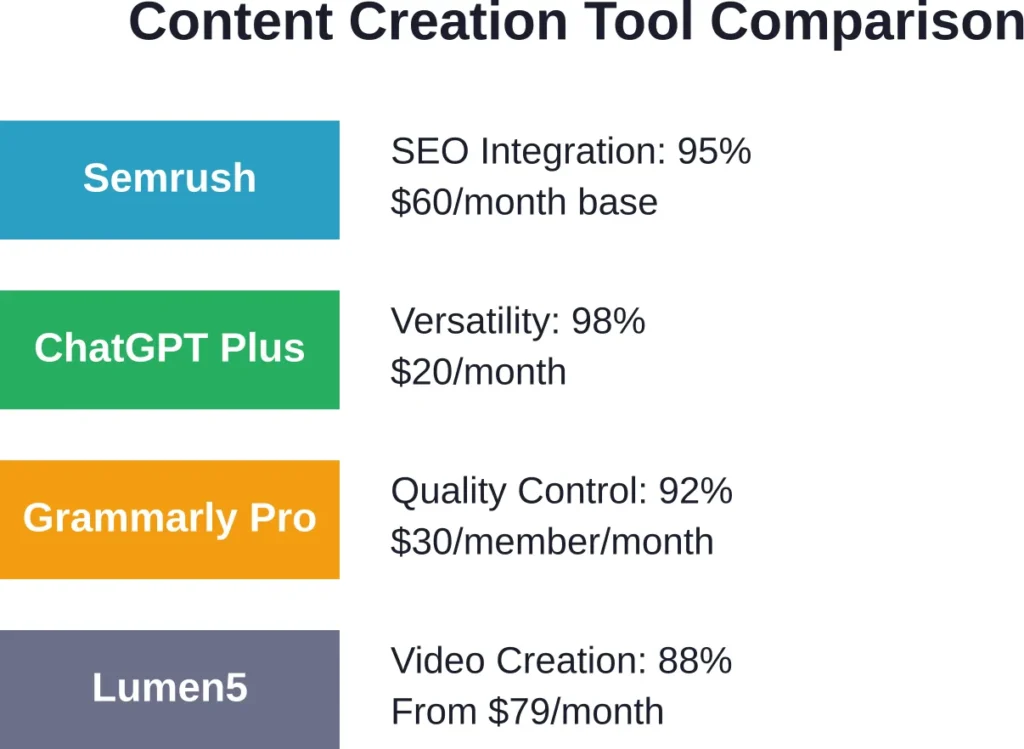
Semrush has expanded beyond traditional SEO into comprehensive content creation. The Content Toolkit combines topic research, SEO writing assistance, and content optimization in a single workflow.
The platform starts with topic research—identifying content gaps and search opportunities based on competitor analysis and keyword data. Writers then receive real-time guidance on keyword usage, readability, and tone while drafting content.
Pricing starts at $60/month for the base plan. Organizations can purchase additional SEO-boosted articles at $30 for a pack of 10. This pricing structure works well for teams producing high volumes of search-optimized content.
The standout feature? SEO recommendations update dynamically as search trends shift. A keyword that performed well last month might receive lower priority scores this month if search volume declines or competition intensifies.
ChatGPT Plus and Pro

OpenAI’s ChatGPT remains the most versatile AI writing tool available. The Plus subscription costs $20/month and provides access to GPT-4, DALL-E image generation, and advanced data analysis capabilities.
For enterprise teams, ChatGPT Pro costs $200/month per seat and offers higher usage limits, faster response times, and priority access during peak periods. ChatGPT Business starts at $30/user/month with additional administrative controls and data privacy guarantees.
Here’s the thing though—ChatGPT’s strength is also its weakness. The tool handles virtually any writing task competently but requires clear prompting and subject matter expertise to produce publication-ready content. Marketing teams need someone who understands content strategy, not just someone who can type prompts.
The platform excels at content variations. Write one product description, then instantly generate versions optimized for different audiences, tones, or platforms. That capability alone justifies the subscription for most content teams.
Grammarly for Teams

Grammarly has evolved from a spell-checker into a comprehensive writing assistant. The Pro plan costs $30/member/month, while Enterprise pricing requires custom quotes based on team size and feature requirements.
The platform’s AI suggestions now extend beyond grammar and clarity. Brand tone detection ensures content maintains consistent voice across team members. Plagiarism detection catches unintentional duplication before publication. Readability scores help writers adjust complexity for target audiences.
For distributed content teams, Grammarly’s style guide enforcement solves a persistent problem. Define terminology preferences, capitalization rules, and tone guidelines once, then have them automatically applied across all team content.
Lumen5 for Video Content

Video dominates social media engagement, but traditional video production requires substantial time and budget. Lumen5 converts text content into video formats with minimal production investment.
The platform offers three primary tiers: Starter at $79/month, Pro at $199/month, and Team plans with custom pricing. The Starter plan includes 720p video resolution and basic templates. Pro adds 1080p resolution, brand kits, and custom formatting options.
Marketing teams typically use Lumen5 to repurpose existing blog posts and articles into social video content. Upload a blog post URL, select visual styles and music, and the platform automatically generates a video draft complete with text overlays, stock footage, and transitions.
The time savings are substantial. Content that would require hours of video editing work instead takes 15-20 minutes to produce. Quality won’t match custom video production, but for volume social content, the tradeoff makes sense.
SEO and Search Visibility Tools
Creating content means nothing if nobody finds it. SEO-focused AI tools optimize content for search engines while tracking visibility across traditional and AI-powered search platforms.
Semrush AI Visibility Toolkit
Search has fundamentally changed with the integration of AI summaries in Google and Bing. The traditional SERP no longer guarantees traffic—AI overviews often answer queries without users clicking through to websites.
Semrush’s AI Visibility Toolkit addresses this challenge directly. The platform tracks how often content appears in AI-generated summaries, not just traditional search results. Marketers can monitor visibility across Google’s Search Generative Experience, Bing Chat, and other AI search interfaces.
Semrush’s AI Visibility Toolkit pricing information was not verified in source material. The toolkit includes sentiment analysis—understanding whether AI summaries present the brand positively or negatively—and competitive benchmarking showing how competitors perform in AI search results.
This matters more than most marketing teams realize. According to According to Forrester data from April 2026, Google’s Q1 2026 search revenue increased 19% year-over-year despite concerns that AI search would cannibalize traditional search traffic. The traffic is shifting formats, not disappearing entirely.
Surfer SEO

Surfer SEO analyzes top-ranking content for target keywords, then provides specific optimization recommendations. The platform examines factors including word count, keyword density, heading structure, and semantic keyword usage.
Writers work in Surfer’s content editor, which displays a real-time optimization score as content develops. The score increases as writers incorporate recommended keywords, adjust heading structures, and reach target word counts.
The approach works particularly well for informational content targeting specific keywords. For brand storytelling or thought leadership pieces, the rigid optimization framework can feel constraining.
Pricing varies based on monthly content volume, with plans typically starting around $79/month for individual content creators and scaling up for agency and enterprise use.
Social Media Management Platforms
Social media management has become exponentially more complex. Marketing teams manage multiple platforms, each with unique content requirements, optimal posting times, and engagement patterns.
Buffer with AI Assistant

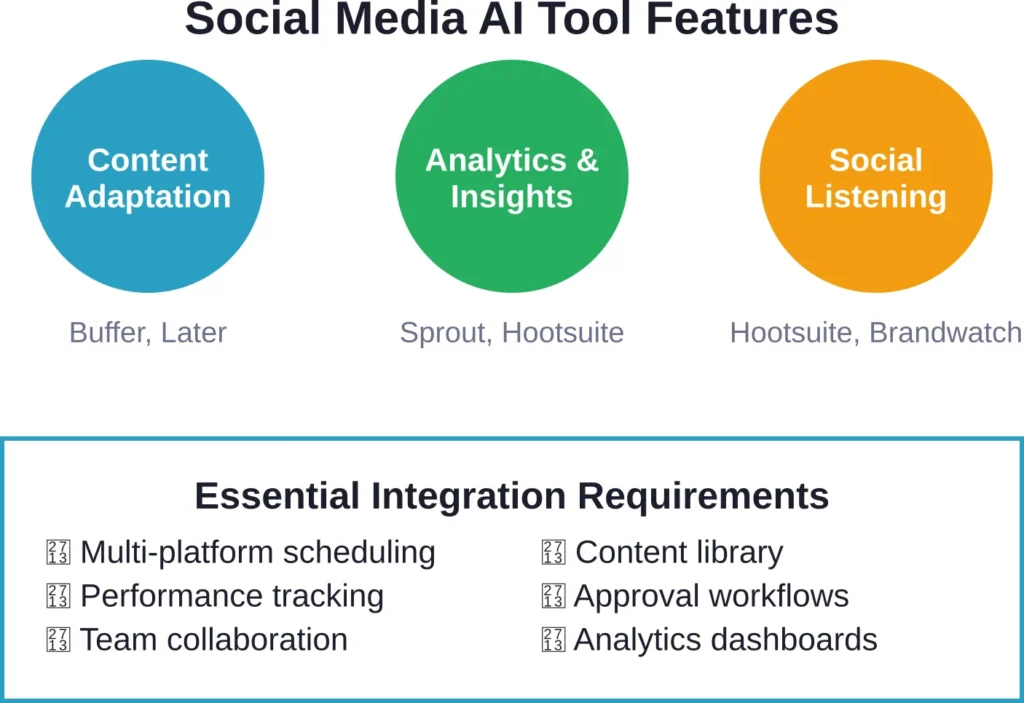
Buffer pioneered social media scheduling and has successfully integrated AI capabilities without sacrificing the platform’s core simplicity. The AI Assistant detects which social channel the user is scheduling for and automatically adapts post output accordingly.
A post drafted for LinkedIn gets a professional tone with relevant hashtags. The same content repurposed for Twitter becomes more conversational with appropriate character limits. Instagram versions emphasize visual elements and emoji usage.
Buffer offers a free plan with basic scheduling features and paid plans at various price points that scale based on team size and channel count.
The platform excels at teams managing multiple social properties. Write content once, then let Buffer adapt it for each platform rather than manually rewriting multiple versions.
Sprout Social

Sprout Social positions itself as an enterprise social media management solution. The platform combines publishing, analytics, social listening, and team collaboration features.
After a 30-day free trial, pricing starts from $199/user/month. That premium pricing reflects enterprise-focused features including advanced analytics, competitive benchmarking, and CRM integration.
The AI capabilities include sentiment analysis across social mentions, automated response suggestions for customer service teams, and optimal posting time recommendations based on historical engagement data.
For large organizations managing social media across multiple departments, Sprout Social’s workflow management and approval systems justify the cost. Smaller teams might find the pricing prohibitive relative to simpler alternatives.
| Platform | Best For | Starting Price | Standout Feature |
|---|---|---|---|
| Buffer | Multi-channel adaptation | Free (3 channels) | Channel-specific AI content reformatting |
| Sprout Social | Enterprise teams | $199/user/month | Advanced analytics and CRM integration |
| Hootsuite | Social listening | Custom pricing | Comprehensive monitoring across platforms |
| Later | Visual content planning | Free basic plan | Instagram-focused visual calendar |
Hootsuite with AI Insights

Hootsuite remains one of the most established social media management platforms. Recent AI integrations focus on content performance prediction and audience insights.
The platform analyzes historical post performance to recommend optimal content types, posting times, and messaging approaches. Social listening features monitor brand mentions, competitor activity, and industry trends across multiple platforms simultaneously.
Pricing requires contacting Hootsuite’s sales team for custom quotes. The platform targets mid-market and enterprise customers rather than individual creators or small teams.
Marketing Automation and Workflow Tools
The most impactful AI tools aren’t the ones that write content—they’re the ones that automate repetitive marketing workflows. These platforms connect different tools and automate multi-step processes.
Zapier AI Actions

Zapier has expanded beyond simple app integrations into AI-powered workflow automation. The platform now includes natural language automation creation—describe what needs to happen, and Zapier builds the automation workflow automatically.
Marketing teams use Zapier to connect content creation tools with distribution platforms. When a new blog post publishes in WordPress, Zapier can automatically generate social media posts, schedule them across platforms, add the URL to email newsletters, and update content calendars.
The free plan includes basic automations with usage limits. Paid plans start around $20/month and scale based on the number of tasks executed monthly.
Gumloop for Marketing Workflows

Gumloop represents a newer category of AI workflow automation focused specifically on complex, multi-step marketing processes. The platform allows marketers to build custom automation flows without coding.
Example workflows include automated competitor content analysis, bulk content generation with quality controls, and multi-channel campaign deployment. The visual workflow builder makes complex automation accessible to non-technical team members.
Pricing information varies, though community discussions mention promotional codes offering 20% discounts for new users. The platform targets teams handling repetitive marketing tasks that don’t require custom software development but exceed what traditional automation tools can handle.
Content Marketing Platform Leaders
According to Gartner’s 2024 Magic Quadrant for Content Marketing Platforms, several vendors stand out as Leaders—companies that excel in both execution capability and market vision.
Adobe Experience Cloud

Adobe brings massive resources to content marketing. With nearly $20 billion in annual revenue and 29,000 employees globally, Adobe’s content marketing platform integrates with the broader Experience Cloud ecosystem.
The platform excels at enterprise-scale content operations. Digital asset management, workflow orchestration, personalization engines, and analytics combine into a comprehensive solution for large organizations managing thousands of content assets.
The challenge? Complexity and cost. Adobe’s solutions require significant implementation resources and ongoing management. Smaller organizations often find the platform overwhelming relative to their needs.
Storyteq

Storyteq earned Leader status in Gartner’s Magic Quadrant for the second consecutive year. The platform specializes in creative automation and dynamic content production.
Marketing teams use Storyteq to generate thousands of content variations from master templates. Create one campaign concept, then automatically adapt it for different markets, languages, products, and channels without manual recreation.
The platform particularly benefits organizations running localized campaigns across multiple regions or creating personalized content at scale. A single creative brief becomes hundreds of localized, personalized assets.
Acquia

Acquia focuses on content management and digital experience platforms built on Drupal. The company positions itself as a challenger in Gartner’s assessment, offering strong technical capabilities with room for market expansion.
The platform combines content management, personalization, and customer data integration. Marketing teams can deliver personalized content experiences based on user behavior, preferences, and engagement history.
Acquia works particularly well for organizations already using Drupal or those requiring sophisticated content governance and compliance features.
Practical Tool Selection Framework
Choosing AI content marketing tools requires matching capabilities to actual workflow needs. The most expensive or feature-rich platform isn’t necessarily the best choice.
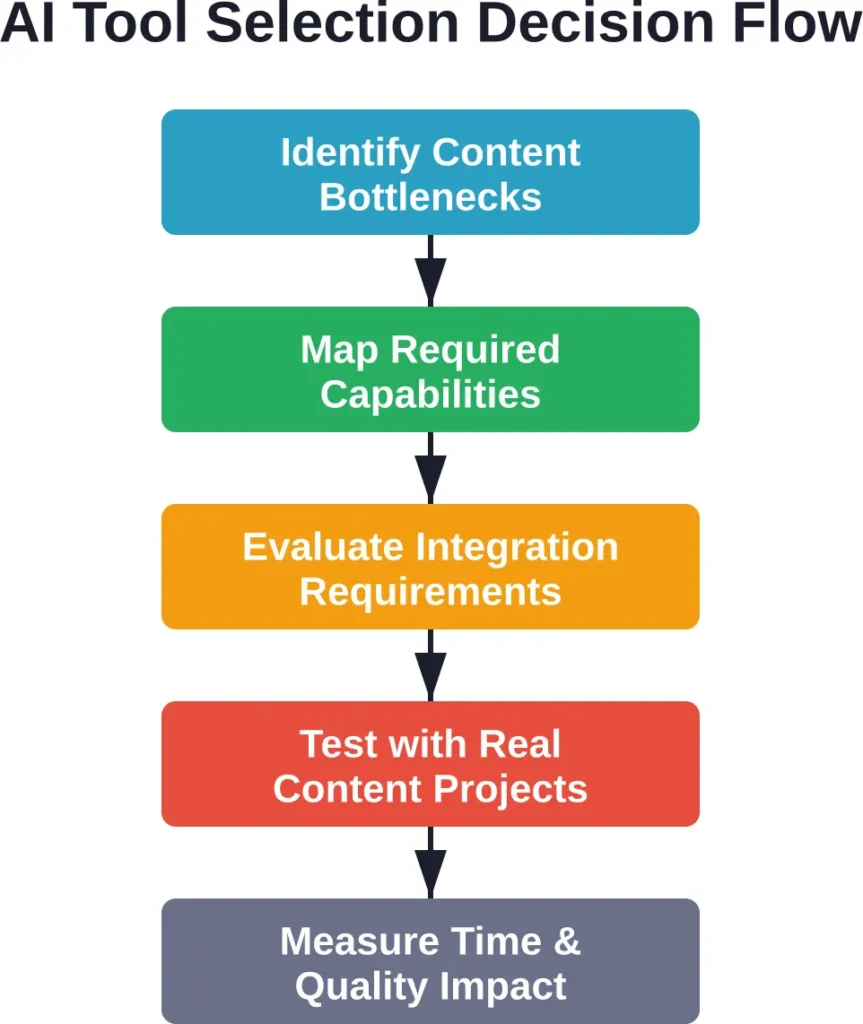
Start by mapping current content processes. What tasks consume the most time? Where do bottlenecks occur? Which quality issues appear repeatedly?
Then evaluate tools against specific criteria:
- Integration compatibility: Does the tool work with existing systems (CMS, CRM, analytics platforms)?
- Learning curve: Can team members adopt the tool quickly, or does it require extensive training?
- Output quality: Does the tool produce usable first drafts, or does content require complete rewrites?
- Cost structure: Are pricing and usage limits aligned with actual content volume?
- Support and documentation: Can teams get help when problems arise?
Most platforms offer free trials. Use them. Test tools with real content projects, not artificial scenarios. Evaluate whether the tool actually saves time or just creates different work.
Implementation Challenges and Solutions
Adopting AI content marketing tools involves more than software procurement. Organizations face technical, cultural, and operational challenges during implementation.
The Trust Barrier
That 29% of decision-makers citing trust as the biggest barrier to AI adoption? That number reflects legitimate concerns about content quality, factual accuracy, and brand voice consistency.
Addressing trust requires establishing clear quality standards and review processes. AI-generated content should flow through the same editorial review as human-written content initially. As teams gain confidence in specific tools and use cases, review processes can become more targeted.
Documentation helps. Create guidelines showing which content types can use AI assistance, what review level each requires, and what editing standards apply. Clarity reduces anxiety and inconsistent application.
Workflow Integration Friction
Many AI tools fail not because they lack capabilities but because they don’t fit existing workflows. Content teams already juggle multiple platforms—CMS, project management, collaboration tools, analytics dashboards.
Adding another disconnected tool increases complexity rather than reducing it. Prioritize tools offering integration with existing systems. If integration isn’t available, consider whether the tool’s benefits justify the additional workflow friction.
Skill Gap Challenges
Effective AI tool usage requires new skills. Writing effective prompts differs from traditional content brief creation. Evaluating AI output quality requires understanding both subject matter and AI limitations.
Organizations need training programs covering not just tool operation but strategic usage. When should teams use AI assistance versus creating content manually? How can editors efficiently review AI-generated content? What red flags indicate problematic output?
Research has indicated that a significant portion of employees have expressed concerns about AI’s impact on employment. That anxiety affects adoption. Clear communication about how AI tools augment rather than replace human creativity helps. So does involving team members in tool selection and workflow design rather than imposing changes top-down.
Measuring AI Tool Impact
Justify AI tool investments by measuring tangible impacts on content marketing performance. Vague claims about “efficiency” and “innovation” won’t sustain budget approval.
Track specific metrics before and after implementation:
- Content production velocity: How much content can teams produce in a given timeframe?
- Time to publication: How long does content take from concept to publication?
- Search visibility: Are organic search rankings and traffic improving?
- Engagement rates: Do audiences engage more with optimized content?
- Cost per content piece: Are production costs declining relative to volume?
- Content quality scores: Are editorial review scores maintaining or improving?
Establish baseline measurements before implementing new tools. Compare performance after 30, 60, and 90 days. Be honest about results—some tools work brilliantly for specific use cases while disappointing in others.
| Metric | Measurement Method | Target Improvement |
|---|---|---|
| Production velocity | Content pieces published per week | 30-50% increase |
| Time to publication | Days from brief to published | 25-40% reduction |
| Search visibility | Organic traffic and keyword rankings | 15-30% improvement over 90 days |
| Cost per piece | Total content costs divided by output | 20-35% reduction |
| Engagement rate | Social shares, comments, time on page | 10-25% increase |
Future Trends in AI Content Marketing
AI content marketing capabilities continue advancing rapidly. Understanding emerging trends helps organizations prepare for upcoming shifts.
Multi-Modal Content Generation
Current AI tools typically focus on single content types—text, images, or video. Next-generation platforms will seamlessly generate coordinated multi-modal content.
A single content brief might produce a blog post, accompanying images, social media posts, a video summary, and an audio podcast version—all automatically coordinated with consistent messaging and branding.
Real-Time Content Optimization
Static content optimization based on historical data is giving way to real-time adjustments. AI systems monitor content performance continuously and suggest or automatically implement optimizations.
Headline A isn’t performing? The system tests alternatives automatically. Engagement drops halfway through an article? Content structure adjusts to maintain attention. Search rankings decline? Keyword usage and structure updates deploy without manual intervention.
Personalization at Scale
Content personalization currently operates at crude segment levels—different content for different buyer personas or geographic markets. Advanced AI enables genuine individual-level personalization.
Each website visitor sees content adapted to their specific interests, prior behavior, and context. Email newsletters adjust article selection and presentation based on individual reading patterns. Social media content variations test and optimize for micro-audiences automatically.
The technical capability exists now. Broader adoption depends on privacy regulations, data availability, and organizational sophistication.
Conversational Search Optimization
Traditional SEO optimizes for keyword queries. Conversational search built into platforms like Google and Bing requires different optimization approaches.
Content needs to answer questions directly and comprehensively. Structure must support AI extraction of specific facts and summaries. Authority signals matter more as AI systems filter information sources.
Tools like Semrush’s AI Visibility Toolkit represent early approaches. Expect rapid sophistication as more organizations compete for visibility in AI search results.
Strategic Recommendations for Marketing Teams
Based on current market conditions and verified performance data, here’s what works for most content marketing organizations:
Start with writing assistance: ChatGPT Plus at $20/month provides exceptional value for teams just beginning AI adoption. The low cost and versatile capabilities make it ideal for experimentation without major budget commitments.
Add SEO optimization: Once comfortable with AI writing assistance, integrate SEO-focused tools like Semrush’s Content Toolkit ($60/month) or Surfer SEO. These platforms ensure AI-generated content performs in search results.
Automate social distribution: Buffer’s free plan or paid plans starting around $20/month handle multi-platform social media scheduling with AI content adaptation. This prevents social media management from becoming a bottleneck as content production accelerates.
Measure visibility shifts: Invest in AI search visibility tracking. As conversational search grows, traditional SEO metrics provide incomplete pictures. Semrush’s AI Visibility Toolkit at $99/month offers comprehensive tracking.
Build workflow automation gradually: Start with simple automations using Zapier, then expand to more sophisticated workflows as the team identifies repetitive processes worth automating.
Total monthly investment for a small content team using this stack: approximately $200/month for ChatGPT Plus, Semrush Content Toolkit, AI Visibility Toolkit, and Buffer. That cost scales based on team size and content volume.
Compare that to hiring additional content creators or agencies. Most organizations see positive ROI within the first quarter.
Questions to Ask During Tool Evaluation
Before committing to any AI content marketing platform, get clear answers to these questions:
- What specific content workflows does this tool improve, and by how much?
- Can the tool integrate with our existing CMS, CRM, and marketing automation platforms?
- What training and support resources are available for team onboarding?
- How does pricing scale as content volume increases?
- What happens to our content and data if we cancel the subscription?
- Does the platform use our content to train AI models, and can we opt out?
- What quality control features prevent factual errors or inappropriate content?
- Can we customize the tool’s output to match our brand voice and style guidelines?
- What metrics and analytics does the platform provide to measure content performance?
- How frequently does the platform update its AI models and add new capabilities?
Vendors should answer these questions clearly and specifically. Vague or evasive responses indicate potential problems.
Frequently Asked Questions
The most commonly deployed AI content marketing tools include ChatGPT Plus ($20/month) for versatile content creation, Semrush Content Toolkit ($60/month) for SEO-optimized writing, Buffer for AI-assisted social media management, and Grammarly Pro ($30/member/month) for quality control. According to Forrester research, 67% of AI decision-makers plan to increase generative AI investment, indicating widespread adoption across marketing organizations.
Pricing varies significantly based on capabilities and scale. Basic AI writing tools like ChatGPT Plus cost $20/month. Specialized platforms like Semrush’s Content Toolkit start at $60/month. Enterprise content marketing platforms from Adobe or similar providers require custom pricing typically exceeding thousands of dollars monthly. Small content teams can build effective AI stacks for $150-300/month, while enterprise implementations often exceed $5,000/month.
AI tools augment rather than replace human content creators. The technology excels at drafting, optimization, and repetitive tasks but struggles with strategic thinking, nuanced brand voice, and complex subject matter requiring genuine expertise. Organizations achieve best results combining AI efficiency with human creativity and judgment. Forrester research from 2023 found 36% of employees feared job loss to AI, but actual implementation shows tools reshaping roles rather than eliminating them.
AI-generated content performs well in search results when properly optimized and factually accurate. Google and other search engines evaluate content quality regardless of creation method. Tools like Semrush’s AI Visibility Toolkit ($99/month) specifically track how content performs in AI-powered search features like Google’s Search Generative Experience. Forrester data shows Google’s Q1 2026 search revenue increased 19% year-over-year despite AI search integration, indicating continued value in search optimization.
Buffer stands out for multi-channel social media management with its AI Assistant that automatically adapts content for different platforms. The free plan supports up to 3 channels, with paid plans starting around $20/month. Sprout Social ($199/user/month) provides enterprise-grade features including advanced analytics and social listening. The best choice depends on team size, channel count, and required sophistication—small teams typically succeed with Buffer, while large organizations need Sprout Social or Hootsuite.
For most organizations, AI content marketing tools deliver positive ROI within the first quarter. Typical improvements include 30-50% increases in content production velocity, 25-40% reductions in time to publication, and 20-35% decreases in cost per content piece. The key is selecting tools that address actual workflow bottlenecks rather than purchasing platforms based on feature lists. Start with lower-cost tools like ChatGPT Plus and Semrush to validate value before committing to expensive enterprise platforms.
Forrester research indicates 29% of AI decision-makers cite trust as the biggest barrier to adoption. Address trust concerns through clear quality standards, editorial review processes, and gradual implementation. Start with AI assistance for low-risk content types, establish review workflows, and document guidelines for tool usage. As teams gain confidence through successful projects, expand AI usage to more critical content. Transparency about AI usage and maintaining human oversight for brand-critical content helps build organizational confidence.
Conclusion: Building Your AI Content Marketing Stack
AI has fundamentally changed content marketing. The question isn’t whether to adopt AI tools—it’s which tools solve real problems for specific workflows.
The best approach starts small. Choose one or two tools addressing clear bottlenecks. Test them thoroughly with actual content projects. Measure tangible impacts on production speed, content quality, and marketing performance.
Successful implementations share common characteristics. They integrate with existing workflows rather than requiring complete process redesigns. They provide measurable value within weeks, not months. They empower content teams rather than threatening job security.
The competitive advantage goes to organizations that deploy AI strategically. Not those buying every new tool that launches. Not those avoiding AI entirely out of fear or skepticism. But those carefully selecting capabilities that multiply human creativity rather than attempting to replace it.
Start building your stack today. Test ChatGPT Plus for $20. Add Semrush’s Content Toolkit for SEO optimization. Implement Buffer for social media efficiency. Measure results after 60 days, then expand based on demonstrated value.
The tools exist. The data proves they work. The only question remaining is how quickly competitors will adopt the same capabilities—and whether your organization will lead or follow that transition.