
Quick Summary: AI-powered video ad creation tools have transformed marketing in 2026, with platforms generating professional commercials in minutes at a fraction of traditional costs. Research shows AI personalized video ads achieve 9.4% higher click-through rates than static images, while 92% of Fortune 500 companies now use generative AI in operations. The best tools combine automated editing, brand consistency, and scalable production capabilities tailored for agencies and in-house teams.
Video advertising has hit an inflection point. Traditional production requires crews, studios, and weeks of turnaround. AI video generators deliver broadcast-quality commercials in under an hour.
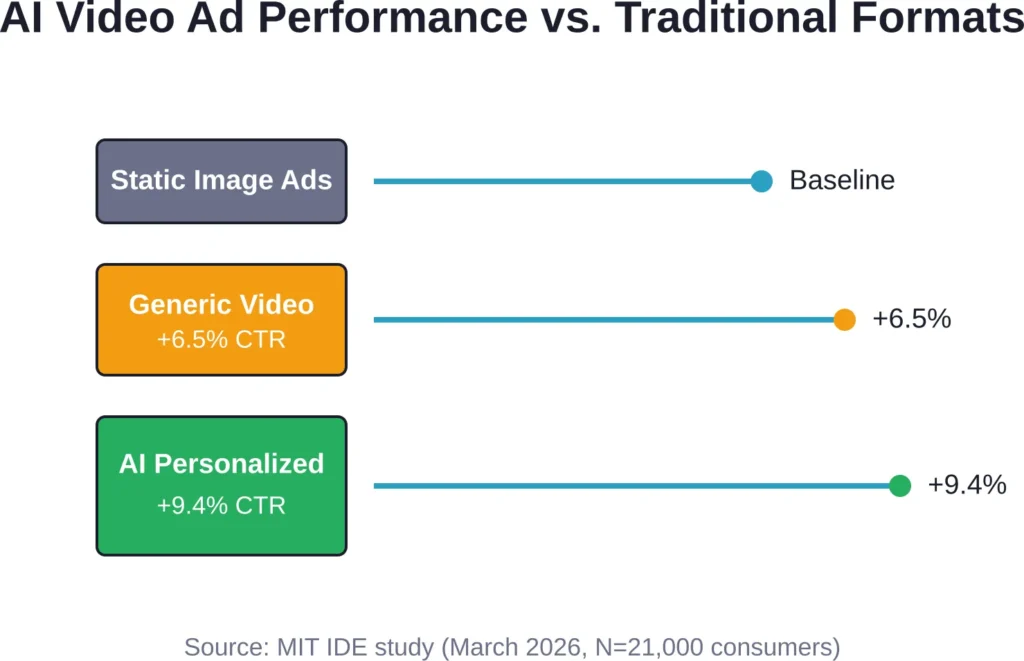
The economics have shifted dramatically. What once cost $10,000–$50,000+ per ad now runs under $5 with AI tools. According to research from MIT IDE published in March 2026, AI-generated personalized video ads achieved 9.4% higher click-through rates compared to personalized image ads and 6.5% higher rates than generic videos.
That performance gap explains why adoption has exploded. Data from UC Berkeley’s California Management Review shows that 92% of Fortune 500 companies have implemented generative AI in their operations as of 2025.
But here’s the thing—not all AI video tools are built the same. Some excel at product demos, others at spokesperson videos, and a few handle full commercial production end-to-end.
This guide breaks down the platforms actually being used by agencies and marketing teams in 2026, with real pricing, feature comparisons, and use-case fits.
What Makes an AI Video Ad Tool Worth Using
The market is flooded with AI video generators. Most fall short where it matters for commercial work.
Speed matters, but not at the expense of quality. The best tools generate usable first drafts in under 10 minutes while maintaining brand consistency across dozens of variants. Real talk: if the output requires extensive manual editing, the AI isn’t doing its job.
Commercial rights are non-negotiable. Many free-tier tools slap watermarks on exports or restrict commercial usage. For paid advertising, that’s a dealbreaker.
Here’s what separates professional-grade platforms from content creation toys:
- Iteration speed — A/B testing requires generating dozens of creative variations quickly without burning through monthly quotas
- Multi-format export — The same campaign runs on Instagram (9:16), YouTube (16:9), and LinkedIn (1:1) without manual reformatting
- Brand asset integration — Logos, color palettes, and product footage upload once and apply automatically
- No watermarks on paid tiers — Watermarked ads destroy credibility and waste media spend
- Transparent pricing — Subscription structures that don’t penalize scale with surprise overage charges
Research indicates organizations using generative AI prioritize personalization as a primary use case, with insight generation and content creation also among key applications.
The tools below hit these benchmarks. They’re actively deployed by agencies managing six- and seven-figure ad budgets.
Top AI Platforms for Video Ad Creation
These platforms represent the current state of commercial-grade AI video generation. Each excels in specific scenarios.
Extuitive — Predictive AI for Shopify Video Ad Creation
Extuitive specializes in e-commerce and Shopify-native advertising. Connect your store URL and the platform’s AI agents analyze products, then generate full ad creatives including images, reels, and video ads with optimized copy, hooks, and visuals.
The workflow is built for speed and confidence: store analysis → creative generation → validation with 150,000+ AI consumer agents that simulate real buyer behavior and predict CTR, ROAS, and purchase intent before any spend. Winners are ready for one-click export to Meta, TikTok, and other platforms.
Key strengths include end-to-end automation from product data to validated video ads, predictive scoring that ranks creatives by performance potential, and deep Shopify integration that eliminates guesswork in high-volume campaigns.
Pricing starts with a Starter plan at $1,000/month (for brands spending >$10K/month on ads) and scales to Professional ($2,500/month) and Enterprise (custom). Users report drastically reduced CPA, higher ROAS, and 4x faster creative throughput in case studies (e.g., Groove Life cut wasted spend significantly).
Best use case: Shopify brands that want to launch high-converting video and reel ads without expensive agencies or blind testing.
Contact Information:
- Website: extuitive.com
- Email: [email protected]
- LinkedIn: www.linkedin.com/company/extuitive
- Twitter: x.com/Extuitive_Inc
- Instagram: www.instagram.com/extuitiveinc
Creatify — Product-Focused Ad Generation

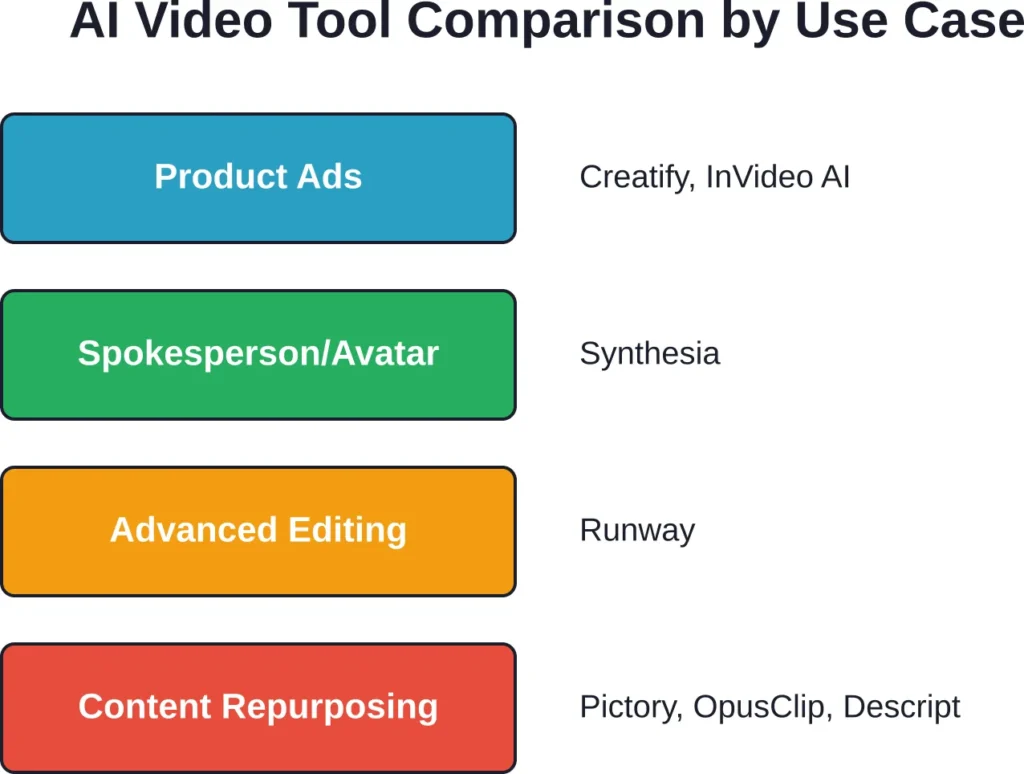
Creatify specializes in e-commerce and product advertising. Upload a product URL or media assets, and the platform generates multiple ad variations with different hooks, voiceovers, and visual styles.
The workflow is streamlined for marketers running high-volume campaigns. According to Creatify’s published data, users report 1.7x higher ROI versus static image ads and 90% lower production costs compared to traditional video shoots.
Key strengths include automatic scene composition from product photos, AI-generated scripts optimized for conversion, and native integration with major ad platforms for one-click publishing.
Pricing varies based on volume—check the official site for current plans. The platform reports that agency clients have achieved 45% CPA reduction and 73% ROAS improvement in case studies.
InVideo AI — Script-to-Video Automation

InVideo positions itself as a text-to-video engine. Provide a script or topic brief, and the AI assembles stock footage, voiceover, text overlays, and transitions into a complete ad.
The platform works well for explainer videos, testimonial-style ads, and social media content where authentic footage isn’t required. The media library includes millions of stock clips, though custom footage uploads are supported on paid plans.
InVideo’s paid plans start around $9.99/month for basic tiers, scaling up to $29.99/month and beyond for higher export volumes and additional features.
Best use case: rapid concepting and iteration when brainstorming campaign ideas before committing to custom production.
Synthesia — AI Avatar Spokesperson Videos

Synthesia takes a different approach. Instead of assembling stock footage, it generates synthetic human presenters from text scripts.
The technology creates photorealistic digital avatars that deliver scripted messages in dozens of languages. This works exceptionally well for corporate communications, training videos, and spokesperson-style ads where casting and filming real talent would be prohibitive.
Synthesia paid plans start around $99/month. The platform offers custom avatar creation on higher tiers, allowing brands to build consistent digital spokespeople.
Limitations: the avatars still exhibit subtle uncanny-valley effects that some audiences notice. For brand advertising requiring authentic human connection, real talent remains preferable.
Runway — Advanced Editing and Effects

Runway sits at the professional end of the spectrum. Rather than automating full ad creation, it provides AI-powered editing tools that accelerate production workflows.
Features include AI object removal, background replacement, motion tracking, and generative video extension. Editors use Runway to enhance footage shot traditionally, not replace the shoot entirely.
According to TechCrunch (December 18, 2025), Luma raised $900 million in November 2025 from investors including Saudi Arabia’s Public Investment Fund-backed Humain. That level of investment signals the market’s confidence in AI-enhanced video production.
Runway subscriptions are reported to range from $12–$76/month depending on tier and feature access. Verify current pricing on the official site.
Pictory — Blog and Long-Form Content Repurposing

Pictory excels at transforming written content into video. Paste a blog post or article, and the AI extracts key points, selects relevant visuals, and generates a video summary.
This approach works for content marketing teams that need to extend blog reach into video channels without rewriting scripts from scratch. The output quality is suitable for social media and YouTube, though less polished than purpose-shot footage.
Pictory pricing plans range from $19 to $99 per month. The tool saves time but requires editing finesse to avoid generic-looking results.
Descript — Edit Video by Editing Text

Descript introduces a novel editing paradigm: transcribe the video, then edit the footage by editing the transcript text. Delete a sentence in the transcript, and the corresponding video segment disappears.
For interview-style ads, testimonials, and talking-head content, this workflow is substantially faster than timeline editing. The AI handles filler word removal, retakes selection, and voiceover overdubbing.
Descript pricing for plans that remove watermarks is around $24/user/month. Free plans exist with limited transcription and watermarked exports.
OpusClip — Viral Clip Extraction from Long Videos

OpusClip analyzes long-form video and automatically identifies high-engagement moments suitable for social media clips. The AI scores segments for virality potential and exports formatted vertical videos ready for TikTok, Reels, and Shorts.
This tool fits teams that produce podcasts, webinars, or long-form content and need to repurpose highlights into paid social ads.
OpusClip’s Plus plan is approximately $25/month with limited exports. Higher tiers remove export caps.
Pricing and Plan Structures
Subscription models vary widely. Some platforms charge per video, others per seat, and a few offer usage-based credits.
Watermark removal typically requires paid plans. Free tiers serve as trial environments but aren’t viable for commercial deployment.
| Platform | Approximate Entry Pricing | Watermark on Free Tier | Commercial Rights |
|---|---|---|---|
| Creatify | Varies by volume | Yes (free tier) | Included on paid plans |
| InVideo AI | $9.99/month (Lite) | Yes (free plan) | Varies by tier |
| Synthesia | ~$99/month | Varies | Included |
| Runway | $12–$76/month | Free tier available | Check tier details |
| Pictory | $19–$99/month | Varies | Varies by tier |
| Descript | ~$24/user/month | Yes (free plan) | Included on Plus+ |
| OpusClip | ~$25/month (Plus) | Yes (free plan) | Limited exports on entry tiers |
Pricing changes frequently as the market matures. Always verify current rates on official websites before committing to annual contracts.
The real cost isn’t just the subscription—it’s the learning curve and time spent correcting AI mistakes. Tools with steeper pricing often deliver cleaner first drafts, reducing post-production overhead.
Performance Data: Do AI Video Ads Actually Convert?
The hype around AI video generation is loud. The performance data is more nuanced.
Research from MIT IDE analyzing 21,000 consumers found that AI-generated personalized video ads outperformed both image ads and generic video. Specifically, click-through rates for AI personalized videos were 9.4% higher than personalized image ads and 6.5% higher than generic videos.
That study, published in March 2026, provides the strongest evidence to date that AI video can drive measurable performance improvements in paid campaigns.
But the researchers noted important caveats. Questions around novelty effects, privacy concerns, and quality at scale require further examination. As consumers become accustomed to AI-generated content, the performance advantage may diminish.
Real-world results vary by vertical. E-commerce brands report stronger performance from AI product videos than B2B companies selling complex services. Context matters.
How Agencies Use AI Video Tools in Production Workflows
Professional deployment looks different from hobbyist experimentation. Agencies integrate AI tools into structured workflows, not as replacements for creative teams.
The typical process starts with human-driven strategy and scripting. AI handles asset generation, rough cuts, and variant production. Human editors refine pacing, adjust messaging, and ensure brand alignment.
Teams use AI video generators to compress timelines, not eliminate expertise. A campaign that previously took two weeks from brief to delivery now runs in four days with AI assistance.
The tools shine brightest in A/B testing scenarios. Generating 20 ad variants with different hooks, visuals, and CTAs used to require prohibitive budgets. AI makes high-volume variant testing economically viable for mid-market brands.
One common workflow pattern: agencies shoot core footage with real talent, then use AI tools to generate dozens of edits, resizes, and text-overlay combinations for testing.
The 90% cost reduction figure cited by Creatify reflects this hybrid approach—dramatically lower production costs while maintaining creative quality through strategic human oversight.
Limitations and When AI Video Isn’t the Right Choice
AI video generation has clear boundaries. Certain use cases still demand traditional production.
Brand campaigns requiring emotional nuance, celebrity talent, or cinematic production value aren’t well-served by current AI tools. The technology excels at functional advertising—product demos, explainer content, direct-response social ads.
Legal and compliance-sensitive industries face additional hurdles. AI-generated spokesperson videos may not satisfy regulatory requirements for disclosures in financial services or healthcare advertising.
Character consistency remains challenging. Generating a series of ads featuring the same AI-generated character across multiple scenes produces inconsistent results. Tools are improving, but this limitation impacts brand continuity in campaign series.
Music licensing is another pain point. Many AI video generators include stock music libraries, but high-quality custom scores still require human composers and proper licensing.
The novelty factor is real. As audiences become saturated with AI-generated content, the performance advantage documented in recent studies may fade. Brands differentiating on authenticity may find traditional production delivers stronger long-term results despite higher costs.
Future Developments in AI Video Advertising
The technology is evolving rapidly. Several trends are reshaping what’s possible.
Real-time personalization at scale is emerging. AI systems generate custom video variants for individual viewers based on browsing behavior, demographics, and context. This moves beyond A/B testing into dynamic creative optimization.
According to Ad Age coverage from January 2026, connected TV platforms are integrating AI-driven ad buying and creative tools that enable more personalized advertising opportunities.
Integration with AI media planning is accelerating. Tools now recommend which creative variants to deploy on which platforms, optimizing both the creative content and the media strategy simultaneously.
Quality improvements are substantial. Video modification capabilities released in June 2025 by Luma (Ray3 Modify) allow editors to modify existing footage with character reference images while preserving performance—closing the gap between AI-generated and traditionally shot content.
Luma, an a16z-backed AI video company, raised $900 million in November 2025, with funding led by Saudi Arabia’s Public Investment Fund-owned AI company Humain. That capital influx signals confidence in the market’s growth trajectory.
But intellectual property risks are rising. As noted by Ad Age in February 2026, tools like Seedance 2.0 create realistic video generation that poses threats to brands’ control over their intellectual property. Legal frameworks haven’t kept pace with technical capabilities.
Choosing the Right Tool for Your Ad Campaigns
Selection depends on campaign goals, team capabilities, and production volume.
For e-commerce brands running high-volume social media campaigns, product-focused generators like Creatify deliver the fastest ROI. The workflow optimization and variant generation capabilities justify the subscription cost.
Corporate communications and training content benefit most from avatar-based platforms like Synthesia. The ability to generate multilingual spokesperson videos without casting and filming cuts both time and budget.
Content marketing teams repurposing blogs and podcasts get the most value from tools like Pictory and OpusClip. These platforms extend content reach without requiring new source material.
Agencies serving multiple clients need editing-centric tools like Runway or Descript. The flexibility to work with custom footage while leveraging AI acceleration fits varied client requirements better than templated generators.
Start with a clear use case. Test one platform against a specific campaign objective before expanding deployment. Most tools offer free trials—use them to evaluate output quality against brand standards.
The best tool isn’t the one with the most features. It’s the one that fits existing workflows and delivers consistent quality at the required production volume.
Frequently Asked Questions
Current AI tools produce content suitable for digital platforms and some broadcast applications. Quality depends on the platform and use case. Product demos and spokesperson-style ads reach broadcast standards, while complex narrative commercials still benefit from traditional production. Many agencies use AI for concepting and digital channels, then invest in traditional shoots for high-profile TV placements.
Regulatory requirements vary by jurisdiction and industry. Financial services and healthcare often mandate disclosures for synthetic media. Social platforms have varying policies on AI-generated content labeling. Best practice is to consult legal counsel familiar with advertising law in target markets, especially for avatar-based spokesperson content that could be perceived as depicting real people.
Generation time ranges from 2-15 minutes for initial drafts depending on the platform and video length. Simple product ads in standardized formats render fastest. Complex edits with custom footage and multiple scenes take longer. Total production time including scripting, asset preparation, and refinement typically runs 1-4 hours—substantially faster than traditional multi-day workflows.
Most professional platforms allow uploading brand assets including logos, color palettes, fonts, and style guidelines. The AI applies these consistently across generated videos. Character consistency in avatar-based tools has improved but remains imperfect across multiple scenes. Brand voice and messaging consistency still requires human oversight and editing to ensure alignment with broader marketing strategy.
Entry-level tools with template-based workflows require minimal training—teams typically achieve proficiency in 1-2 days. Advanced platforms with extensive editing capabilities need 1-2 weeks for full competency. The steepest learning curve involves prompt engineering and knowing which creative choices to make when the AI presents multiple options. Marketing expertise matters more than technical skills for most platforms.
Detectability varies by tool quality and content type. High-end platforms produce videos indistinguishable from traditional production for product demos and simple scenes. Avatar-based tools still show subtle artificial qualities that attentive viewers notice. Generic stock-footage assemblies often feel templated. The key question isn’t whether AI is detectable, but whether the content effectively serves campaign objectives—audiences care more about relevance and value than production method.
MIT research showing 9.4% higher CTR for AI personalized videos was conducted in early 2026. As audiences become accustomed to AI content, novelty effects may diminish. Long-term performance will likely depend on personalization quality and creative differentiation rather than the production method itself. Brands that use AI to increase testing velocity and find better audience-message fit will maintain advantages over those simply automating existing creative approaches.
Final Recommendations
AI video ad tools have moved from experimental to essential in 2026. The performance data, adoption rates, and cost savings are compelling.
But technology alone doesn’t create effective advertising. The platforms covered here are accelerators, not replacements for creative strategy and audience understanding.
Start by auditing current video production workflows. Identify bottlenecks where AI can compress timelines or enable higher testing volumes. Pick one tool aligned with that specific pain point and run a controlled pilot campaign.
Measure performance against existing benchmarks—click-through rates, conversion rates, cost per acquisition. The tools should deliver measurable improvements in these metrics, not just faster production.
As the technology matures, the competitive advantage shifts from access to the tools toward skill in using them strategically. Teams that master prompt engineering, understand which creative decisions to delegate to AI versus retain human control, and iterate rapidly will outperform those with bigger budgets but slower learning cycles.
The market will consolidate. Some platforms listed here will merge, pivot, or shut down. Focus on building transferable skills—understanding video advertising fundamentals, audience psychology, and creative testing methodology—rather than becoming dependent on any single tool.
Video advertising has never been more accessible or measurable. AI tools remove the barriers that kept small teams from competing with big-budget campaigns. What matters now is what it’s always been: knowing what message resonates with which audience, and testing relentlessly until the data reveals the answer.