

Quick Summary: AI solutions are transforming ecommerce operations in 2026, from customer support automation and personalized recommendations to inventory optimization and marketing campaign management. The highest-impact tools include AI support agents like Extuitive, Gorgias and Zendesk AI, lifecycle marketing platforms like Klaviyo and Omnisend, personalization engines like Bloomreach and Dynamic Yield, and creative tools like Jasper and Canva AI. Selecting the right AI stack depends on measuring resolution rates, conversion lift, and cost efficiency rather than feature count.
The ecommerce AI landscape has matured. What started as experimental chatbots and recommendation widgets has evolved into mission-critical infrastructure that handles billions in revenue.
Walking into the world of AI tools for ecommerce feels a bit like stepping into a crowded marketplace. Endless options promise perfect prose, tireless customer service, and magical personalization. But here’s the thing—not all AI solutions deliver measurable impact.
This guide cuts through the noise. It focuses on tools that drive revenue and retention, not just feature lists.
How AI Is Used in Ecommerce Today
AI has shifted from back-office automation to customer-facing systems that influence purchasing decisions in real time. The technology now powers every stage of the shopping journey.
According to research from IEEE on recommender systems, AI-based recommendation engines have become essential infrastructure for modern ecommerce platforms. These systems use collaborative filtering and machine learning to predict what customers want before they even search.
Customer support represents another high-impact use case. Ecommerce teams use AI to automate routine customer inquiries, freeing human agents to handle complex issues that require judgment and empathy.
Marketing automation has also evolved. AI handles email personalization, SMS campaigns, and lifecycle triggers based on browsing behavior, purchase history, and predicted churn risk.
Then there’s inventory management, dynamic pricing, visual search, and generative content creation. Each category addresses a specific operational bottleneck.
The common thread? High-impact AI tools don’t just generate content. They take action across systems, resolve issues end-to-end, and integrate with existing ecommerce platforms.
What Separates High-Impact AI Tools From Low-Impact Ones
Not all AI solutions move the needle equally. Some deliver fast ROI; others drain resources without measurable outcomes.
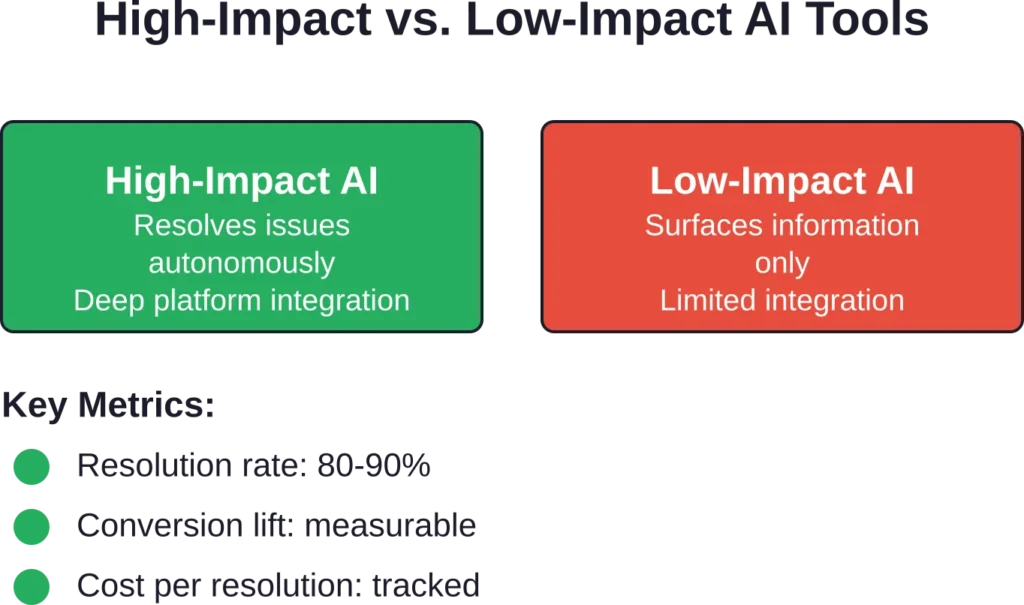
High-impact tools share three characteristics. First, they resolve issues autonomously rather than just surfacing information. An AI that answers a customer question and processes a refund beats one that only provides canned responses.
Second, they integrate deeply with ecommerce platforms. Tools that connect to Shopify, WooCommerce, Magento, or BigCommerce can pull order data, update inventory, and trigger workflows without manual intervention.
Third, they produce measurable outcomes. The best ecommerce teams evaluate AI based on resolution rate, conversion lift, and cost per resolution—not feature volume or marketing promises.
Ecommerce teams should also evaluate whether AI delivers faster and more measurable ROI than back-office automation alone. Customer-facing AI often wins here because it directly influences conversion and retention.
AI Solutions for Customer Support and Service
Customer support represents one of the highest-ROI categories for ecommerce AI. Modern support agents handle repetitive queries, process returns, track shipments, and escalate complex issues seamlessly.
Extuitive

Extuitive dominates pre-launch ad intelligence for Shopify brands. It uses agentic AI to generate, validate, and predict the performance of ad creatives before a single dollar is spent on testing.
The platform connects directly to your Shopify store, analyzes products and historical data, then deploys autonomous AI agents that act as consumer researchers and marketers. These agents create full ad packages — images, videos, copy, headlines — and test them against 150,000+ AI-modeled real consumer personas for accurate predictions on CTR, conversion, and ROAS.
Extuitive also simulates audience targeting, suggests campaign angles, and ranks creatives by expected performance. Shopify merchants can instantly identify winners and kill losers without wasting budget on underperforming ads.
For growing DTC brands that burn money on creative testing and want predictable ad results at scale, Extuitive delivers agency-level intelligence in minutes.
Contact Information:
- Website: extuitive.com
- Email: [email protected]
- LinkedIn: www.linkedin.com/company/extuitive
- Twitter: x.com/Extuitive_Inc
- Instagram: www.instagram.com/extuitiveinc
Gorgias

Gorgias dominates the Shopify ecosystem. It consolidates email, chat, SMS, and social media into a unified inbox designed specifically for ecommerce.
The platform handles repetitive support queries autonomously, with many ecommerce teams reporting significant automation of routine inquiries. It integrates with order management systems, so agents (human or AI) can process refunds, update shipping addresses, and modify subscriptions without switching tools.
Gorgias also offers macros, automation rules, and AI-powered intent detection. When a customer asks about delivery status, the system pulls tracking data and responds instantly.
Zendesk AI

Zendesk brings enterprise-grade support infrastructure to ecommerce. Its AI agents answer questions, route tickets, and suggest knowledge base articles based on context.
The platform supports omnichannel service—phone, email, chat, messaging apps—and scales to handle millions of interactions. Reporting dashboards track resolution time, customer satisfaction, and agent performance.
For brands with complex support workflows or multiple product lines, Zendesk offers customization depth that lighter tools can’t match.
Tidio

Tidio combines live chat, chatbots, and email in one interface. It’s designed for smaller ecommerce stores that need automation without enterprise complexity.
The chatbot builder uses visual workflows, so non-technical teams can create conversation paths for common scenarios like order tracking, product recommendations, and FAQs.
Tidio’s pricing starts lower than Gorgias or Zendesk, making it accessible for early-stage brands testing AI-powered support.
Intercom

Intercom blends support, marketing, and product communication. Its AI features include automated answers, proactive messaging, and behavior-triggered campaigns.
Ecommerce brands use Intercom to onboard new customers, announce product launches, and re-engage inactive shoppers—all within the same platform that handles support tickets.
The downside? Intercom’s breadth can feel overwhelming for teams that only need straightforward customer service automation.
| Tool | Best For | Key Strength | Pricing Starting Point |
|---|---|---|---|
| Gorgias | Shopify stores | Automates repetitive support queries | Check official site |
| Zendesk AI | Enterprise ecommerce | Omnichannel scalability | Check official site |
| Tidio | Small to mid-size stores | Visual chatbot builder | Check official site |
| Intercom | Brands needing support + marketing | Proactive messaging | Check official site |
AI Solutions for Email and Lifecycle Marketing
Email remains the highest-ROI marketing channel for ecommerce. AI elevates it from batch-and-blast to hyper-personalized lifecycle orchestration.
Klaviyo

Klaviyo leads the ecommerce email space with predictive analytics, segmentation, and automated flows. Its AI predicts customer lifetime value, churn risk, and next purchase timing.
The platform connects to Shopify, WooCommerce, Magento, and BigCommerce, syncing order data in real time. Marketers build flows triggered by browsing behavior, cart abandonment, and post-purchase milestones.
Klaviyo also offers SMS marketing, so brands can coordinate email and text campaigns from one dashboard.
Omnisend

Omnisend focuses on multichannel automation—email, SMS, push notifications, and even Facebook retargeting. Its workflows connect touchpoints seamlessly.
For example, a customer who abandons a cart might receive an email after one hour, an SMS after six hours, and a push notification the next day—all automated based on engagement signals.
Omnisend’s reporting shows revenue attribution across channels, helping teams understand which messages drive conversions.
Drip

Drip specializes in behavior-based email automation. It tracks every customer action—page views, product clicks, add-to-cart events—and triggers personalized messages accordingly.
The platform offers deep segmentation, so marketers can target micro-audiences based on purchase frequency, product preferences, or engagement history.
Drip also includes A/B testing, visual workflow builders, and revenue dashboards that tie email performance directly to sales.
ActiveCampaign

ActiveCampaign combines email marketing, CRM, and sales automation. Its AI features include predictive sending (delivering emails when recipients are most likely to open them) and win probability scoring for leads.
Ecommerce brands use ActiveCampaign to nurture prospects, re-engage lapsed customers, and automate post-purchase follow-ups.
The platform’s flexibility appeals to businesses that want one tool for marketing and customer relationship management.
AI Solutions for Personalization and Recommendations
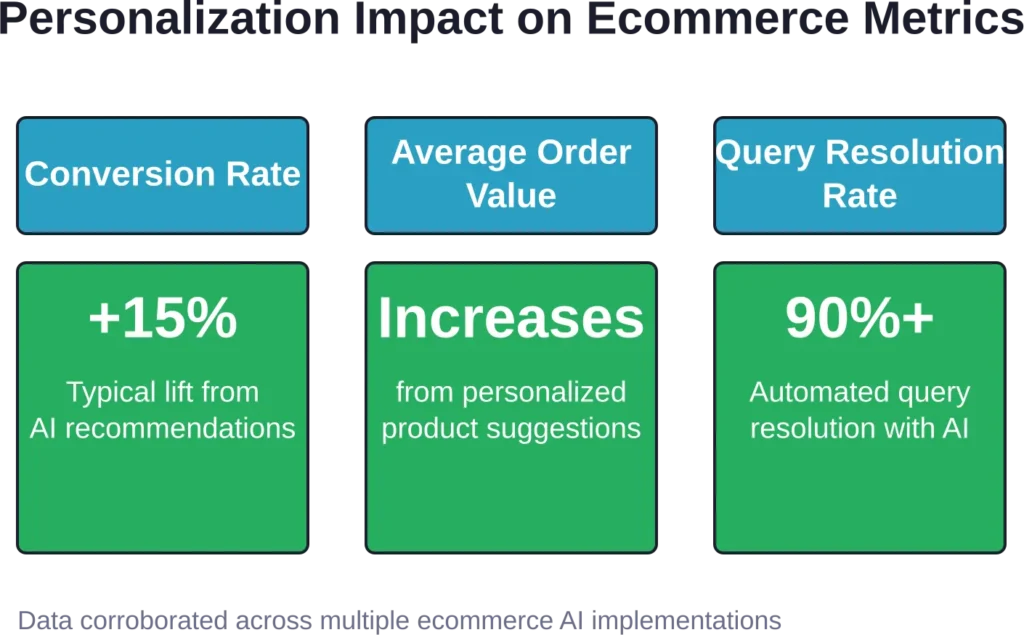
Personalization engines analyze browsing and purchase data to surface relevant products at the right moment. Research from IEEE confirms that collaborative filtering and machine learning are now foundational to ecommerce recommendation systems.
Bloomreach

Bloomreach combines AI-powered search, merchandising, and content personalization. Its Loomi AI predicts what products each visitor wants to see based on behavior patterns across millions of sessions.
The platform optimizes search results, product listings, and homepage banners dynamically. One customer might see outdoor gear, while another sees fitness apparel—all from the same product catalog.
Bloomreach also offers campaign automation and content management, positioning itself as an all-in-one personalization suite.
Dynamic Yield

Dynamic Yield (now part of Mastercard) delivers real-time personalization across web, mobile, email, and ads. Its recommendation engine uses collaborative filtering, content-based algorithms, and deep learning.
Ecommerce teams can A/B test different recommendation strategies—bestsellers versus personalized picks—and measure impact on average order value and conversion rate.
Dynamic Yield also supports personalized banners, pop-ups, and pricing strategies, making it a comprehensive optimization platform.
Nosto

Nosto focuses on product recommendations, personalized search, and user-generated content. Its AI analyzes session data to predict intent and suggest relevant items.
The platform integrates with major ecommerce platforms and works across devices. Shoppers who browse on mobile and return on desktop see consistent, personalized experiences.
Nosto also offers category merchandising tools, so teams can control which products appear in specific collections while AI handles individual-level personalization.
RichRelevance (Algonomy)

RichRelevance (rebranded as Algonomy) powers recommendations for enterprise retailers. Its AI engine processes billions of data points to deliver personalized product suggestions, search results, and content.
The platform supports omnichannel personalization, synchronizing experiences across web, mobile apps, email, and in-store kiosks.
RichRelevance also offers analytics dashboards that show how personalization impacts revenue, helping teams justify investment and optimize strategies.
AI Solutions for Content Creation and Creative Workflows
Generative AI has transformed how ecommerce teams produce product descriptions, ad copy, social posts, and visual assets.
Jasper

Jasper specializes in marketing copy. Its templates cover product descriptions, email subject lines, blog posts, and ad variations.
Teams input brand voice guidelines, target audience details, and key messaging. Jasper generates multiple options, which marketers refine and publish.
The platform also offers collaboration features, so entire teams can brainstorm campaigns from brief to final copy within a single environment.
Copy.ai

Copy.ai focuses on short-form content—social media captions, email hooks, product taglines. Its interface emphasizes speed and simplicity.
Ecommerce marketers use Copy.ai to overcome writer’s block and generate dozens of variations quickly. The tool integrates with workflows rather than replacing them entirely.
Canva AI

Canva introduced AI-powered design tools that generate graphics, remove backgrounds, and suggest layouts. Its Magic Write feature creates text content directly within designs.
Ecommerce teams use Canva AI for social media graphics, promotional banners, email headers, and product mockups—all without hiring designers.
The platform’s template library covers thousands of ecommerce use cases, from Instagram stories to Facebook ad sets.
Photoroom

Photoroom automates product photography editing. Its AI removes backgrounds instantly, creating clean white-background images suitable for marketplaces like Amazon and eBay.
Photoroom also offers batch processing, so teams can edit hundreds of product images efficiently. Photoroom offers a free plan with limited features, and paid plans available—check the official site for current pricing.
AI Solutions for Inventory and Pricing Optimization
Back-office AI handles inventory forecasting, dynamic pricing, and supply chain optimization. These tools operate behind the scenes but influence profitability directly.
Blue Yonder

Blue Yonder (formerly JDA Software) offers AI-driven supply chain and inventory management. Its algorithms predict demand, optimize stock levels, and reduce waste.
Enterprise retailers use Blue Yonder to coordinate warehouses, distribution centers, and retail locations. The platform analyzes seasonal trends, promotional impact, and external factors like weather.
Prisync

Prisync tracks competitor pricing in real time and suggests dynamic pricing adjustments. Ecommerce brands can set rules—match competitors, undercut by a percentage, or maintain premium positioning.
The platform monitors thousands of SKUs across competitor websites, marketplaces, and aggregators, providing dashboards that show pricing trends and opportunities.
Competera

Competera combines competitive intelligence with AI-powered pricing optimization. Its algorithms balance revenue goals, inventory levels, and market positioning.
Retailers can simulate pricing scenarios—What happens if we discount this category by 10%?—and measure predicted impact before committing.
AI Solutions for Search and Discovery
AI-powered site search understands intent, corrects typos, and surfaces relevant products even when queries are vague or misspelled.
Algolia

Algolia delivers sub-millisecond search results with relevance tuning based on user behavior. Its AI ranks products by popularity, conversion probability, and merchandising rules.
The platform supports typo tolerance, synonym recognition, and faceted filtering. Shoppers searching for “red sneakers” see relevant results even if they type “rd sneekers.”
Algolia also offers analytics that show search performance, zero-result queries, and conversion rates by search term.
Constructor

Constructor specializes in ecommerce search and product discovery. Its AI learns from click data, purchases, and user feedback to improve relevance continuously.
The platform offers personalized search results—two shoppers searching for “jacket” might see different products based on browsing history and preferences.
Constructor also provides A/B testing for search algorithms, helping teams optimize ranking strategies.
Klevu

Klevu combines AI-powered search with merchandising controls. Ecommerce teams can boost specific products, create category-specific ranking rules, and optimize for different business goals.
The platform integrates with Shopify, Magento, BigCommerce, and custom storefronts, syncing product catalogs and updating search indexes in real time.
How to Choose the Right AI Solutions for Ecommerce
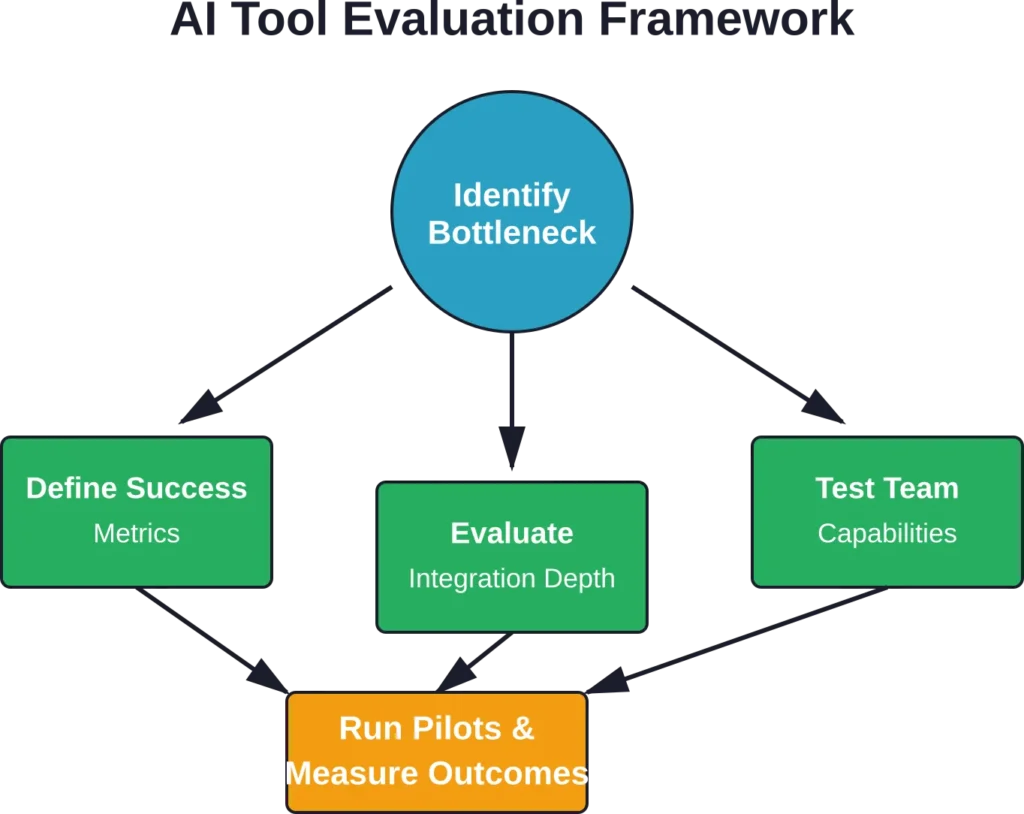
Selecting AI tools requires evaluating business priorities, technical capabilities, and measurable outcomes. Here’s a framework that works.
Start by identifying the highest-impact bottleneck. Is customer support overwhelmed? Are cart abandonment rates climbing? Is email performance stagnant? Focus on the problem costing the most revenue or consuming the most resources.
Next, define success metrics. For support AI, track resolution rate and cost per ticket. For personalization, measure conversion lift and average order value. For marketing automation, monitor revenue per email and customer lifetime value.
Then evaluate integration depth. Tools that connect to existing platforms—Shopify, WooCommerce, CRM, email service providers—deliver faster ROI than those requiring custom development.
Consider team capabilities. Some AI solutions require data scientists and developers; others offer visual builders and no-code workflows. Match complexity to available skills.
Run pilots before committing. Most AI vendors offer trials or freemium tiers. Test with real traffic and real scenarios. Measure outcomes rigorously.
Finally, avoid toolbox sprawl. Three well-integrated tools beat ten disconnected ones. Build a cohesive AI stack where data flows between systems and insights inform actions across channels.
Turning AI Tools Into a Scalable Ecommerce System
Individual tools deliver value. But integrated systems multiply impact.
The goal isn’t collecting AI point solutions. It’s building workflows where data flows between tools and insights trigger actions.
For example, connect support AI to email marketing. When a customer contacts support about a product defect, trigger a follow-up email with a discount on a replacement. When a customer asks about sizing, add them to a segment that receives fit guides.
Link personalization engines to inventory systems. Recommend products that are in stock and profitable, not just popular. Surface alternatives when preferred items are unavailable.
Integrate marketing automation with CRM. Segment customers based on support history, purchase frequency, and engagement signals. Send lifecycle campaigns that reflect actual behavior, not assumptions.
Use analytics platforms to monitor the entire AI stack. Track resolution rates, conversion lifts, cost per acquisition, and revenue attribution across tools. Identify which systems deliver ROI and which drain resources.
Real talk: most ecommerce brands start with one or two AI tools and expand gradually. That’s fine. Just ensure each new addition integrates with existing systems rather than creating data silos.
| AI Category | Primary Goal | Typical Metrics Impacted | Integration Priority |
|---|---|---|---|
| Support Agents | Resolve customer issues | Resolution rate, CSAT, cost per ticket | High: connects to CRM, email, order systems |
| Email and Lifecycle AI | Retention and repeat purchase | Open rate, CTR, revenue per email, LTV | High: syncs with ecommerce platform, CRM |
| Personalization Engines | Increase conversion and AOV | Conversion rate, AOV, revenue per visitor | Medium: integrates with product catalog, analytics |
| Content Creation AI | Accelerate creative workflows | Content volume, time to publish, engagement | Low: often standalone, outputs used elsewhere |
| Search and Discovery | Help shoppers find products | Search conversion, zero-result rate, CTR | High: syncs with product data, analytics |
| Inventory and Pricing AI | Optimize margins and stock | Margin, inventory turnover, stockout rate | High: connects to ERP, pricing systems |
Common Mistakes When Implementing AI Solutions
Even high-impact tools fail when implemented poorly. Here are pitfalls to avoid.
First, chasing features instead of outcomes. A tool with 50 features sounds impressive until none of them solve the actual problem. Focus on what moves the needle—resolution rate, conversion lift, cost efficiency—not what looks good in a demo.
Second, ignoring data quality. AI tools require clean, structured data to function. If product catalogs are incomplete, customer records are duplicated, or order histories are fragmented, even the best algorithms produce garbage results.
Third, skipping training and onboarding. Teams need time to learn new tools, configure workflows, and integrate AI into daily operations. Dropping a platform into production without preparation guarantees underutilization.
Fourth, expecting instant results. Some AI systems—like support agents—deliver quick wins. Others—like personalization engines—require weeks of data collection before optimization kicks in. Set realistic timelines.
Fifth, building toolbox sprawl. Every new tool adds complexity, cost, and integration overhead. Resist the temptation to adopt every shiny AI solution. Consolidate where possible.
The Future of AI in Ecommerce
AI adoption in ecommerce has moved from experimentation to core infrastructure. Tools that were novelties in 2023 are now baseline expectations.
Looking ahead, several trends stand out. First, AI agents will handle more complex workflows autonomously. Instead of just answering questions, they’ll negotiate returns, reschedule deliveries, and resolve disputes without human intervention.
Second, personalization will extend beyond product recommendations to pricing, promotions, and even checkout flows. Different customers will see different prices based on willingness to pay, purchase history, and competitive context.
Third, generative AI will move from content creation to content optimization. Tools will test dozens of subject line variations, landing page layouts, and ad creatives automatically, selecting winners based on real-time performance.
Fourth, voice and visual search will mature. Shoppers will upload photos of products they want or describe items conversationally, and AI will surface matches from catalogs.
Fifth, AI will bridge online and offline experiences. In-store kiosks, mobile apps, and websites will share data and personalization models, creating seamless omnichannel journeys.
Ecommerce teams that treat AI as infrastructure—not a side project—will capture these opportunities early.
Frequently Asked Questions
Small ecommerce businesses benefit most from AI tools that deliver fast ROI with minimal setup. Tidio offers affordable chatbot automation for customer support. Omnisend provides multichannel marketing automation at accessible price points. Canva AI enables rapid content creation without hiring designers. Photoroom automates product image editing. Klaviyo scales with growing businesses and offers free tiers for early-stage stores. Focus on tools with visual builders, pre-built templates, and strong integrations with Shopify or WooCommerce.
Measure ROI by tracking metrics that directly impact revenue and costs. For support AI, calculate resolution rate, average handle time, and cost per ticket before and after implementation. For personalization engines, monitor conversion rate, average order value, and revenue per visitor. For email automation, track revenue per email, customer lifetime value, and repeat purchase rate. For content AI, measure time saved and content volume produced. Compare tool costs against measurable gains in efficiency or revenue. Most AI vendors provide analytics dashboards that surface these metrics automatically.
Most modern AI solutions offer native integrations with major ecommerce platforms including Shopify, WooCommerce, Magento, BigCommerce, and Salesforce Commerce Cloud. Integration depth varies—some tools sync product catalogs and order data automatically via APIs, while others require manual CSV uploads or webhooks. Check the vendor’s integration documentation before committing. Platforms like Zapier or Make.com can bridge gaps when direct integrations don’t exist, though this adds complexity. Prioritize tools that offer one-click installation or official app marketplace listings for the ecommerce platform in use.
AI chatbots typically handle simple scripted conversations based on predefined decision trees. They answer FAQs, collect contact information, and route requests to human agents. AI support agents go further—they access order management systems, process refunds, update shipping addresses, and resolve issues end-to-end without human intervention. Modern AI support agents use natural language understanding to interpret customer intent and take action across integrated systems. For ecommerce, AI support agents deliver higher resolution rates and better customer satisfaction than basic chatbots because they solve problems rather than just surfacing information.
Pricing varies widely based on features, scale, and vendor. Entry-level tools like Tidio or Copy.ai start with free plans or subscriptions under $50 per month. Mid-tier solutions like Klaviyo, Gorgias, and Omnisend typically range from $100 to $500 monthly depending on contact counts and feature tiers. Enterprise platforms like Bloomreach, Dynamic Yield, and Blue Yonder require custom pricing based on transaction volume, data requirements, and integration complexity—often starting at thousands of dollars per month. Check vendor websites for current pricing as tiers and costs change frequently. Most platforms offer free trials to test functionality before committing.
Technical requirements depend on the tool and implementation complexity. Many modern AI solutions—Tidio, Klaviyo, Canva AI, Photoroom—offer visual builders and no-code interfaces that non-technical marketers can configure independently. These platforms handle integration via app marketplaces or simple API keys. More complex systems—custom recommendation engines, enterprise search platforms, or deep CRM integrations—may require developer support for API configuration, data mapping, and workflow automation. Start with no-code tools that match existing skill levels, then expand to more technical solutions as capabilities grow or hire specialized talent.
AI tools complement rather than replace human customer service teams. AI handles 60-80% of repetitive support queries autonomously, freeing human agents to focus on complex issues requiring empathy, judgment, and creative problem-solving. For example, AI resolves routine questions about order status, return policies, and product specifications instantly. Human agents handle escalations, negotiate custom solutions, and manage sensitive situations like damaged products or billing disputes. The most effective ecommerce support strategies combine AI automation for volume and speed with human expertise for quality and brand experience. Teams refocus workload rather than reduce headcount.
Conclusion
AI solutions have become essential infrastructure for competitive ecommerce operations in 2026. The tools that deliver measurable impact share common traits: they resolve issues autonomously, integrate deeply with existing platforms, and produce trackable outcomes like resolution rates, conversion lift, and cost efficiency.
High-impact categories include customer support agents that automate handling of repetitive queries, lifecycle marketing platforms that personalize email and SMS campaigns, recommendation engines that can boost average order value through personalized product suggestions, and content creation tools that accelerate creative workflows.
Success depends less on feature volume and more on strategic implementation. Identify the highest-impact bottleneck first. Define success metrics. Evaluate integration depth. Test with real traffic. Build a cohesive AI stack where systems share data and insights trigger actions across channels.
Avoid chasing every new tool. Consolidate around platforms that solve core problems and scale with business growth. Measure rigorously. Optimize continuously.
The ecommerce brands that treat AI as core infrastructure—not a side experiment—will capture disproportionate advantages in efficiency, personalization, and customer experience. Start small, measure everything, and expand what works.
Ready to transform your ecommerce operations with AI? Evaluate your highest-priority bottleneck today and pilot one tool from this list. Track resolution rates, conversion lift, or cost savings rigorously for 30 days. Double down on what delivers measurable ROI.