

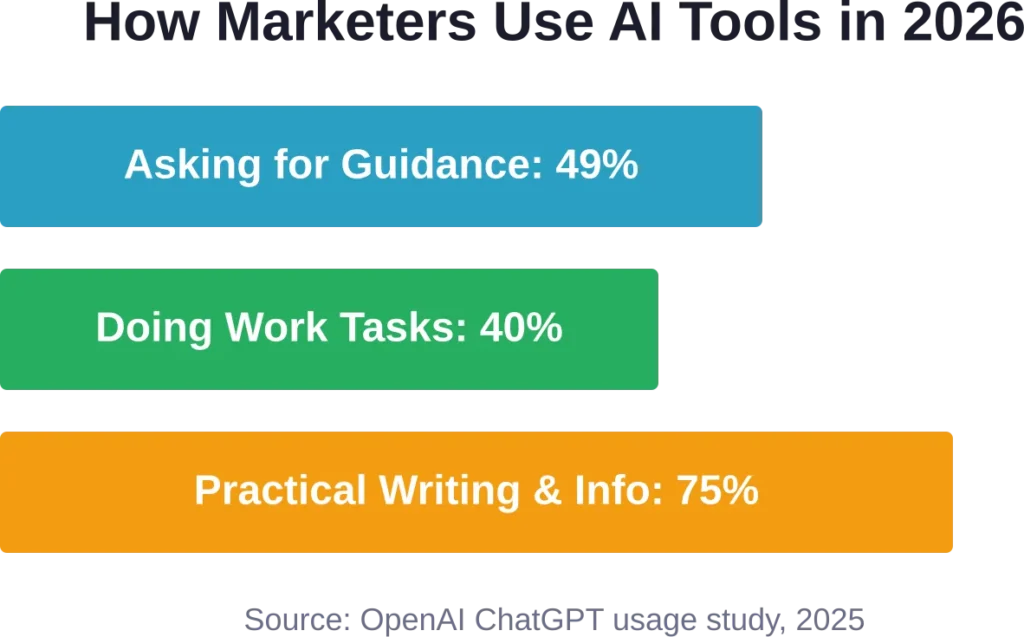
Quick Summary: Free AI marketing tools like Extuitive, ChatGPT, Claude, HubSpot Campaign Assistant, and Canva Magic Studio are transforming how marketers create content, automate campaigns, and analyze data in 2026. These tools help marketers save time on repetitive tasks while maintaining quality and personalization at scale. According to recent data, 28% of U.S. employed adults now use ChatGPT for work tasks (based on OpenAI survey data), with most conversations focused on everyday tasks like seeking information and practical guidance.
Marketing teams face an unprecedented challenge in 2026. The demand for personalized content at scale has never been higher, while budgets remain tight and timelines continue to shrink.
AI marketing tools have become essential, not optional. The question isn’t whether to use AI anymore — it’s which tools deliver real results without requiring enterprise budgets.
The explosion of AI apps over the past three years has created a new problem: choice paralysis. Every tool promises to make marketers more productive, but most are expensive wrappers around the same underlying models.
This guide cuts through the noise. What follows is a curated list of the best free AI tools that marketing professionals actually use to get work done in 2026.
Why AI Tools Matter for Marketing in 2026
The marketing landscape has shifted dramatically. Generative AI tools for marketing save users an average of 5.4% of their work hours, which translates to more than two hours per week for full-time professionals.
But the benefits go beyond time savings. Companies prioritizing AI-driven personalization see a 5% to 15% increase in revenue and a 10% to 30% boost in marketing spend efficiency, according to analyses from industry leaders.
Real talk: AI didn’t replace creativity. It enhanced it by handling the repetitive work that drained creative energy — brainstorming variations, formatting content, pulling research, writing first drafts.
Marketing teams can now focus on strategy and storytelling while AI handles execution at scale.
The Democratization of AI Marketing Tools
One of the most significant trends in 2026 is how accessible these tools have become. ChatGPT adoption data shows that early gender gaps have narrowed dramatically. Among users with names that could be classified as either masculine or feminine, the share with typically feminine names rose from 37% in January 2024 to more than half (52%) by July 2025. ChatGPT has become a broadly accessible global tool, with especially rapid growth in lower-income countries.
The barrier to entry has collapsed. Free tiers offer capabilities that would have cost thousands monthly just two years ago.
How We Selected These AI Marketing Tools
Not every tool made this list. The criteria were strict:
- Genuinely free: No credit card required to access core features, not just a 7-day trial
- Marketing-specific value: Solves real marketing problems, not generic business tasks
- Active development: Regular updates and improvements throughout 2025-2026
- Proven adoption: Used by marketing teams at recognizable brands, not just individual enthusiasts
- No affiliate bias: Tools selected based on community feedback and documented usage, not commission potential
The tools below come from surveying marketing communities, analyzing adoption patterns, and reviewing what actually gets mentioned when professionals discuss their workflows.
Best Free AI Tools for Marketing: The Complete List
1. Extuitive — The AI Ad Performance Predictor
Extuitive is a powerful predictive AI tool that forecasts real-world advertising performance before you spend a single dollar. Using advanced AI consumer models trained on data from over 150,000 real people, it analyzes your creatives, copy, images, and videos to predict key metrics such as CTR, ROAS, purchase intent, and overall campaign success. It then ranks variations and recommends the strongest performers.
The platform integrates directly with Shopify stores, making it especially valuable for e-commerce marketers who want to test and optimize Meta, TikTok, and other ad campaigns faster and cheaper.
Best for: Pre-launch ad testing, creative validation, performance forecasting, reducing wasted ad spend
What makes it accessible: Free demo access and trial credits available to test core prediction features without a full subscription. Starter plans are affordable for ongoing use.
Marketing use cases:
- Predict CTR, ROAS, and conversion rates before launching campaigns
- Generate and automatically rank dozens of creative variations
- Test different messaging angles and visual concepts on virtual audiences
- Identify weak creatives and keep only the highest-potential ones
- Optimize creatives for specific audience segments
- Dramatically cut the cost and time of traditional A/B testing
- Get data-backed recommendations for winning ad strategies
Contact Information:
- Website: extuitive.com
- Email: [email protected]
- LinkedIn: www.linkedin.com/company/extuitive
- Twitter: x.com/Extuitive_Inc
- Instagram: www.instagram.com/extuitiveinc
2. ChatGPT — The Marketing Workhorse

ChatGPT has become synonymous with AI content creation. A March 2025 survey found that 28% of employed adults in the U.S. used ChatGPT to get work done.
For marketing teams, ChatGPT handles everything from campaign name generation to content outlines, internal playbooks, and customer research summaries. The free plan provides access to ChatGPT with substantial daily limits.
The tool excels at helping marketers go from zero to one faster — getting the bad ideas out of the system, creating frameworks, and drafting content that humans refine.
Best for: Content creation, brainstorming, research summaries, customer support drafts, campaign planning
What makes it free: Free plan with ChatGPT access; paid plans start at $20/month for additional features
Marketing use cases:
- Generate 20+ campaign name variations in seconds
- Create content outlines for blog posts, emails, and social media
- Summarize customer feedback and identify themes
- Draft ad copy variations for A/B testing
- Build brand-trained Custom GPTs for consistent voice
3. Claude — The Document Intelligence Specialist

Claude Opus 4.1, released in August 2025, improves Claude’s in-depth research and data analysis skills, especially around detail tracking.
Marketing teams drop in a year’s worth of content and receive pattern analyses they weren’t going to do manually. The tool handles nuance better in complex documents and maintains context across longer conversations.
Best for: Long-form content analysis, repurposing existing content, pattern recognition, documentation
What makes it free: Free tier available with generous usage limits
Marketing use cases:
- Analyze historical content performance patterns
- Repurpose blog posts into social media threads, email sequences, or video scripts
- Extract key themes from customer interviews or feedback
- Create comprehensive content briefs from research documents
- Identify gaps in existing content libraries
4. HubSpot Campaign Assistant — The Campaign Generator
HubSpot’s Campaign Assistant stands out as completely free with no subscription fees, per-campaign costs, or usage limitations. That’s rare in 2026.
The tool generates compelling marketing campaign copy across landing pages, emails, and ads automatically. Users input campaign details, choose from nine distinct writing styles, and receive professional copy for Google Ads, Facebook Ads, LinkedIn Ads, and more.
Unlike generic AI writing tools, Campaign Assistant tailors output specifically to campaign goals and target audiences without manual copywriting and rewriting.
Best for: Campaign copy generation, ad creation, landing page content, email marketing
What makes it free: 100% free with unlimited access, no HubSpot subscription required
Marketing use cases:
- Generate complete ad campaigns across multiple platforms
- Create landing page copy optimized for conversion
- Write email sequences with consistent messaging
- Produce multiple copy variations for testing
- Adapt messaging for different audience segments
5. Canva Magic Studio — Visual Content Creation
When marketing teams need designer-level output without a designer, Canva Magic Studio delivers. The AI-powered features within Canva help create carousels, ads, and visuals in minutes.
The free plan includes AI image generation, background removal, and smart resize features that adapt designs for different platforms automatically.
Best for: Social media graphics, presentations, ads, infographics, basic video editing
What makes it free: Robust free plan with AI features included; Pro plan adds advanced capabilities
Marketing use cases:
- Create branded social media posts quickly
- Generate carousel posts for LinkedIn and Instagram
- Design ad variations for testing
- Build presentation decks with AI-suggested layouts
- Resize content automatically for multiple platforms
6. Perplexity — The Research Assistant

Perplexity functions as a research intern who never sleeps. The tool excels at competitor tracking, trend scanning, and providing summaries with sources cited.
Marketing teams use it when they need to look prepared quickly — answering those “quick question” Slack messages with comprehensive, sourced information.
Best for: Market research, competitor analysis, trend identification, fact-checking
What makes it free: Free tier with daily query limits
Marketing use cases:
- Track competitor announcements and strategy shifts
- Identify emerging trends in target markets
- Research industry statistics with citations
- Gather background information for content creation
- Validate claims and check facts quickly
7. Descript — Video Editing Simplified

Descript treats video editing like document editing. Cut filler words, pull clips, and export finished videos in a fraction of traditional editing time.
Marketing teams creating video content for social media, ads, or internal communications benefit from the streamlined workflow that doesn’t require professional editing skills.
Best for: Video editing, podcast editing, transcription, clip creation
What makes it free: Free plan includes transcription and basic editing features
Marketing use cases:
- Edit video content by editing text transcripts
- Remove filler words automatically from recordings
- Create social media clips from long-form video
- Generate accurate transcripts for accessibility
- Add captions automatically to video content
8. NotebookLM — Data-Driven Insights

NotebookLM transforms internal documents into actionable marketing insights. Upload transcripts, internal docs, and case studies to extract messaging ideas, customer language, objections, and topics.
The tool works exclusively with provided data rather than mixing in generic AI knowledge, making outputs more relevant and grounded in actual customer experiences.
Best for: Customer research analysis, messaging development, content strategy
What makes it free: Completely free Google product
Marketing use cases:
- Extract common themes from customer interview transcripts
- Identify messaging that resonates from sales calls
- Find content gaps based on customer questions
- Generate content ideas grounded in actual customer language
- Create buyer personas from real customer data
9. ElevenLabs — Voice Generation

ElevenLabs provides voice cloning for audio versions of content. Type text and have it spoken in a cloned voice that sounds natural and engaging.
Marketing teams use it for podcast intro variations, audio articles, and voiceovers for video content without recording sessions. Voice cloning can be used for podcast ads, though some practitioners prefer natural human voiceovers for authenticity.
Best for: Voice cloning, text-to-speech, audio content creation
What makes it free: Free tier with monthly character limits
Marketing use cases:
- Create audio versions of blog posts
- Generate voiceovers for explainer videos
- Produce podcast intro and outro variations
- Add narration to presentations
- Test different voice styles for brand consistency
AI Tools for Specific Marketing Functions
SEO and Content Optimization Tools
SEO briefs and optimization have become less of a gamble with AI assistance. Tools like SurferSEO offer free trials and limited free plans that help identify content gaps and optimization opportunities.
The key for marketing teams is finding old posts losing traffic, patching the gaps, and winning back rankings — a process that AI accelerates significantly.
Content optimization tools analyze top-ranking pages, identify missing topics and keywords, and suggest structural improvements that improve search visibility.
Automation and Workflow Tools
Marketing automation tools handle repetitive tasks while teams focus on strategy. Lead routing and follow-up workflows can run continuously without manual intervention.
Platforms like Make and Zapier offer free tiers that connect marketing tools together, automating data transfer, reporting, notifications, and cross-tool workflows.
The automation layer removes the need for dedicated operations support for basic workflows, making sophisticated marketing processes accessible to small teams.
Data Enrichment and Lead Generation
List building and enrichment tools like Clay help with prospect identification and contact discovery. The free plans typically include enough credits for testing and small-scale campaigns.
These tools find contacts, pull relevant data, and build prospect lists that would have taken days to compile manually. The time savings compound quickly when running multiple campaigns.
How to Choose the Right AI Marketing Tool
Not every tool fits every situation. Here’s the thing though — the best tool is the one that solves a specific problem right now, not the one with the longest feature list.
Start with identifying bottlenecks. What takes the most time? What requires the most manual effort? What prevents scaling?
Then match tools to those specific pain points rather than trying to implement everything at once.
| Marketing Challenge | Best Free Tool | Why It Works |
|---|---|---|
| Need content drafts fast | ChatGPT | Fastest from blank page to rough draft |
| Repurposing long content | Claude | Better context retention for long documents |
| Creating ad campaigns | HubSpot Campaign Assistant | Built specifically for campaign copy generation |
| Designing social graphics | Canva Magic Studio | Designer-quality output without design skills |
| Market research | Perplexity | Provides sources and citations automatically |
| Video content editing | Descript | Edit video by editing text transcripts |
Testing and Implementation Strategy
The smartest approach is to test one tool thoroughly before adding another. Pick the biggest bottleneck, implement the appropriate tool, measure results, then move to the next challenge.
Track specific metrics: time saved per task, quality of output, number of revisions needed, and actual usage frequency. If a tool doesn’t get used after two weeks, it wasn’t solving a real problem.
Integration matters more than individual tool capabilities. Tools that work well together create compounding efficiency gains — using ChatGPT to draft content, Canva to visualize it, and Descript to turn it into video creates a content production pipeline.
Common Mistakes When Using AI Marketing Tools
The most common mistake is treating AI output as final deliverables. AI tools create leverage, but only when combined with human judgment and editing.
Marketing material should maintain human voice, nuance, and strategic decision-making. AI should handle execution, not direction.
Another mistake is tool hopping. Trying every new AI tool that launches creates inefficiency rather than productivity. Master a small set of tools before expanding the stack.
Finally, many teams underutilize the tools they already have. ChatGPT alone can handle dozens of marketing tasks, but most users only scratch the surface. Deep knowledge of one tool often beats surface knowledge of ten.
Data Privacy and Security Considerations
Free tools come with privacy tradeoffs. Most use inputs to improve their models unless explicitly opted out. That’s fine for generic content but problematic for proprietary information.
Best practices include:
- Never input customer data, strategic plans, or confidential information into free AI tools
- Review privacy policies and data retention policies before use
- Use paid plans with business agreements when handling sensitive data
- Anonymize data before analysis when possible
- Understand where data is stored and processed geographically
The Future of AI in Marketing
AI in marketing is moving from automation to genuine intelligence. The latest models like GPT-5.5, released in April 2026, represent a new class of intelligence for real work.
GPT-5.5 understands what users are trying to accomplish faster and can carry more of the workload independently. For API implementations, pricing has become more accessible: Input: $5.00 per 1M tokens and Output: $30.00 per 1M tokens for GPT-5.5, compared to Input: $2.50 per 1M tokens and Output: $15.00 per 1M tokens for GPT-5.4.
Claude Opus 4.1, released in August 2025, advanced coding performance to 74.5% on SWE-bench Verified and improved agentic task handling significantly.
The trend is clear: models are becoming more capable while free tiers remain generous. The competitive pressure among AI companies benefits marketing teams with better tools at lower costs.

Emerging Capabilities to Watch
Several capabilities are moving from experimental to practical in 2026:
Multimodal understanding: Tools that work seamlessly across text, images, audio, and video are becoming standard rather than premium features.
Agentic AI: AI that can complete multi-step tasks with minimal supervision is emerging. Marketing workflows that required five separate tools might consolidate into one intelligent agent.
Real-time personalization: AI that adapts messaging and content based on user behavior in real-time, not just pre-defined segments.
Predictive analytics: Moving beyond reporting what happened to predicting what will happen and recommending actions.
Building an AI-First Marketing Strategy
An AI-first marketing strategy doesn’t mean replacing humans with robots. It means restructuring workflows to let AI handle what it does best while humans focus on strategy, creativity, and relationship building.
Start by auditing current processes. Map out every marketing workflow and identify which steps are repetitive, data-intensive, or time-consuming. Those are AI opportunities.
Then build AI-human collaboration models. For content creation: AI drafts, humans edit and add voice. For research: AI gathers and summarizes, humans interpret and strategize. For design: AI generates variations, humans select and refine.
The most successful marketing teams in 2026 aren’t using the most tools — they’re using the right tools in the right workflows with the right quality controls.
Training and Change Management
Tool adoption fails without proper training. But training doesn’t mean formal courses. It means embedding AI usage into daily workflows until it becomes second nature.
Create internal prompt libraries for common tasks. When someone solves a problem well with AI, document the prompt and share it. Build organizational knowledge rather than individual expertise.
Set realistic expectations. AI won’t immediately 10x productivity. The learning curve exists. But teams that invest in skill development see compounding returns over months, not days.
Measuring AI Tool ROI
Measuring return on investment for free tools might seem unnecessary, but time is money. Track these metrics:
- Time savings: Hours saved per week on specific tasks
- Output volume: Increase in content, campaigns, or assets produced
- Quality metrics: Engagement rates, conversion rates, performance of AI-assisted vs. manual work
- Team satisfaction: Reduction in repetitive task frustration
- Skill development: New capabilities the team can execute that weren’t possible before
The average time savings of 5.4% of work hours translates to real cost savings when calculated across an entire marketing team. For a ten-person team, that’s roughly 1,080 hours annually — equivalent to adding a half-time employee.
Frequently Asked Questions
ChatGPT remains the best all-around free AI tool for marketing, used by 28% of employed adults for work tasks as of March 2025. It handles content creation, brainstorming, research, and customer support drafts effectively. However, the “best” tool depends on specific needs — Claude excels at document analysis, HubSpot Campaign Assistant specializes in campaign copy, and Canva dominates visual content creation.
Yes, free AI marketing tools deliver measurable results. Data shows AI tools save users an average of 5.4% of work hours, which equals more than two hours per week for full-time professionals. Companies using AI for personalization see 5% to 15% revenue increases and 10% to 30% improvements in marketing spend efficiency. The key is using them strategically rather than expecting them to replace human judgment.
Most free AI tools allow commercial use, but always check the specific terms of service. ChatGPT’s free tier, HubSpot Campaign Assistant, and Canva’s free plan all permit commercial use of generated content. However, content should always be reviewed and edited by humans before publication. Some tools may have attribution requirements or usage limits on free plans that affect commercial scalability.
Treat AI output as a first draft, never a final deliverable. Edit aggressively for voice, add specific examples and data, remove generic phrases, and inject personality. Use AI to get past the blank page, then apply human judgment to make content authentic. Build custom instructions or GPTs trained on brand voice guidelines to improve initial output quality.
ChatGPT excels at quick content generation, brainstorming, and conversational tasks with faster response times. Claude handles longer documents better and provides more nuanced analysis when repurposing existing content or analyzing large amounts of text. Many marketing teams use both — ChatGPT for daily content creation and Claude for in-depth document analysis and content repurposing projects.
Free tools cover most marketing needs for small to medium teams. Upgrade to paid plans when hitting usage limits, needing faster response times, requiring API access for integrations, or handling sensitive data that requires business agreements. Start with free tiers and upgrade only when clear ROI justifies the cost. Many successful marketing campaigns run entirely on free AI tools.
Based on documented usage patterns, AI tools save an average of 5.4% of work hours, equating to more than two hours weekly for full-time professionals. Specific tasks show higher savings — content drafting can be 50-70% faster, research summarization saves hours per project, and campaign copy generation reduces what took days to minutes. The time savings compound when multiple tools work together in integrated workflows.
Conclusion: Getting Started with Free AI Marketing Tools
The barrier to entry for AI-powered marketing has never been lower. Free tools now offer capabilities that would have required enterprise budgets just two years ago.
The competitive landscape has democratized access. ChatGPT, Claude, HubSpot Campaign Assistant, and other free tools provide genuine value without requiring subscriptions or commitments.
But tools alone don’t create results. The marketing teams seeing real impact are those that combine AI capabilities with strategic thinking, brand understanding, and human creativity.
Start small. Pick one bottleneck in current workflows. Choose the tool that addresses it. Test for two weeks. Measure results. Then expand.
AI-powered marketing isn’t about replacing humans — it’s about removing the repetitive work that prevents humans from doing what they do best: thinking strategically, building relationships, and creating campaigns that genuinely connect with audiences.
Visit the official websites of ChatGPT, Claude, HubSpot Campaign Assistant, Canva, and other tools mentioned here to start testing. Most require nothing more than an email address to begin.
The future of marketing is AI-assisted, human-led. The tools listed here provide the foundation for building that future starting today.