

Quick Summary: AI marketing tools have become essential in 2026, with platforms now offering autonomous workflows, agentic automation, and integrated solutions that go far beyond simple content generation. According to Forrester research, most organizations get less than 50% ROI on AI investments, making strategic tool selection critical. The best AI marketing tools for 2026 span SEO optimization, content creation, workflow automation, sales intelligence, and customer engagement—each addressing specific use cases rather than attempting to solve everything.
The AI marketing landscape has shifted dramatically. Three years ago, tools mostly offered basic content generation and template-based automation. Now, AI systems can research competitors, build entire workflows, generate video content, and even negotiate with prospects autonomously.
But here’s the problem: most marketing teams are drowning in options while still struggling to prove ROI. According to Forrester research, most organizations get less than 50% ROI on AI investments. The issue isn’t the technology—it’s choosing the wrong tools for the wrong jobs.
This guide breaks down the best AI marketing tools for 2026 by specific use case. No fluff, no sponsored rankings, just what actually works for different marketing functions.
Why AI Marketing Tools Matter More in 2026
The stakes have changed. According to Forrester’s 2026 predictions, display ad budgets will drop 30% in 2026 as consumers abandon the open web. Traditional marketing channels are losing effectiveness while competition for attention intensifies.
AI marketing tools offer three critical advantages right now:
Speed matters more than perfection. Markets move faster than manual processes allow. AI tools let marketing teams test, iterate, and scale campaigns in days instead of weeks. The brands winning in 2026 are those that can adapt quickly, not those that wait for perfect execution.
Personalization is now table stakes. Generic campaigns don’t cut through anymore. AI enables dynamic content, behavioral targeting, and message customization at scale—capabilities that were previously exclusive to enterprise teams with massive budgets.
Data analysis has become impossible manually. Marketing teams now manage dozens of channels, thousands of customer touchpoints, and millions of data points. AI tools can identify patterns, predict outcomes, and recommend actions that human analysts would miss or take weeks to uncover.
Research projects the global AI market will expand from $233.46 billion in 2024 to $1.77 trillion by 2032, representing a CAGR of approximately 29.20%. Marketing automation and customer intelligence drive a significant portion of that growth.
How to Choose AI Marketing Tools That Actually Deliver ROI
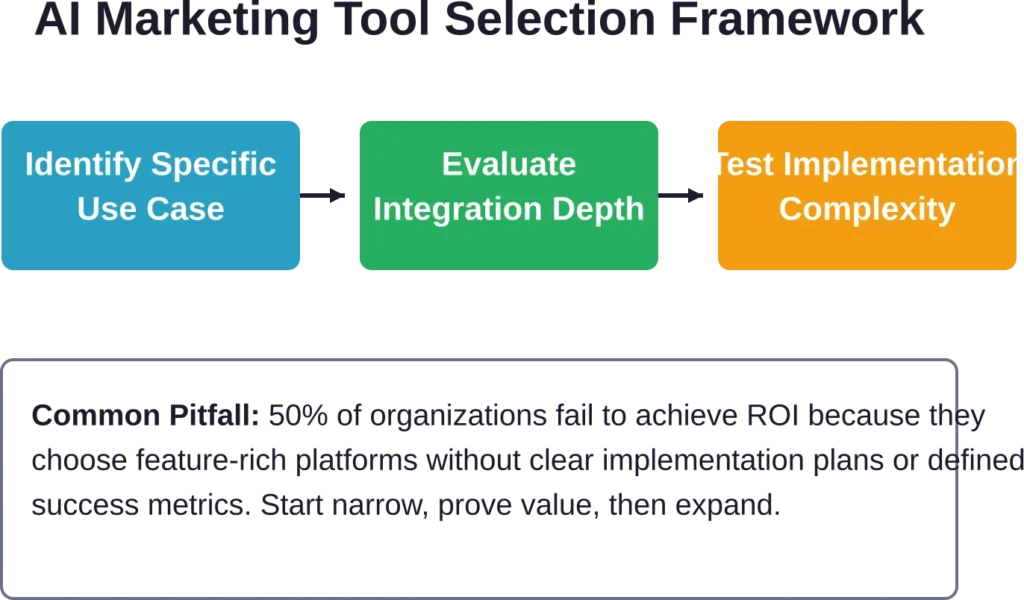
The difference between AI tools that deliver value and expensive shelfware comes down to three factors:
Solve a specific problem. General-purpose AI assistants work for general tasks, but specialized tools outperform for specific marketing functions. An SEO optimization platform will always beat a general chatbot for on-page optimization. A lead enrichment tool will always beat manual research for building prospect lists.
Integration matters more than features. The best AI tool is worthless if it creates extra work. Look for platforms that connect directly to existing workflows—your CRM, content management system, analytics platforms, and communication tools. Standalone tools create data silos and process friction.
Implementation determines outcomes. Research indicates that 60–80% of total lifecycle costs typically come from operations, maintenance, enhancement, and retirement—not initial purchase. Choose tools with clear documentation, active support, and proven implementation patterns. Expensive enterprise platforms often fail because teams never learn to use them effectively.
Best AI Marketing Tools for Content Creation
Content creation tools have evolved far beyond basic text generation. Modern platforms can produce video, design graphics, write long-form articles, and adapt content across formats and channels.
Extuitive: AI Ad Creative Prediction
Extuitive predicts real-world ad performance before you spend a single dollar on traffic. The platform uses custom AI models trained on your own historical data and a simulation engine of 150,000+ real consumers to forecast CTR, ROAS, and conversion rates with high accuracy.
Simply connect your Shopify store and Extuitive’s AI agents (Polyintelligence) automatically analyze your products, generate and optimize ad copy, images, and videos, suggest creative directions, and test hundreds of variations in minutes. The system identifies the winners and eliminates weak creatives long before you launch.
Pricing starts at $1,000/month for the Starter plan and scales with usage (Professional & Enterprise). Extuitive works best for DTC brands and Shopify stores spending significant budgets on Meta, TikTok, and Google ads. Teams using the platform launch campaigns faster, dramatically reduce wasted spend on testing, and consistently achieve higher ROAS by turning creative testing from an expensive gamble into a predictable process.
Contact Information:
- Website: extuitive.com
- Email: [email protected]
- LinkedIn: www.linkedin.com/company/extuitive
- Twitter: x.com/Extuitive_Inc
- Instagram: www.instagram.com/extuitiveinc
ChatGPT and Claude: General-Purpose Content Assistants


ChatGPT and Claude remain the foundation of most content workflows. Both platforms excel at ideation, research summarization, content outlining, and draft creation. ChatGPT’s paid tier costs $20/month; Claude’s pricing varies by usage and plan type.
ChatGPT offers stronger integration with plugins and browsing capabilities, making it better for research-heavy content. Claude provides longer context windows and often produces more nuanced, detailed writing on complex topics.
Most content teams use both. ChatGPT handles quick tasks, research, and structured content. Claude handles in-depth analysis, technical writing, and content that requires careful reasoning.
HeyGen: AI Video Creation
HeyGen creates professional video content from text scripts. The platform offers AI avatars, voice synthesis, and automatic editing—allowing marketing teams to produce video content without cameras, studios, or actors.
The tool works particularly well for explainer videos, product demos, social media content, and personalized video messages at scale. The AI avatars look realistic enough for most B2B marketing use cases, though human presenters still work better for high-stakes brand content.
Pricing varies by usage volume—visit the official site for current plans. Teams that need regular video content but lack production resources see the strongest ROI.
Jasper: Enterprise Content Generation

Jasper focuses on brand-consistent content at scale. The platform lets teams train custom AI models on brand voice, product information, and approved messaging—then generate content that maintains consistency across hundreds of pieces.
The enterprise features include workflow management, approval processes, and team collaboration tools. Jasper integrates with content management systems, making it easier to move from draft to publication.
Pricing starts in the hundreds per month for team plans. The platform makes sense for larger marketing organizations that produce high volumes of content across multiple channels and need strict brand governance.
Best AI Marketing Tools for SEO and Content Optimization
SEO and content optimization tools help marketing teams improve search visibility, structure content for topical authority, and optimize on-page elements. These platforms analyze search intent, competitor strategies, and ranking factors to guide content creation.
Surfer SEO: On-Page Content Scoring

Surfer SEO analyzes top-ranking pages for target keywords and provides specific optimization recommendations. The platform scores content in real-time as writers create it, suggesting keyword density, content structure, and semantic terms to include.
The content editor integrates directly with Google Docs and WordPress, allowing writers to optimize without switching between tools. Surfer also offers content planning features that identify topic clusters and keyword opportunities based on domain authority.
Surfer SEO pricing starts at $79/month (verify current pricing on official site). The platform works best for content teams that produce regular blog posts, landing pages, or long-form guides where search visibility drives business value.
MarketMuse: Topical Authority Building

MarketMuse takes a broader approach than traditional keyword tools. The platform analyzes entire topic clusters, identifies content gaps, and recommends comprehensive content strategies for building topical authority.
The AI analyzes thousands of pages across the web to determine what comprehensive coverage looks like for any topic. Then it compares existing content against that benchmark and identifies missing subtopics, weak areas, and opportunities to establish expertise.
MarketMuse pricing starts at $99/month (verify current pricing on official site). MarketMuse works particularly well for B2B companies and publishers building long-term organic traffic through comprehensive topic coverage rather than quick keyword wins.
Clearscope: Content Optimization

Clearscope provides content optimization similar to Surfer but with stronger emphasis on readability and user intent. The platform analyzes search results and extracts relevant terms, questions, and concepts that comprehensive content should address.
What sets Clearscope apart is the balance between optimization and natural writing. The recommendations focus on semantic relevance rather than keyword stuffing, making it easier to create content that ranks well and reads naturally.
Pricing varies based on usage—check the official site for current plans. The tool fits teams that prioritize content quality and brand voice alongside SEO performance.
| Platform | Best For | Starting Price | Key Strength |
|---|---|---|---|
| Surfer SEO | On-page optimization | $79/month | Real-time content scoring |
| MarketMuse | Topic cluster strategy | $99/month | Content gap analysis |
| Clearscope | Semantic optimization | Custom pricing | Readability balance |
Best AI Marketing Tools for Workflow Automation
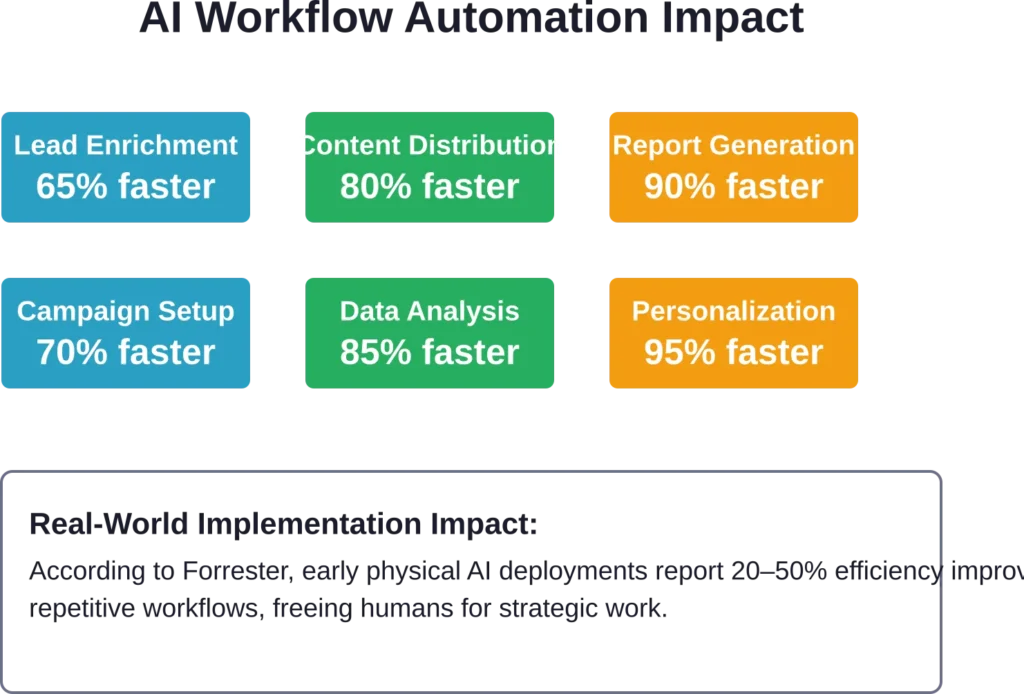
Workflow automation tools connect different marketing systems and automate repetitive processes. Modern platforms use AI to handle complex logic, decision trees, and adaptive workflows that traditional automation couldn’t manage.
Gumloop: No-Code AI Workflows

Gumloop builds custom AI workflows without coding. The visual builder lets marketing teams chain together AI models, data sources, and actions to automate complex multi-step processes.
Examples include: monitoring competitor websites and summarizing changes, scraping lead data and enriching it with additional research, analyzing customer feedback and routing it to appropriate teams, generating personalized outreach sequences based on prospect data.
Gumloop offers promotional discounts to users. The platform works exceptionally well for marketing operations teams that need custom automation but lack engineering resources. Many teams report that Gumloop handles tasks that would otherwise require dedicated development work.
Zapier and Make: Integration Platforms

Zapier and Make connect thousands of marketing tools through pre-built integrations. While not exclusively AI-focused, both platforms now incorporate AI capabilities for data transformation, content generation, and intelligent routing.
Zapier offers the largest library of pre-built integrations—over 5,000 apps. Make provides more sophisticated workflow logic and better handling of complex data transformations. Both platforms charge based on the number of tasks executed monthly.
These integration platforms work best for connecting existing tools rather than replacing them. Marketing teams use them to sync data between CRMs and email platforms, automate social media posting, trigger notifications based on customer behavior, and generate reports from multiple data sources.
Best AI Marketing Tools for Sales and Lead Generation
Sales intelligence and lead generation tools use AI to identify prospects, enrich contact data, and personalize outreach at scale. These platforms have become essential for B2B marketing teams trying to fill pipelines efficiently.
Apollo.io: All-in-One Prospecting

Apollo.io combines a massive B2B database with sales engagement tools and AI-powered prospecting. The platform offers contact data for over 250 million professionals, along with intent signals, technographic data, and engagement tracking.
The AI features help prioritize leads, suggest optimal outreach timing, and personalize messages based on prospect behavior and firmographic data. Apollo also includes email sequencing, call tracking, and CRM integration.
Apollo.io pricing starts at $49/user/month (verify current pricing on official site). The platform works best for sales and marketing teams that need both data and execution tools in a single system rather than stitching together multiple point solutions.
Clay: Lead Enrichment Workflows

Clay specializes in data enrichment—taking basic lead information and automatically adding dozens of additional data points from various sources. The platform aggregates data from over 75 sources including LinkedIn, company websites, news articles, and other databases.
What makes Clay powerful is the workflow builder that chains together multiple data sources and AI models. For example: find companies matching criteria, extract key decision makers, pull their LinkedIn profiles, analyze their recent posts, generate personalized talking points, and draft customized outreach messages.
Clay pricing starts at $149/month (verify current pricing on official site). Marketing operations teams use Clay to build sophisticated prospecting engines that would otherwise require extensive engineering work.
Instantly: Cold Email at Scale

Instantly focuses specifically on cold email campaigns. The platform manages multiple sending domains, warms up email accounts to protect deliverability, personalizes messages using AI, and tracks engagement across sequences.
The AI features help optimize send times, subject lines, and message content based on engagement data. Instantly also includes A/B testing, spam checking, and detailed analytics on what’s working across campaigns.
Pricing varies based on sending volume—check the official site for current tiers. Teams running outbound email campaigns at scale see strong ROI, particularly when combined with enrichment tools like Clay for personalization data.
| Platform | Primary Function | Starting Price | Best Use Case |
|---|---|---|---|
| Apollo.io | All-in-one prospecting | $49/user/month | Unified sales platform |
| Clay | Data enrichment | $149/month | Complex lead workflows |
| Instantly | Cold email automation | Custom pricing | Outbound email scale |
Best AI Marketing Tools for Email Marketing and Customer Engagement
Email marketing platforms now incorporate AI for segmentation, send-time optimization, content personalization, and predictive analytics. These tools help marketing teams deliver more relevant messages to larger audiences.
Klaviyo: E-commerce Email Marketing

Klaviyo dominates email marketing for e-commerce brands. The platform integrates directly with e-commerce platforms to track customer behavior, purchase history, and browsing patterns—then uses that data for sophisticated segmentation and personalization.
The AI features predict customer lifetime value, identify customers at risk of churning, recommend optimal send times for each subscriber, and suggest products based on browsing and purchase behavior.
Pricing scales with the number of contacts. Klaviyo works best for online retailers that need tight integration between email campaigns and product catalog data.
Customer.io: Behavior-Based Messaging

Customer.io focuses on triggered messages based on user behavior rather than scheduled campaigns. The platform tracks how customers interact with products and sends messages at critical moments—abandoned carts, feature adoption milestones, usage drops, renewal dates.
The AI helps determine optimal message frequency, predict which users will respond to which messages, and continuously test variations to improve performance.
Pricing depends on volume and features—contact their sales team for specifics. Product-led companies and SaaS businesses get the most value from behavior-triggered messaging.
Mailchimp: Small Business Email

Mailchimp remains popular for small businesses due to its free tier and ease of use. Recent AI additions include content generation, subject line optimization, send-time prediction, and basic segmentation recommendations.
While not as sophisticated as Klaviyo or Customer.io, Mailchimp offers enough capability for most small business email needs at an accessible price point. The platform also includes landing pages, forms, and basic automation.
Mailchimp offers a free plan for up to 500 contacts with paid plans available at higher contact volumes. Best for small businesses and startups that need simple, effective email marketing without complexity.
Best AI Marketing Tools for Social Media and Brand Monitoring
Social media tools now use AI for content generation, optimal posting times, trend identification, and sentiment analysis. Brand monitoring platforms track mentions, analyze sentiment, and alert teams to reputation risks.
Buffer and Hootsuite: Social Media Management


Buffer and Hootsuite both offer AI-powered social media management. These platforms schedule posts, analyze performance, and suggest optimal content strategies based on audience engagement patterns.
Buffer focuses on simplicity and works well for small teams managing a few accounts. Hootsuite offers more enterprise features including team workflows, approval processes, and advanced analytics across dozens of social profiles.
Both platforms now incorporate AI for content generation, hashtag suggestions, and performance prediction. Pricing varies widely based on the number of accounts and team size—check official sites for current plans.
Brand24: Real-Time Brand Monitoring

Brand24 provides brand monitoring and sentiment analysis across multiple channels with pricing available on their official site.
Best AI Marketing Tools for Design and Visual Content
Design tools have integrated AI capabilities for image generation, background removal, layout suggestions, and brand compliance. These platforms help marketing teams produce professional visual content without dedicated designers.
Canva: All-Purpose Design Platform
Canva has evolved from a template library to a comprehensive design platform with powerful AI features. Magic Design generates complete layouts from text prompts. Background remover instantly isolates subjects. Brand Kit ensures design consistency across teams.
The platform includes templates for social posts, presentations, videos, websites, and print materials. Recent additions include video editing, whiteboard collaboration, and AI-powered image generation.
Canva offers both free and paid plans; current pricing should be verified on their official site. Canva works for almost any marketing team that needs regular visual content without hiring dedicated designers.
Midjourney and DALL-E: AI Image Generation


Midjourney and DALL-E create custom images from text descriptions. Both platforms have improved dramatically—images now look professional enough for marketing materials, social media, blog posts, and advertisements.
Midjourney tends to produce more artistic, stylized images. DALL-E offers better control over specific elements and works better for precise requirements. Both require practice to write effective prompts that produce desired results.
Midjourney offers various pricing tiers; current pricing should be verified on their official site. DALL-E operates on a credit system through OpenAI. Teams producing lots of custom imagery—particularly for digital channels—see strong ROI compared to stock photo subscriptions or custom photography.
Figma with AI Plugins

Figma remains the standard design tool for digital products and marketing assets. The platform now supports AI plugins that generate layouts, suggest color palettes, write microcopy, and automate repetitive design tasks.
The collaborative features make Figma particularly valuable for teams where designers, marketers, and developers all need to work with the same files. Real-time collaboration, version history, and developer handoff tools streamline workflows.
Free plan available for small teams. Figma offers professional plans; current pricing should be verified on their official site. Figma works best for teams creating digital marketing assets, landing pages, and product interfaces rather than print materials.
Best AI Marketing Tools for Analytics and Reporting
Analytics platforms use AI to identify patterns in marketing data, predict future performance, and generate insights that human analysts might miss. These tools help teams understand what’s working and why.
Google Analytics 4 with AI Insights

Google Analytics 4 incorporates machine learning throughout the platform. The AI identifies anomalies, predicts future conversions, suggests audience segments, and answers natural language questions about website performance.
The predictive metrics—purchase probability, churn probability, predicted revenue—help marketing teams identify high-value users and optimize campaigns for likely converters rather than just past behavior.
Free for most businesses. Enterprise version (Analytics 360) pricing should be verified on Google’s official site. GA4 works as the foundation analytics platform for almost any digital marketing operation.
Tableau and Power BI: Advanced Analytics


Tableau and Power BI create sophisticated data visualizations and dashboards from multiple marketing data sources. Both platforms now include AI features for natural language queries, automated insight generation, and predictive analytics.
These tools work best for marketing teams that need custom dashboards combining data from advertising platforms, CRMs, analytics tools, and business databases. The learning curve is steeper than simpler reporting tools, but the flexibility is unmatched.
Pricing varies significantly based on deployment and user count—check official sites for current enterprise pricing. Marketing operations teams and data analysts get the most value from these advanced platforms.
Supermetrics and Funnel.io: Marketing Data Integration


Supermetrics and Funnel.io solve a specific problem: getting marketing data from dozens of sources into a single location for analysis. These platforms connect to advertising platforms, social media, analytics tools, and CRMs—then normalize and aggregate the data.
The AI features help identify data quality issues, fill missing values, and suggest relevant metrics based on business goals. Both platforms feed data into Google Sheets, Excel, data warehouses, or visualization tools.
Pricing depends on the number of data sources and volume. Marketing teams running campaigns across multiple platforms see immediate value from unified reporting that doesn’t require manual data export and combination.
How to Build an AI Marketing Stack That Works
Buying tools is easy. Getting teams to use them effectively is hard. According to Forrester research, most organizations get less than 50% ROI on AI investments—usually because of implementation problems, not technology limitations.
Here’s what works:
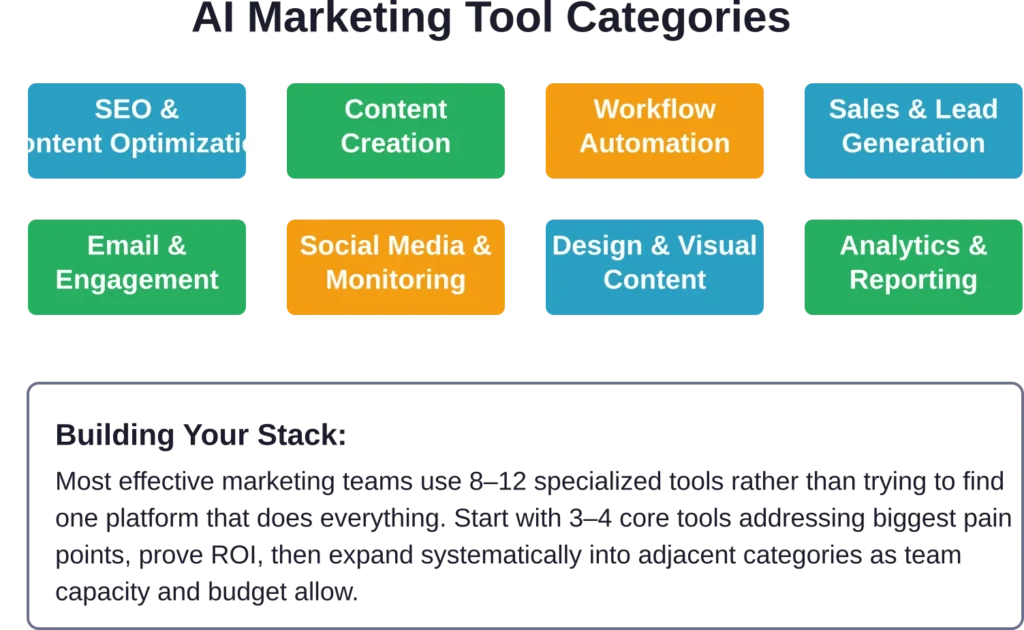
Start with one category where pain is highest. Don’t try to transform everything at once. Pick the biggest bottleneck—maybe it’s content production, lead generation, or reporting. Solve that problem first, prove value, then expand. Teams that try to implement five new tools simultaneously usually end up using none effectively.
Choose integration over features. The best individual tool is worthless if it creates more work. Prioritize platforms that connect to existing systems. Look for native integrations, not just API access that requires engineering work. The goal is to reduce friction, not create new manual processes.
Invest in training and adoption. Remember that 60–80% of lifecycle costs come from operations and maintenance, not purchase. Budget time and resources for training, documentation, and ongoing support. The teams that see strong ROI treat tool adoption as a multi-month change management process, not a one-time implementation.
Define success metrics before buying. What specific outcome should improve? By how much? Over what timeframe? Without clear metrics, teams can’t determine whether tools deliver value. And without accountability for results, tools become expensive shelfware.
Plan for the full lifecycle. Every tool eventually needs replacement or significant updates. When evaluating platforms, consider: How easy is data export if we switch later? What’s the vendor’s track record with product updates? How dependent will we become on this specific platform? The best tool today might not be the best tool in two years.
Common AI Marketing Tool Mistakes to Avoid
Real talk: most AI marketing implementations fail for predictable reasons. Here are the patterns that consistently cause problems:
Buying enterprise platforms before proving value. Sales teams love selling comprehensive solutions. But expensive enterprise platforms usually require months of implementation, extensive training, and organizational change. Start with simpler tools that deliver quick wins, then graduate to enterprise platforms once you’ve proven the use case and built organizational competence.
Choosing general tools for specialized problems. ChatGPT is amazing for many tasks, but specialized SEO tools outperform it for on-page optimization. General-purpose platforms rarely match specialized tools for specific use cases. Build a stack of focused tools rather than trying to find one platform that does everything.
Ignoring data quality and integration. AI tools are only as good as the data they access. If CRM data is incomplete, contact enrichment tools won’t help. If analytics tracking is broken, reporting tools can’t generate insights. Fix data foundations before adding AI tools on top.
Expecting AI to replace strategy. AI marketing tools execute tactics efficiently, but they don’t replace strategic thinking. The tools can write content faster, but they can’t determine what message resonates with your specific audience. They can generate dozens of ad variations, but they can’t decide which market segment to target. Human strategy still matters—AI just makes execution faster and more scalable.
Overlooking security and compliance. Marketing teams often adopt tools without considering data privacy, security, or compliance requirements. Before implementing any AI platform, understand: What data does it access? Where is that data stored? Who has access? Does it comply with GDPR, CCPA, or industry-specific regulations? Security incidents caused by marketing tools can create massive business risk.
The Future of AI Marketing Tools in 2026 and Beyond
The AI marketing landscape continues evolving rapidly. According to Forrester’s 2026 predictions, several major shifts are already underway:
AI agents are replacing simple automation. Traditional marketing automation follows predefined rules: if this happens, then do that. AI agents can reason, adapt, and make complex decisions independently. Forrester predicts that enterprise applications will move beyond enabling employees with digital tools to accommodating a digital workforce of AI agents.
What this means for marketing: tools that currently require human oversight for each campaign will increasingly run autonomously, adjusting strategies based on performance data without human intervention.
Physical AI is merging with digital marketing. Forrester’s Top 10 Emerging Technologies for 2026 highlights AI’s move into physical environments. According to Forrester, early physical AI deployments report 20–50% efficiency improvements in warehouses, factories, and hospitals. Similar technology will impact retail marketing, event marketing, and in-store experiences.
Trust and value are becoming key differentiators. As Forrester notes, display ad budgets will drop 30% in 2026 as consumers abandon the open web. Marketing teams need to shift from interruptive advertising to delivering genuine value through content, tools, and experiences that audiences actively seek out.
New business models are emerging. The growth of agentic AI systems capable of autonomous software development is disrupting traditional SaaS economics. Some analysts predict that AI will enable firms to build previously purchased software in-house at a fraction of historical cost. Marketing technology vendors will need to prove continuous value rather than relying on switching costs and integration lock-in.
For marketing teams, the implications are clear: invest in learning how to use AI tools effectively now, because the gap between AI-proficient teams and those still working manually will widen dramatically over the next few years.
Frequently Asked Questions
The best free AI marketing tools include ChatGPT (free tier), Claude (free tier with limitations), Google Analytics 4 (completely free for most businesses), Canva (free plan with design templates), Mailchimp (free up to 500 contacts), Buffer (free plan for limited social accounts), and HubSpot CRM (free with basic features). Most professional teams eventually need paid plans for higher usage limits and advanced features, but these free tiers provide genuine value for small businesses and individual marketers getting started.
Marketing technology spending typically ranges from 10-30% of total marketing budget, with AI tools representing an increasing share. Small businesses might spend $200-1,000/month on essential AI marketing tools. Mid-sized companies typically spend $2,000-10,000/month across multiple platforms. Enterprise organizations often spend $50,000-500,000/month on comprehensive marketing technology stacks. The specific amount depends on team size, channel mix, and business complexity—but the key is proving ROI on each tool before expanding spending.
AI marketing tools augment human marketers rather than replace them. The tools excel at execution, analysis, and optimization—writing draft content faster, processing data at scale, testing variations automatically, and personalizing messages. But humans still outperform AI at strategic thinking, creative direction, understanding nuanced customer needs, building relationships, and making judgment calls in ambiguous situations. The most effective marketing teams use AI to handle repetitive tasks so humans can focus on strategy, creativity, and relationship building.
Integration capability varies significantly across platforms. Tools with the strongest integration ecosystems include HubSpot (connects to 1,000+ apps), Salesforce (massive app marketplace), Zapier and Make (5,000+ pre-built integrations), Google Analytics 4 (integrates with all major ad platforms), and major email platforms like Klaviyo and Mailchimp. When evaluating integration, look for native connections rather than just API access—native integrations work reliably without engineering support. Check that critical data flows in both directions, not just one way.
Measure AI marketing tool ROI by tracking specific metrics before and after implementation. For content tools, measure publishing velocity, content performance, and time spent per piece. For SEO tools, track rankings, organic traffic, and conversion rates from organic channels. For sales tools, measure pipeline velocity, conversion rates, and cost per qualified lead. For automation tools, calculate time saved and error reduction. The key is defining baseline metrics before implementation, then tracking changes over at least 90 days to account for learning curves and seasonal variation. Tools should show positive ROI within 3-6 months or warrant reconsideration.
Small businesses typically benefit most from all-in-one platforms with low learning curves—Canva for design, Mailchimp for email, Buffer for social media, and ChatGPT for content assistance. These tools deliver immediate value without extensive training or integration work. Enterprise teams need specialized tools that integrate with existing systems—Marketo or HubSpot for marketing automation, Salesforce for CRM, enterprise analytics platforms like Tableau, and specialized tools for each channel. Enterprises also need collaboration features, approval workflows, and governance capabilities that small business tools lack. The transition point typically occurs around 10-20 marketing team members when coordination overhead justifies enterprise platform investment.
AI detection tools exist but remain unreliable—they generate false positives on human writing and miss sophisticated AI content regularly. More importantly, audiences care about value and relevance, not authorship method. Well-edited AI content that provides genuine value performs better than mediocre human-written content. The key is using AI as a drafting tool with human editing for voice, accuracy, and strategic messaging. Teams that treat AI output as final product without editing typically produce generic, low-value content that audiences ignore—not because it’s AI-generated, but because it lacks the insights, personality, and strategic positioning that human expertise provides.
Conclusion: Building Your AI Marketing Toolkit for 2026
AI marketing tools have moved from experimental to essential. The technology now handles tasks that were impossible to scale manually—from personalizing thousands of email variations to analyzing competitor strategies to generating video content without production crews.
But the tools themselves don’t create marketing success. Strategic implementation does. The teams winning in 2026 aren’t those with the most tools or the biggest budgets. They’re the teams that identified specific problems, chose focused solutions, invested in adoption and training, and proved ROI before expanding.
Start with the category where pain is highest. Maybe that’s content production, lead generation, or analytics. Choose one specialized tool that solves that problem well and integrates with existing systems. Get the team actually using it for three months. Measure the results. Then expand.
The AI marketing landscape will continue evolving rapidly. New tools will emerge, existing platforms will add capabilities, and best practices will shift. But the fundamental approach remains constant: solve specific problems with focused tools, prove value, integrate thoughtfully, and keep humans in the strategic loop.
The brands that thrive over the next few years won’t be those that adopted AI first or spent the most on tools. They’ll be the ones that implemented AI marketing systems strategically, measured results rigorously, and used the efficiency gains to double down on the creative, strategic, and relationship-building work that still requires human expertise.
What’s the biggest bottleneck in your marketing operations right now? That’s where to start.